Yuru-chara: Kumamon and the Empire of Japanese Mascots
Kumamon, Funassyi, Hikonyan: a deep dive into yuru-chara, the regional mascots worth billions of yen that embody Japan's brand of place marketing.
La rédaction Kotoba Interactive
Studio éditorial
In 2011, a black bear with red cheeks earned 12.4 billion yen for Kumamoto Prefecture without a single image-rights invoice ever being issued. That figure, confirmed by the Bank of Japan, describes an economic anomaly: a local government that built a brand worth billions by voluntarily giving up all royalties. The bear is called Kumamon (くまモン), and he is not alone. He belongs to a tribe of several thousand costumed creatures that populate the train stations, town halls and festivals of the archipelago.
These mascots have a name: yuru-chara (ゆるキャラ). They tell the story of a singular strategy, that of Japanese local governments which, lacking massive advertising budgets, bet on endearing characters to attract tourists and subsidies. Behind the cuteness lies a commercial machine, a fierce national contest and a public debate about taxpayers' money. This feature traces how an illustrator's joke became a pillar of Japanese regional marketing.
What the word yuru-chara really means#
The term yuru-chara was popularized in the early 2000s by Miura Jun (みうらじゅん), an illustrator and pop-culture critic who trademarked it midway through the decade. The word is a contraction of yurui (ゆるい), meaning "soft," "laid-back" or "loose," and kyara (キャラ), short for the English "character." The most accurate translation would be "soft, wobbly character."
Yuru-chara (ゆるキャラ) a contraction of yurui (ゆるい, "soft, laid-back") and kyara (キャラ, "character"). The term refers to these deliberately clumsy and endearing mascots, as opposed to the polished characters of the animation industry.
Miura Jun laid out three criteria for a character to earn the label. First, it must express a strong love for its home region or town. Second, its movements must be unique, unsteady, a little awkward. Finally, it has to stay simple, lumbering and lovable. This paradoxical brief prizes imperfection: a mascot that is too polished betrays the yuru-chara spirit.
A distinction is drawn between gotochi-kyara (ご当地キャラ), literally "local characters," tied to a specific locality, and mascots for companies or events. All of them rest on the same craft: the kigurumi (着ぐるみ), the full-body costume worn by a performer to bring the character to life during public appearances. Much of the charm plays out inside the kigurumi, where the tottering gait and clumsy gestures are part of the show.
Kumamon, the bear worth billions#
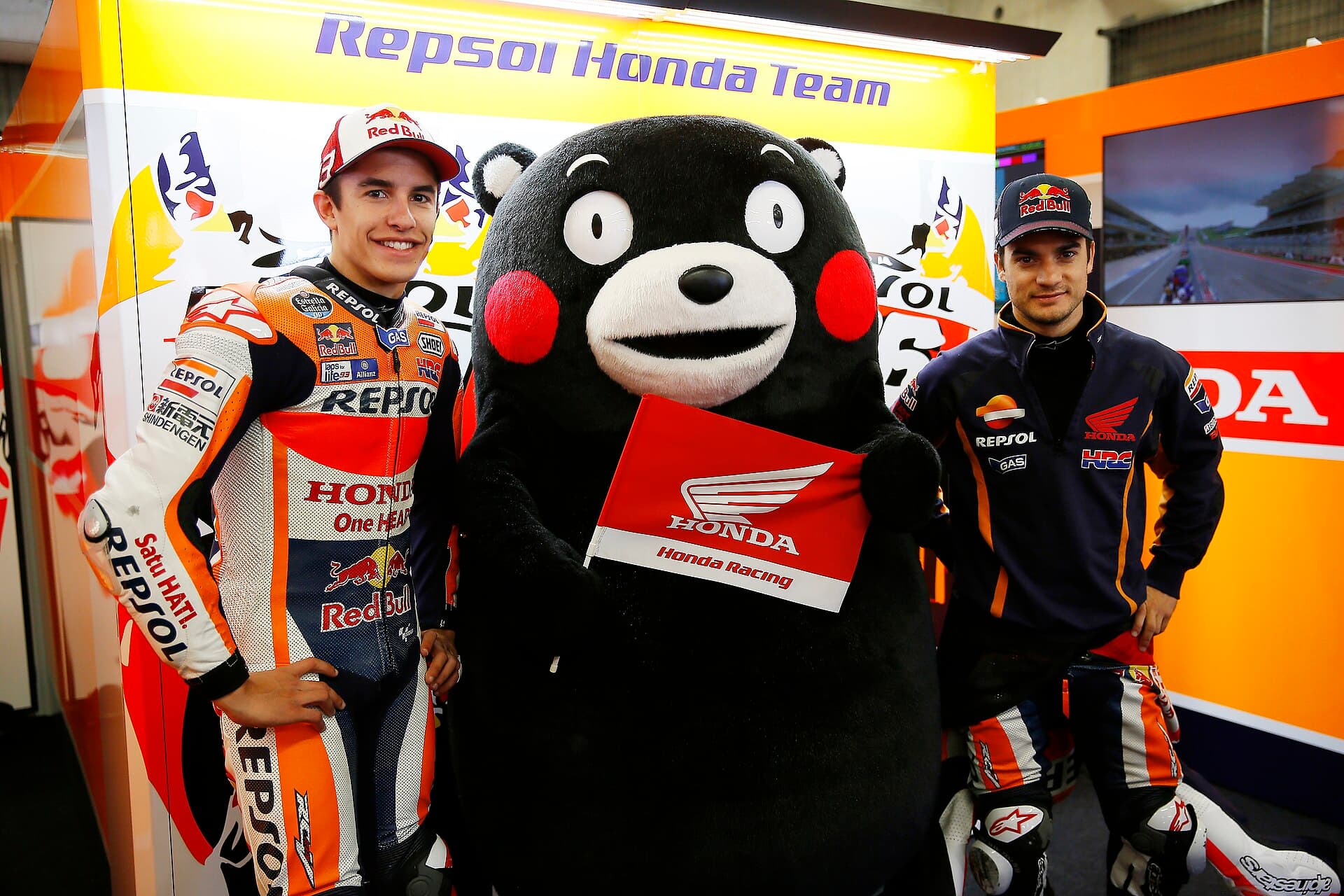
Kumamon was born in 2010, created by Kumamoto Prefecture on the island of Kyushu to accompany the opening of the Kyushu Shinkansen high-speed line. The initial idea was modest: to catch the attention of travelers who would now race toward Kagoshima without stopping in Kumamoto. The character, designed by art director Mizuno Manabu, is a black bear with scarlet cheeks and wide-open eyes, and he never speaks.
The stroke of genius was as much legal as it was graphic. The prefecture registered Kumamon as a protected work but decided to charge no usage fee, on the condition that products promote goods or services from Kumamoto. Any company could therefore stamp the bear onto its cakes, its towels or its bottles of sake, free of charge, provided it served the region. This choice, first adopted to help small local businesses, set off an avalanche.
Kumamoto turned a waiver of copyright into the most profitable marketing campaign in Japan.
The numbers are staggering. The Bank of Japan estimated that Kumamon generated roughly 12.4 billion yen in economic impact over the two years following his 2011 launch. Across the decade, cumulative sales of merchandise topped 900 billion yen. In 2020, despite the pandemic, Kumamon-branded goods still brought in nearly 170 billion yen. The bear now has his own office within the prefectural administration, a department that manages his "civil servant" schedule and his international travel.
A national menagerie: Hikonyan, Funassyi and the rest#
The true kickoff of the yuru-chara boom dates back to 2007, with Hikonyan (ひこにゃん), a white cat topped with a red samurai helmet. Created for the 400th anniversary of Hikone Castle, in Shiga Prefecture, he drove tourist numbers and souvenir sales up dramatically, proving that a mascot could become an economic engine in its own right.
| Mascot | Japanese name | Territory | Status and distinctive trait |
|---|---|---|---|
| Kumamon | くまモン | Kumamoto Prefecture | Official (2010), mute bear with red cheeks, free licensing |
| Hikonyan | ひこにゃん | Hikone Castle (Shiga) | Official (2007), white cat with a samurai helmet |
| Sento-kun | せんとくん | City of Nara | Official (2008), baby Buddha with deer antlers, controversial |
| Funassyi | ふなっしー | Funabashi (Chiba) | Unofficial, yellow pear that talks and jumps |
| Chiitan | ちいたん | Susaki | Unofficial, otter known for viral stunts |
Sento-kun and the 2008 controversy#
Not every launch goes off without a hitch. In 2008, the city of Nara unveiled Sento-kun (せんとくん), a baby Buddha fitted with deer antlers, designed for the 1,300th anniversary of the ancient capital. The reaction was scathing. Residents and Buddhists found the character ugly, even blasphemous, an irreverent blend of sacred iconography and local animal. The controversy swelled in the national press. Paradoxically, this rejection gave Sento-kun a fame few mascots ever reach, and he eventually established himself as the official figure of the celebrations.
Funassyi, the pear that screams#
At the opposite end of institutional decorum stands Funassyi (ふなっしー), arguably the most atypical yuru-chara. This hyperactive yellow pear represents the city of Funabashi, in Chiba Prefecture, yet it has never been officially recognized by the municipality. Funassyi talks, screams, leaps and pulls off backflips, going against the placidity expected of a mascot. Its chaotic energy earned it national fame in the early 2010s, all the way to television appearances and advertising deals. In the same rowdy vein, Chiitan (ちいたん), an unofficial otter attached to the city of Susaki, became known for its violent stunts and viral videos, to the point of causing tensions with the very municipality it claimed to represent.
Funassyi (ふなっしー) is described on its encyclopedia entry as "neither a boy nor a girl, but a pear." Its costume includes a mechanism that lets it jump, a rarity for a kigurumi, which explains the acrobatics that most other mascots cannot manage.
Before Hikonyan the samurai cat, Japan already adored lucky felines: discover the maneki-neko and the supernatural cats of folklore.
The Yuru-Chara Grand Prix, a national election#
The Yuru-Chara Grand Prix was launched in 2010, the same year as Kumamon, as a popularity contest decided by public online voting. The event quickly took on considerable scale. In 2015, it gathered 1,727 candidates and tallied more than 50 million online votes, turning the affair into a full-blown electoral competition, complete with campaigns, alliances and accusations of ballot stuffing.
The stakes went beyond vanity. A Grand Prix victory meant massive media coverage, a rise in tourism and strengthened legitimacy for the local government running the mascot. Kumamon won the 2011 edition, propelling the bear once and for all to national stardom. Local administrations saw it as a low-cost communication lever, with each voting campaign rallying schools, shopkeepers and residents behind a single banner.
The contest ran from 2010 to 2020, before being rebranded "Yuruverse" starting in 2023. Its decade of existence coincides exactly with the golden age of place mascots, a period during which nearly every town, public service or company in the country acquired its own character. Prefectures, the postal service, prisons and even the Financial Services Agency ended up with their own yuru-chara.
Behind every mascot lies vocabulary waiting to be deciphered: ゆるキャラ (yuru-chara), 着ぐるみ (kigurumi, the full-body costume) and くま (kuma, the bear in Kumamon). Learn to read hiragana, katakana and kanji with JapaneseSRS, the spaced repetition that makes Japanese stick for good.
Saturation, failures and public money#
At the crest of the wave, Japan counted several thousand official mascots, a figure so high that officials themselves grew worried. As early as 2014, the government of Osaka Prefecture publicly raised the alarm about the proliferation of local characters, fearing that an anarchic multiplication would dilute the identity of each territorial brand instead of reinforcing it. When everyone has a mascot, none of them stands out.
The question of public cost comes up regularly. Designing a character, making the costumes, paying the performers and organizing the appearances all represent an expense for local governments that are often in debt. For every profitable Kumamon, how many anonymous mascots, launched at great cost and then forgotten, never generated the slightest return? The debate pits those who see yuru-chara as a clever tourism investment against those who denounce them as a waste of public funds dressed up as cuteness.
Even so, the model has spread well beyond its original soil. The logic of the lovable character as a vehicle for territorial attachment has diffused into advertising, administrations and even public-awareness campaigns. Yuru-chara have proven that a mute bear with red cheeks can accomplish what millions of yen of conventional advertising struggle to achieve: sincere and lasting affection.
Read alsoJapanese Idols: From AKB48 to Morning MusumeMascots and idols share the same mechanics of attachment and popular voting: explore the world of Japanese idol groups.
Getting your picture taken with your favorite mascot is a ritual: dive into the culture of purikura, the Japanese photo booths that became a social phenomenon.
FAQ#
Who coined the term yuru-chara? Illustrator and pop-culture critic Miura Jun (みうらじゅん) popularized the term in the early 2000s and registered it as a trademark. He formed it by contracting yurui ("laid-back") and kyara ("character"), and defined three criteria: love of the region, clumsy movements and a simple, lovable look.
Why is Kumamon so popular? Kumamon owes his success to a free-licensing strategy adopted in 2010 by Kumamoto Prefecture. Any company can use his image without paying, as long as it promotes local products. This openness multiplied his commercial presence and generated hundreds of billions of yen in sales.
What is the difference between yuru-chara and gotochi-kyara? The term yuru-chara refers to all soft, laid-back mascots, whether they represent a city, a company or an event. Gotochi-kyara (ご当地キャラ) are a specific subcategory: the mascots tied to a given locality, tasked with promoting a territory and its specialties.
Does the Yuru-Chara Grand Prix still exist? The original contest ran from 2010 to 2020. In 2015, it counted 1,727 candidates and more than 50 million votes. After a pause, it was rebranded "Yuruverse" starting in 2023, marking the end of the competition's golden age but the survival of its spirit.
How many mascots does Japan have? Japan recorded several thousand official yuru-chara at the height of the phenomenon, in the 2010s. This saturation worried some administrations, such as Osaka Prefecture in 2014, which feared a dilution of brand identity in the face of the uncontrolled proliferation of characters.
A bear that does not speak, a pear that screams and a baby Buddha with deer antlers: yuru-chara have pulled off what conventional advertising so often fails to do, turning an administration into an object of affection. Behind every tottering costume hides a marketing lesson that the whole world now studies.
Photo credits: images in this article come from Wikimedia Commons under free licenses.
Maid Café: Origins and Codes of the Japanese Meido Kafe
History and rituals of the Japanese maid café (メイドカフェ): birth in Akihabara, moe culture, the okaerinasaimase welcome, cheki photos, etiquette and variants.
Cover image: Box Repsol · Box Repsol, via Wikimedia Commons · CC BY 2.0