The Goryeo Kings: Where the Name Korea Comes From
The word Korea comes not from Joseon but from Goryeo, the dynasty of 918 to 1392: Wang Geon, celadon, the Jikji, and the caravans that carried the name west.
La rédaction Kotoba Interactive
Studio éditorial
A twelfth-century Persian merchant, at the end of the Silk Road and a sea crossing, notes in his ledger the name of a kingdom at the edge of the world: something like Gōli, Cauli, later Corea. The country he means still exists today, but it no longer bears that name: Koreans renamed it five centuries before we were born. The word the West still carries on its tongue is the name of a vanished kingdom.
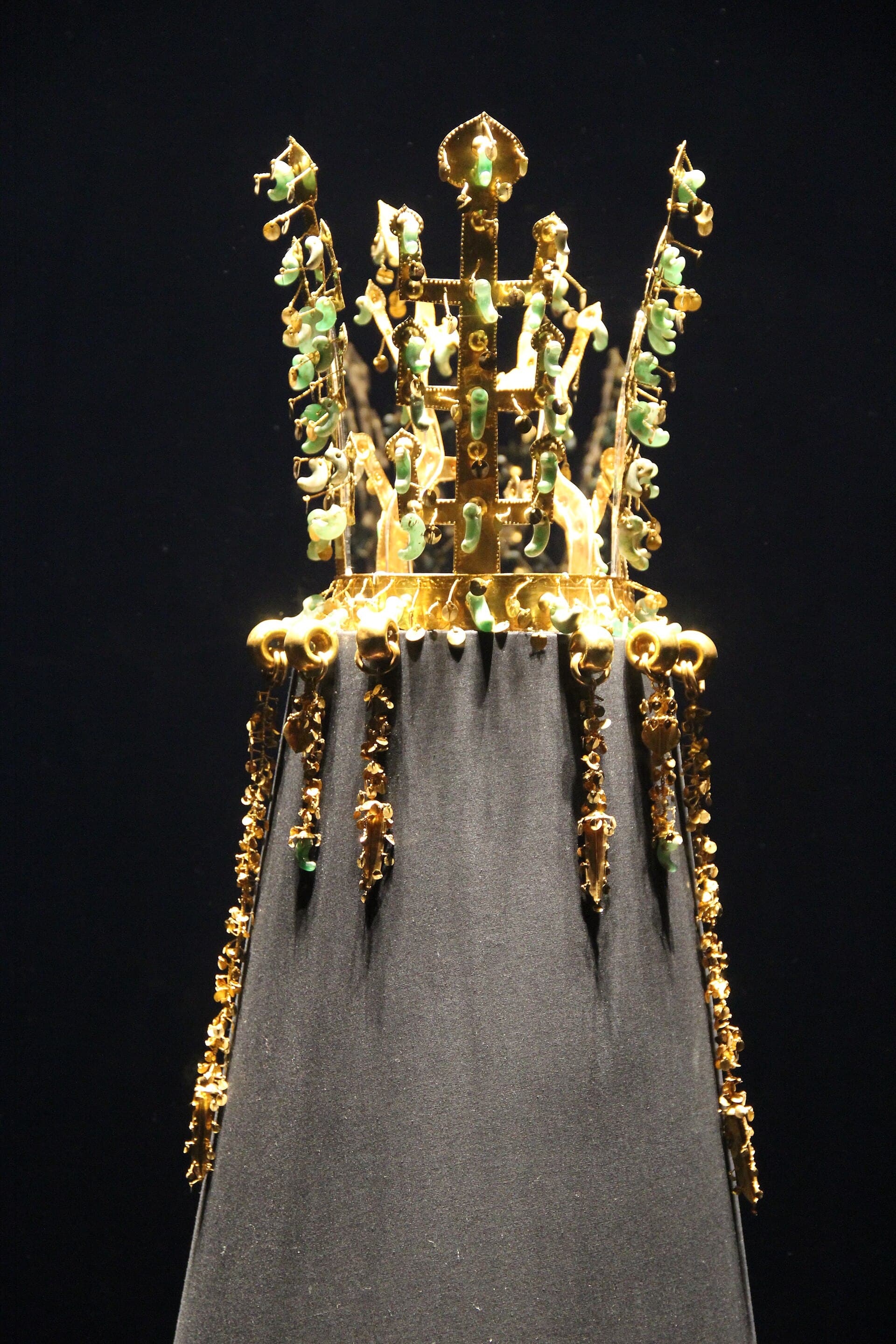
That kingdom was , and it ruled from 918 to 1392. From it, and not from the dynasty that followed, our "Korea," the Italian Corea, descends directly. To understand this lineage is to travel back to Wang Geon the founder, to jars of gray-green celadon, to eighty thousand carved woodblocks, and to the oldest book in the world printed with movable metal type. It is also to follow a traveling word, transliterated from caravan to port until it outlived the very dynasty that had borne it.
Wang Geon reunifies the peninsula in 918#
Goryeo was born in 918, when a general named founded a new dynasty and took the reign name of . The peninsula was then torn apart by the so-called Later Three Kingdoms period, in which three rival powers fought over the legacy of the Silla kingdom, once the unifier but by then dying. Wang Geon, lord of the Songak region, pushed his rivals aside, received the surrender of the last Silla king in 935, and crushed the rival kingdom of Hubaekje in 936. The peninsula was one again.
Taejo reigned until 943 and governed less by force than by alliance. Rather than destroy the local aristocracies, he won them over, married their daughters, handed out titles and land, and absorbed the Silla elite into the new order. He set his capital at , today , north of the present border. Backed by mountains and laid out according to geomancy, the city would remain the heart of the kingdom for nearly five centuries.
The name is a contraction of , the powerful northern kingdom of ancient Korea. By claiming it, Wang Geon placed his dynasty in a prestigious lineage and declared a territorial ambition toward the north. It is this founding syllable, transcribed by foreign travelers, that would become "Korea."
The Ten Injunctions: a testament made to last#
Before dying in 943, Taejo left his successors a celebrated political text: the . This testament, mixing advice on government with spiritual prescriptions, set out the principles meant to guarantee the dynasty's survival. It placed Buddhism at the foundation of the kingdom, warned against building too many temples, urged respect for geomancers in choosing sites, and cautioned the ruler against certain regions deemed rebellious.
Some of the injunctions have fueled lasting controversy, especially those dealing with relations with China and with regional origins. Historians still debate the document's full authenticity, since the oldest surviving copy is late. It remains a pillar of medieval Korean political thought, quoted and pondered by the Goryeo kings as a founding charter. Rarely has a ruler weighed so heavily, from beyond the grave, on five centuries of history.
Buddhism, the religion of a kingdom#
Under Goryeo, Buddhism became the state religion and shaped art, politics, and the calendar. The kings funded the building of monasteries, ordered the copying and printing of sacred texts, and granted leading monks a rank comparable to that of ministers. Buddhist ceremonies, such as the , the lantern festival, set the rhythm of the year for court and people alike, and endure today to the point of being inscribed on the UNESCO intangible heritage list.
This fervor had a prodigious material side: it drove the kingdom to print, carve, and craft on an unprecedented scale. It was Buddhist faith that commanded the carving of the great woodblock canon, and it was a workshop tied to the monasteries that, later, gave birth to metal printing. Goryeo prayed, and from its prayer came a technical revolution.
The golden age: celadon, carved canon, and printing#
Goryeo produced three masterpieces that rank among the peaks of Korean civilization: celadon, the Tripitaka Koreana, and the first book printed with movable metal type. This flowering, between the eleventh and fourteenth centuries, placed the small kingdom at the technical and artistic forefront of East Asia.
Celadon 청자, an inimitable gray-green#
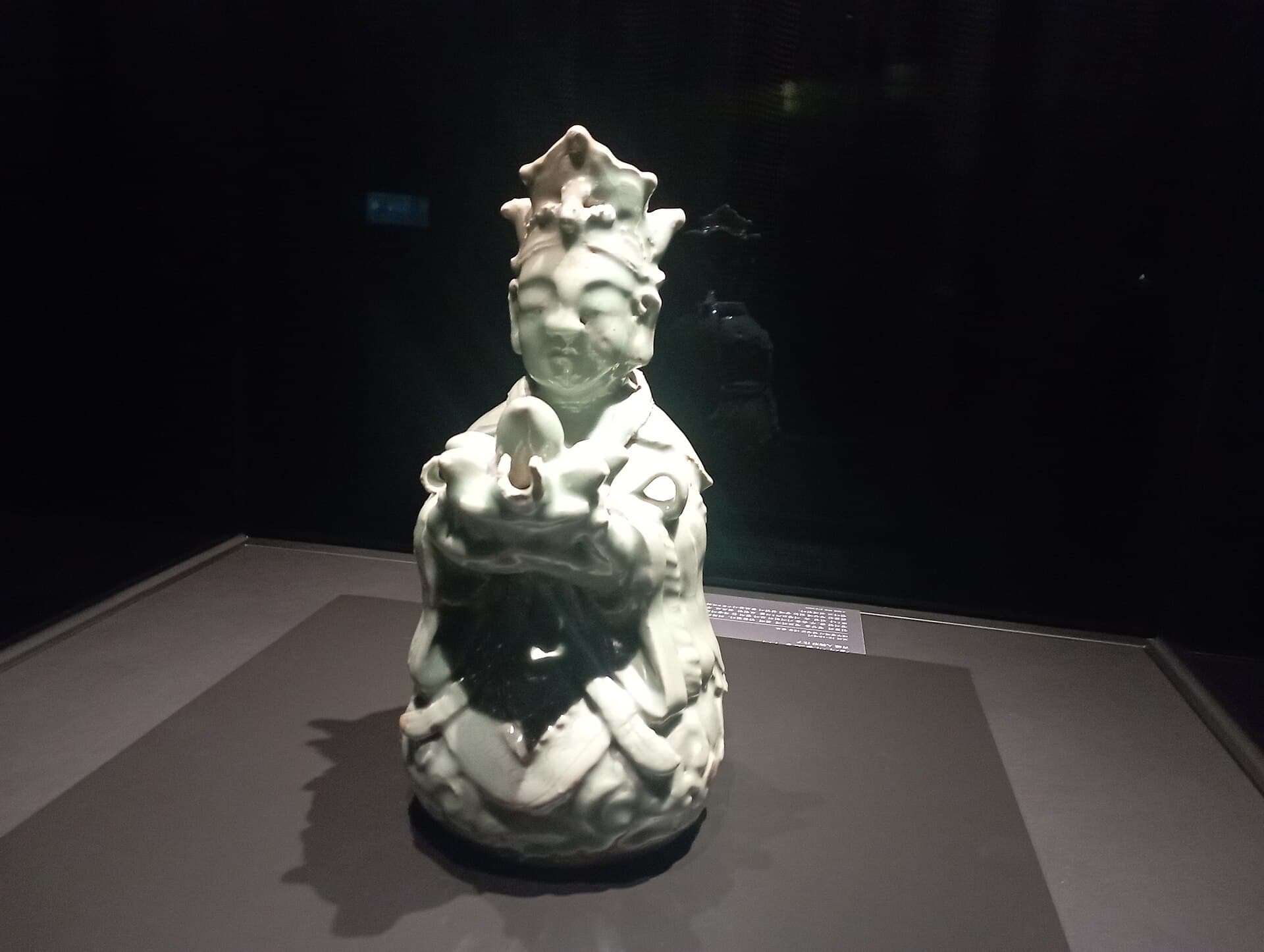
is a porcelain with a gray-green glaze that the potters of Goryeo raised to a perfection admired as far as China. The word names this translucent glaze, tending toward jade and blue-green, obtained by firing in a reducing atmosphere. As early as the twelfth century, a visiting Chinese scholar ranked Korean celadon among the finest things of his age, a rare reversal at a time when China saw itself as the model for everything.
Korean potters also invented a technique of their own: , inlay. The motif, a crane, a cloud, a willow, a chrysanthemum, was carved into the still-raw clay, the hollows filled with white or black slip, and the whole covered with the celestial glaze. The decoration seems to float beneath the surface. No other ceramic tradition pushed this art of the buried image as far.
The Tripitaka Koreana 팔만대장경#
The is the most complete surviving collection of the Buddhist canon carved on wood. Its name declares its scale: more than eighty thousand woodblocks, bearing over fifty million characters, carved between 1236 and 1251. This titanic undertaking was launched as a collective prayer, in the hope that the fervor of the work would win Heaven's protection for the kingdom against the Mongol invader.
The blocks have been kept since the fifteenth century in the halls of monastery, whose architecture, natural ventilation and shelving designed against humidity, has preserved the wood almost intact for eight centuries. The near-absence of carving errors across millions of characters still astonishes philologists. UNESCO has inscribed the whole, blocks and buildings, on the World Heritage list.
The Jikji 직지, printed before Gutenberg#
The , printed in 1377, is the oldest surviving book produced with movable metal type, roughly seventy years before Gutenberg's Bible. Its full title names a Buddhist anthology compiling the teachings of the great Zen masters. The second volume, the only one preserved, was printed at Heungdeoksa monastery, near present-day Cheongju, using bronze types cast one by one.
The surviving copy is today held at the National Library of France, where it was identified in the twentieth century by a librarian of Korean origin, Park Byeong-seon. UNESCO inscribed it on the Memory of the World register in 2001. That the oldest trace of metal printing is Korean, and not European, remains one of the most counterintuitive facts in the history of technology.
Eighty thousand blocks against the Mongols, a bronze book against oblivion: Goryeo answered fear with memory, and left the world objects made to outlast the very empires that threatened them.
The vocabulary of Korea's golden age is read first in its script: 고려 (Goryeo, the dynasty), 청자 (cheongja, celadon), 직지 (Jikji, the bronze book), 왕건 (Wang Geon, the founder). KoreanSRS, our spaced-repetition app for learning Korean, is coming soon: join the waitlist to start deciphering hangeul and these words of history from day one.
The Mongols and the century of the yoke#
In the thirteenth century, the Mongol Empire launched a series of invasions against Goryeo that, within a generation, broke the kingdom's independence. From 1231, the armies of the empire founded by Genghis Khan swept over the peninsula wave after wave. The court, taking refuge on Island, held out from its island shelter for nearly thirty years, while the mainland was ravaged and the first carved Buddhist canon burned, which would prompt the carving of the present Tripitaka.
Resistance eventually gave way. Around 1270, Goryeo submitted and became a vassal state of the , the Mongol dynasty then ruling China. The Goryeo kings married Mongol princesses, sent hostages to the Beijing court, adopted some of the victor's customs, and supplied men and ships for Mongol expeditions, including the attempted invasions of Japan. For a century, the kingdom kept its dynasty and its name but governed under tutelage. Only with the decline of the Yuan, in the mid-fourteenth century, did Goryeo loosen the grip and regain its freedom of action.
How "Goryeo" became "Korea"#
The Western name for Korea is the transcription, by merchants and then foreign cartographers, of the syllable Goryeo. This is the decisive point of the story: at the moment East Asia opened to the trading networks of medieval Islam and, later, of Europe, the country known to foreigners was called Goryeo. The Arab and Persian traders who frequented the region's ports carried its name back in forms like Gōli or Kauli, derived from the pronunciation of 고려.
From these Eastern sources the name passed to Europeans. Medieval travel accounts, then the first Portuguese and Italian sailors and Jesuits of the Renaissance, wrote Cauli, Corea, Coria. The form Corea settled on Western maps and took hold in European languages, giving French "Corée," Italian Corea, English "Korea." The spelling with C or K varied by language and era, but the root stayed the same founding syllable.
Here lies the paradox: in 1392, Korea changed dynasty and name, but the West kept the old one. The country now called Joseon went on being called Corea abroad, as if the merchants' word had taken on a life of its own, detached from the kingdom that had made it. Our "Korea" is a linguistic fossil: the name of a state extinct for more than six centuries, preserved intact by the sheer inertia of trade and maps.
The country's internal Korean name does not come from Goryeo. After 1392, the new dynasty chose , while South Korea today is called and North Korea Joseon. None of these names resembles "Korea": the word we use remained the one Goryeo had bequeathed to foreigners, and to them alone.
1392: Yi Seong-gye closes the book#
Goryeo came to an end in 1392, when general deposed the last king and founded the Joseon dynasty. Weakened by a century of Mongol tutelage, undermined by clan struggles, pirate raids, and a suffocating landed aristocracy, the kingdom faltered in the second half of the fourteenth century. The turning point came when Yi Seong-gye, sent to fight in the north, turned his army around at Wihwado rather than obey an order he judged senseless, and marched on the capital.
Now master of the kingdom, he waited a few years and then, in 1392, founded a new dynasty, soon giving it the name Joseon in reference to an ancient kingdom. The capital would move to Hanyang, present-day Seoul. A page turned: state Buddhism gave way to Neo-Confucianism, the aristocracy of Gaegyeong to a new scholar elite. But while internal Korea became Joseon, the outside world, indifferent to the change, went on tracing the name of Goryeo on its maps. The dynasty was gone; its name had conquered the West for good.
Read alsoLand of the Morning Calm: Why Korea Is Really the Morning BrightAnd the internal Korean name comes from elsewhere: Joseon, the "Morning Freshness," mistranslated as "Morning Calm" by nineteenth-century travelers.
Korean genius for the written support did not stop at carved wood: hanji, the mulberry paper said to live a thousand years, carries on the same passion for the lasting trace.
Goryeo's legacies at a glance#
Five centuries of rule left behind objects, places, and texts that became emblematic. Here are Goryeo's major legacies, with their Korean names.
| Legacy (hangul + romanization) | Nature | Significance |
|---|---|---|
| 왕건 (Wang Geon) | Founder, King Taejo | Reunified the peninsula in 918 and founded the dynasty |
| 개경 (Gaegyeong) | Capital, today Kaesong | Political heart of the kingdom for nearly five centuries |
| 훈요십조 (hunyo sipjo) | Political testament | The "Ten Injunctions" of Taejo, the dynasty's founding charter |
| 청자 (cheongja) | Gray-green celadon | Ceramic admired as far as China, a peak of Korean art |
| 팔만대장경 (palman daejanggyeong) | Carved Buddhist canon | More than 80,000 blocks (1236-1251), UNESCO World Heritage |
| 직지 (Jikji) | Book printed in 1377 | Oldest book with movable metal type, before Gutenberg |
FAQ#
Does the name "Korea" come from Joseon or Goryeo? From Goryeo (고려), the dynasty that ruled from 918 to 1392. Arab, Persian, and then European merchants transcribed this syllable as Cauli, Corea, Korea. The name survived in the West even after Korea took the name Joseon in 1392.
Who founded the Goryeo dynasty? The general Wang Geon (왕건), who took the reign name Taejo. He founded Goryeo in 918 and reunified the peninsula by around 936, at the end of the Later Three Kingdoms period. His capital was Gaegyeong, today's Kaesong.
What is the Jikji and why does it matter? The Jikji (직지), printed in 1377, is the oldest surviving book produced with movable metal type, roughly seventy years before Gutenberg. Inscribed on UNESCO's Memory of the World register, it is kept at the National Library of France.
Why does the Tripitaka Koreana have so many woodblocks? The Tripitaka Koreana (팔만대장경) gathers more than eighty thousand blocks carved between 1236 and 1251, bearing the entire Buddhist canon. It was undertaken as a collective prayer to win the kingdom protection against the Mongol invasions.
What happened to Goryeo in 1392? General Yi Seong-gye (이성계) deposed the last Goryeo king and founded the Joseon dynasty, which would rule Korea until 1897. The capital moved to Hanyang, present-day Seoul, and Neo-Confucianism replaced state Buddhism.
Crédits photographiques : les images de cet article proviennent de Wikimedia Commons et sont sous licence libre.
Gojoseon, Silla, Goryeo, Joseon: Korea's dynasties made clear
Two thousand years in five names: the founding kingdom, the Three Kingdoms, unified Silla, Goryeo which gave the country its name, and Joseon which lasted five centuries.
Cover image: Suohros · Suohros, via Wikimedia Commons · CC0