The Three Friends of Winter: Pine, Plum, Bamboo
Pine, bamboo, plum: the 歲寒三友, Three Friends of Winter, haunt Chinese art. Song origins, Confucian symbolism, and their spread across the Sinosphere.
La rédaction Kotoba Interactive
Studio éditorial
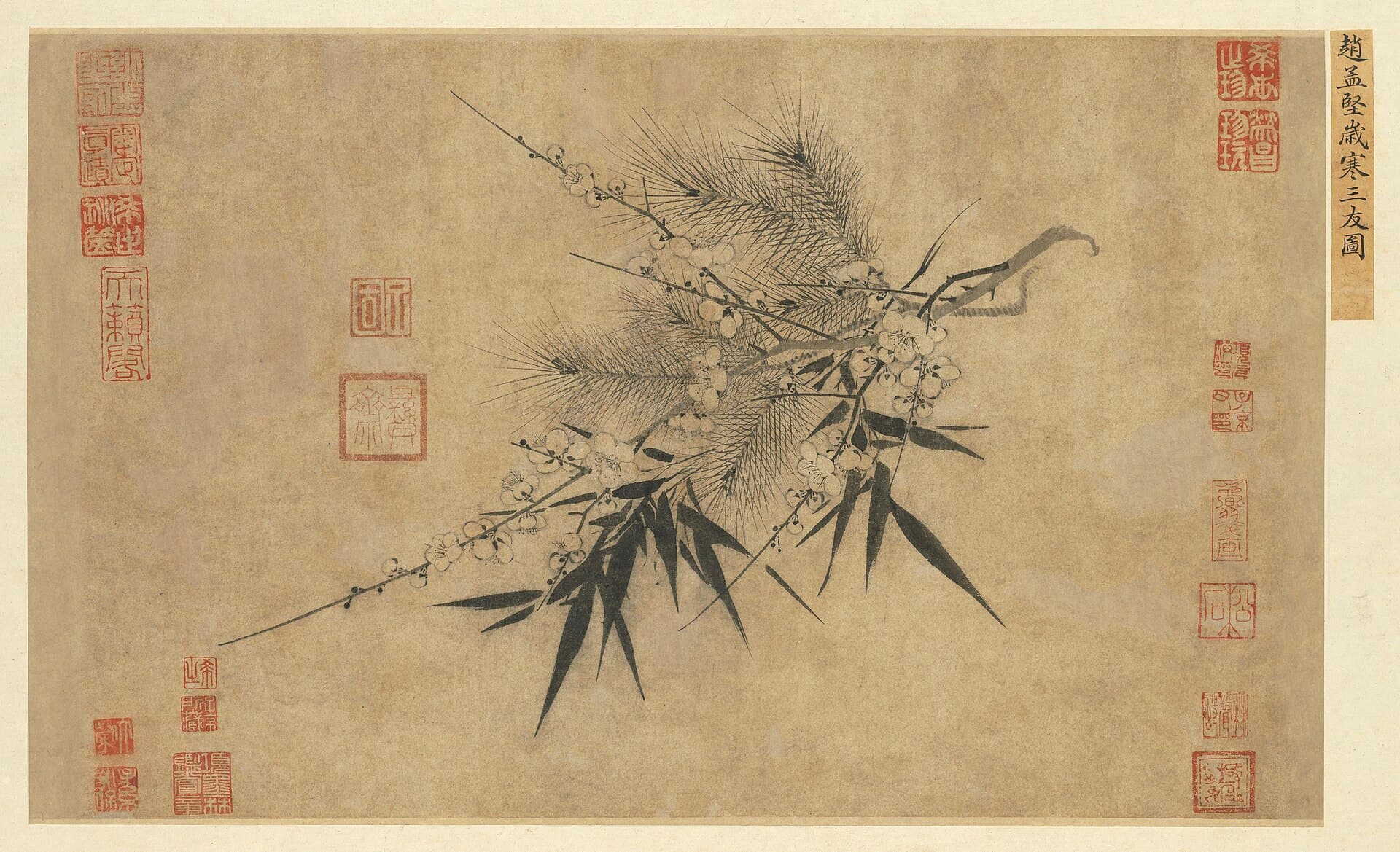
A scroll unrolls across the scholar's table, right to left. First a gnarled pine branch, twisted by winters one senses were many. Then bamboo stalks rising straight, leaves drooping, as if laid flat by a wind no one can see. Finally a few plum blossoms, five petals each, opened on dry black wood. Nothing else: no color, no sky, no figure. In ink alone, a Song dynasty painter has just summed up an entire moral code.
These three plants together bear a name, , "the three friends of the cold season." Pine, bamboo, and plum share a property that literati China loaded with meaning: they endure winter when everything else withers. The pine keeps its needles, the bamboo stays green, and the plum goes so far as to bloom in the cold. From that stubborn vitality, Confucian thought drew an allegory of the , the person of virtue who holds fast in adversity. This article follows the motif from its birth in Song literati painting to its spread across porcelain, gardens, jade, and, well beyond China, across the whole of East Asia.
Three plants, one lesson of winter#
The suìhán sānyǒu brings together pine, bamboo, and plum because they are among the rare plants that endure or bloom in the depth of winter. The phrase itself echoes a line from Confucius's Analects, where the sage observes that "only when the year turns cold do we understand that the pine and cypress are the last to shed their leaves" (歲寒然後知松柏之後彫也). Winter, the season of trial, reveals who holds. To place these three plants side by side is to paint moral steadfastness without ever naming it.
Each carries its own virtue. The is endurance and longevity: evergreen, it lives for centuries and twists without breaking under the snow. The is upright suppleness: it bends under weight yet springs back, and its hollow stem figures , the "empty heart," meaning the humility and open mind of the sage. The , finally, is pure resilience: its opens before spring, on bare wood, often under snow, the first sign of life in a dead landscape.
literally means "the three friends of the cold year." names the heart of winter, the harsh season; , "the three friends." The word friends is not decorative: it ranks pine, bamboo, and plum as companions of the scholar, models of moral bearing.
Su Dongpo and the birth of a Song motif#
The motif took shape under the Song (960-1279), the golden age of literati painting. The three-friends formula appears in texts of that era, which report that the poet and painter , better known by his brush name , planted pines, bamboo, and plum around his place of exile and felt himself surrounded by friends. The precise attribution of the phrase remains debated, but the spirit of the gesture belongs to his time: the scholar sought in nature figures of his own uprightness.
This context is no anecdote. Su Dongpo championed a painting that pursues not likeness but the spirit of the thing. To paint bamboo, he suggested, one must first hold it whole within one's breast, the famous , "having the completed bamboo in the heart" before lifting the brush. The plant is no longer an object to copy but a thought to project. The suìhán sānyǒu was born of that revolution: three plants became three ideas.
To paint the three friends is not to depict a winter garden. It is to paint oneself as someone who does not yield.
A scroll preserved at the National Palace Museum in Taipei, Three Friends of Winter attributed to , shows the genre's maturity as early as the thirteenth century: pine, bamboo, and plum in monochrome ink, without setting, in a bareness that gives the brushstroke all the room. It is already the full vocabulary of the motif, fixed for the eight centuries to come.
The ideal of the wénrén: the scholar who paints his virtue#
The motif is inseparable from the figure of the , the scholar-painter. Unlike the court painter, salaried and virtuosic, the wénrén painted as a cultivated amateur, for himself and his peers, ink serving as an extension of calligraphy and poetry. The three friends offered an ideal subject: simple to draw, rich in meaning, and coded enough that each stroke says something about the one who holds the brush.
Painting the plum, the bamboo, or the pine became a moral exercise as much as a technical one. The exiled, disgraced scholar, shut out from power, consoled himself by tracing plants that, like him, did not give up. Bamboo painted in the rain speaks of tenacity; plum blooming against the cold speaks of hope preceding the thaw; pine battered by wind speaks of constancy. The painting is a mirror held up to the painter's soul.
These three plants are read before they are contemplated: 松 (sōng, pine), 竹 (zhú, bamboo), 梅 (méi, plum), and 君子 (jūnzǐ, the person of virtue). ChineseSRS is already live: learn to decode hanzi and hundreds of everyday words through its spaced repetition, so you can recognize these characters on a scroll or a porcelain vase.
How to read a Three Friends painting#
A Three Friends painting is deciphered by reading each plant as a word in the same poem. The Chinese eye seeks not a scene but an arrangement of signs, and the order, posture, and season of each plant steer the meaning. Here are the reading cues.
The pine often holds the place of the main trunk, anchored, massive, its needles clustered in tufts. Its twisting is not a flaw but an age: the more gnarled, the more centuries endured it speaks of. The bamboo is known by its segmented stalks and its leaves in groups of three or five, drawn with a swift gesture that betrays the calligrapher's hand. A stalk that leans without snapping speaks of suppleness; a perfectly straight one, of rectitude. The plum is read by its five-petaled flowers on angular, dark wood: those five petals are sometimes tied to the five blessings, and their opening on a bare branch marks the stubbornness of life.
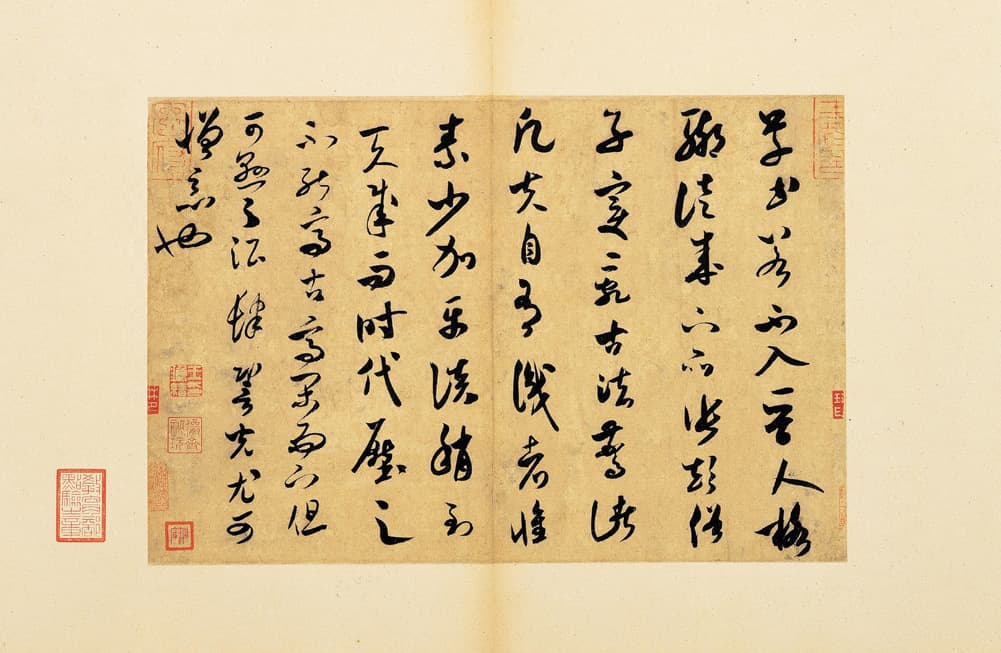
Three further signs complete the reading. Snow, suggested by the reserved white of the paper, recalls the harshness of the season. The void, the space left bare around the plants, is not a lack but a fullness of silence, echoing the hollow heart of the bamboo. Finally, the calligraphy and seals added to the scroll, often a poem inscribed by the painter or a collector, bring the word into the image: for the literatus, painting and writing are two gestures of the same brush.
From Three Friends to Four Gentlemen#
The suìhán sānyǒu has a broader cousin, the , the "Four Gentlemen." This quartet gathers the , the , the , and the , each tied to a season and to a virtue of the Confucian gentleman. The plum opens the ending winter, the orchid perfumes spring, the bamboo holds summer, the chrysanthemum braves autumn and the first frost.
The two motifs overlap without merging. Bamboo and plum belong to both; the orchid and chrysanthemum are proper to the Four Gentlemen, while the pine is reserved for the Three Friends. For the scholar, the sìjūnzǐ form an ink-painting primer: one learns the brush by first tracing these four plants, each demanding a particular stroke, from the trembling gesture of the plum to the clean line of the bamboo. To paint the gentlemen is to learn to paint at all.
| Motif | Hanzi | Pinyin | Virtue | Season |
|---|---|---|---|---|
| Pine | 松 | sōng | Endurance, longevity | Winter |
| Bamboo | 竹 | zhú | Suppleness, integrity, humility | Summer (in the Four Gentlemen) |
| Plum | 梅 | méi | Resilience, purity | Late winter |
| Orchid | 蘭 | lán | Quiet nobility | Spring |
| Chrysanthemum | 菊 | jú | Constancy in decline | Autumn |
| The three together | 歲寒三友 | suìhán sānyǒu | The junzi in adversity | Depth of winter |
Everywhere: from porcelain to jade#
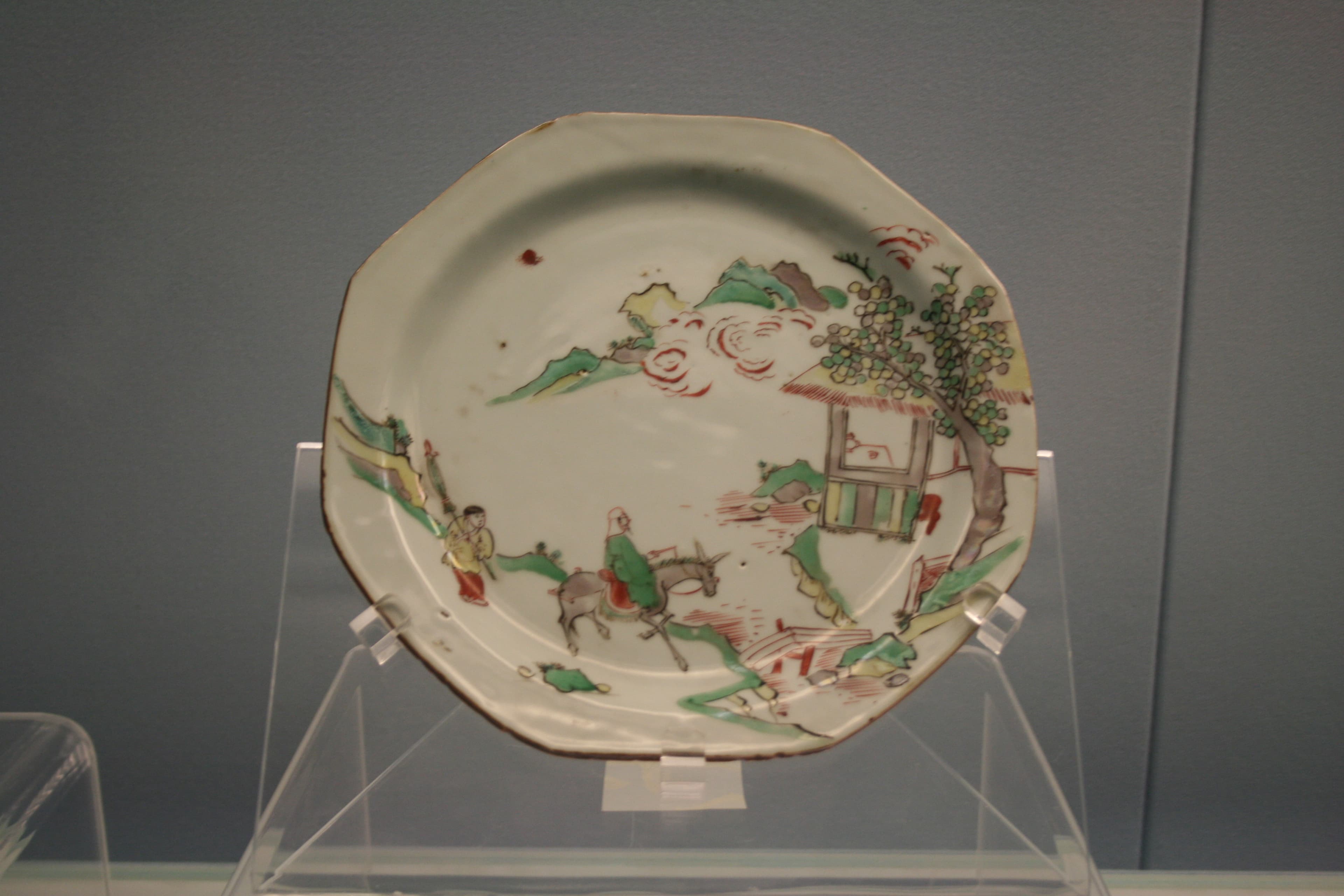
Once born in painting, the motif spread across every Chinese art. On the blue-and-white porcelain of Jingdezhen, the suìhán sānyǒu winds around vases and bowls, cobalt drawing pine, bamboo, and plum onto the white glaze: a wish for longevity and moral bearing offered with the object. The Walters Art Museum and other major collections hold many such pieces, vases and boxes, where the three plants become decoration charged with meaning.
The motif turns up wherever Chinese art seeks to voice a wish and a virtue. In scholar gardens, pine, bamboo, and plum were planted together to compose a living picture the owner contemplated like a painting. On carved jade, on textiles embroidered on robes and hangings, on lacquers and inkstones, the three friends return, often given for a New Year or a birthday, for they carry a wish for long life and firm character.
The plum of the Three Friends, the , blooms so early in the year that it is linked to Chinese New Year. To give a branch of flowering plum, or its painted image, is to wish that virtue and joy may open at the harshest point of winter, even before spring returns.
A motif that overflows China#
The suìhán sānyǒu spread across the whole Sinosphere, adopted by Japan, Korea, and Vietnam. In Japan the trio became , "pine-bamboo-plum," omnipresent in art, kimonos, and New Year decoration. Curiously, it also serves there as a three-tier ranking system: in restaurants and for certain products, , , and denote the high, middle, and low grade respectively, from menu to sake, without any of the three ever being pejorative.
In Korea, pine, bamboo, and plum fill literati painting and folding screens, often alongside the orchid and chrysanthemum of the Four Gentlemen. In Vietnam, the motif adorns lacquers and ceramics in the same Confucian spirit. Everywhere, the original lesson survives translation: three plants that brave winter, three figures of a virtue that does not bend. On a Song scroll or a New Year bowl in Kyoto, the same ink says the same thing, hold fast when the cold comes.
FAQ#
What are the Three Friends of Winter? They are the pine (松, sōng), the bamboo (竹, zhú), and the plum (梅, méi), gathered under the name . These three plants endure or bloom in the depth of winter, which made them, in Chinese art, an allegory of the virtue that holds in adversity.
Why these three plants specifically? Because they defy winter when everything withers: the pine stays green, the bamboo too, and the plum blooms on bare wood, often under snow. Confucian thought saw in them the image of the , the person of virtue who keeps their integrity when times are hard.
How do they differ from the Four Gentlemen? The are the plum, orchid, bamboo, and chrysanthemum, tied to the four seasons. Bamboo and plum belong to both motifs, but the pine is proper to the Three Friends, while the orchid and chrysanthemum are proper to the Four Gentlemen.
Where does the motif come from? It took shape under the Song dynasty (960-1279), the golden age of literati painting, and is traditionally linked to the poet-painter Su Dongpo (蘇東坡, 1037-1101). The exact phrase appears in texts of that era, though its precise attribution remains debated.
What does shōchikubai mean in Japan? The is the Japanese version of the motif, pine-bamboo-plum, common at New Year. It also serves as a three-tier ranking system (high, middle, low) in restaurants and for certain products, with no pejorative sense for any of the three.
Read alsoChinese calligraphy: the art of the brush and the breathPine, bamboo, and plum spring from the same brush as calligraphy. Discover the gesture of the Chinese scholar, where writing and painting are one.
The Three Friends of Winter also wind around blue-and-white vases. Dive into the art of Chinese porcelain and its cobalt decoration.
Photo credits: the images in this article come from Wikimedia Commons and are under a free license.
Blue and white porcelain: China's fragile treasure
History of Chinese blue and white porcelain: Jingdezhen, cobalt, Yuan and Ming dynasties, kraak ware, export to Europe and a living legacy.
Cover image: Zhao Mengjian · Zhao Mengjian, via Wikimedia Commons · Public domain