The Japanese Occupation of Korea (1910-1945)
The 1910 annexation, the March 1st Movement, forced assimilation, forced labor: thirty-five years of Japanese colonial rule that still haunt Korea today.
La rédaction Kotoba Interactive
Studio éditorial
On March 1, 1919, in Seoul's Taehwagwan pavilion, thirty-three men sign a document and calmly wait to be arrested. At the same moment, in nearby Tapgol Park, a student climbs onto a pavilion and reads aloud a . The crowd takes up a cry that will spread across the entire country within hours: Daehan dongnip manse (대한독립만세), "long live Korean independence." They are unarmed. Facing them, the Japanese colonial police carry rifles.
This scene sums up half a century of Korean history: a nation stripped of its state, a largely peaceful resistance, and an occupying power determined to break it. From 1910 to 1945, Korea no longer existed on the map as a sovereign country; it was a colony of the Empire of Japan. These thirty-five years, brief on the scale of a three-thousand-year-old civilization, nonetheless left a scar so deep that it still shapes, to this day, relations between Seoul and Tokyo. To understand contemporary Korea, its national pride, its living memory, and its diplomatic disputes, one must return to this colonial interlude.
The 1910 Annexation: The End of a Kingdom#
Korea officially became a Japanese colony on August 29, 1910, the day the took effect. Signed a week earlier, on August 22, by Korean Prime Minister Yi Wan-yong and Japanese Resident-General Terauchi Masatake, this document put an end to five centuries of the Joseon dynasty (조선, 1392-1897) and to thirteen years of a short-lived Korean Empire (대한제국, 1897-1910).
The annexation was no bolt from the blue: it was the culmination of a decade of gradual encroachment. After its victories over China (1895) and then Russia (1905), Japan imposed on Korea the of 1905, which stripped it of its diplomatic autonomy and established a protectorate. Emperor , who attempted in 1907 to alert the Hague Conference to the plundering of his country, was forced to abdicate. His successor, the frail , would reign for three years before the throne vanished altogether.
is made up of han (한, Korea), il (일, Japan), and byeonghap (병합, "merger, annexation"). Korean historians often prefer the term gukchi (국치), "the national disgrace," to designate this event.
The very legality of the treaty is contested today. Many Korean legal scholars point out that it was never ratified nor sealed by Emperor Sunjong in person (a step normally required) and that it was extracted under military duress. This question, far from academic, still underpins Seoul's official positions: for Korea, the annexation was "null and void" from the outset, while Japan long regarded it as a valid diplomatic act of its time.
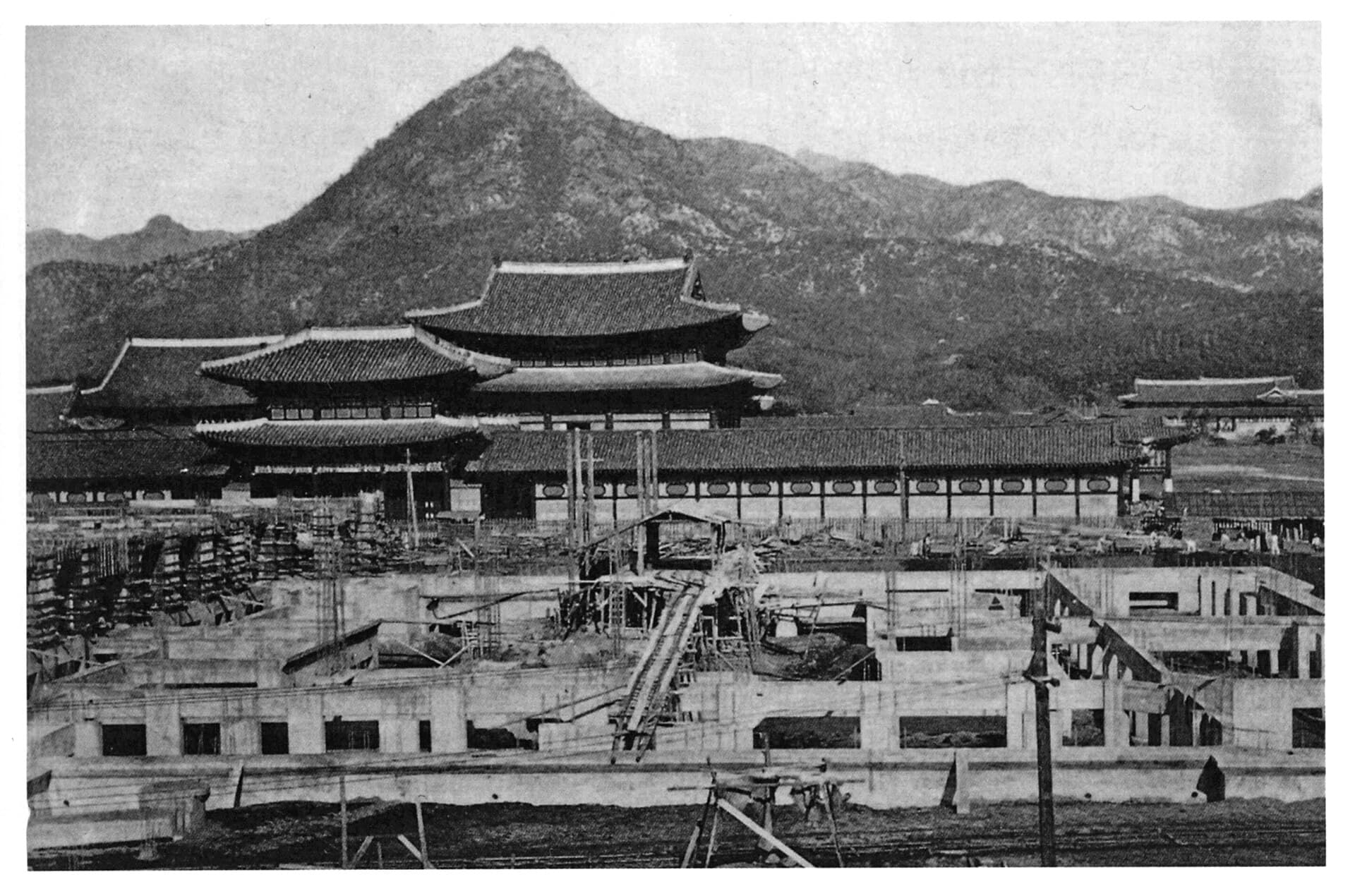
From the moment of signing, real power passed to the , a colonial administration headed by a governor-general always drawn from the Japanese army or navy and answerable directly to the emperor. Terauchi became its first holder. The vast neo-Baroque building that would house this administration was erected, a deliberate act of urban provocation, right in front of the royal palace of Gyeongbokgung (경복궁), masking the symbolic heart of Korean sovereignty behind the occupier's stone.
The "Rule by Force" and the Exploitation of a Country#
The first colonial decade (1910-1919) bears a name that remains infamous: the military policy or budan jeongchi (무단정치), literally "government by force." It established a police regime of striking harshness, in which even the civil administration was militarized: teachers wore uniforms and carried sabers in the classroom, the blanketed the countryside, and corporal punishment by flogging, abolished in principle in Japan itself, was reserved for Koreans alone.
The colonization was not monolithic: it passed through three distinct phases of government, each named in Korean for its method.
| Phase | Korean name | Period | Defining trait |
|---|---|---|---|
| Rule by force | 무단정치 (budan jeongchi) | 1910-1919 | Military police regime, gendarmerie, flogging |
| Cultural policy | 문화정치 (munhwa jeongchi) | 1919-1931 | Cosmetic loosening after March 1st |
| Total assimilation | 내선일체 (naeseon ilche, Japanese reading naisen ittai) | 1931-1945 | Erasure of language, names, and worship |
The economic objective was clear: to turn the peninsula into an agricultural annex and a captive market. The , carried out from 1910 to 1918, was its most consequential instrument. Under the guise of modernizing property titles, it required peasants to complete complex and costly administrative procedures; those who could not formally prove their rights, often passed down orally for generations, were dispossessed. Considerable tracts of land passed to the colonial state, to the , and to Japanese settlers.
Korean rice then made its way to the ports. From 1920 onward, the raised yields, but most of the harvest was exported to a Japan in the throes of industrialization. The paradox was cruel: production rose, per-capita Korean consumption fell, and many peasants fell back on millet imported from Manchuria. Hundreds of thousands of Koreans emigrated: to Japanese factories, to Manchuria, to the Russian Far East.
Read alsoChaebols: History, Structure and Succession of Korea's GiantsA colony is never anything but a machine for transferring wealth: the rice went east, the misery stayed west.
Some of the great family conglomerates that dominate the South Korean economy today trace their earliest roots to the industrial fabric of the colonial period.
March 1, 1919: The Cry of a People#
The was the first national uprising of colonized Korea and the matrix of all modern Korean nationalism. It erupted on March 1, 1919, and continued for months, mobilizing, by some estimates, up to two million people in more than fifteen hundred gatherings, a considerable figure for a country of seventeen million.
The cry of that day, 대한독립만세 (daehan dongnip manse, "long live Korean independence"), still echoes in the very language colonial Japan tried to erase. With KoreanSRS and its spaced repetition, you will soon learn 한글 (hangeul, the Korean alphabet) and words heavy with memory such as 자유 (jayu, freedom).
Several sparks converged. The sudden death of former emperor Gojong, in January 1919, fed rumors of poisoning and fixed a date: his national funeral, set for early March, was expected to draw crowds to Seoul. On the international stage, U.S. President Woodrow Wilson's Fourteen Points, with their principle of the self-determination of peoples, electrified Korean intellectuals, as did the declaration of independence drafted a month earlier in Tokyo by Korean students.
Thirty-three religious figures (Christian, Buddhist, and adherents of ) signed the Declaration of Independence. Its text, of remarkable dignity, called not for revenge but for justice, and explicitly urged non-violent resistance. The poet and activist composed its closing address.
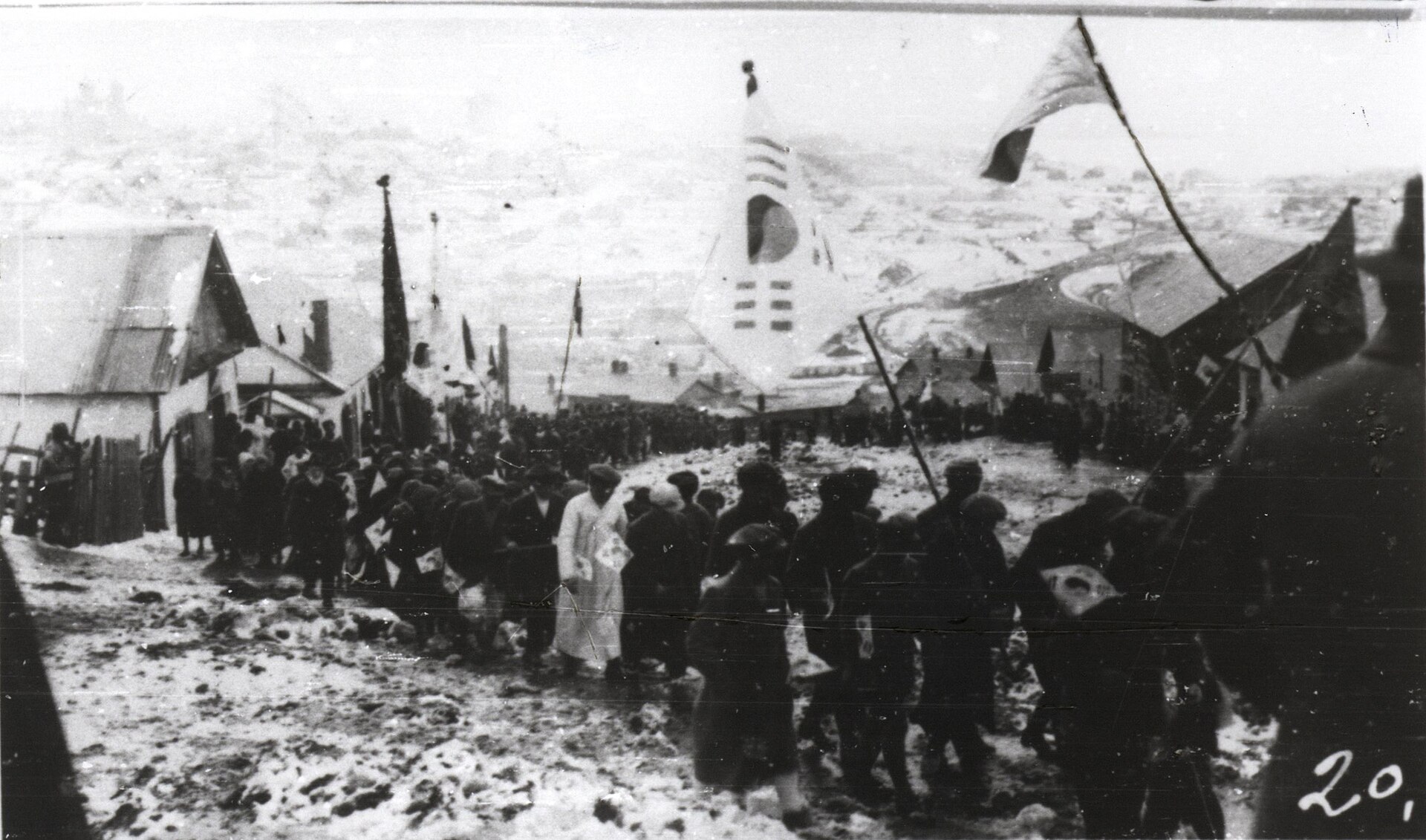
The colonial response was ferocious. Police and troops fired on the unarmed crowds. The toll is uncertain: Korean sources of the time cited some seven thousand five hundred dead, tens of thousands wounded, and nearly fifty thousand arrests; official Japanese figures were far lower. One episode captures the brutality of the crackdown: in the village of , in April 1919, Japanese soldiers locked villagers inside a Methodist church, opened fire, and then set it ablaze.
One of the movement's most poignant figures is , a sixteen-year-old high school student who organized demonstrations in her home province. Arrested and tortured, she died in prison in 1920 at the age of seventeen. In Korea she has become the very embodiment of patriotic sacrifice, a kind of national Joan of Arc whose name every schoolchild knows.
The March 1st Movement did not free Korea, but it inspired others under colonial rule: China's May Fourth Movement, that same year of 1919, explicitly echoed it, and both Gandhi and Indian nationalists praised the Korean strategy of non-violent resistance.
The movement failed to win independence, but it changed everything. Shaken, Japan officially softened its methods and, a few weeks later, replaced its "rule by force" with a . Above all, March 1st gave rise, a month later, to the seed of a government in exile.
Assimilate, Erase, Rename#
From the 1930s onward, and still more after the outbreak of the Second Sino-Japanese War (1937), colonial policy shifted into a project of total assimilation summed up by the slogan naisen ittai (내선일체, "Japan and Korea are one body"). The aim was no longer merely to dominate Korea, but to dissolve Korean identity into Japanese identity. This was the most traumatic phase of the colonization, the one that reached into language, names, and souls.
The Forced Name Change#
The most emblematic measure was the , launched in 1939-1940. It effectively compelled Koreans to abandon their traditional family name and adopt a Japanese-style surname. Officially presented as optional, the measure became coercive in practice: without a Japanized name, families were denied access to schools, government offices, rations, and employment. Within a few months, roughly 80% of Koreans complied.
literally means "to create a clan name (sōshi) and change the given name (kaimei)." For a people whose family name inscribed the individual within a lineage stretching back centuries, imposing it was an assault on identity of a particular depth.
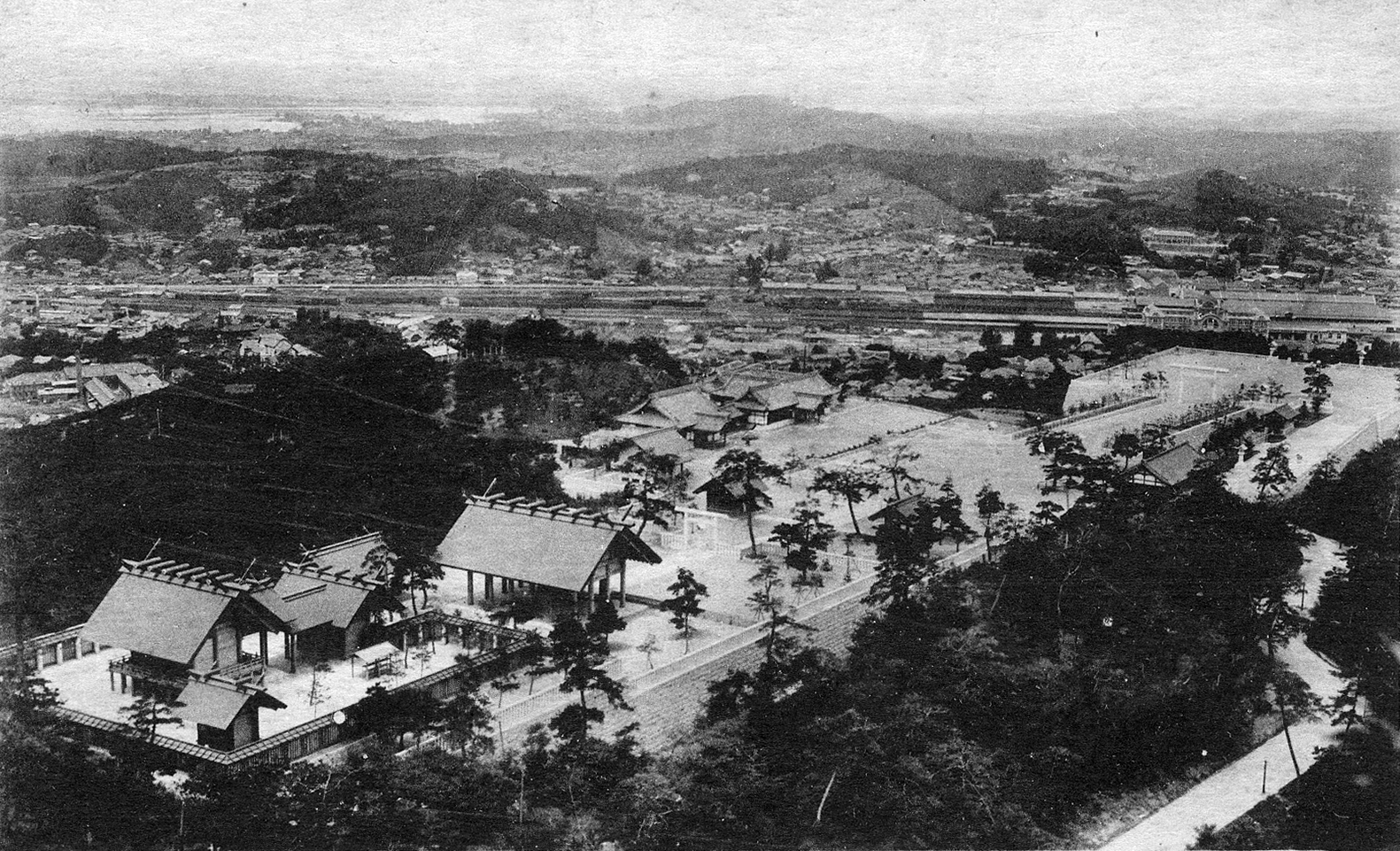
At the same time, the colonial state imposed the cult: shrines were erected across the country, beginning with the imposing on the heights of Seoul, and Koreans, including Christians, which caused grave crises of conscience, were ordered to bow before them. Schoolchildren had to recite the Oath of Imperial Subjects and turn each morning toward the imperial palace in Tokyo.
The Suppression of the Korean Language#
Linguistic repression reached its peak toward the end of the period. As the war advanced, Japanese became the only language permitted in schools, government, and the press. Korean was progressively barred from teaching, then banished from public life. In 1942, the saw the arrest and torture of dozens of linguists who had been working clandestinely on a great Korean dictionary; two of them died in detention. Compiling the language of one's own people had become a crime.
It was in this context that the Korean alphabet, hangeul, took on an unprecedented political charge: to preserve and pass on this writing system uniquely Korea's own became an act of quiet cultural resistance.
Read alsoHangeul: The Korean Alphabet Invented by King SejongBanned from schools under the occupation, hangeul became a symbol of resistance. A look back at the most ingenious alphabet in the world, a gift from King Sejong.
The very language colonial Japan tried to erase, you will soon be able to learn online: KoreanSRS (koreansrs.com) opens soon: join the waitlist to master hangeul and Korean vocabulary from day one.
Forced Labor and "Comfort Women": The Open Wounds#
From 1938, with the National Mobilization Law, Japan exploited Korea for its war effort with growing intensity. Hundreds of thousands of Koreans were conscripted into : coal mines, shipyards, and munitions factories in Japan, on Sakhalin, and across the Pacific islands. Some of these mines, such as Hashima Island (군함도, "Battleship Island"), since inscribed on UNESCO's World Heritage list, have become painful sites of memory, where the Japanese narrative of "industrial modernization" and the Korean narrative of forced labor still clash.
The gravest and most sensitive chapter remains that of the , the euphemism for the women forced into sexual slavery in the "comfort stations" of the Japanese Imperial Army. Tens of thousands of women, Korean in large numbers, but also Chinese, Filipino, Indonesian, Dutch, and Japanese, were recruited through deception, coercion, or force. This subject demands rigor and restraint: overall estimates vary widely by source, the exact scale is debated among historians, and the archives are fragmentary, in part because documents were destroyed in 1945.
What is no longer seriously contested by historical research is the existence of an organized system and the reality of the coercion these women endured. Long silenced by shame and trauma, Korean survivors began to testify publicly from 1991 onward, notably Kim Hak-sun, whose testimony shifted the entire debate. Since then, every Wednesday, a demonstration has been held outside the Japanese embassy in Seoul to demand an apology and reparations. The issue still poisons diplomacy: a 2015 bilateral agreement, meant to settle the dispute "finally," was largely rejected by victims' associations, which reproached it for having been concluded without them.
To address this history is to refuse two symmetrical pitfalls: minimization, which denies the victims' suffering, and instrumentalization, which reduces it to a political weapon. The halmoni (할머니, "grandmothers"), as the survivors are respectfully called in Korea, asked first and foremost for one thing: the recognition of the truth.
The Government in Exile and Armed Resistance#
Faced with an occupation that seemed seamless at home, Korean resistance organized itself chiefly abroad. On April 11, 1919, in the wake of the March 1st Movement, exiles founded in Shanghai the . It was a founding act: this government in exile adopted a republican constitution, took the name Daehan Minguk (대한민국), the very name South Korea bears today, and broke with the old monarchical order.
Its dominant figure would long be , an uncompromising activist who led it from China. The provisional government pursued a diplomacy of recognition, funded clandestine operations, and, at the end of the war, formed a alongside the Chinese Kuomintang forces.
Armed resistance took other forms. In Manchuria and Siberia, partisan groups harried the Japanese army; the , in 1920, where independence fighters inflicted heavy losses on the Japanese, remains a source of national pride. Others chose individual action: had already, in 1909, gunned down Itō Hirobumi, the architect of the protectorate, in Harbin; threw a bomb at Japanese officials in Shanghai in 1932. In Korea, these men are absolute heroes.
A third current, communist and nationalist, operated from Manchuria and the USSR; it was from this partisan matrix that Kim Il-sung, the future founder of North Korea, would later emerge. The ideological split within the resistance already foreshadowed, in outline, the future division of the peninsula.
Read alsoGwangju 1980: The Uprising That Awakened Korean DemocracyThe thirst for freedom born under the occupation did not die out in 1945: forty years later, Gwangju rekindled it in the face of military dictatorship.
1945: Liberation and the Legacy of a Wound#
Korea regained its freedom on August 15, 1945, the day of Japan's surrender. This date, , is the most emotionally charged national holiday of both Koreas. The joy of liberation, celebrated in the streets beneath flags brought out of hiding, was soon overshadowed: Korea did not recover its full sovereignty but was divided along the 38th parallel between an American occupation zone in the south and a Soviet one in the north, a prelude to the Korean War and to a partition that endures to this day.
Thirty-five years of occupation shaped today's Korea profoundly. They forged a fierce nationalism, a stubborn distrust of the Japanese neighbor, and a living memory sustained by textbooks, cinema, and commemorations. On the material level, the legacy is ambiguous: Japan left behind railways, factories, and schools, but built for colonial exploitation, not for the welfare of Koreans: a historiographical debate, that of "colonial modernization," which remains sharp.
Contemporary tensions are almost all rooted in this period. The "comfort women" dispute, the forced-labor lawsuits that led South Korea's Supreme Court to condemn Japanese companies as early as 2018, the friction over Japanese history textbooks, the visits of officials to the Yasukuni Shrine: each of these disputes replays, in its own way, the question of acknowledging the colonial past. In 1995, South Korea demolished the Government-General building that had masked Gyeongbokgung, a highly symbolic gesture of reclaiming its space and its history.
The Japanese occupation was but an instant in Korea's long history, but an instant that concentrated everything: loss, humiliation, resistance, and rebirth. If South Korea insists so strongly that the world hear this story, it is not out of resentment, but because a people that came close to being erased knows better than anyone the price of a name, a language, and a freedom.
FAQ#
How long did the Japanese occupation of Korea last? Japanese colonial rule lasted thirty-five years, from the Annexation Treaty of August 29, 1910, to Japan's surrender on August 15, 1945. A protectorate phase had preceded it from 1905, with the Eulsa Treaty.
What was the March 1st Movement of 1919? It was the first great national uprising against the occupation. On March 1, 1919, Koreans proclaimed their country's independence and demonstrated peacefully in the hundreds of thousands. Violently repressed, the movement became the founding symbol of modern Korean nationalism.
What was the sōshi-kaimei (창씨개명)? It was the colonial policy of 1939-1940 that effectively compelled Koreans to replace their traditional family name with a Japanese-style surname. Presented as optional, it became coercive: without a Japanized name, one lost access to schooling, employment, and rations.
Who were the "comfort women"? "Comfort women" (위안부, wianbu) is the euphemism for the women forced into sexual slavery by the Japanese Imperial Army. Korean in large numbers but also of other nationalities, they have demanded recognition and reparations since 1991. The subject remains a major dispute between Seoul and Tokyo.
Why do Korea-Japan relations remain tense? Because most of today's disputes, forced labor, "comfort women," history textbooks, contested islets, go back to the colonial period and to the question of acknowledging it. The memory of those thirty-five years remains vivid in South Korean society.
Photo credits: images in this article come from Wikimedia Commons and are under free licenses.
Gojoseon, Silla, Goryeo, Joseon: Korea's dynasties made clear
Two thousand years in five names: the founding kingdom, the Three Kingdoms, unified Silla, Goryeo which gave the country its name, and Joseon which lasted five centuries.
Cover image: Wikimedia Commons · Public domain