Sejong the Great: The Scholar-King Who Invented Hangeul
A portrait of Sejong the Great (1397-1450), 4th king of Joseon: his accession, the scientific golden age of his reign, and the invention of hangeul.
La rédaction Kotoba Interactive
Studio éditorial
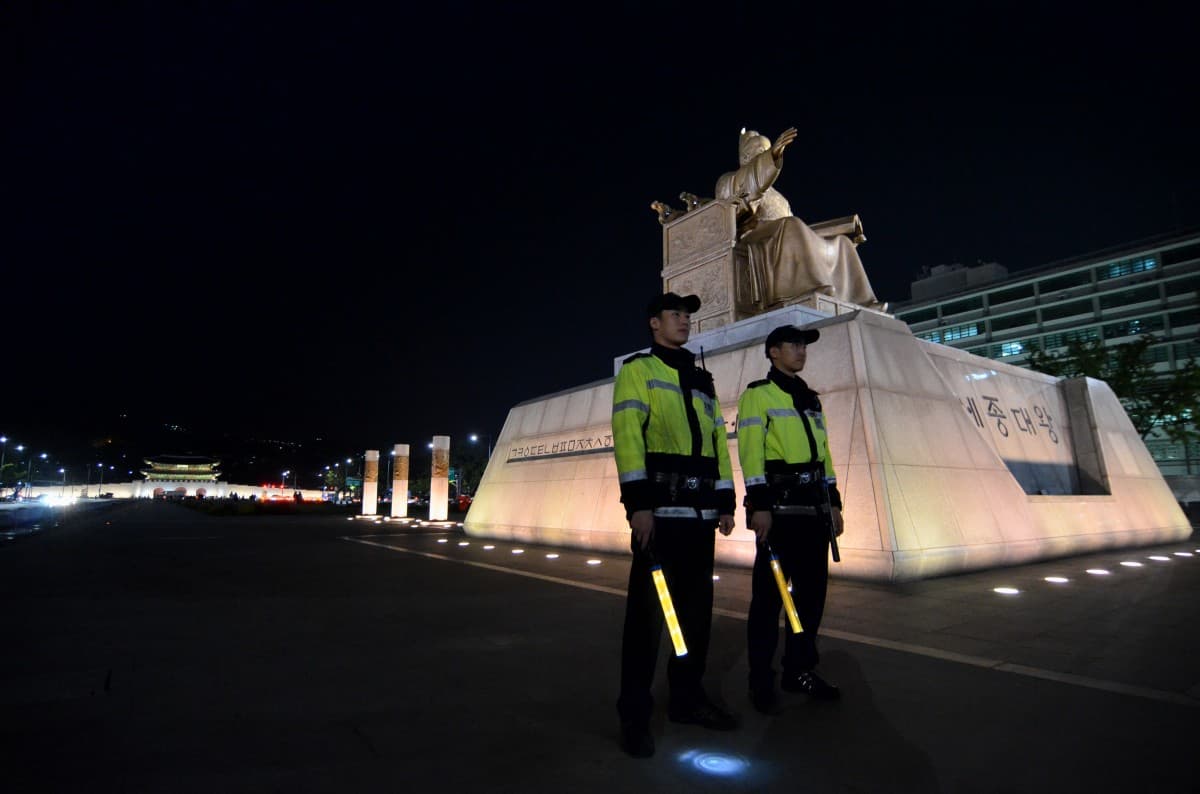
On Square, in the heart of Seoul, a gilt-bronze statue more than six meters tall looks down on the passersby: a seated man, an open book on his knees, his gaze turned southward. He is neither a general nor a conqueror. He is a lettered king, and the only sovereign in all of Korean history whom posterity has crowned with the title "the Great." On the 10,000-won note, it is still his face that changes hands every day. Korea has many heroes; it has only one Sejong.
Born in 1397, fourth king of the dynasty, Sejong reigned from 1418 to 1450 and turned a young kingdom into a scientific, agricultural and literary hub from which Korea still draws its pride. He is remembered for inventing , the Korean alphabet, and rightly so. But reducing Sejong to that alphabet is to read a single chapter of a life that has ten. This article tells the story of the man and the monarch: how a third son became king, how he surrounded himself with the finest minds of his age, what instruments his reign gave the world, and why his great writing project was the logical crown of a politics wholly turned toward shared knowledge.
A third son who should not have reigned#
Sejong reached the throne through a dynastic anomaly: he was not the designated heir. A son of King , Joseon's third sovereign, the young Yi Do had two elder brothers ahead of him, and Confucian custom held that the crown should pass to the firstborn. The eldest, Prince , was nonetheless set aside: his repeated misdeeds and his open contempt for study made him, in the eyes of the court, unfit to rule.
Korean tradition long held that Yangnyeong deliberately ruined his own standing, piling on scandals to clear the way for the younger brother whose genius everyone could see. The story may be too neat, but it states a truth the fifteenth-century court took seriously: talent should outweigh birth order. Taejong, an authoritarian monarch who had seized power by force of arms, named Yi Do crown prince in 1418, then abdicated in his favor that same year while keeping a hand on the army for a time. At twenty-one, the tireless reader became king.
The reign name is a posthumous title made of 世 (se, "generation, world") and 宗 (jong, "venerated ancestor, lineage"). Like all Joseon kings, he received this name only after his death; in his lifetime, no one ever addressed him by it.
The Jiphyeonjeon: a collective brain for the kingdom#
Sejong governed through knowledge and institutionalized research by refounding the , the "Hall of Worthies." Established in 1420 out of an older academy, this body gathered the kingdom's brightest young scholars, chosen by examination, and freed them from administrative chores so they could devote themselves to study, documentary research and the writing of official works. The king came in person to debate, listened, contradicted, and let himself be contradicted.
The Jiphyeonjeon worked like a state institute avant la lettre: it compiled history, revised rites, and studied agronomy, medicine, astronomy and phonetics. From this pool would come the scholars charged with supporting the great writing project. Sejong practiced a rare method of government for an absolute ruler: he preferred to persuade by demonstration rather than impose by decree, and he tolerated scholarly dissent so long as it kept to proper form.
A king who listens to his scholars before deciding: it is perhaps here, more than in any of his instruments, that Sejong's modernity lies.
The scientific golden age and the genius of Jang Yeong-sil#
In some thirty years, Sejong's reign produced a flowering of scientific instruments with no equal in earlier Korea. The central figure of that ferment was not an aristocrat but a craftsman of humble birth: . The son of a government office servant, a low tier of Joseon's social order, Jang was noticed for his mechanical skill. Sejong lifted him out of his condition, ennobled him and entrusted him with building the machines the kingdom needed. That choice, scandalous to the rigid Confucian hierarchy, says everything about how the king judged men.
Measuring time and the heavens#
From this royal workshop came marvels of clockwork. In 1434, Jang Yeong-sil completed the , an automatic water clock that announced the hours through figurines striking drums and gongs with no human hand. The same period saw the birth of the , public cauldron-shaped sundials set up in the streets so that anyone, literate or not, could read the time. The kingdom also acquired armillary spheres and observation instruments that fed a properly Korean astronomy.
That astronomy led to the , a calendar-calculation system completed around 1442, which adapted Chinese and Islamic tables to the latitude of Seoul. For the first time, the Joseon court could predict eclipses and planetary positions from the meridian of its own capital, and not from that of Beijing. It was a scientific claim as much as a political one.
Counting the rain#
In 1441, Korea invented the , one of the oldest standardized rain gauges in the world. This simple graduated cylinder, distributed to provincial administrations, made it possible to measure and compare rainfall from one region to another by a single standard. Behind the object lay an agricultural intent: to know the rain better in order to manage harvests, taxes and famines. Tradition credits the idea to the crown prince Munjong, Sejong's son, which shows that the scientific spirit had passed all the way into the heir's chamber.
Korea's 1441 rain gauge predates its European counterpart, usually credited to the Italian Benedetto Castelli around 1639, by nearly two centuries. The cheugugi was no scholar's curiosity: it was an instrument of state, deployed across the whole territory to steer agriculture.
To feed, to sing, to defend: a reign on every front#
Beyond instruments, Sejong reformed the material and cultural foundations of the kingdom. In agronomy, he commissioned the , published in 1429: instead of copying Chinese treatises, his envoys gathered the know-how of the most experienced Korean farmers, region by region, to produce a manual suited to the peninsula's soil and climate. The kingdom also reformed land taxation, seeking to base the tax on the real quality of the land and the hazards of the harvest.
Court music was not forgotten. Sejong relied on the theorist to reform , ritual music, correct the tuning of instruments and fix a system of notation. The king is even credited with composing musical pieces, a great rarity for an East Asian sovereign.
At the borders, finally, the reign was on the offensive. Against the tribes harassing the north, Sejong established a lasting system: the along the Yalu River and the along the Tumen. This push fixed for centuries the northern outline of Korea, roughly that of the present-day border. The scholar-king knew how to hold a military line too.
Read alsoLand of the Morning Calm: Why Korea Is Really the Morning Bright"Land of the Morning Calm": where does this nickname for Korea come from, and what does it really say about the kingdom Sejong ruled?
The Hunminjeongeum: knowledge given back to the people#
The crown of the reign was an alphabet designed so that the people could read. Until then, Korean was written with Chinese characters, the , whose mastery demanded years of study reserved for an elite. A farmer, a craftsman, a common woman were in effect illiterate, unable to set their language on paper. Sejong saw this as an injustice, and he stated it himself in the preface to the :
"The language of our country differs from that of China. And so an ignorant man, even when he wishes to express what is in his heart, often cannot do so. I have had pity on this, and have created twenty-eight new letters. I wish only that everyone may learn them easily and use them conveniently in daily life."
The new alphabet was presented in 1443 and officially promulgated in 1446, together with an explanatory manual written by the scholars of the Jiphyeonjeon. Its design deserves an article of its own; what matters here is the political project: to give every Korean, whatever their rank, a tool to read and write their own language within a few days. The lettered aristocracy, attached to the prestige of Chinese, resisted; some denounced a betrayal of civilization. Sejong overrode them. It was the act of a sovereign who, all his life, preferred shared knowledge to hoarded knowledge.
Read alsoHangeul: The Korean Alphabet Invented by King SejongHow the alphabet he brought into being actually works: jamo, syllable blocks, and the engineer's logic of hangeul.
The vocabulary of his reign reads better once you know his alphabet: 세종 (Sejong), 한글 (hangeul), 조선 (Joseon, the dynasty), 훈민정음 (Hunminjeongeum, the 1446 manifesto). KoreanSRS, our spaced-repetition app for learning Korean, is coming soon: join the waitlist to decode hangeul and these words of history from day one.
A reign that ended in shadow and illness#
Sejong's final years were darkened by illness, which did not dent his work. Diabetes, eye trouble that left him nearly blind, joint pain: the king suffered for a long time and delegated more and more of affairs to his eldest son, the future , who ran a de facto regency. Sejong died in 1450, at fifty-three, after thirty-two years on the throne, and rests at last in the royal tomb of .
His death opened a troubled period. Munjong, in fragile health, reigned only two years; his young son Danjong would soon be deposed and killed by his uncle, the usurper Sejo. The dynasty would survive, but the scholarly harmony of Sejong's reign would not return. It is perhaps that contrast that etched so deeply into Korean memory the image of a unique and fleeting golden age.
A legacy carved into the nation#
No Korean sovereign is as present in contemporary daily life as Sejong. His portrait adorns the 10,000-won note; his statue sits on Gwanghwamun Square, facing the palace from which he ruled. In 2012, Korea even gave his name to a new administrative city, , which houses part of the government. Every October 9, the country celebrates , Hangeul Day, a public holiday dedicated to the alphabet he gave his people.
This omnipresence is no personality cult manufactured after the fact. It rests on the fact that Sejong embodies, better than anyone, a certain idea Korea holds of itself: a country that bets on education, science and ingenuity rather than on force alone. When a Korean child learns to read, when a researcher consults the meridian of Seoul, when a merchant makes change, the scholar-king is there, quiet and permanent. He did not merely invent an alphabet: he gave a nation the measure of its own genius.
In a single table, here are the great achievements that made the golden age of his reign:
| Achievement (hangeul + romanization) | Field | Contribution |
|---|---|---|
| 훈민정음 Hunminjeongeum | Writing | Hangeul, an alphabet created to make reading accessible to the whole people |
| 집현전 Jiphyeonjeon | Scholarship | The "Hall of Worthies," a state institute that steered the kingdom's research |
| 자격루 Jagyeongnu | Timekeeping | Automatic water clock announcing the hours with no human hand |
| 앙부일구 Angbu-ilgu | Astronomy | Public sundials set up in the streets, readable by anyone |
| 측우기 Cheugugi | Meteorology | Standardized rain gauge, one of the oldest in the world |
| 칠정산 Chiljeongsan | Calendar | Calendar system set to the meridian of Seoul rather than that of Beijing |
| 농사직설 Nongsa-jikseol | Agriculture | Farming manual based on the know-how of Korean peasants |
FAQ#
Why is Sejong called "the Great"? Because he is the only king in Korean history to have received the title, on account of the scale of his work: the invention of hangeul, a scientific golden age, agricultural and musical reforms, and the consolidation of the borders. His reign (1418-1450) remains the absolute benchmark of the Joseon dynasty.
Did Sejong invent hangeul alone? The project was driven by the king, who set its vision and wrote its preface, but he relied on the scholars of the , the Hall of Worthies, for the technical work and the explanatory manual. The alphabet was presented in 1443 and promulgated in 1446.
Who was Jang Yeong-sil? An engineer of humble birth, the son of a servant, whom Sejong ennobled for his mechanical talent. He notably designed the water clock in 1434 and contributed to the sundials and astronomical instruments of the reign.
Which inventions mark Sejong's reign? The automatic Jagyeongnu water clock, the public angbu-ilgu sundials, the standardized rain gauge of 1441, the Chiljeongsan calendar system, the agricultural treatise Nongsa-jikseol, and of course hangeul.
Where is Sejong seen in Korea today? On the 10,000-won note, as a gilded statue on Gwanghwamun Square in Seoul, in the name of the administrative city of Sejong, and every October 9 on Hangeul-nal, Hangeul Day.
Photo credits: the images in this article come from Wikimedia Commons and are under a free license.
In this article
The cultural terms covered here, each with a short definition.
- Joseon
- Korea's last royal dynasty (1392-1897), which shaped its language and culture.
Gojoseon, Silla, Goryeo, Joseon: Korea's dynasties made clear
Two thousand years in five names: the founding kingdom, the Three Kingdoms, unified Silla, Goryeo which gave the country its name, and Joseon which lasted five centuries.
Cover image: Auteur inconnu (CC0) · Auteur inconnu (CC0), via Wikimedia Commons · CC0