Retro gaming in Japan: Super Potato and the art of collecting
Super Potato, Akihabara, Nakano Broadway, Den Den Town: where to find retro games in Japan, how to read the labels and why prices have exploded.
La rédaction Kotoba Interactive
Studio éditorial
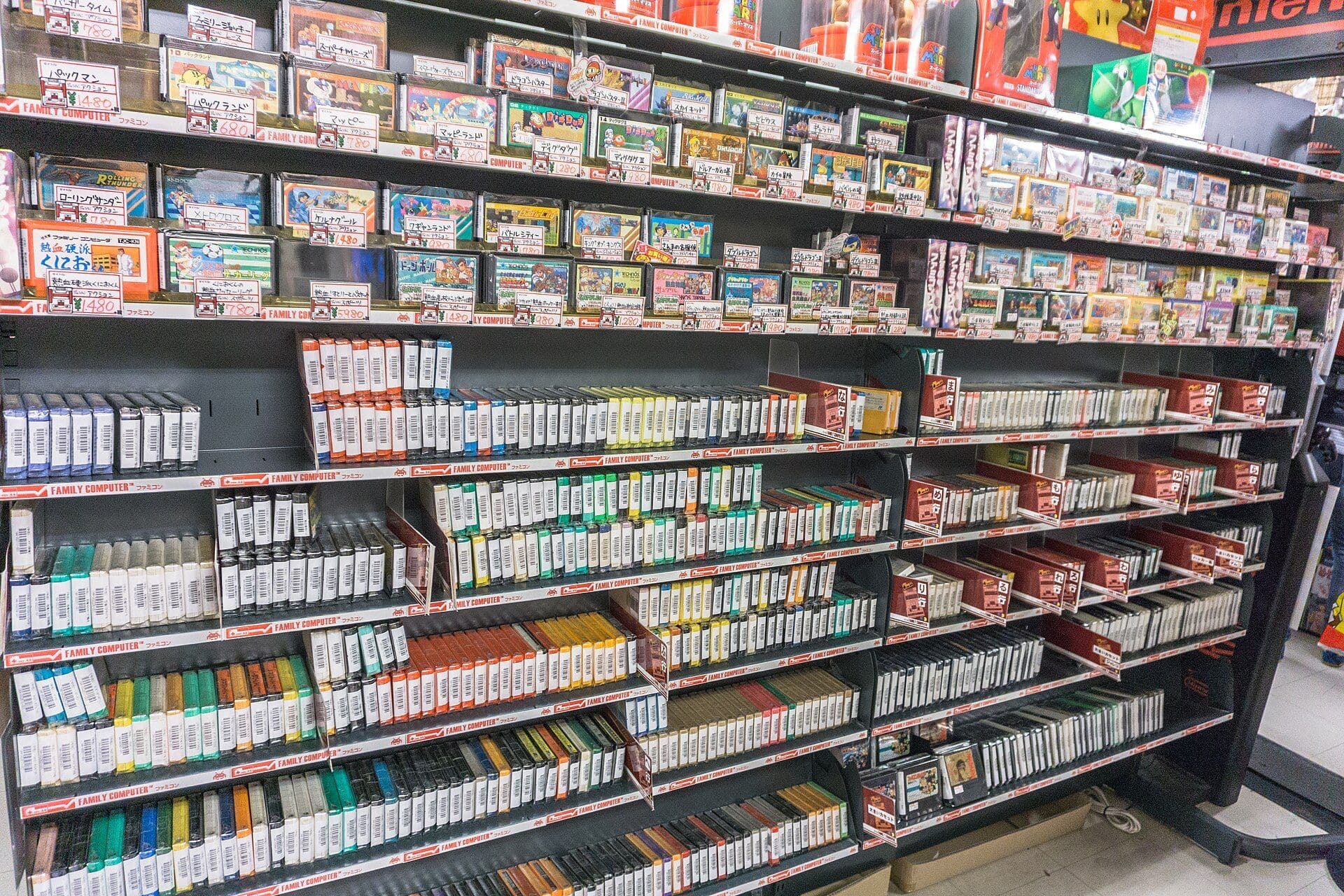
On the third floor of a narrow Akihabara building, Famicom cartridges are shelved like paperbacks: spine out, handwritten label, sorted by publisher. Nobody looks at them one by one. Regulars head straight for the bin they care about and pull a box by instinct. Two floors up, a row of 1980s arcade cabinets is still running at a hundred yen a game.
The shop is called , and it has become, almost against its will, the symbol of retro game tourism. It is only one address in a much denser network that covers Tokyo, Osaka and most Japanese suburbs, and that follows codes worth knowing before you walk out with an overpriced cartridge.
Akihabara, from radio parts to video games#
Akihabara was first known as the "electric town" (電気街, denkigai). After 1945, a market of radio components settled under the railway tracks, where the Radio Center still stands. The district then sold televisions, video recorders, and home computing in the 1980s.
The shift towards games and otaku culture happened in the 1990s, when personal computers and software overtook home appliances. Second-hand game shops moved in because the stock was already there and so were the customers. Retro was not a genre back then: it was simply unsold inventory.
is a Japanese word built on English, which appeared in the Japanese specialist press in the 1990s. It does not describe a fixed age but a superseded generation of hardware. The commonly accepted threshold keeps moving: it once covered the Famicom, it now includes the PlayStation 2 and the Game Boy Advance.
Reading a Japanese label without getting it wrong#
The price of a cartridge depends less on the game than on its declared condition. Japanese shops use a stable vocabulary, handwritten on a slip of paper stuck to the case.
| Label | Reading | What it means |
|---|---|---|
| 中古 | chūko | Second-hand, decent condition, working |
| 箱説付き | hako-setsu tsuki | With box and manual, the most sought-after mention |
| ソフトのみ | sofuto nomi | Cartridge only, no box or manual |
| 未開封 | mikaifū | Still in its original seal, never opened |
| ジャンク | janku | Sold as is, untested, often faulty |
| 動作確認済 | dōsa kakuninzumi | Operation verified by the shop |
The junk bin is where the knowledgeable play. It holds thousand-yen consoles that only need their connectors cleaned, and cartridges whose save battery has died and can be replaced for a couple of euros. It also holds the genuinely bad surprises, since nothing is guaranteed.
The four addresses that matter#
Super Potato Akihabara occupies several floors of the Kitabayashi building, with a retro arcade floor at the top. It is the most expensive shop in the district, precisely because it is the one everyone knows. It stays essential for the density of its stock and for the atmosphere.
, founded in Nakano in 1980 by manga artist Masuzō Furukawa, expanded into video games from its flagship in Nakano Broadway, a 1960s shopping centre turned labyrinth of specialist stalls. Prices are often calmer than in Akihabara and the sorting by publisher is meticulous.
and Hard Off cover the rest of the country. The latter, a consignment chain present all over Japan including the suburbs, is where serious collectors go hunting: the bins are less picked over because the clientele is local.
, in Nipponbashi, Osaka, is the Kansai equivalent of Akihabara, with its own shop signs and prices that have not yet suffered the same fame effect.
Three words are enough to navigate a second-hand game shop: 中古 (chūko, second-hand), 説明書 (setsumeisho, the manual) and 動作 (dōsa, operation). JapaneseSRS, our spaced repetition app, installs that vocabulary and the everyday Japanese that goes with it.
Why prices have doubled#
Until 2019, Japanese retro gaming had a reputation for being cheap. A common Famicom cartridge cost a few hundred yen, a complete Super Famicom the price of a meal. Three factors tipped the market.
The first is the gradual closing of digital storefronts: Nintendo shut the 3DS and Wii U eShops in March 2023, making several hundred titles legally unavailable. Physical copies became the only route to part of the catalogue.
The second is professional grading. Since 2018, American companies have encapsulated sealed games in plastic with a numerical grade, creating a speculative market where the object is no longer played. The record sales of that period, widely reported and later disputed, pushed sellers' expectations upwards.
The third is simply tourism. A weak yen since 2022 has made Japan very attractive to foreign buyers, and Akihabara shops have adjusted their labels accordingly.
Japanese retro gaming stopped being leftover stock the day it became a destination.
Collecting, preserving, playing#
A Tokyo association, the , founded in 2011 by Frenchman Joseph Redon, archives the most fragile Japanese formats: PC-88 and PC-98 floppy disks, tapes, manuals, sleeves. Its finding is blunt: 1980s floppy-based games decay far faster than cartridges, and part of Japan's computing heritage is already gone.
The average Japanese collector does not necessarily share that heritage approach. Many genuinely play what they buy, replace batteries, clean connectors with isopropyl alcohol, and resell what they no longer use. The second-hand chain is so well organised in Japan that the same copy can change owner six times without ever leaving the circuit.
Famicom cartridges do not use standard screws: they open with a gamebit screwdriver, which Akihabara shops sell right next to the cartridges. Japanese collectors carry one in their bag alongside a microfibre cloth.
What to check before buying#
Three traps come up every time. Japanese consoles run on NTSC-J with 100-volt power, which means an adapter and sometimes a transformer depending on your country. Super Famicom cartridges do not fit a European Super Nintendo without physically modifying the slot. And save-enabled games from the 1980s and 1990s carry a coin battery whose useful life is long past.
None of this is a deal-breaker, but the question to ask the seller is always the same: dōsa kakunin shimashita ka (動作確認しましたか), "have you tested it?". In a good shop the answer is written on the label before you even ask.
Read alsoJapanese game centers: arcade culture and its declineJapanese arcades, the other half of gaming culture on the ground.
From playing cards to the Famicom: where the stock filling these shops came from.
FAQ#
Is Super Potato really the best place? It is the most spectacular and best stocked in central Akihabara, but rarely the cheapest. For a specific purchase, comparing with Surugaya, Mandarake in Nakano and suburban Hard Off branches often saves thirty to fifty percent.
Can you play a Japanese cartridge in Europe? On a Japanese console, yes, with a power adapter suited to 100 volts. On a European console, not without modification: slots and regional locks differ from machine to machine.
What does "junk" mean on a label? Sold as is, with no guarantee it works. Some units are fixable in minutes, others are beyond saving. It is an accepted gamble, not a scam: the label says so plainly.
Are prices better in Osaka? Often yes. Den Den Town draws fewer tourists than Akihabara, and the gap on common titles is noticeable. On rarities the market is national and prices converge.
How do you know whether a save still works? The coin battery in a 1980s or 1990s cartridge is very likely dead. Replacement costs a few euros and requires desoldering two tabs; clip-in holders exist to avoid soldering.
Photo credits: the images in this article come from Wikimedia Commons and are under free licences.
In this article
The cultural terms covered here, each with a short definition.
- Akihabara
- Tokyo district that is the global hub of otaku culture, anime goods and electronics.
Oshikatsu: the Japanese culture of supporting your oshi
Oshi, oshikatsu, ita-bag, saidan, ninchi: the vocabulary and rituals of supporting an idol in Japan, and why the banks joined in.
Cover image: IQRemix · IQRemix, via Wikimedia Commons · CC BY-SA 2.0