Matsuri: a guide to Japan's great festivals
Gion, Tenjin, Kanda, Awa Odori, Kanto: what a matsuri really is, what the mikoshi is for, when the big festivals happen and how to attend.
La rédaction Kotoba Interactive
Studio éditorial
A matsuri does not begin with a parade: it begins with a removal. On the appointed day, the shrine's deity leaves its building to be installed in a , a palanquin carried on men's shoulders, and tours its own territory. The shouting, the drums, the deliberate jolting of the palanquin are not folklore: the mikoshi is shaken to rouse the kami and amplify its blessing on the streets it passes through.
The word 祭り (matsuri) comes from the verb 祀る (matsuru), "to enshrine a deity, to worship it". Everything else, the food stalls, the dances, the fireworks, accreted around that religious act. Japan holds several hundred thousand of them a year, from a fifty-person neighbourhood event to the three great gatherings that move millions of visitors.
What you see at a matsuri#
The vocabulary is the same from Hokkaidō to Kyūshū, with local variations in pronunciation.
| Element | Writing | Role |
|---|---|---|
| Mikoshi | 神輿 | Palanquin carrying the deity outside the shrine |
| Dashi or yamahoko | 山車 / 山鉾 | Monumental float pulled by ropes, often multi-storey |
| Yatai | 屋台 | Food or game stall along the route |
| Happi | 法被 | The carrier's short coat, in the colours of the district |
| Ujiko | 氏子 | The shrine's parishioners, who organise everything |
| Kagura | 神楽 | Sacred dance performed before the deity |
| Hanabi | 花火 | Fireworks, often the closing act |
The distinction between mikoshi and float matters. The mikoshi carries the deity and is borne on shoulders; the float is a mobile stage loaded with tapestries, musicians and sometimes puppets, and it is pulled. Kyoto is a city of floats, Tokyo a city of mikoshi.
shares a root with matsurigoto (政), an old word that meant government. In archaic Japan, administering and performing worship were the same gesture: the sovereign ruled by carrying out the rites. The language has kept the trace.
The big three#
Japanese tradition recognises three festivals at the top, though the list is neither official nor fixed.
The in Kyoto fills the whole of July. Its origin is an epidemic: in 869, a procession of halberds was organised to appease the spirits held responsible for plague. The high point, the parade of yamahoko floats, falls on 17 and 24 July. Some floats weigh around ten tonnes and are steered by sliding wet split bamboo under the wheels to turn at junctions. The festival has been on the UNESCO intangible cultural heritage list since 2009.
The in Osaka is held on 24 and 25 July around Osaka Tenmangū shrine, dedicated to Sugawara no Michizane. Its distinctive feature is aquatic: a hundred or so boats travel up the river after nightfall, with fireworks overhead.
The in Tokyo, tied to Kanda Myōjin shrine, takes place in mid-May in odd-numbered years. Its full version mobilises more than two hundred neighbourhood mikoshi in the centre of the capital.
The real calendar: why summer is saturated#
The great festivals cluster in July and August for two reasons that have nothing to do with tourism. The first is agricultural: protective rites for the crops were performed before the harvest. The second is , the period when the souls of the dead return to visit their families, around 15 August in most regions.
| Festival | Place | Dates | Distinctive feature |
|---|---|---|---|
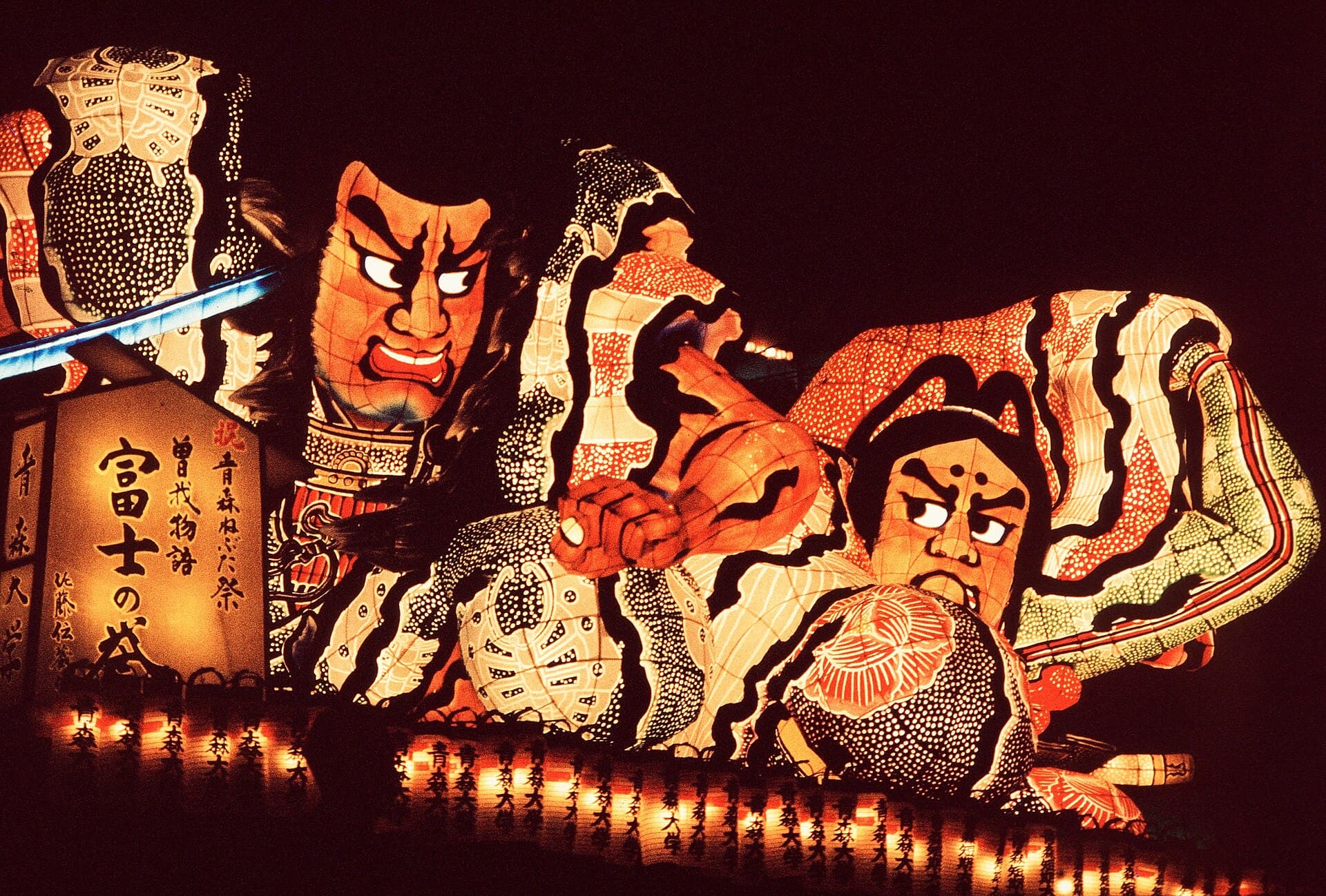
| Nebuta Matsuri | Aomori | 2-7 August | Giant paper lantern floats |
| Kanto Matsuri | Akita | 3-6 August | Bamboo poles loaded with lanterns, balanced |
| Tanabata | Sendai | 6-8 August | Paper decorations hung across the streets |
| Awa Odori | Tokushima | 12-15 August | Collective street dance, since 1587 |
| Gozan no Okuribi | Kyoto | 16 August | Giant fires lit on the mountainsides |
| Danjiri Matsuri | Kishiwada | September | Floats run at speed around corners |
The Awa Odori in Tokushima deserves a word. It is a dance, not a procession: troupes called ren move through the city on a two-beat rhythm, and the traditional refrain says roughly that the dancers are fools, the watchers too, so you may as well dance. Some eight hundred thousand to a million visitors attend each year.
Three words are enough to follow a matsuri: 祭り (matsuri, the festival), 神輿 (mikoshi, the palanquin) and 屋台 (yatai, the stall). JapaneseSRS, our spaced repetition app, installs that vocabulary and the everyday Japanese that goes with it.
Eating at a matsuri#
The row of yatai is a cuisine in its own right, almost identical from one end of the country to the other: octopus balls, fried noodles, grilled squid, shaved ice with syrups, coated banana on a stick, candied apple.
Then come the games: , scooping goldfish with a rice-paper net designed to tear, and cork rifle shooting. These stalls are not a modern addition: they have accompanied festivals since the Edo period, when pilgrimages already fed a roadside economy.
On 17 and 24 July, the Gion Matsuri floats have no steering mechanism. To turn a right angle, a team slides water-soaked split bamboo under the wheels, then pivots ten tonnes of float in one sharp movement, to applause. The manoeuvre is called tsuji-mawashi.
What is changing, and what is disappearing#
In 2016, UNESCO inscribed a set of thirty-three float festivals under the name Yama, Hoko, Yatai, recognising both the parades and the carpentry and weaving skills that make them possible.
That recognition comes in a difficult context. Carrying a mikoshi takes dozens of shoulders, and the ageing of rural neighbourhoods makes recruitment hard. Festivals merge, shorten their routes, or recruit carriers from outside the district, which would have been unthinkable fifty years ago.
The rules are shifting too. In 2024, the Konomiya festival in Inazawa admitted female participants for the first time in a rite previously reserved for men, after more than a thousand years of existence. The decision was widely reported in the Japanese press and debated at other shrines.
A matsuri is not preserved like a monument: it lasts as long as there are shoulders to carry it.
How to attend without a misstep#
Get to the route early, not to the arrival square: the mikoshi looks best in a narrow street. Do not touch the palanquin unless a carrier explicitly invites you. Stand to the side rather than in the middle of the road, where the procession sometimes accelerates without warning.
Cash remains essential at the yatai, and the return trains are packed for an hour after the fireworks. Finally, a matsuri is not a ticketed show: in most cases there is no ticket, no seating and no programme, only a poster stuck on the shrine wall a few weeks before.
Read alsoNebuta Matsuri: Aomori's Giant Lantern FloatsThe Aomori festival in detail, its paper floats and its haneto dancers.
The other great collective appointment in the Japanese calendar, in spring.
FAQ#
Which is the biggest matsuri in Japan? Gion Matsuri in Kyoto, for its length (the whole of July) and its documented age. On two-day attendance, Osaka's Tenjin Matsuri and Asakusa's Sanja Matsuri each draw more than a million people.
Can a foreigner carry a mikoshi? Sometimes, yes. Certain districts, notably in Asakusa and in tourist towns, accept outside volunteers, usually by registering in advance with the neighbourhood association. It is never a last-minute decision.
Do you need to wear a yukata? It is not required but appreciated, especially at summer festivals. The carrier's working coat, the happi, belongs to their district and is not worn by a visitor.
What is the difference between a matsuri and a hanabi taikai? A hanabi taikai (花火大会) is a fireworks competition, a civil event with no religious dimension. Many matsuri end with fireworks, but the reverse is not true.
Are there winter matsuri? Yes. The Namahage of Oga, on 31 December, stages masked visitors coming down from the mountain; it has been on the UNESCO intangible heritage list since 2018. The snow festivals of the north, by contrast, are twentieth-century creations.
Photo credits: the images in this article come from Wikimedia Commons and are under free licences.
Nebuta Matsuri: Aomori's Giant Lantern Floats
Every August, Aomori sets the night ablaze with towering washi-paper lantern floats. History, craft, and the haneto dance of Japan's most flamboyant matsuri.
Cover image: Z3144228 · Z3144228, via Wikimedia Commons · CC BY-SA 4.0