Nebuta Matsuri: Aomori's Giant Lantern Floats
Every August, Aomori sets the night ablaze with towering washi-paper lantern floats. History, craft, and the haneto dance of Japan's most flamboyant matsuri.
La rédaction Kotoba Interactive
Studio éditorial
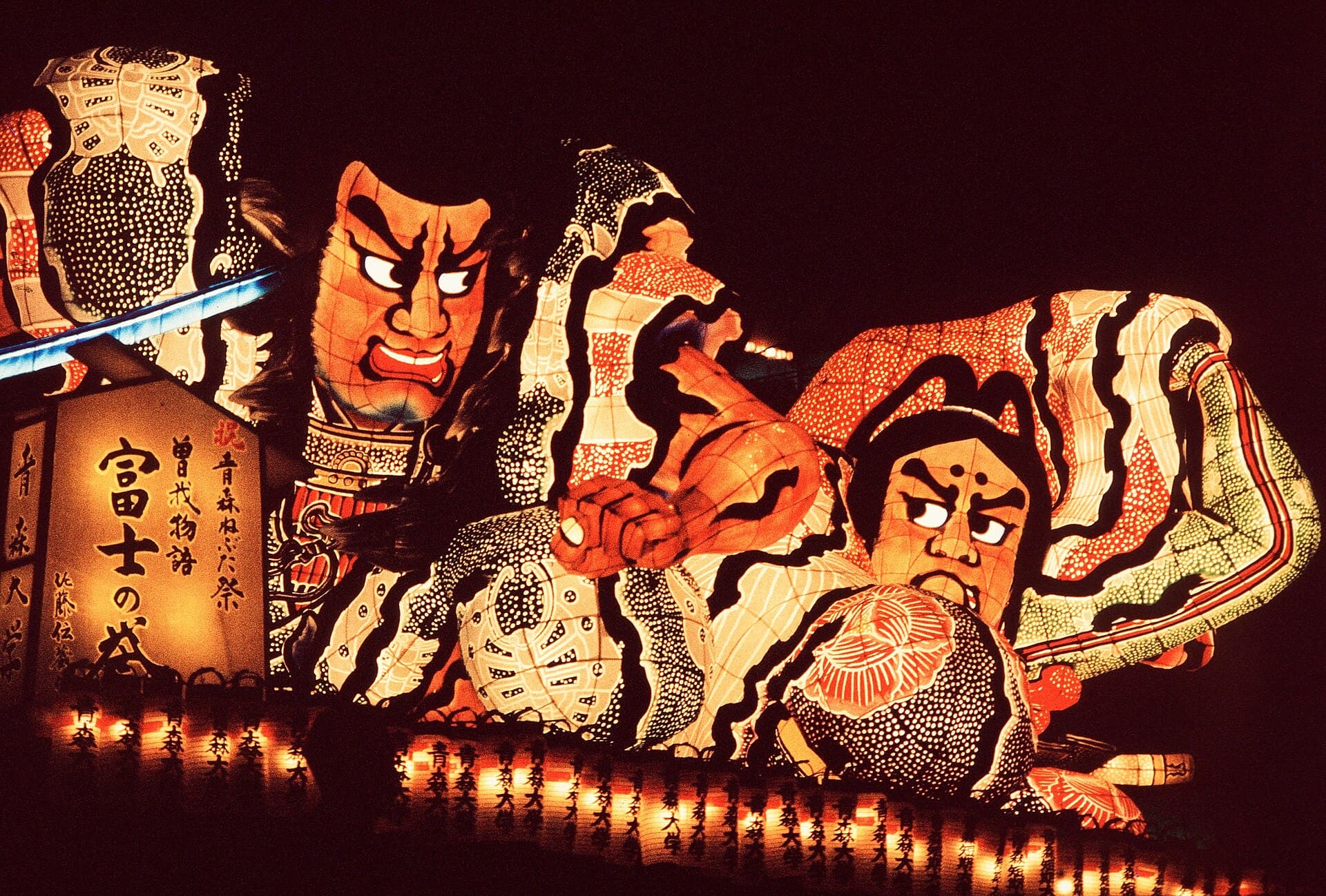
Night has fallen over Aomori, and an orange glow rises up the avenue like a tide. Then the thing appears: a warrior nine meters wide, his face twisted with fury, sword raised, made entirely of paper stretched over a wire frame and lit from within by hundreds of bulbs. Around him, a crowd in white and pink costumes leaps in place, shouting "rassera, rassera," to the beat of drums and flutes. The float advances, sways, spins on itself, and for a second, the paper god seems to fix its gaze on you.
This is the , the festival that, every early August, turns this port city in northern Honshū into a parade of monumental lanterns. It is not a folkloric procession frozen for tourists: it is a living ritual, designated an Important Intangible Folk Cultural Property of Japan, one that keeps artisans busy year-round, swallows millions of yen per float, and draws two to three million visitors over six days. Behind the spectacle lie centuries of superstition, a craft of paper and light passed from master to apprentice, and a collective energy that makes Nebuta one of the three great festivals of Tōhoku.
Fire Against Summer: The Origins of Nebuta#
Nebuta sinks its roots into a summer purification ritual far older than its present-day floats. Originally it was not about giant warriors but about simple lanterns set adrift on the water or carried through the streets to drive off the torpor of summer and evil spirits before the great autumn harvest work. The word nebuta itself is thought to derive from nemuri (眠り, "sleep") or its dialect form neputa: the festival would be a , a rite to "sweep away the drowsiness" that weighs on farmers during the heat waves.
This practice grafts itself onto , the star festival imported from China and celebrated on the seventh day of the seventh month. During Tanabata, people wrote wishes, decorated bamboo branches, then threw ornaments and paper lanterns into the river to symbolically rid themselves of impurities and fatigue, a gesture called , the release of floating lanterns. Aomori's Nebuta preserves the trace of this aquatic origin: on the final evening, several prize-winning floats are loaded onto barges and paraded around the bay beneath fireworks, as if returning to the sea what had always belonged to it.
Onto this ritual bedrock is grafted a persistent legend, that of General . The first great sei-i taishōgun ("barbarian-quelling generalissimo"), he is said, according to local tradition, to have used enormous lanterns and drums to lure and frighten the Emishi, the indigenous peoples of the north whom he fought in the eighth century. Historians are cautious: nothing proves a direct link between those campaigns and the festival, and the association seems to have been forged much later to give Nebuta a heroic ancestor. The city of Aomori itself acknowledges that this lineage belongs more to founding myth than to established fact.
probably comes from neputa, the Tōhoku form of nemutai ("to feel sleepy"). The festival is a nemuri-nagashi, literally "to make sleep flow away": you wash the lethargy of summer into the water in order to face the harvest.
The earliest written mentions of a lantern parade in Aomori date back to the early eighteenth century, under the Edo period. The lanterns were then modest, carried by hand or mounted on small carts. It was over the course of the nineteenth and twentieth centuries that the race toward the colossal began, with each neighborhood, each guild, striving to produce the largest, brightest, most spectacular float. Electrification, in the 1930s and especially after the war, tipped the festival into another dimension: the trembling candle gave way to hundreds of bulbs, allowing enormous structures that a flame could never have lit without setting them ablaze.
Gods of Paper and Wire#
A nebuta float is a luminous sculpture built according to a precise, entirely handmade technique, whose result can reach nine meters wide, five meters tall, seven meters deep, and weigh about four tons once set on its wheeled platform. These dimensions are not decorative: they are capped by the power lines and the width of Aomori's avenues, which the float must cross without snagging, forcing the bearers to tilt and pivot it in millimeter-perfect maneuvers.
It all starts with the frame. Once made of bamboo, it is today shaped from wire, bent and welded to draw out the volumes: a clenched fist, a cheek swollen with anger, the folds of a suit of armor, the maw of a dragon. This is the stage that fixes the expression, and thus the soul of the float. Next comes the installation of the interior lighting: hundreds of tubes and bulbs placed as close as possible to the paper so that the light reaches every recess without leaving a dead zone.
The is then glued over the entire structure, sheet after sheet. This traditional Japanese paper, translucent and resilient, is what gives the nebuta its stained-glass quality: the light does not bounce off it, it passes through. Then comes the coloring. The artisans first trace the outlines with melted paraffin wax (the technique of rō-gaki, 蝋書き) which, once the paper is lit, lets the light pass more vividly along the lines, creating those incandescent contours that structure the warriors' faces. The flat areas are then painted with ink and dyes, from blood red to deep blue.
A nebuta is not painted to be seen by day. It is painted for what it will become at night, when light is born from within and turns every stroke of wax into a vein of fire.
These creators have a name: the , the nebuta masters. They are a handful, in Aomori, who make a living from this art. A large float demands up to a year of design and several months of construction in the workshop, often in the dedicated seaside hangar where the public can watch them work. The cost of a major float runs into tens of millions of yen, financed by sponsors (big local companies, banks, cooperatives) whose names appear on the round lanterns hung at the base of the structure. Becoming a nebuta-shi is taught in no school: you enter as an assistant to a master, you glue paper for years, and you only get your own float when the community judges you capable of it.
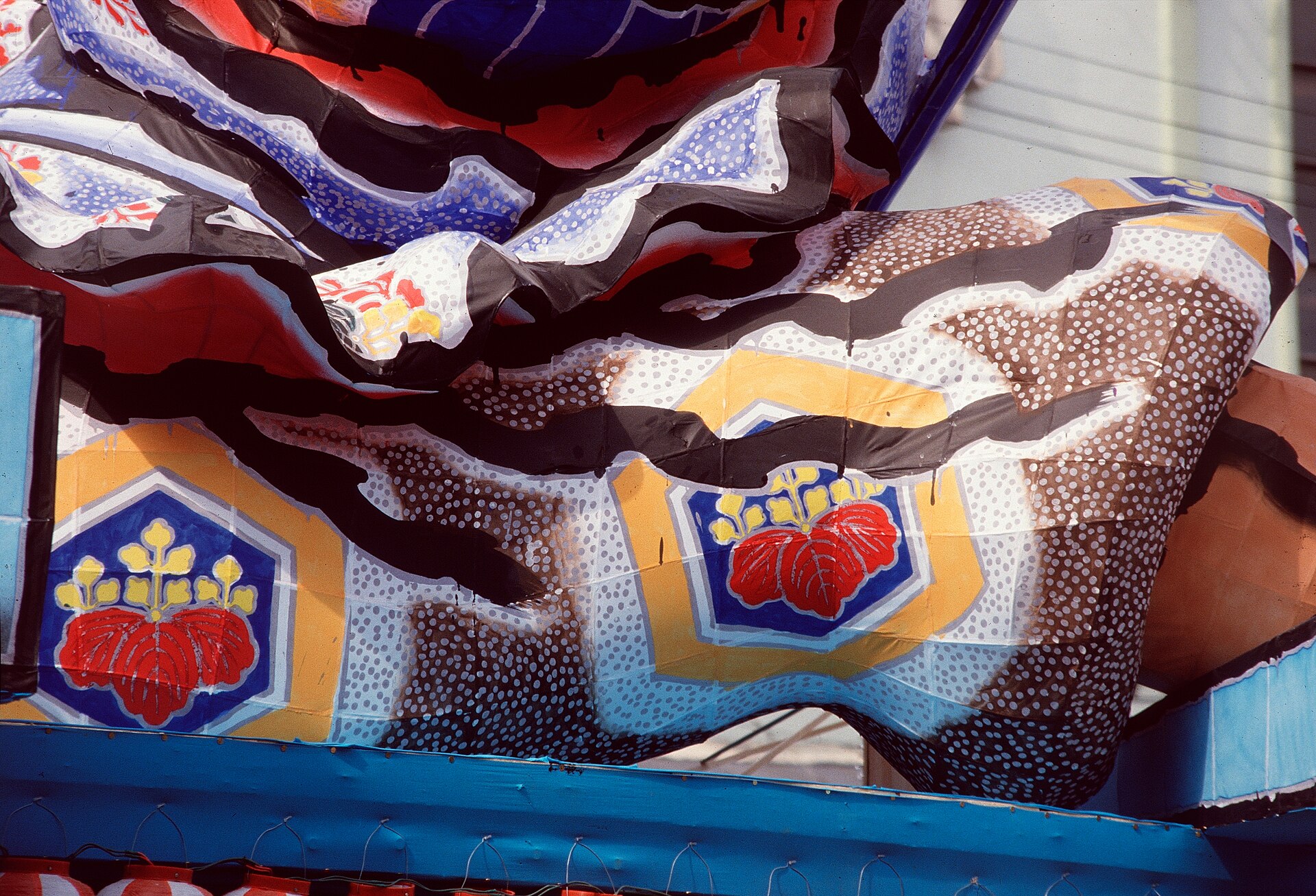
The subjects are almost always figures of power: heroes of Japanese history, gods of the Shintō and Buddhist pantheons, characters from , legendary warriors, demons, dragons. Many stage combats (a warrior slaying a serpent, a god taming a monster) because the tension of a clash lends itself to the frozen gesture, the strained muscle, the bulging stare that the luminous paper magnifies. A jury awards prizes each year to the finest floats, and the rivalry between nebuta-shi and between neighborhoods is fierce.
The Nebuta floats are a living little dictionary: 祭 (matsuri, festival), 和紙 (washi, Japanese paper), and 鬼 (oni, demon) turn up everywhere once you start reading about Japanese culture. Learn to read these characters without a dictionary through the spaced repetition of JapaneseSRS.
The Haneto: Dancing to Exhaustion#
A nebuta float would not move without the , the leaping dancers who surround it by the hundreds and form the kinetic soul of the festival. Their name comes from the verb haneru (跳ねる, "to bound, to jump"), and their step is radically simple: you hop from one foot to the other, knees lifted high, chanting the festival's cry. In Aomori, that cry is "rassera, rassera" (ラッセラー), an onomatopoeia with no fixed translation, said to have once urged people to offer up sake, or simply to raise their voices.
The costume is as codified as it is joyful. The haneto wears a light yukata hitched high on the thighs, a wide sash, and above all a flower hat, the , overflowing with pink, yellow, and purple artificial flowers. Bells, the , are sewn onto the costume and the sash: with each leap they chime, and when thousands of haneto jump together, the whole street becomes an instrument. Tradition holds that a bell dropped to the ground during the dance brings luck to whoever picks it up.
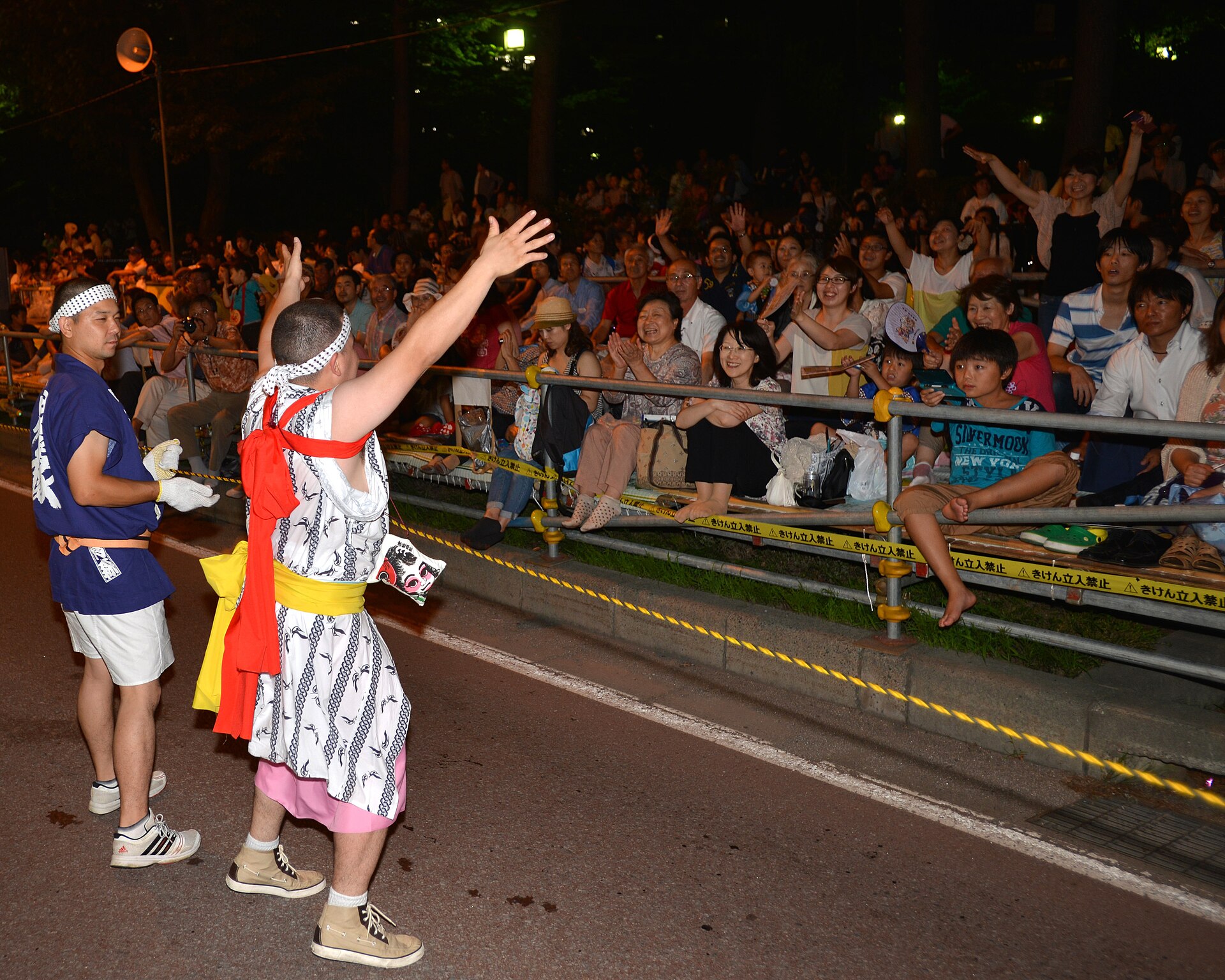
The distinctive feature of Aomori's Nebuta, unique among Japan's great festivals, comes down to this: anyone can dance. All it takes is to put on the regulation costume (bought or rented in town for a few thousand yen) to join the procession freely, with no registration, no rehearsal, and no group membership. An Australian tourist, a family from Ōsaka, a neighborhood child can leap side by side behind the same float. This openness explains part of the fervor: the spectator is never far from becoming a performer.
The haneto costume is so strictly codified that, without it, you cannot dance: the organizers remind everyone each year that a plain yukata is not enough: you need the hanagasa hat and the bells. Once in costume, however, no registration is required, joining the procession is a right, not a privilege.
Around the haneto orbit the festival's other bodies: the bearers who maneuver the float by shoulder and by rope, the , musicians of the taiko drums, the flutes, and the cymbals, who set the tempo, and the technicians who manage the electricity and make sure the paper colossus strikes neither a traffic light nor a balcony. Together they form an organism of a hundred to several hundred people per float, advancing at a few kilometers an hour over a three-kilometer course completed in several hours.
Neputa, Nebuta: A Family of Festivals#
Aomori's Nebuta does not stand alone: it belongs to a constellation of lantern festivals native to Aomori Prefecture, and its most famous cousin is written almost the same but pronounced differently. In , a former castle town some forty kilometers to the south, they celebrate at the same time the , with a p, not a b. This phonetic difference conceals a difference in form.
| Festival | City | Float form | Atmosphere |
|---|---|---|---|
| Aomori (青森) | Three-dimensional warriors, up to 9 m wide | Raw energy, leaping haneto | |
| Hirosaki (弘前) | Painted flat fans (ōgi-neputa, 扇ねぷた) | Lyrical, melancholic, slow music | |
| Goshogawara (五所川原) | Vertical tower-floats, up to 20 m tall | Vertiginous, verticality |
The Hirosaki floats are not three-dimensional warriors but great flat fans, the , on which are painted battle scenes drawn from Chinese iconography, notably from the novel Water Margin (Suikoden, 水滸伝). One face, the , shows the hero in all his martial glory; the other, the , presents a female figure painted in darker, more melancholic tones. Where Aomori bets on three-dimensional volume and the raw energy of the haneto, Hirosaki cultivates pictorial refinement and a more lyrical, almost nostalgic atmosphere, carried by slower music.
Other towns in the prefecture have their own variants: Goshogawara and its , vertical tower-floats some twenty meters tall, are the most vertiginous example. This diversity is a reminder that Nebuta is not a registered trademark but a regional cultural fund, adapted to the genius of each locality. Aomori's Nebuta, Hirosaki's Neputa, and Akita's Kantō are, moreover, among the festivals inscribed as Important Intangible Folk Cultural Properties of the country; they are not, however, part of the UNESCO yama, hoko, yatai listing inscribed in 2016, which covers thirty-three Japanese processional float festivals, several of them in Tōhoku.
A few kilometers apart, one word tips over on a single consonant: nebuta in Aomori, neputa in Hirosaki. The whole emotional geography of a region sometimes rests in that shift of sound.
For anyone learning Japanese, Nebuta is an ideal lexical playground: matsuri (祭), taiko (太鼓), hanagasa (花笠), washi (和紙), oni (鬼) are all words that open onto entire swaths of the culture.
Want to read these characters without a dictionary? JapaneseSRS (japanesesrs.com) is coming soon to help you learn matsuri vocabulary and everyday kanji, sign up for the waitlist.
A Cultural and Economic Machine#
The Nebuta Matsuri is held every year from August 2 to 7, fixed dates that have set the rhythm of Aomori's life for decades. Over this handful of days, the city (just under 270,000 residents) welcomes a turnout estimated at between two and three million visitors depending on the year, making it one of the most heavily attended tourist events in northern Japan. On the final day, August 7, a daytime parade, a maritime procession of the prize-winning floats around the bay, and a grand fireworks display come together, closing the festival on the very aquatic gesture that gave birth to it.
The economic impact is considerable for a Tōhoku region facing aging and rural exodus. Hotels booked months in advance, restaurants stormed, sales of haneto costumes, souvenirs, transport: Nebuta is the financial lung of the local summer. To extend this windfall beyond the six days, the city inaugurated in 2011 the , a seaside museum that exhibits full-scale floats from the previous edition and lets visitors, year-round, approach these paper colossi and understand the work of the nebuta-shi.
This success does not erase the tensions. The transmission of the nebuta-shi craft remains fragile: they are few, the apprenticeship is long and poorly paid, and dependence on sponsors exposes the floats to economic uncertainty. The festival must also reckon with its own popularity: crowds to channel, safety, respect for a ritual that refuses to become a mere tourist product. Every year the question surfaces: how to remain a living rite, open and free to watch, when you are also an industry?
The answer perhaps lies in what the festival asks of those who make it. To build a nebuta is to spend a year giving form to a paper god, knowing it will live only six nights before being dismantled. To dance as a haneto is to leap to exhaustion for a float that is not yours, in a city that may not be yours, for the sheer pleasure of the collective jump. Nebuta does not survive in spite of its ephemeral nature: it survives because of it. Each August, Aomori relights its warriors, parades them one last time, then returns them to the night, and already, in the seaside workshops, the next ones are beginning to be born.
FAQ#
When and where does the Nebuta Matsuri take place? The festival is held every year from August 2 to 7 in the city of Aomori, capital of the prefecture of the same name, at the northern tip of Honshū. The great night parades take place in the evening, except on August 7, which combines a daytime parade, a maritime procession of the floats, and fireworks.
What does the dancers' cry "rassera" mean? "Rassera, rassera" is the encouragement cry of Aomori's haneto. A simple onomatopoeia with no literal translation, it paces the leaps and rallies the crowd. Its origin is uncertain: it is sometimes linked to an old call to offer sake to the dancers.
Can tourists take part in the dance? Yes, and that is what sets Nebuta apart. Anyone wearing the regulation haneto costume (hitched-up yukata, hanagasa flower hat, bells) can join the procession freely, with no registration or rehearsal. Costumes are easily rented or bought in town during the festival.
What is the difference between Aomori's Nebuta and Hirosaki's Neputa? In Aomori, the floats are three-dimensional figures of warriors and gods, surrounded by leaping haneto. In Hirosaki, the neputa are great flat fans painted with battle scenes, in a more lyrical and melancholic atmosphere. Two neighboring traditions, two aesthetics.
What are nebuta floats made of? On a frame of welded wire, the artisans glue translucent washi paper, then trace the outlines with wax before painting. Hundreds of bulbs light the interior. A large float reaches nine meters wide and weighs about four tons.
Read alsoHanami: The Japanese Art of Cherry Blossom Viewing
Another of Japan's great seasonal gatherings, where nature and the collective meet: the contemplation of cherry blossoms in bloom.
The oni demons and creatures that haunt the nebuta floats belong to Japan's vast supernatural bestiary.
Across the sea, a Chinese cousin of the release of lights: the Lantern Festival, where the night is lit up to close out the New Year.
Photo credits: images in this article come from Wikimedia Commons and are under free licenses.
Matsuri: a guide to Japan's great festivals
Gion, Tenjin, Kanda, Awa Odori, Kanto: what a matsuri really is, what the mikoshi is for, when the big festivals happen and how to attend.
Cover image: Marie-Sophie Mejan · Marie-Sophie Mejan / Wikimedia Commons · CC BY 4.0