Lolita fashion: the origins and styles of a Japanese look
Inside Japanese Lolita fashion. From the streets of Harajuku to communities worldwide: the origins, the substyles and the strict codes of a singular aesthetic.
La rédaction Kotoba Interactive
Studio éditorial
A Sunday afternoon on Jingu-bashi bridge, at the entrance to Yoyogi Park in Tokyo. Young women in bell-shaped dresses, voluminous petticoats and Victorian lace pose for photographers. Their outfits defy convention: pastel colours or deep gothic black, minutely matched accessories, elaborate hairstyles crowned with ribbons or miniature tiaras. They are neither cosplayers nor extras from a period film. They are followers of Lolita fashion, one of Japan's most distinctive clothing subcultures.
is a stylistic movement born in the 1980s, inspired by rococo, Victorian and Edwardian aesthetics. Despite its name, which has nothing to do with Nabokov's novel, it is an essentially modest and childlike style, a gentle rebellion against the demands of seduction made by mainstream fashion.
The word Lolita in this context carries none of the connotations of Nabokov's novel. It derives from ロリータ (roriita), a Japanese transliteration evoking childhood innocence and doll's clothing. Its followers firmly reject any association with sexualisation. Lolita fashion is, on the contrary, an assertion of non-erotic elegance.
Origins: from the street to a culture#
The roots (1980-1990)#
Lolita fashion emerged on the streets of Tokyo in the mid-1980s, within the nebula of Harajuku subcultures. It draws on several sources.
- Visual kei: visual rock bands such as Malice Mizer, with their baroque, gothic costumes, inspired a theatrical aesthetic.
- The pioneer labels: Milk (founded in 1970) and Pink House introduced romantic clothes with Victorian silhouettes. Baby, The Stars Shine Bright (1988) and Angelic Pretty became the pillars of the movement.
- A reaction to the mainstream: faced with the westernised, sexualised fashion of the 1980s and 1990s, some young women looked for an alternative that favoured artifice, modesty and an idealised childhood.
The golden age (2000-2010)#
Lolita fashion exploded in the 2000s, carried by three forces.
- Magazines: the Gothic & Lolita Bible, launched in 2001, codified the styles, presented the labels and printed sewing patterns. It became the movement's literal bible.
- Otaku culture: visual novels, anime and manga featured characters in Lolita dress, crossing audiences.
- Internationalisation: Lolita communities appeared in Europe, the United States and Latin America. The internet made it possible to order Japanese labels from anywhere.
The film Kamikaze Girls (Shimotsuma Monogatari, 2004), adapted from Novala Takemoto's novel, follows an obsessive Lolita in the Japanese countryside. It brought the movement to a general audience and became a cult work within the community.
The main substyles#
Lolita fashion comes in many variations, each with its own codes.
| Substyle | Japanese term | Dominant palette | Signature |
|---|---|---|---|
| Sweet Lolita | 甘ロリ (ama-rori, "sweet Lolita") | Pastels (pink, sky blue, cream) | Cake prints, giant bows, abundant lace |
| Gothic Lolita | ゴスロリ (gosu-rori, "gothic Lolita") | Black, burgundy, deep purple | Crosses, roses, macabre motifs |
| Classic Lolita | クラロリ (kura-rori, "classic Lolita") | Neutral and earth tones | Elegant florals, Victorian inspiration |
| Hime Lolita | 姫ロリ (hime-rori, "princess Lolita") | White, gold, royal pink | Tiaras, opulent wigs |
| Wa Lolita | 和ロリ (wa-rori, "Japanese Lolita") | Traditional Japanese prints | Kimono fusion, obi and wa fabrics |
Sweet Lolita (甘ロリ, ama-rori)#
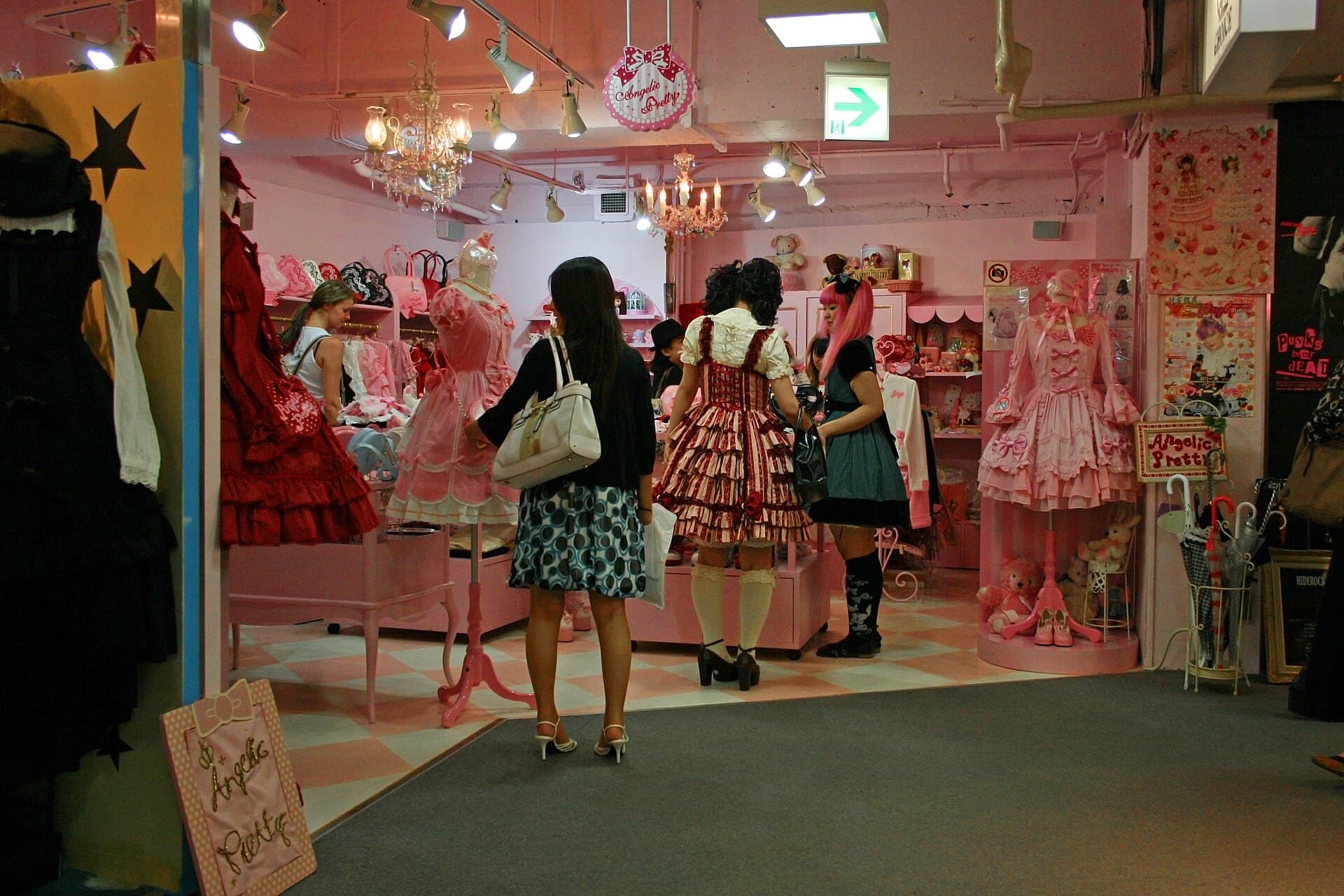
The most recognisable style. Pastel colours, prints of cakes, fruit and cute animals, enormous bows, abundant lace. The aesthetic suggests a sugary childhood world, a wearable patisserie.
Signature labels: Angelic Pretty, Baby, The Stars Shine Bright.
Gothic Lolita (ゴスロリ, gosu-rori)#
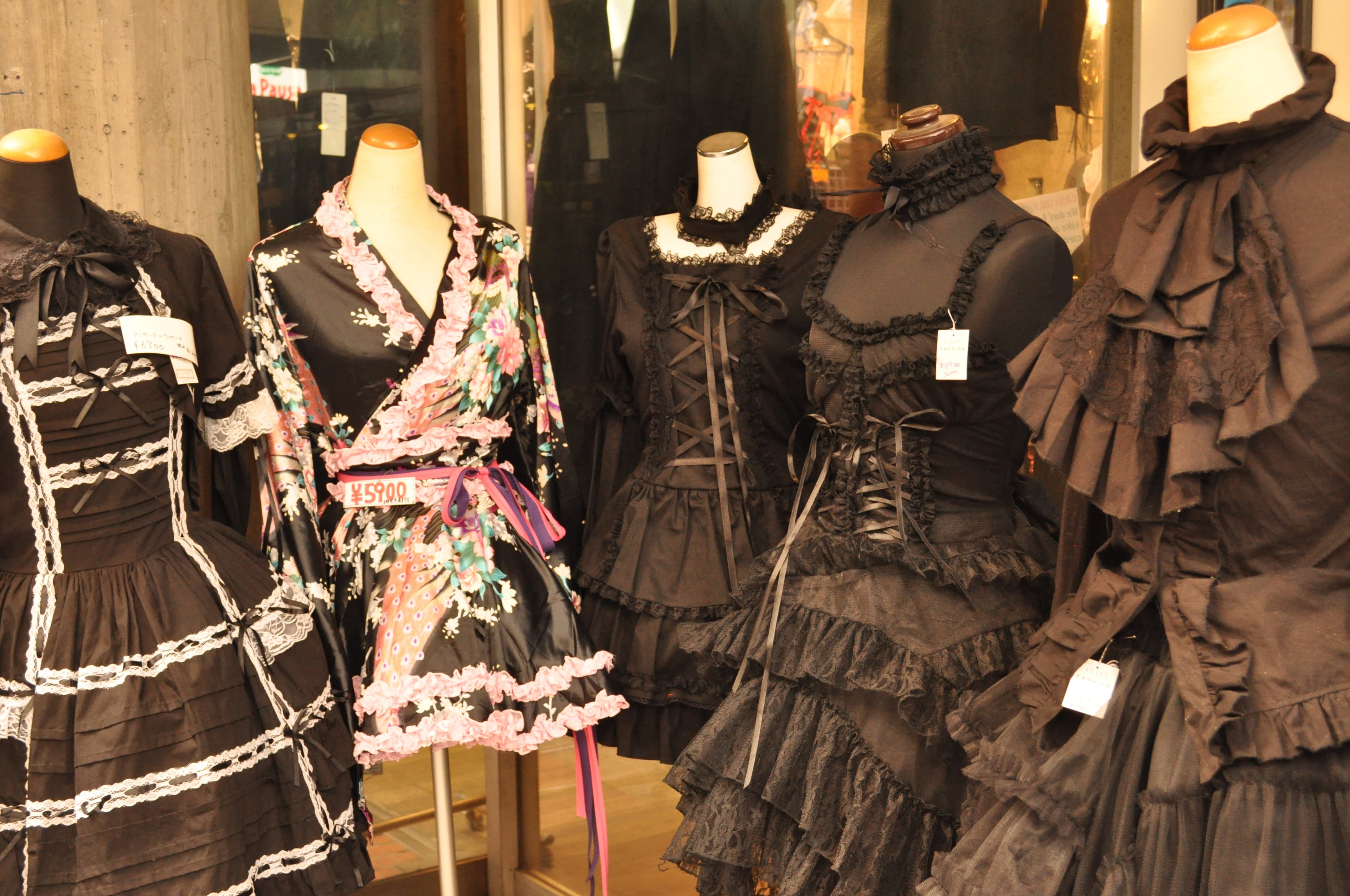
The dark version. Black dominates, sometimes with accents of burgundy, deep purple or white. Crosses, roses, chains, religious or macabre motifs. Western goth influence meets the Lolita silhouette.
Signature labels: Moi-même-Moitié, founded by Mana of Malice Mizer, and Atelier Boz.
Classic Lolita (クラロリ, kura-rori)#
A more mature, restrained version. Neutral or earth colours, elegant floral prints, fewer frills. Victorian and Edwardian inspiration is more direct. It is the most wearable style day to day.
Signature labels: Innocent World, Victorian Maiden, Mary Magdalene.
Other variations#
- : the princess version, with tiaras, elaborate wigs and maximum opulence.
- Ero Lolita: a contested version, shorter and lower cut, which challenges the code of modesty.
- Punk Lolita: fusion with punk aesthetics, tartan, chains, controlled tears.
- : fusion with the kimono, a Lolita silhouette in traditional Japanese fabrics and prints.
- : fusion with the Chinese qipao.
Behind every brand label and every magazine lies a vocabulary to decode: 甘ロリ (ama-rori, "sweet Lolita"), 姫 (hime, princess) or 痛い (itai, "painful", for an outfit that misses). Learn to read those terms in their original script with JapaneseSRS and its spaced repetition, and explore Lolita fashion at the source.
The rules of the style#
Lolita fashion is not an improvised costume. It follows strict aesthetic rules, known and debated within the community.
The silhouette#
The heart of the look is the bell-shaped skirt, supported by a petticoat that creates the characteristic volume. The skirt should reach the knee, no shorter. Shoulders are usually covered. The overall silhouette is that of a doll or a Victorian child.
Coordination#
Every element must be coordinated: dress, headwear (bows, bonnets, tiaras), shoes, bag, jewellery. Colours are harmonised. A badly matched outfit is criticised in the community as ita, painful.
The shoes#
Tea party shoes with straps, rocking horse shoes with their curved wooden soles, adopted from Vivienne Westwood, and Victorian boots are the standards.
Makeup and hair#
Soft makeup, usually focused on the eyes with false lashes and gentle liner. Elaborate hair: curls, pigtails, wigs matched to the outfit. Headwear, whether headbows, mini hats or headdresses, is all but compulsory.
The term describes, in Lolita jargon, an outfit that fails: poor coordination, low quality, or a shallow grasp of the codes. It is the community's ultimate insult, but also a learning tool: you avoid becoming "ita" by studying the rules.
The community#
Lolita fashion is not only a way of dressing: it is a subculture with its gatherings, social codes and internal debates.
Tea parties and meetups#
Lolitas gather at tea parties organised by labels or local communities. These events, often in tea rooms or gardens, are a chance to show off recent purchases and socialise "in coord".
Conventions#
Lolitas appear at anime and manga conventions, but insist on being distinguished from cosplay. Wearing Lolita is not playing a character: it is expressing a personal aesthetic identity.
Social media#
Instagram and TikTok, and before them LiveJournal and Tumblr, structured the worldwide community. Lolita influencers count followers in the hundreds of thousands. The hashtag #lolitafashion gathers millions of posts.
Tensions#
Like any subculture, the Lolita community has its debates: gatekeeping over who may call themselves Lolita, cultural appropriation and whether the style can be worn by non-Japanese people, and commercialisation. Those tensions are part of the movement's life.
Lolita beyond Japan#
What began as a Tokyo niche has become a worldwide movement. Active communities exist in France, Germany, the United States, Brazil and Russia. Western labels and independent makers produce pieces that meet the standards.
The economy of the style is substantial: a Japanese brand dress costs between 200 and 500 euros, a petticoat between 50 and 150, accessories on top. The second-hand market, through platforms such as Lacemarket, is very active. A Lolita may invest several thousand euros in a wardrobe.
Read alsoCosplay: From American Sci-Fi to Japanese Pop Culture PhenomenonAlthough distinct from cosplay, the Lolita movement shares spaces with it (conventions), practices (photoshoots) and an economy (specialist labels, made-to-measure). The two subcultures often cross, even as their members insist on the difference.
FAQ#
Is Lolita fashion connected to Nabokov's novel? No. The Japanese term evokes childhood innocence and doll's clothes, with no sexual connotation. Its followers firmly reject that association.
Can you wear Lolita every day? Some do, especially in the Classic style. But preparation time, the cost of the clothes and the stares in public mean that many keep their outfits for events and weekends.
Do you have to buy Japanese labels? Purists consider Japanese brands such as Angelic Pretty and Baby, The Stars Shine Bright the standard. However, independent makers and Chinese labels now produce pieces of comparable quality, accepted by part of the community.
Are there men in Lolita fashion? Yes. The Ouji (prince) or boystyle look is the masculine counterpart, with breeches, waistcoats and top hats. Men also wear classic Lolita, and the community is generally inclusive on that point.
Photo credits: freely licensed images, Wikimedia Commons.
Lolita substyles: sweet, gothic and classic decoded
How to recognise the three great schools of Lolita fashion, the brands that define them, and why one dress can switch from one to another.
Cover image: Ocdp · Ocdp, via Wikimedia Commons · CC0