Lolita substyles: sweet, gothic and classic decoded
How to recognise the three great schools of Lolita fashion, the brands that define them, and why one dress can switch from one to another.
La rédaction Kotoba Interactive
Studio éditorial
Take a navy blue jumper skirt, flared cut, white lace at the collar. Add a ribboned bonnet, opaque tights and low court shoes: that is classic. Swap the bonnet for a black lace headdress, the tights for fishnets and the shoes for buckled platforms: the same dress has become gothic. Now add printed knee-high socks, a pastel bow in the hair and a heart-shaped bag, and you are among the sweets.
This is the first thing beginners get wrong. The Lolita substyle is almost never decided by the main garment, it plays out in the coordination, what the Japanese community calls コーデ (kōde, short for coordinate). Here is how to read the three major schools, then the dozen or so variants orbiting them.
What a substyle actually designates#
A substyle is a grammar: a colour range, a silhouette, a register of motifs, a type of shoe and a way of doing hair. The dress is only one element of it.
Three abbreviations turn up in every Japanese listing. JSK stands for ジャンパースカート, the sleeveless jumper skirt worn over a blouse. OP stands for ワンピース, the one-piece dress, sleeves included. SK is the skirt alone. Volume always comes from a パニエ (panier, the petticoat), and how much of it you allow determines half the reading of a substyle on its own.
The Japanese names of the three schools are casual contractions: 甘ロリ (ama-rori, "sweet lolita"), ゴスロリ (gosu-rori, from gothic lolita) and クラロリ (kura-rori, from classical lolita). The word ロリータ itself does not point to Nabokov's novel in Japanese usage: it was borrowed for its evocation of a childlike, ornamental femininity, and the community regularly repeats that the style is built against the sexualising gaze, not for it.
Sweet: pastels and the printed story#
Sweet is the most immediately recognisable version, the one the foreign press has photographed for twenty-five years. Its palette holds three shades: baby pink, sky blue, white, with lavender and mint added around the edges.
Its real signature, though, is not colour but the narrative print. A sweet dress tells you something: a circus, a confectioner's, an enchanted library, a bear taking tea. Those motifs are drawn specially, carry a name, and collectors refer to them by that name the way one refers to a painting.
The silhouette is called cupcake, a short and heavily domed skirt achieved with a bell petticoat. Accessories follow the same logic of controlled accumulation: socks matched to the print, a wide headbow, a figurative bag, round strapped shoes.
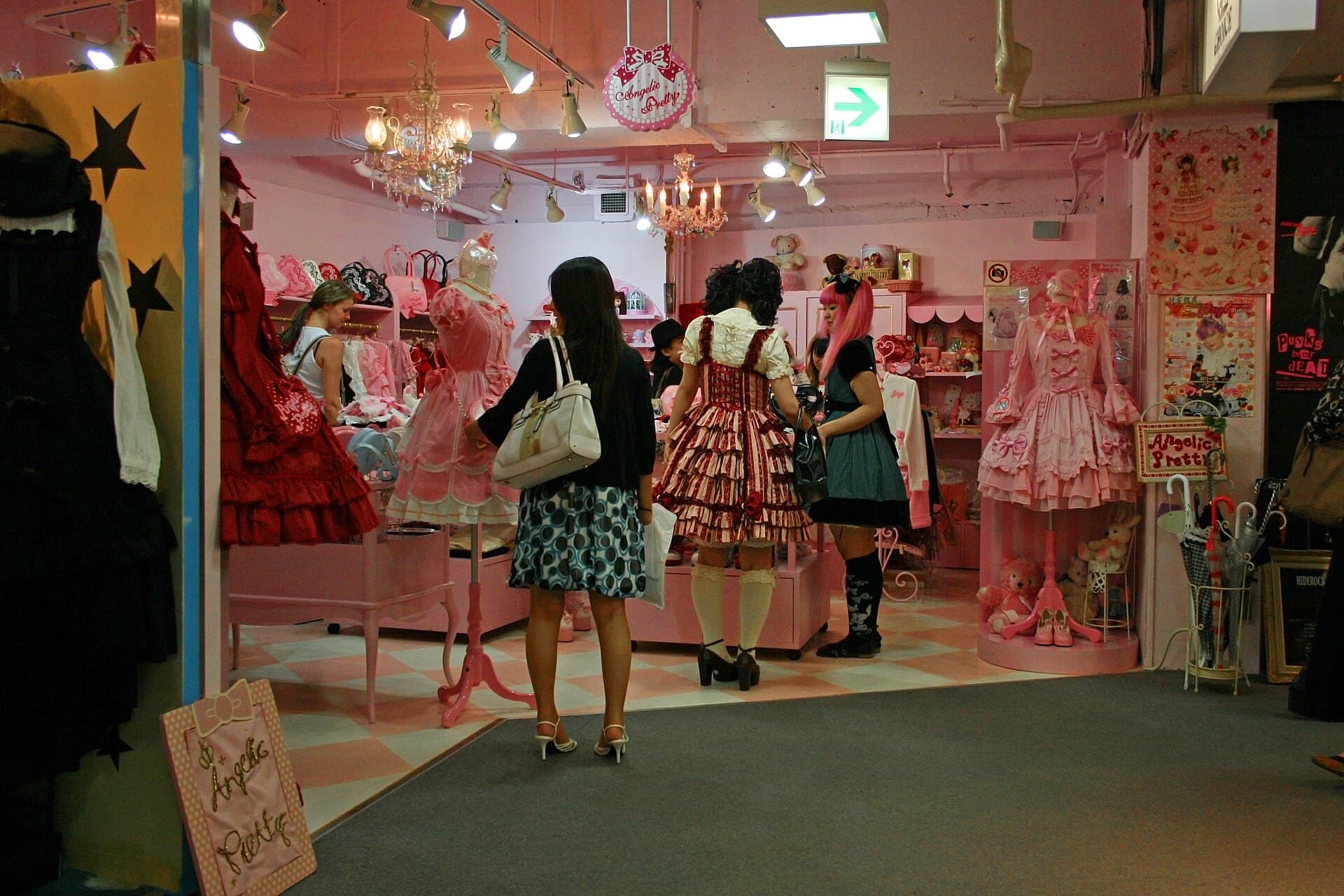
Two houses carry the school. Angelic Pretty, born in 1979 as Pretty and renamed in 2001, is its chromatic laboratory, with a historic shop inside Laforet Harajuku. Baby, The Stars Shine Bright, founded in 1988 by Akinori and Fumiyo Isobe, holds the softer, more romantic wing of the register.
Gothic: black is only the starting point#
Gothic lolita grew out of the meeting between Lolita fashion and the Japanese gothic scene of the 1990s, itself fed by visual kei. Its palette starts at black and moves up through burgundy, deep purple and off-white, used as contrast rather than as ground.
The difference from sweet is not only chromatic. Motifs abandon childhood narrative for the emblem: crosses, roses, stained glass, bats, heavy crocheted lace, velvet. The silhouette lengthens, the skirt drops, the petticoat flattens into an A-line. Shoes gain a platform, and make-up commits to a dark eye the other two schools avoid.
One person structured this vocabulary: Mana, guitarist of Malice Mizer, who founded the label Moi-même-Moitié in 1999 and coined the expressions Elegant Gothic Lolita and Elegant Gothic Aristocrat. The brand's name, "myself" and "half", states the logic of doubling that runs through his whole aesthetic.
Gothic lolita does not borrow from Western mourning: it borrows from a Japanese idea of elegance that refuses the light.
Classic: the school that ages best#
Classic aims at the garment rather than the character. Its colours are muted, burgundy, plum, forest green, ivory, navy, and its motifs come from European ornament: bouquets, rococo frames, wallpapers, library scenes.
Proportions change everything. The skirt reaches the knee or passes it, the petticoat stays discreet, and the cut draws more on the Empire dress and eighteenth-century costume than on cake. A bonnet, short gloves and low-heeled shoes complete a silhouette you could wear to an office in some cities without drawing a glance.
Innocent World, founded in Osaka in the late 1990s by Yumi Fujiwara, is its reference point, alongside Victorian Maiden and Mary Magdalene on the most historicist wing. It is also the substyle many wearers migrate toward after ten years of practice, something the English-speaking community calls ageing into classic.
| Criterion | Sweet (甘ロリ) | Gothic (ゴスロリ) | Classic (クラロリ) |
|---|---|---|---|
| Palette | Pastels, pink, sky blue | Black, burgundy, purple | Muted shades, floral |
| Motifs | Narrative prints, sweets, bears | Crosses, roses, stained glass | Bouquets, rococo, solids |
| Silhouette | Cupcake, short domed skirt | A-line, long skirt | Soft line, knee and below |
| Shoes | Round, strapped | Platforms, buckles | Low court shoes, ankle boots |
| Hair | Curls, wide bow | Sleek or waved, lace headdress | Chignon, bonnet |
| Landmark brands | Angelic Pretty, BABY | Moi-même-Moitié, Atelier Pierrot | Innocent World, Victorian Maiden |
Japanese shops and marketplaces display almost nothing in English. Three words are still enough to navigate them: 甘ロリ (ama-rori, sweet), ジャンパースカート (janpāsukāto, the jumper skirt) and 中古 (chūko, second-hand). JapaneseSRS, our spaced-repetition app, installs that vocabulary and opens up Harajuku listings without a translator.
The variants orbiting the three#
and are not schools but constraints: all white for one, all black for the other, monochrome coordination down to the shoes. They are often worn as a pair, at meet-ups and photo sessions.
pushes classic toward the court: crowns, heavy lace, voluminous hair. plays on the contrast between a white dress and fake stained bandages, a broken-doll aesthetic inherited from Japanese underground theatre.
grafts the kimono onto the Western silhouette: wide sleeves, obi worn high, traditional Japanese motifs. Punk lolita adds tartan, safety pins and chains. Country goes for gingham, straw and a basket. Sailor borrows the sailor collar from the school uniform.
Finally, is the masculine or androgynous wing of the wardrobe: short breeches, waistcoat, ruffled shirt, ankle boots. It is also called boystyle, and it is worn by women as readily as by men, which makes it one of the most open spaces in the subculture.
The film that made Lolita known outside Japan is Kamikaze Girls (下妻物語, Shimotsuma monogatari), released in 2004 under the direction of Tetsuya Nakashima, adapted from Novala Takemoto's 2002 novel. The heroine's outfits came from BABY, The Stars Shine Bright, and the brand saw foreign customers pour in over the following months.
Where the fashion stands today#
The 2010s were rough. FRUiTS, the street fashion magazine that had documented Harajuku since 1997, stopped publishing in 2017; the same year KERA, launched in 1998, ended its print edition after nineteen years and moved online, and the Gothic & Lolita Bible, published since 2001 by Index Communications at the initiative of former KERA editor Mariko Suzuki and backed from the start by Mana, went on hiatus.
That Japanese retreat came paired with expansion abroad. Communities in Europe, North America, Brazil and China took over, with their own tea parties, second-hand sales and local brands. Chinese production in particular now supplies a large share of the outfits worn worldwide, at prices unrelated to the 40,000 yen of a Japanese printed dress.
The clearest sign of a return is on the street itself: in December 2025, the eyewear chain Zoff opened a shop on Takeshita-dōri in Harajuku called Zolita TOKYO, devoted entirely to frames designed for Lolita coordination. A mass-market brand does not give an address over to a niche substyle for an audience that is disappearing.
Read alsoCosplay: From American Sci-Fi to Japanese Pop Culture PhenomenonThe other Japanese practice of dressing as an image, its history and its codes, often confused with Lolita and quite distinct from it.
What these three schools share comes down to one sentence: they dress a body to remove it from ordinary view, with a sartorial discipline few subcultures have sustained for so long. A substyle is not a shop label, it is the dialect you choose to speak.
Read alsoGyaru: The Japanese Fashion Subculture That Defied ConventionThe other great subculture born on Tokyo's streets, at the exact aesthetic opposite of Lolita.
FAQ#
What is the difference between gothic lolita and goth? Gothic lolita keeps the Lolita silhouette, petticoat included, and its decorative register owes as much to rococo as to dark romanticism. Western goth imposes neither skirt volume nor coordination rules as strict.
How much does a full Lolita outfit cost? From a leading Japanese brand, a new printed dress runs between 25,000 and 45,000 yen, plus blouse, petticoat, shoes and accessories. The second-hand market and Chinese brands divide that budget by three to five.
Can you mix two substyles? Yes, and many outfits live on the borders. The community simply distinguishes readable mixes, such as a classic with gothic accents, from coordinations that lose all coherence of silhouette.
Is ouji only for men? No. Prince style is worn by anyone, and a significant share of its Japanese practitioners are women. It works as the androgynous counterpart of the Lolita wardrobe, not as its exclusively masculine version.
Do you need a petticoat for every outfit? For very nearly all of them, yes. It is the piece that creates the silhouette, and its absence is the first thing the community notices, before any question of colour.
Photo credits: the images in this article come from Wikimedia Commons and are under free licences.
Gyaru: The Japanese Fashion Subculture That Defied Convention
A complete guide to gyaru (ギャル): from Shibuya's kogal girls to ganguro, the history of a rebellious Japanese subculture, its styles, its magazines, and its lasting influence on global fashion.
Cover image: Christian Kadluba · Christian Kadluba, via Wikimedia Commons · CC BY-SA 2.0