Chinese Hotpot: The Bubbling Feast That Unites China
From fiery Sichuan broth to delicate Cantonese stock, Chinese hotpot is far more than a meal. Explore the history and traditions of China's ultimate communal feast.
La rédaction Kotoba Interactive
Studio éditorial
Night falls over Chongqing, and a red steam pours through the open doors of thousands of restaurants. Sunk into the center of a stainless-steel table, a pot bubbles: a blood-red liquid coated in oil where dried chilies, Sichuan peppercorns, star anise, ginger, and garlic float together. Around it, six friends dip their chopsticks in to pull out marbled beef, tripe, duck throat, tofu, enoki mushrooms, and noodles. Welcome to the world of , Chinese hotpot: a culinary ritual more than a thousand years old that feeds and gathers a nation of 1.4 billion people.
Hotpot is not just a dish but a way of life with no chef: every diner is their own cook, and the pot a canvas where each person composes their meal. From Chongqing to Beijing, Canton to Yunnan, Inner Mongolia to Taiwan, it comes in dozens of regional variations, each claiming its own legitimacy and history.
A Thousand Years of Broth: The History of Huoguo#
From Bronze Cauldrons to Spinning Tables#
The idea of cooking food in a shared pot of boiling liquid is as old as Chinese civilization. Archaeologists have unearthed ritual bronze cauldrons called dating to the Shang dynasty (1600-1046 BCE), some bearing traces of meat and bone broth. These objects of power were used in sacrificial banquets offered to ancestors, where beef, mutton, pork, and game simmered together. Diners did not serve themselves, but the principle of a shared broth was already in place over three thousand years ago.
The earliest explicit accounts of shared cooking date to the Eastern Zhou dynasty (770-256 BCE). The Liji (礼记, "Book of Rites"), compiled during the Warring States period, describes banquets where nobles dipped pieces of meat into vessels of boiling broth placed at the center of the table.
It was under the Song dynasty (960-1279) that the concept took shape with the , the "ancient pot," in which ingredients cooked in simmering broth at the table. The name is thought to be onomatopoeic, mimicking the "gu-dong" sound of bubbling broth. The poet of the Southern Song dynasty (1127-1279) describes in his treatise Shanjia Qinggong (山家清供) a preparation called : thin slices of rabbit cooked in boiling broth and seasoned with soy sauce, vinegar, and ginger, a direct ancestor of hotpot.
Legend has it that Mongol cavalrymen, during their 13th-century conquests, boiled mutton in their upturned helmets over campfires. Probably a myth, but it speaks to the nomadic origins of one major branch: Mongolian hotpot, which developed in northern China and became one of the most refined dishes of the imperial court.
Hotpot experienced its first golden age under the Qing dynasty (1644-1912). The Manchu emperors brought to Beijing the , a lamb hotpot of aristocratic elegance. Emperor , a great gourmand, was a devoted enthusiast. In 1796, to celebrate his abdication in favor of his son, he hosted the , at which 1,550 hotpots were served to over five thousand elderly dignitaries from across the empire, one of the largest banquets in history.
The Rise of Sichuan and Mala#
While northern hotpot had conquered the palaces, it was in the southwest, along the Yangtze, that the fieriest version would be born: Sichuan hotpot, defined by the flavor, a unique combination of numbing and spicy heat that has become the signature of an entire region.
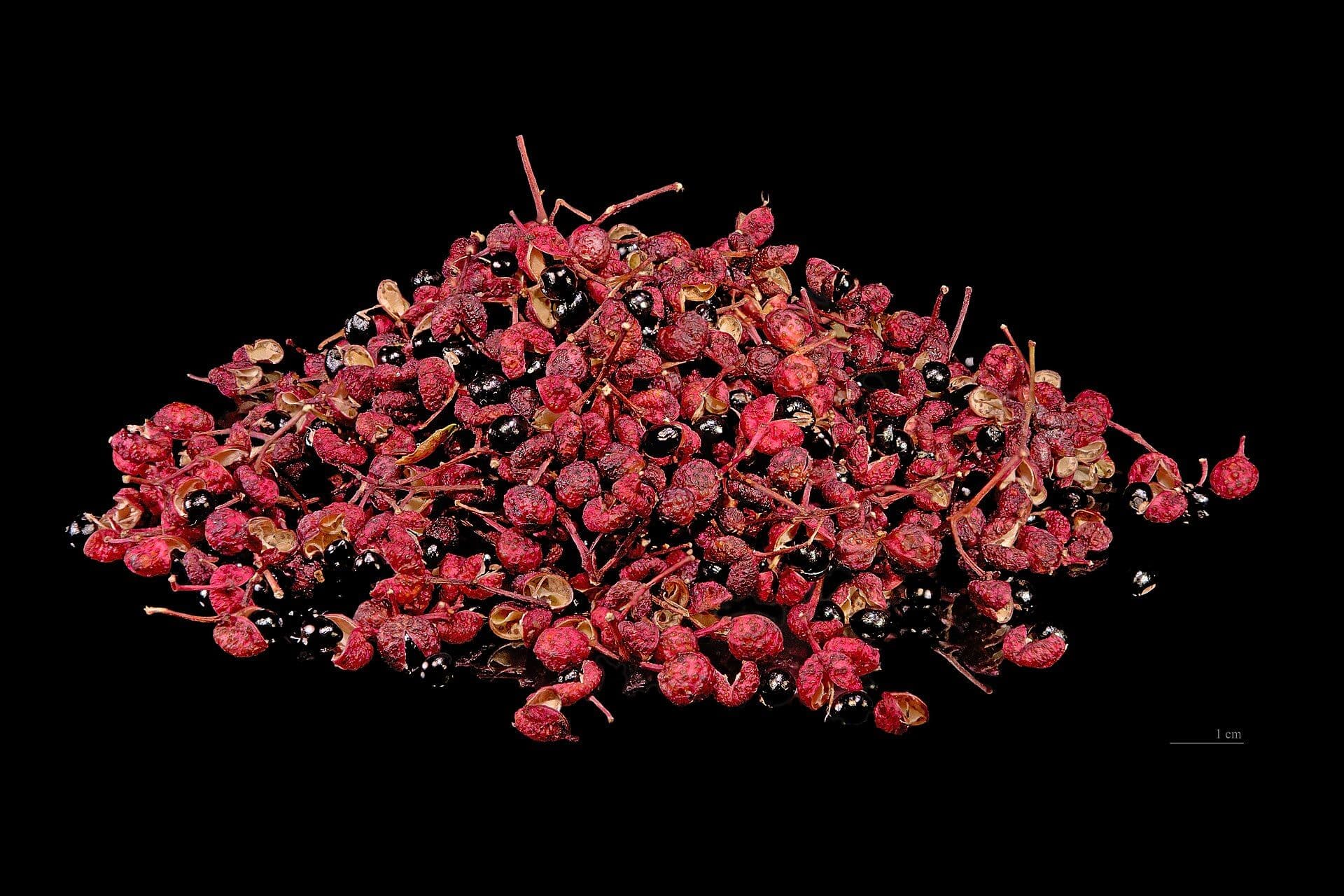
Mala rests on two ingredients. , Sichuan peppercorn, a reddish-brown berry from the citrus family (not a true pepper), produces a vibrating numbness on the tongue, the . , the chili pepper, which arrived in China from the Americas via Portuguese and Spanish trade routes in the 16th century, provides the , the burning heat. The combination of these two sensations creates an experience simultaneously painful and addictive.
Sichuan hotpot was born on the docks of the Yangtze in Chongqing (then part of Sichuan province, now an autonomous municipality) in the early 20th century, probably in the 1920s or 1930s. Dock workers and porters salvaged the offal and cuts that butchers could not sell. Plunged into a violently spiced broth, these strong, tough pieces were masked by the chili and tenderized by prolonged simmering, while the heat of the spices warmed bodies in Chongqing's damp, cold winters.
From a survival food, Chongqing hotpot became a cultural phenomenon. Specialized restaurants opened in the 1940s and 1950s in Chengdu and across Sichuan. The Cultural Revolution (1966-1976) stalled its rise, but from the 1980s onward, with economic opening, Sichuan hotpot exploded and conquered all of China, from Guangdong to Manchuria. Today, Chongqing alone has more than 50,000 hotpot restaurants.
The Great Regional Traditions#
China is a culinary continent, and each region has developed its own version of hotpot, adapted to its climate, produce, medical traditions, and threshold for chili heat. Here are the four great families.
| Tradition | Broth | Star ingredient | Flavor profile |
|---|---|---|---|
| Sichuan and Chongqing | Red (红汤, hóngtāng), tallow and chili | Beef tripe (毛肚, máodù) | Mala (麻辣): numbing and burning |
| Beijing | Clear copper pot (铜锅, tóngguō) | Rinsed lamb (涮羊肉, shuàn yángròu) | Pure, gentle, all in the sesame sauce |
| Canton and the South | Clear consomme (清汤, qīngtāng) | Live seafood (鲜味, xiānwèi) | Delicate, medicinal, tonifying (补, bǔ) |
| Yunnan | Mushroom broth (菌汤, jūntāng) | Wild mushrooms (菌, jūn) | Woody umami, earthy, forest-like |
Sichuan and Chongqing: The Reign of Mala#
Sichuan hotpot is a sensory assault. Its red broth, the , starts with melted down, into which one fries , , dried chilies, garlic, ginger, , , , , , , and sometimes up to twenty other spices. This mixture cooks slowly into a dark red paste called the , then diluted in bone broth.
One of the features of Chongqing hotpot is the . The pot is divided into nine compartments by a metal grid, creating zones of different temperatures. The center, above the flame, boils furiously for thick pieces; the outer squares, calmer, suit delicate ingredients.
The Chongqing style, rawer, oilier, and wilder (beef tallow reigns supreme, the chili sometimes terrifying), must be distinguished from the Chengdu style, more refined and balanced: vegetable oil sometimes replaces tallow, spices are measured with subtlety, and the broth lets you taste the individual flavors.
, with its rough texture, is the king of the table: dipped for seven to eight seconds, it emerges crunchy and fragrant. cooks in a few seconds with an elastic texture. , , and round out the table.
Beijing: Mongolian Lamb Hotpot#
Thousands of miles to the north, Beijing hotpot offers a striking contrast. No red broth, no chili: is an exercise in purity.
The pot itself is a work of art. The , of hammered red copper, is topped with a central chimney in which charcoal burns, a northern nomadic design that keeps the broth at a constant temperature. The broth is staggeringly simple: water, a few slices of ginger, goji berries, dried jujubes, perhaps a green onion. The flavor comes entirely from the quality of the lamb and the dipping sauce.
The lamb, traditionally from Inner Mongolia, is sliced to extreme thinness. So thin they are nearly translucent, the slices cook in two to three seconds: you "rinse" them in the boiling water with a quick flick of the wrist, hence the verb . The meat, barely seared, retains all its tenderness.
The dipping sauce, , is the soul of Beijing's shuan yangrou. Thick, creamy, tasting of toasted hazelnuts, it is enriched with , scallion, cilantro, chili oil, and sometimes Chinese chive blossom. Every restaurant has its own recipe.
The most famous shuan yangrou restaurant in Beijing is , founded in 1903 by a Hui Muslim named . Located near Wangfujing Street, it survived every upheaval of the 20th century without ever closing and remains the definitive reference for shuan yangrou today.
Canton and the South: The Finesse of Clear Broth#
In the south, in Guangdong, the culinary philosophy is the polar opposite of Sichuan. Cantonese cuisine, renowned for the purity of its flavors and its respect for freshness, has developed a hotpot that is delicate, subtle, almost medicinal.
The , or Cantonese hotpot, is built on a , a limpid consomme of pork bones, chicken, sometimes fish, simmered for hours with ingredients from traditional Chinese medicine: jujubes , goji berries , dried longan , Chinese yam , lotus root. Golden and translucent, this broth is designed to nourish as much as to heal: eating a clear-broth hotpot is an act of , a gesture of care toward one's own body.
The ingredients reflect the proximity of the sea: live shrimp, rock fish, oysters, clams, and squid sit alongside vegetables of impeccable freshness. Fish is sometimes brought to the table alive, killed and cut in front of diners. This obsession with freshness, summed up in the word , reaches its apex in hotpot.
Yunnan: Wild Mushrooms and Mountain Herbs#
In Yunnan province, hotpot takes on an almost mystical dimension. Yunnan is a mycological paradise: more than 800 species of edible mushrooms grow in its mountain forests, from porcini and matsutake to endemic species found nowhere else.
The is a hymn to this wealth. The broth simmers for hours from dried and fresh wild mushrooms, creating an amber liquid of staggering umami depth. Into it go seasonal mushrooms, slices of Yunnan black chicken (a local breed with black flesh and bones, prized for its medicinal properties), wild herbs, and local tofu, for a result of extraordinary finesse, with woody, earthy flavors that evoke a forest after rain.
The black chicken and medicinal herb hotpot, , pushes the link between cooking and pharmacopoeia further: ginseng, Chinese angelica , astragalus , and other roots make it a "meal-as-remedy." This tradition is a reminder that for the Chinese, the line between food and medicine is porous. Did the great Tang dynasty physician not say that "he who does not know how to eat does not know how to live"?
In a Yunnan broth, the mushrooms tell stories of mountains, rain, and forest floors. Every sip is a walk through the woods with your eyes closed, a conversation between the earth and the one it feeds.
The Art of the Broth#
The broth, or , is the soul of hotpot. Without a good guodi, the finest ingredients are nothing but a jumble of flavors drifting in hot water. So when the Chinese choose a hotpot restaurant, the first question is always "How is the guodi?"
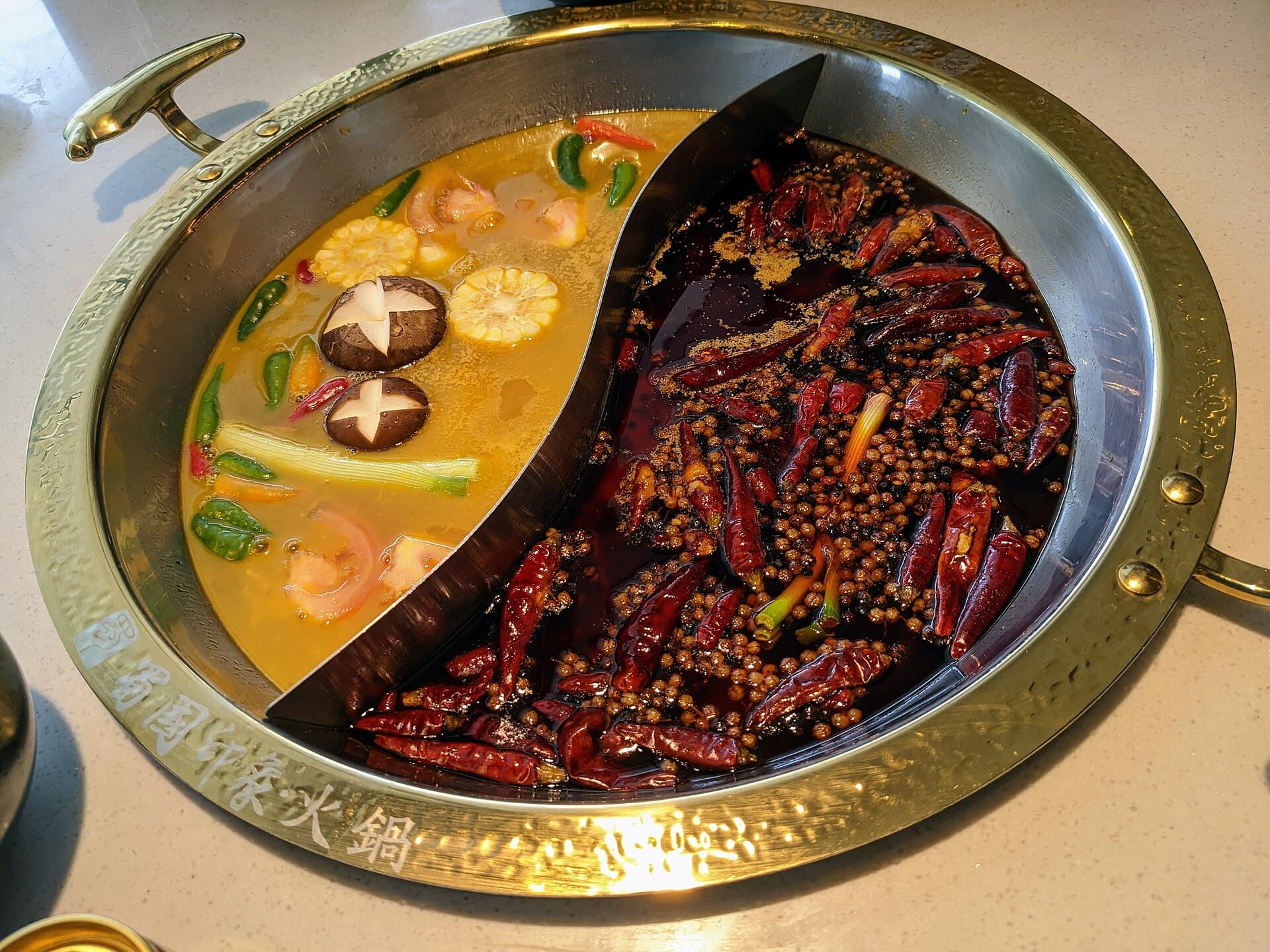
The most popular concept is the , divided in two by an S-shaped divider: on one side the spicy red broth, on the other the clear white broth. Mandarin ducks, symbols of conjugal love, lend their name to this pot whose two halves form an inseparable whole: a diplomatic compromise that lets mala lovers and sensitive stomachs coexist at the same table.
Preparing a Sichuan red broth demands patience. Beef tallow is clarified and melted, then spices and aromatics are added in a precise order. from Pixian, fermented for at least one year, brings complex heat and umami; , added near the end, preserves its volatile aroma. contributes licorice-like notes, roundness, a smoky depth, an anise touch, and is used sparingly. Every master guards the secret of their proportions: a single gram can transform the balance.
Beyond flavor, the broth follows the principles of traditional Chinese medicine, dominated by the concept of . Each ingredient has its properties: ginger warms the body and expels dampness, jujubes nourish the blood, goji strengthens the kidneys and eyesight, astragalus boosts . Even the red broth has its logic: in Sichuan's humid climate, warming spices are believed to expel internal dampness and stimulate circulation.
Temperature itself is a subject of debate. The Chinese distinguish the moment when the broth "smiles," , with small bubbles rising gently, from the moment it "laughs out loud," boiling vigorously. Thin meat slices and duck intestine can only take a few seconds in a "laughing" broth; radish, potatoes, and cartilage need a long soak in one that "smiles."
Just explored the world of 火锅 (huǒguō, fire pot)? Learn to order in Chinese and read dozens of everyday words, from 辣 (là, spicy) to 鲜 (xiān, freshness), with ChineseSRS and its spaced repetition.
The Hotpot Table: Ingredients and Rituals#
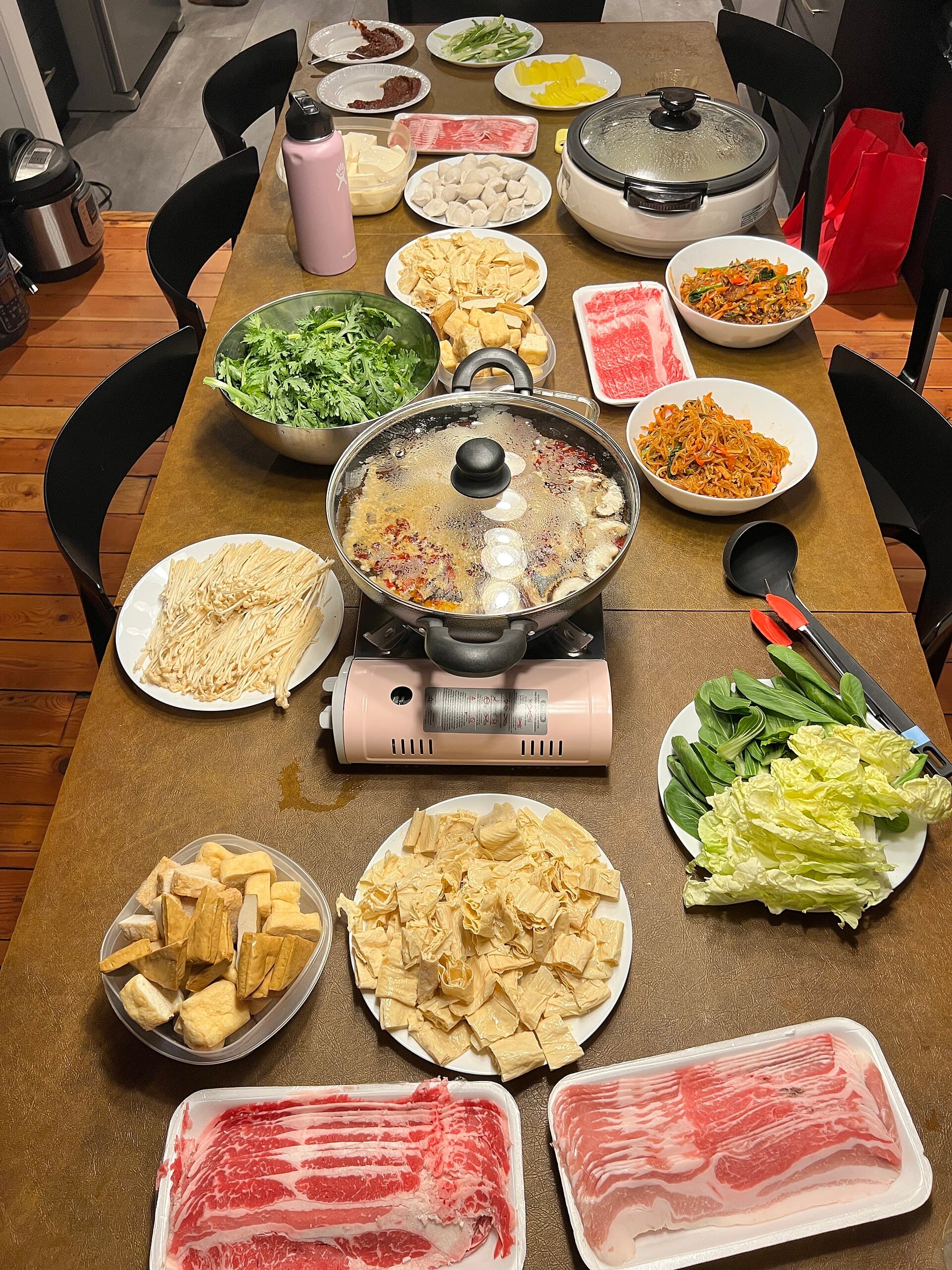
A hotpot dinner is a spectacle: the table fills with dozens of plates, small dishes, and sauces, every category of ingredient having its place and its moment.
Meats arrive first. , sliced so thin its marbling forms pink and white arabesques, is the most ordered ingredient in China. , in rolled slices, is inseparable from northern hotpot. Offal, the glory of Chongqing, holds a place of honor: , , , , , each requiring a different cooking time.
Vegetables form the second wave. Lotus root , in chambered rounds, absorbs the broth and develops a crunchy, sweet texture. Chinese cabbage , spinach, lettuce, and winter melon bring freshness and lightness. Enoki mushrooms , oyster mushrooms, and shiitake complete the vegetable tableau.
Tofu, in all its forms, is a pillar: fresh tofu , silky; fried tofu , spongy; tofu skin , thin as parchment; frozen tofu , whose honeycomb structure absorbs prodigious amounts of broth. Coagulated duck blood , in dark red cubes, is a Sichuan specialty that regulars devour with passion.
Noodles come at the end of the meal, when the broth has been enriched by all the previous flavors. , translucent, capture broth in their folds; , thick and gelatinous, are the Sichuan favorite. Some restaurants also offer fresh wheat noodles or rice, cooked in the concentrated broth for a final soup of extraordinary richness.
Sauces: The Expression of Self#
If the broth is the collective soul of hotpot, the individual dipping sauce is its personal expression. Each diner assembles THEIR sauce from a buffet of condiments, and that choice reveals a great deal about their regional origins.
In Chongqing, tradition is radical: a bowl of pure sesame oil with a few crushed cloves of raw garlic. The smooth oil counterbalances the violence of the red broth and shields the mouth from the burn; garlic, a natural antibacterial, acts as health insurance. Purists look with condescension at anyone who adds anything else.
In Beijing, sesame paste is king, enriched with fermented tofu , Chinese chives, cilantro, and chili oil. In the south, light soy sauce , with fresh chili, scallion, and sesame oil, accompanies seafood and vegetables with restraint.
Some modern restaurants offer dozens of condiments: oyster sauce, Chinkiang black vinegar, shrimp paste, crushed peanuts, toasted sesame, garlic, ginger, cilantro, XO sauce. Building your sauce becomes a creative act, and debates over the "best combination" are part of hotpot's social pleasures.
The Order of Cooking#
Hotpot has its unwritten rules, which every Chinese person absorbs from childhood. You start with meats, whose fats enrich the broth. Offal comes next, its quick cooking demanding broth at a full boil. Then vegetables, which absorb the accumulated flavors. Noodles come last, to take advantage of a broth that has become a concentrate of every flavor.
The technique of is the first lesson. To cook a slice of meat to perfection, you dip it and lift it seven or eight times in succession: briefly seared with each immersion, it cooks evenly without toughening.
Managing the heat is a collective responsibility. The broth must never overflow, since spilled fat could catch fire. When the level drops, you add hot broth (never cold); when scum collects, you skim it off with a strainer. These instinctive gestures are the small liturgies of a ritual that transforms a meal into a shared experience.
Haidilao and the Modern Hotpot Revolution#
The story of contemporary hotpot cannot be told without , the chain that revolutionized the restaurant industry in China and beyond.
Haidilao was founded in 1994 in , Sichuan, by , a former tractor factory worker who was twenty-three. With 8,000 yuan (roughly $1,000 at the time) and four tables, he opened an unremarkable restaurant. What set him apart was not his broth, decent but unremarkable, but his obsession with service: free snacks and manicures during the wait, plastic aprons, hair ties, phone cases. His servers refilled an empty glass before the customer noticed.
This model, revolutionary in a China where restaurant staff were often indifferent, transformed Haidilao into a cultural phenomenon. In 2018, it was listed on the Hong Kong Stock Exchange with an initial valuation of over $12 billion, making Zhang Yong the richest person in Singapore (his tax residency). By 2024, it had more than 1,400 restaurants worldwide, from New York to London, Seoul to Sydney.
The innovation did not stop at service: robot servers, tablet ordering, customizable broths, hand-pulled noodle performances by acrobatic servers, video game rooms in waiting areas. The Haidilao experience has become total entertainment that draws families and young social-media content seekers alike.
At Haidilao, the broth is almost beside the point. What people come for is the joy of being treated like royalty in a palace of steam and chili, the surprise of a server bringing a birthday cake you never ordered, and the certainty that for one evening at least, the world revolves around your table.
The success spawned an army of competitors. , founded in Chengdu in 2014, banks on the authenticity of Sichuan flavor and pure beef tallow. , also from Chengdu, stands out with theatrical presentation. offers "terroir" hotpots with certified locally sourced ingredients. Hundreds of brands compete in a market estimated at over 500 billion yuan (approximately $70 billion) in 2024.
One recent trend is the rise of "solo hotpot." In urban China, where eating alone is no longer taboo, restaurants offer individual mini-pots along counters equipped with tablets. Hotpot adapts to modern solitude without losing its essence: even alone, you are still your own cook, master of your choices.
Hotpot Beyond China#
Chinese hotpot, like tea, silk, and porcelain before it, has crossed borders to take root across Asia and, increasingly, around the world.
In Southeast Asia, the concept has produced fascinating variants. In Thailand, mookata (หมูกะทะ), a hybrid of barbecue and hotpot, is served on a domed plate whose top grills meat while the outer moat cooks vegetables and noodles. In Malaysia and Singapore, the steamboat (a name inherited from British colonial days) is served with a coconut milk broth. In Vietnam, lau reprises the principle with Vietnamese flavors: lemongrass, galangal, fresh chili.
The most famous cousin of Chinese hotpot is Japanese . Imported to Japan in the 1950s, probably by businessmen who had tasted shuan yangrou in Beijing, it gets its name from the onomatopoeia of meat being "swished" in broth. Its broth is a delicate dashi made from kombu (dried kelp), its meats wagyu beef and pork, its sauces ponzu and sesame. Gentler than its Chinese ancestor, it illustrates the Japanese ability to absorb a foreign influence and transform it into something new.
In the West, hotpot has experienced spectacular expansion since the 2010s. Paris, London, New York, Los Angeles, Toronto, and Sydney now count dozens of restaurants, often opened by the Chinese diaspora but attracting a diverse clientele. In Paris, Belleville and the 13th arrondissement house several Sichuan establishments; in New York, Flushing in Queens has become a hotpot destination.
The "hotpot at home" phenomenon has exploded in recent years, accelerated by the 2020 pandemic. Asian supermarkets now sell ready-made guodi packets by Haidilao, Xiaolongkan, and other brands. With pre-sliced frozen meats, noodles, and pre-packaged vegetables, home hotpot has become a popular social ritual that preserves the essence: the pot at the center, friends around it, the freedom to choose your own ingredients.
Local adaptations are sometimes bold. Vegetarian hotpot replaces beef tallow with vegetable oil and bone broth with mushroom or tomato stock. Cheese hotpot, a fusion invention from Taiwan and South Korea, adds a slice of melting cheese that creates a creamy emulsion. Collagen hotpot, popularized in Japan and China, features a cube of collagen-rich gelatinous broth said to beautify the skin.
Hotpot has also become a social-media phenomenon. On TikTok, Instagram, and , videos have racked up billions of views. The simmering broth, the steam, the incandescent color: everything is photogenic, and restaurants now design their presentations for "food content," meats in rosettes and two-tone broths shaped like yin and yang.
But beyond the trends, the deeper reason for hotpot's universal success is simpler: it speaks the language of sharing. With no culinary skill or specialized equipment, all you need is a pot, a flame, fresh ingredients, and people to eat with. This ability to bring strangers together around a shared cloud of steam makes it a universal dish, understood from Chongqing to Chicago, from Canton to Copenhagen.
The next time you sit before a bubbling pot, remember that this gesture has been performed by millions of human beings before you, from the bronze cauldrons of the Shang dynasty to the connected tables of Haidilao. Hotpot is a fire pot, but above all a pot of memory, in which the Chinese art of eating together has been simmering for three thousand years.
In this article
The cultural terms covered here, each with a short definition.
- Chinese hot pot
- Communal Chinese fondue where meats, vegetables and noodles cook in a shared simmering broth.
- Mala
- Sichuan flavor combining chili heat with the tingling numbness of Sichuan pepper.
- Sichuan cuisine
- Chinese cuisine known for its heat and the numbing sensation called "mala."
Why Sichuan eats so much chilli
Chilli has only existed in China since the 16th century. How Sichuan, already famous for its taste for pungency, made it the pillar of its cuisine: migration, climate, economics.
Cover image: Praneeth Thalla · Wikimedia Commons · CC BY-SA 4.0