Capsule Hotels: Born in Osaka in 1979, Designed by Kurokawa
The Japanese capsule hotel: the first one opened in Osaka in 1979 by architect Kisho Kurokawa, the regulated dimensions, Metabolism and the Nakagin Tower, and today's design version.
La rédaction Kotoba Interactive
Studio éditorial
The world's first capsule hotel, the カプセル・イン大阪 (Capsule Inn Osaka), opened on 1 February 1979 in the Umeda district of Osaka. It had around 400 stacked cells on two levels, for men only, and was designed by the architect 黒川紀章 (Kisho Kurokawa), a leading figure of Japan's Metabolist movement.
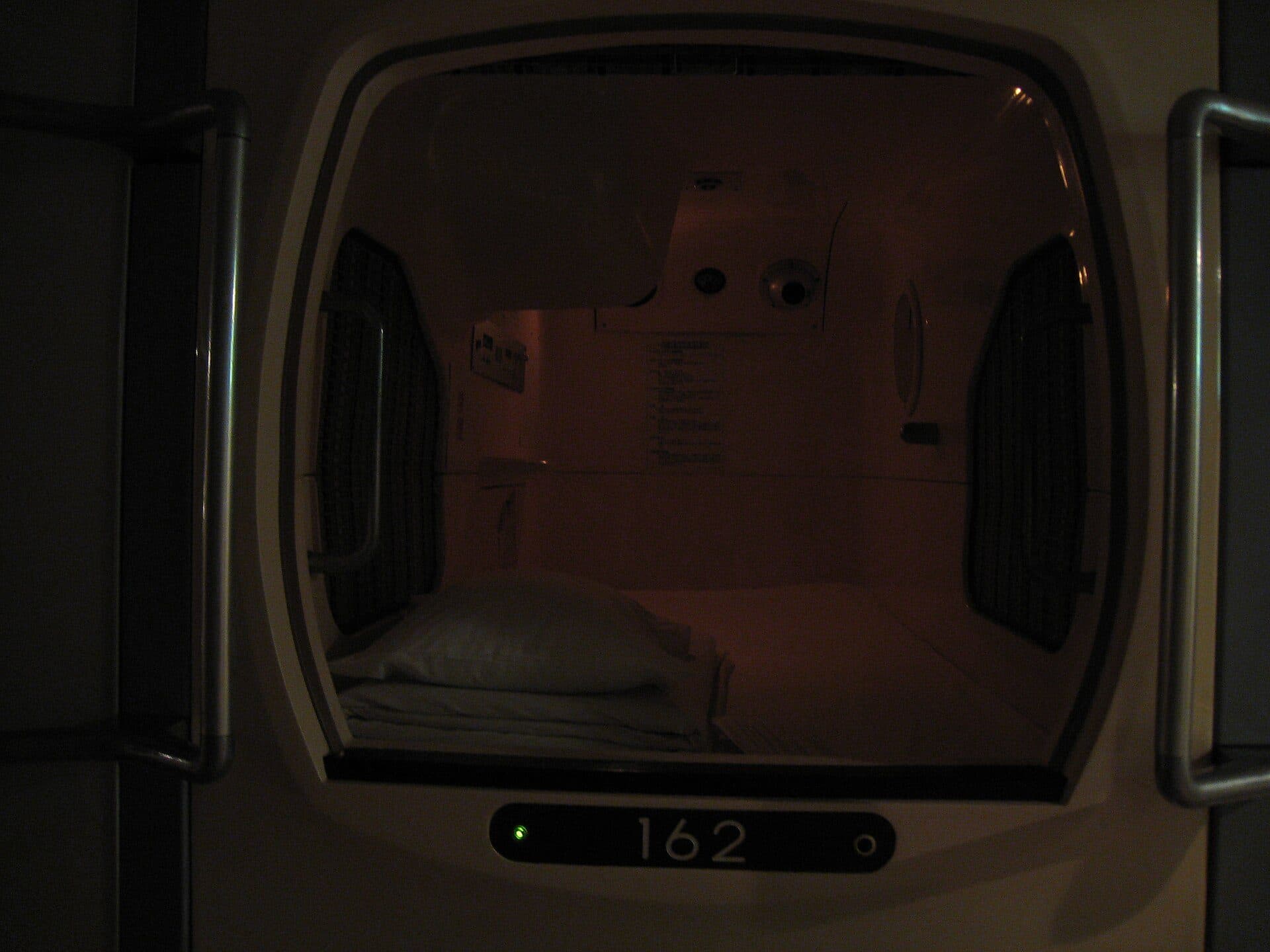
A capsule measures roughly one metre wide, one metre high and two metres deep. It holds a mattress, a light, a socket, often a small screen, and closes with a curtain or a blind: fire regulations prohibit a lockable door.
What the format solves#
The capsule hotel answers a very concrete problem in large Japanese cities: the last train. The rail network stops around midnight, night taxis are expensive, and an evening that runs long leaves an office worker thirty kilometres from home with no way back.
The format is built around that need. A night costs between 2,000 and 5,000 yen, with lockers, shared baths, house yukata, and a departure at dawn straight to the office. The historic establishments sit metres from major stations and drinking districts.
| Element | What you get |
|---|---|
| The capsule | Mattress, night light, socket, screen or radio, curtain or blind |
| The locker | Storage for luggage and clothes, since the capsule does not lock |
| The bath | 大浴場 (daiyokujō), communal bath, sometimes with a sauna |
| Common areas | Lounge, vending machines, light food, rest room |
| The rules | Silence, no luggage in the cabin, usually separation by sex |
The word カプセル is English "capsule" transcribed into katakana. It comes from the vocabulary of 1960s Metabolist architecture, where a capsule means a self-contained living unit, factory-made and plugged into a load-bearing structure, exactly as an organ attaches to a body.
Metabolism, and the tower that never lived#
Kurokawa did not invent the capsule for hotels. He belonged to , the Japanese architectural movement formed around the 1960 exhibition, which conceived the city as a living organism: durable infrastructure onto which replaceable cells are grafted.
Its most famous demonstration is the 中銀カプセルタワービル (Nakagin Capsule Tower), completed in Ginza in 1972: two concrete towers, 140 factory-built capsules bolted on one by one by crane over a few weeks, each with a bed, an integrated bathroom, a telephone and a circular window. The plan called for replacing them every twenty-five years.
That replacement never happened. With no agreement among co-owners and no technical solution, the building deteriorated and was dismantled in spring 2022. Some twenty capsules were saved, restored and dispersed to museums and institutions, including the Museum of Modern Art in New York. The idea survived as a collector's item, not as a construction method.
The hotel capsule is Metabolism's only living descendant. The movement wanted replaceable cities; it left behind stackable bedrooms.
What the law says#
A capsule hotel is not a hotel in Japanese regulatory terms. It falls under the 簡易宿所 (kan'i shukusho, "simplified lodging") category of the Hotel Business Act (旅館業法), alongside dormitories and youth hostels.
The category imposes precise rules: minimum floor area per occupant, ventilation, fire detection, and above all the impossibility of shutting an occupant inside their cell. That is why a capsule never locks, a point that consistently surprises foreign travellers.
The reform of the act that took effect in 2018, aimed at regulating tourist rentals, simplified these categories and made it easier to open small establishments, which the format took advantage of.
Accommodation vocabulary can be learned in an evening and serves a whole trip: 宿 (yado, inn), 大浴場 (daiyokujō, the large communal bath), 素泊まり (sudomari, a night without meals). JapaneseSRS teaches these words with their kanji and readings.
The format's second life#
The format reinvented itself in the late 2000s, when two chains decided to pull it out of its image as a dormitory for tired employees.
ナインアワーズ (Nine Hours), launched in 2009, cuts the stay into the three blocks named in its title: one hour to wash, seven to sleep, one to get ready. The whole thing is designer-made, in white and grey, with an ovoid capsule lit by a gradual wake-up system.
First Cabin, the same year, took the opposite reference: the aircraft cabin, with taller units where a guest can stand, sold as "business" or "first" class.
Three developments followed. Women-only floors, then entirely women-only establishments, opened the format to a clientele largely excluded from it. International tourism adopted it as budget city-centre accommodation. And Japan's enthusiasm for saunas, pronounced since the late 2010s, turned the sauna-plus-capsule pairing into an offer in its own right, where the bath becomes the reason to come and the night an add-on.
Nakagin Tower capsules had a round window, a fixed bed, and a reel-to-reel tape recorder and radio set into a console: the standard equipment of a single 1972 executive, frozen into the furniture of the room itself.
FAQ#
How big is a capsule? About one metre by one metre in section, two metres long. You can sit up in it, not stand, except in recent cabin-style formats.
Can couples or families stay? No. Establishments are usually separated by sex, a capsule takes one person, and luggage stays in the locker.
Do capsule hotels accept foreigners? Yes, very widely, especially the recent chains. A few older establishments admit men only or refuse tattooed guests because of the shared bath.
How much is a night? From 2,000 to 5,000 yen in classic establishments, more in the design chains of the big cities.
Read alsoJapanese Housing: Decoding Mansion, Apāto and the 1K CodeJapanese housing and its formats, from the 1K studio to the "mansion", where the same economy of space appears.
Sources and further reading#
- Capsule Inn Osaka, opened 1979, designed by Kisho Kurokawa
- Nakagin Capsule Tower (1972-2022), archives of the capsule preservation and restoration project
- Japan's Hotel Business Act (旅館業法) and its 2018 revision
- Museum of Modern Art, New York, Nakagin Tower capsule acquired for the collection
Going to a sumo tournament in Tokyo: the practical guide
Tickets, timings, masu-seki boxes, etiquette and the ideal day at the Ryōgoku Kokugikan: everything you need to see a sumo basho in Tokyo.
Cover image: Syced · Syced, via Wikimedia Commons · CC0