Moutai: The Chinese Spirit That Trades Like a Blue Chip
Moutai (茅台), the baijiu of Guizhou: its twelve-month production cycle, its diplomatic role, its Shanghai listing, and why a bottle resells far above its official price.
La rédaction Kotoba Interactive
Studio éditorial
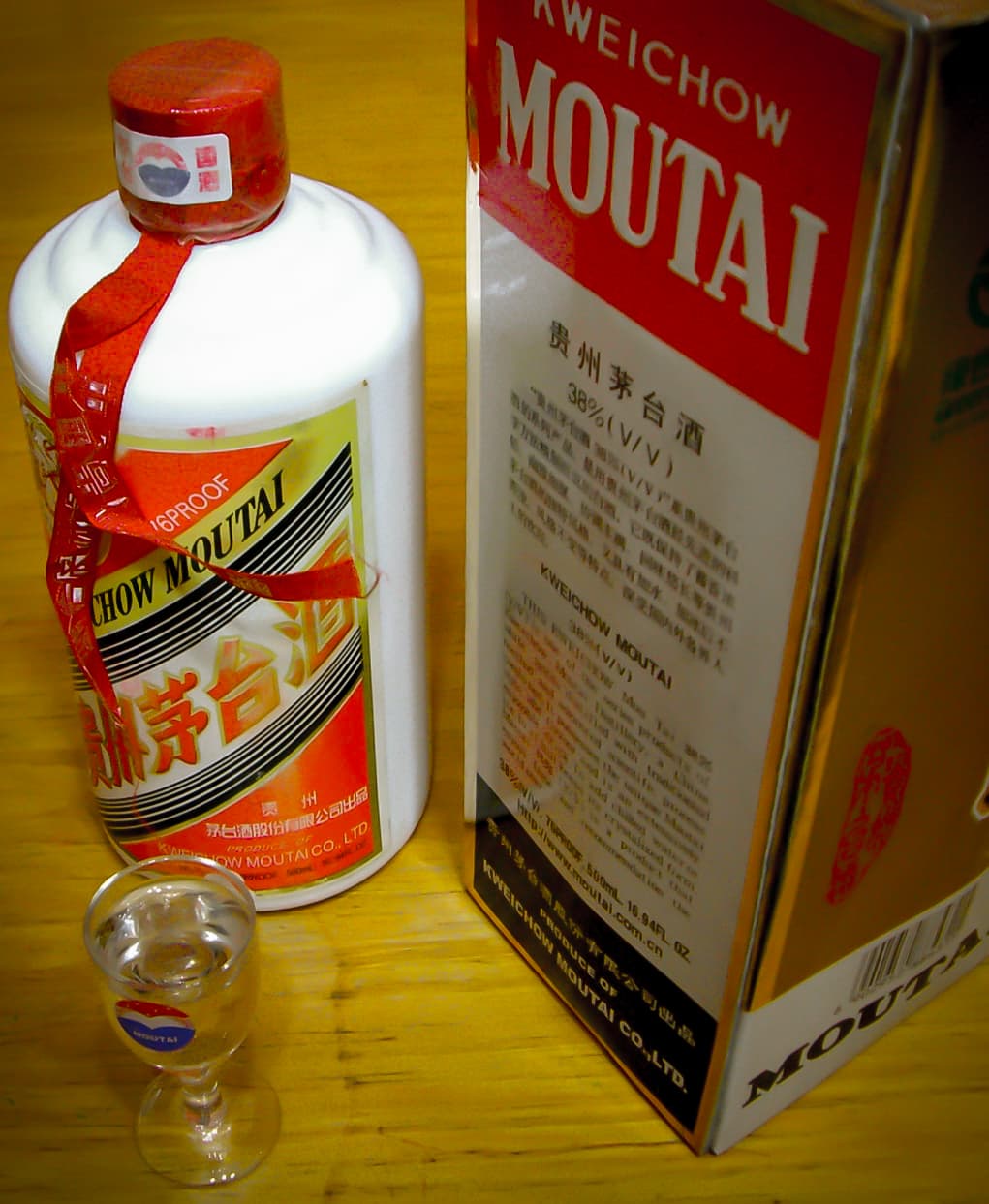
is a Chinese sorghum spirit at 53% alcohol, produced in the town of Maotai, Renhuai county, in Guizhou province. It is a , the category covering Chinese grain distillates, and it belongs to the 酱香型 (jiàngxiāngxíng) family, "sauce aroma", the heaviest and most fermented of the genre's main families.
Its distinctiveness lies less in the taste than in the status. The producer, Kweichow Moutai, has been listed on the Shanghai Stock Exchange since 2001 and has repeatedly ranked among China's largest listed companies, ahead of banks and technology groups.
Twelve months for one year's production#
The process is codified and slow. It starts in September, at the harvest of the local waxy red sorghum, and follows a single annual cycle.
| Stage | What it involves |
|---|---|
| Two grain additions | Sorghum is added in two batches, a month apart |
| Nine steamings | The grain is re-steamed at each round |
| Eight fermentations | In stone and clay pits, with a wheat starter, the 大曲 |
| Seven spirit draws | Each distillation yields a different spirit, kept separately |
| Ageing | At least three years in earthenware jars, before blending |
| Blending | Several hundred lots combined to recover the house profile |
A bottle therefore leaves the distillery about five years after the grain went in. That duration explains part of the scarcity: today's production was decided five years ago, and no sudden demand can increase it.
白酒 (báijiǔ), literally "white alcohol", covers all Chinese grain spirits and has nothing to do with white wine. 酱香 (jiàngxiāng), "sauce aroma", refers to the fermented note recalling soy sauce, the marker of the Maotai style. The other main families are 浓香 (thick aroma) and 清香 (light aroma).
Terroir, and the experiment that tested it#
The producer maintains that its spirit can only be made at Maotai, because of the water of the Chishui river, the valley's microclimate and the yeasts living in the workshop walls. The argument sounds like marketing. It was nonetheless tested.
Between 1975 and 1985, a state experiment tried to reproduce Moutai elsewhere in Guizhou, at Zunyi: the same master distillers, the same sorghum, the same starter, the same process, down to soil carted from Maotai. The result, judged good but different, was never sold under the Moutai name. It still exists, under another brand.
From the diplomatic table to the stock exchange#
Moutai owes its national standing to official use. Served at state banquets from the 1950s, it accompanied the toasts of foreign visits, including the dinner given for Richard Nixon in 1972, the episode that put the name into the Western press.
The brand long presented itself as the national liquor, a claim it eventually dropped in 2019 after intellectual property authorities repeatedly refused to register the phrase.
Its stock market trajectory is the other side. Listed in 2001, the share passed 2,000 yuan, the highest quotation on the mainland market, and the company's capitalisation exceeded several trillion yuan at the 2021 peak. The stock became an indicator: when Chinese high-end consumption slows, it falls before the others.
A bottle of Moutai is not only a spirit. It is a gift, a store of value and a barometer of Chinese spending, in an order that changes with the period.
Chinese banquet vocabulary can be learned in one evening and lasts a lifetime: 白酒 (báijiǔ, white spirit), 干杯 (gānbēi, "empty the glass"), 敬酒 (jìngjiǔ, to toast someone of higher rank). ChineseSRS teaches these words with their characters and their pinyin.
The price, and the gap with the price#
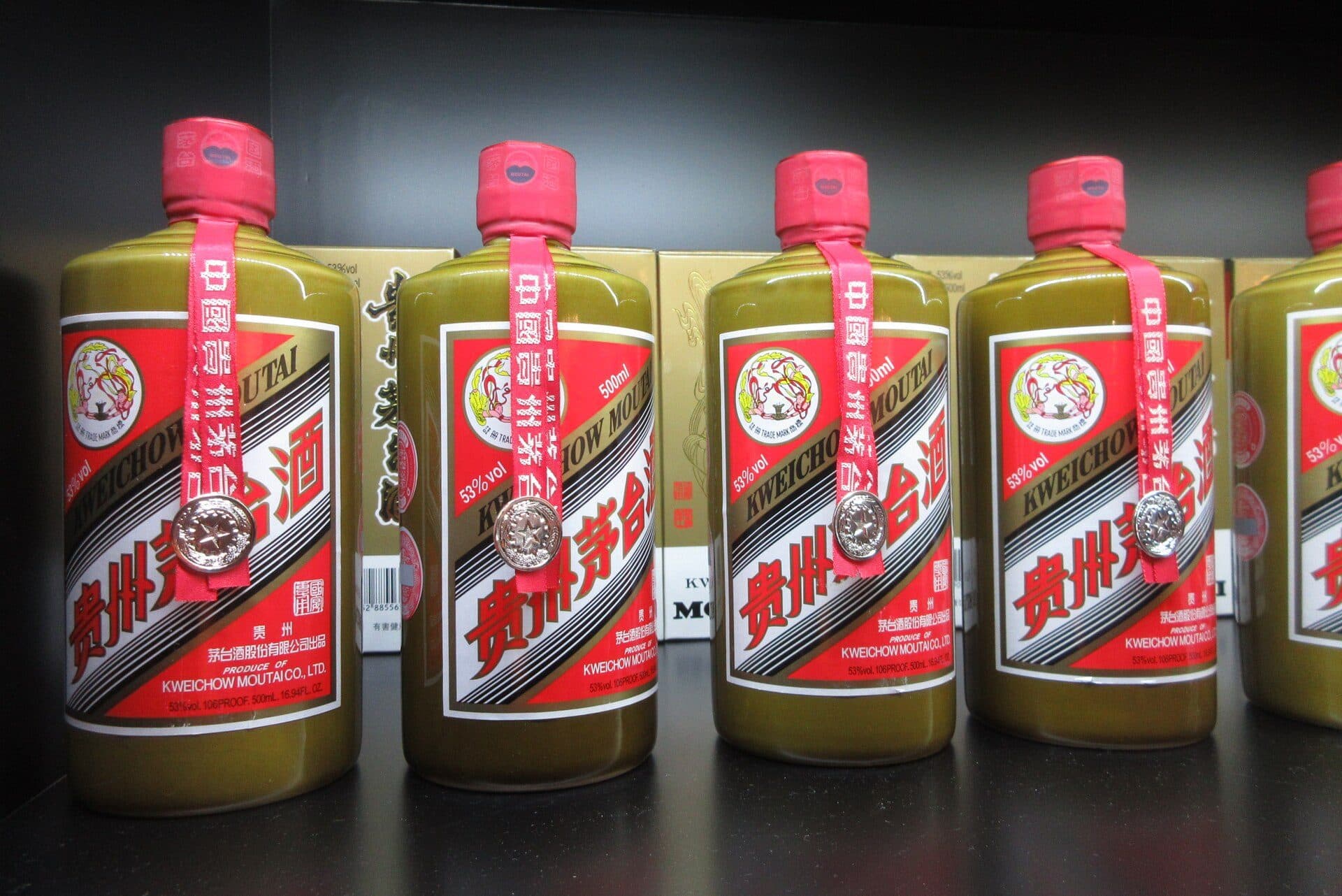
The business model rests on an accepted gap. The reference bottle, the 500 ml Feitian, has carried a recommended price of 1,499 yuan since 2018. On the actual retail market it trades well above that, the gap moving with the economy and the gift-giving season.
That gap sustains a parallel economy: private resale, speculative storage, quoted values tracked like those of a fine wine. Older vintages go to auction, and even empty bottles are resold, feeding a high-grade counterfeiting practice that consists of refilling a genuine container.
The sector took a hit in 2012 and 2013, when the campaign against official spending abolished the administrative banquet at a stroke, then the main outlet for high-end spirits. The company rebuilt on private consumption and business gifts, and its share price later passed its pre-campaign levels.
In September 2023, Moutai partnered with the coffee chain Luckin to launch a baijiu-flavoured latte. The chain announced more than five million cups sold on the first day. The brand had already tried ice cream the previous year, with the same intent: reaching a generation that does not drink strong spirits at banquets.
How it is drunk#
Moutai is not served like a Western digestif. It accompanies the meal, in small glasses of one or two mouthfuls, and is drunk on invitation: someone offers a toast, everyone follows, and the glass goes down empty.
Hierarchy shows in three details. Who gives the first toast, the order in which the table is worked round, and the height at which each person holds their glass at the clink, the younger placing theirs slightly below the elder's.
FAQ#
What is Moutai's alcohol content? 53% for the standard bottle. Versions at 43% exist, mainly for export.
Why is it so expensive? A five-year cycle from grain to sale, geographically capped production, and gift demand that far exceeds drinking use.
Can it be produced elsewhere? Other jiangxiang-style spirits exist, in Guizhou and beyond. The reproduction experiment run at Zunyi between 1975 and 1985 did not yield the same product.
How do you spot a fake? The producer has layered on authentication devices, from chip codes to the cap. The trickiest counterfeit remains a genuine bottle filled with something else.
Read alsoChinese tea: a journey through the six familiesThe six families of Chinese tea, the other great classification of a Chinese drink by process.
Sources and further reading#
- Kweichow Moutai, annual reports and listing documents, Shanghai Stock Exchange, since 2001
- Documentation on the relocated production experiment conducted at Zunyi between 1975 and 1985
- Chinese national standards for 酱香 type baijiu
- Decisions of the Chinese intellectual property office on the trademark claiming national liquor status
Baijiu: the national spirit of China
History and secrets of baijiu, China's clear grain spirit: sorghum distillation, qū ferment, Moutai aromas, the culture of ganbei and the banquet, drink of diplomacy.
Cover image: HunagnTwuai · HunagnTwuai, via Wikimedia Commons · CC BY-SA 4.0