Patbingsu: The Mountain of Shaved Ice That Cools Korea
From royal ice-storage dessert to Instagrammable chains: a journey through patbingsu, the mountain of shaved ice that cools the Korean summer.
La rédaction Kotoba Interactive
Studio éditorial
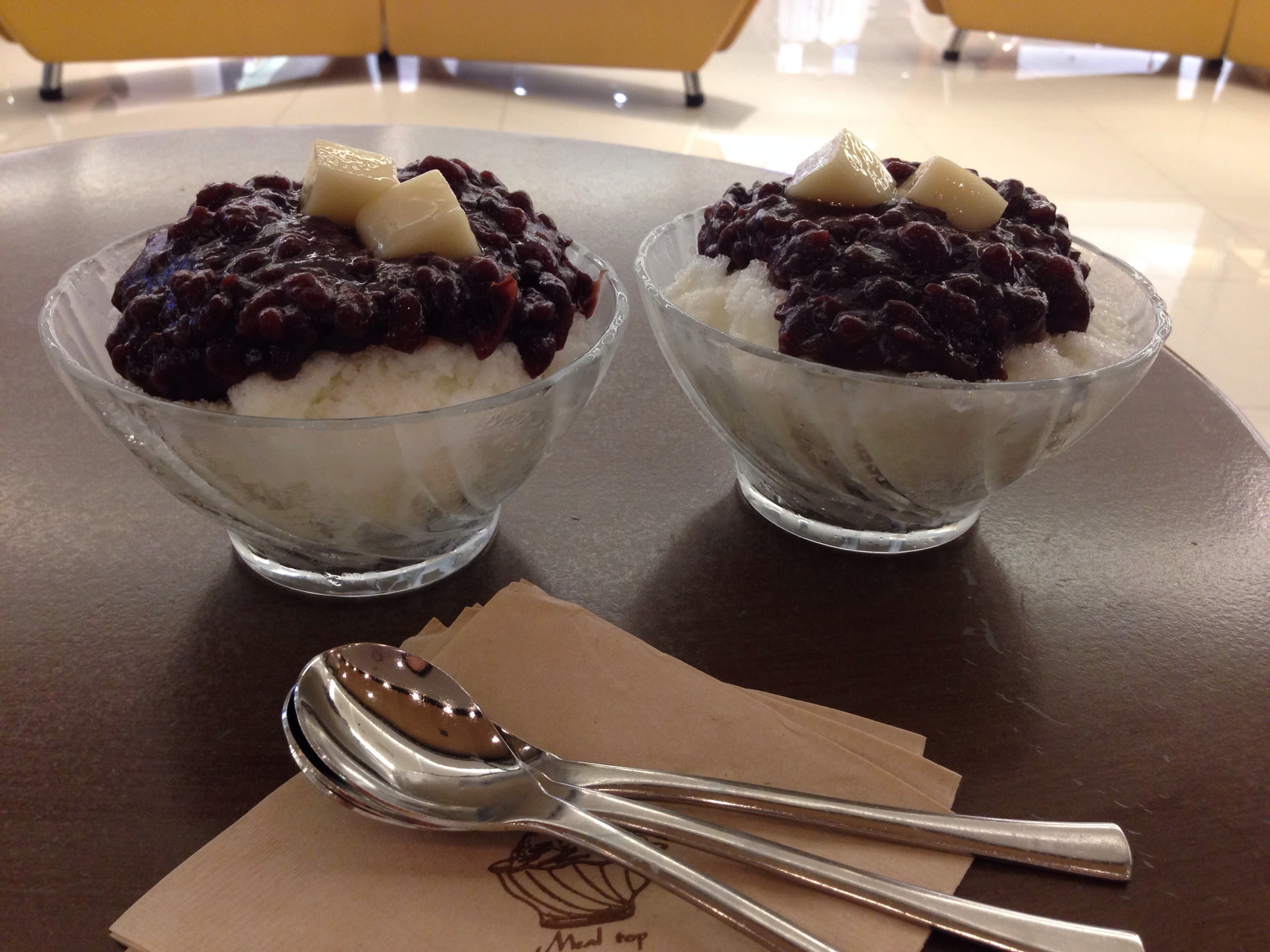
It is three in the afternoon, the middle of August, and Seoul is smothering under a muggy heat that glues shirts to skin. In an air-conditioned café in the Hongdae district, a server sets down in the middle of the table a bowl as wide as a hat, overflowing with a white, downy mountain. At the summit, a crown of glossy red beans, a drizzle of condensed milk running down in sweet threads, a few cubes of rice cake. Four spoons plunge in at once. The mountain collapses in a few minutes, and the whole table sighs with recovered coolness.
This bowl is , the most emblematic summer dessert in Korea. The word joins and . In other words: finely shaved ice topped with sweetened red beans. Behind its apparent simplicity lies a history several centuries long, running from the underground ice houses of the Joseon dynasty to the air-conditioned dessert chains where people photograph their mountain of snow before devouring it.
Bingsu: Anatomy of a Mountain of Ice#
is not a single dessert but an entire family, of which patbingsu is the ancestor and the most classic representative. The principle is always the same: a base of finely worked ice (얼음, eoreum), an arrangement of toppings set upon it, and a sweet binder that unites the whole. It is by nature a sharing dessert, served in a large bowl attacked with several spoons, and this collective dimension is an integral part of the pleasure.
breaks down into pat (팥, "red bean," the azuki) and bingsu (빙수), itself formed of bing (氷, "ice") and su (水, "water"). The name thus literally says "iced water with red beans," an exact description of the dish: shaved ice crowned with sweetened beans.
In its traditional version, patbingsu is made of a few clearly identified elements. The ice forms the base and the volume. The , long simmered with sugar into a paste or melting grains, brings the signature sweetness and an almost earthy note. Sweetened coats the whole with a creamy thread. Then come the toppings: the rice cake , soft and slightly sticky, in other forms, fresh cut fruit, and sometimes a shower of , which adds a toasted soybean aroma.
The strength of patbingsu lies in a contrast: the cold of the ice, the sweetness of the bean, the chew of the tteok, and the freshness of the fruit, gathered in a single spoonful.
Origins: The Ice of the Joseon Kings#
Before it was a café dessert, ice was in Korea a royal luxury. Under the Joseon dynasty (조선, 1392-1897), keeping ice through the height of summer was both a technical feat and a privilege of state. Each winter, blocks of ice were cut from the frozen rivers, notably the Han River, and stored in underground stone ice houses called .
These seokbinggo, several of which still survive today, notably the one in Gyeongju listed as a national treasure, were ingeniously designed semi-buried chambers: stone vaults, a drainage system to carry off meltwater, orientations and vents to maintain the cold. The ice thus preserved served to chill the food of the court, to keep provisions, and, when summer came, to offer a little coolness to the royal family and high officials. Ice was so precious that it was rationed and distributed by the administration as a favor.
The seokbinggo of Gyeongju, still visible today, could keep winter ice into the heart of summer thanks to its stone vaults and careful drainage of the meltwater. Long before the refrigerator, Korea knew how to hold the cold for months underground.
From this precious ice to a frozen dessert was but a step, but a step only the elite could take. It is said that officials of late Joseon enjoyed a shaved ice garnished with fruit, a distant ancestor of bingsu. Ice as a sweet pleasure nonetheless remained the preserve of a minority: it would take industrial modernity to democratize it.
The Birth of Modern Bingsu#
Patbingsu as we know it took shape in a troubled era, that of the Japanese colonial period (1910-1945). It was then that the Korean dessert met the Japanese kakigori, shaved ice coated with syrup, itself popularized by the spread of ice-shaving machines. The drink stalls and cafés of the time began to offer sweetened shaved ice, and Korea adopted the principle and made it its own.
The ingredient that makes all the difference, and that anchors the dessert in Korean taste, is the . Long used in Korean cooking for its virtues and its sweetness, in cakes, soups, and pastries, the pat became the signature topping of the shaved ice. Where the Japanese kakigori often relies on colored syrups, Korean patbingsu asserts its identity through this mountain of melting beans, less sweet in appearance, more rustic and nourishing.
In the postwar decades, with the rise of refrigerators and ice machines, patbingsu spread across the whole country. It became the summer dessert par excellence, the one you share with family or friends when the heat becomes overwhelming. The recipe settled around the trio of ice, red bean, and condensed milk, with its regional and household variants.
The words of the Korean dessert become readable once you know hangul: 팥빙수 (patbingsu), 빙수 (bingsu, "shaved ice"), 얼음 (eoreum, "ice"), and 연유 (yeonyu, "condensed milk") appear on every café menu. Learn to decipher them with KoreanSRS and its spaced repetition.
Anatomy of the Classic Patbingsu#
To understand what you are eating, you have to know how to read the components of a bowl. Each plays a precise role of texture, temperature, or aroma, and the art of patbingsu lies in their balance.
| Component | Hangul | Role in the bowl |
|---|---|---|
| Ice | 얼음 (eoreum) | Cold base, volume, freshness |
| Red bean | 팥 (pat) | Signature sweetness, earthy note |
| Condensed milk | 연유 (yeonyu) | Creamy, sweet binder |
| Injeolmi | 인절미 (injeolmi) | Soft, sticky rice cake |
| Tteok | 떡 (tteok) | Elastic texture |
| Bean powder | 콩가루 (konggaru) | Toasted soybean aroma |
The ice is its heart, and its texture determines everything. Coarsely shaved ice crunches under the tooth and quickly melts into a puddle, while finely shaved ice melts in the mouth like snow. It is precisely on this point that the modern version of the dessert would work a revolution. The red beans, for their part, must be cooked just enough to stay melting without turning to purée, and sweetened with measure so as not to crush the rest. The condensed milk, finally, is poured at the last moment, often at the table, so each diner may dose their own indulgence.
Nunkkot-bingsu: The Snow Revolution#
At the turn of the 2010s, patbingsu underwent a spectacular metamorphosis with the appearance of , literally "snow-flower ice." The difference lies entirely in the texture of the ice. Instead of shaving cubes of frozen water, one freezes milk directly, which is then shaved into flakes of extreme fineness. The result no longer resembles a classic shaved ice: it is a milky snow, almost impalpable, that melts instantly on the tongue and carries the toppings away in its creamy thaw.
This innovation is largely associated with the chain , founded in the early 2010s and which has spread across Korea and then abroad. Sulbing built its success on this ultra-fine milk snow and on endless variations: bingsu with soybean powder and injeolmi, with seasonal fruit, with green tea, with chocolate. Nunkkot-bingsu transformed the dessert from a rustic pleasure into a refined, airy experience, and above all a highly photogenic one.
With nunkkot-bingsu, shaved ice stops crunching under the tooth and melts like snow: the summer dessert becomes an experience, and a photo backdrop.
For nunkkot-bingsu arrives right on time for the age of social media. Its smooth white mountain, crowned with vivid fruit or a cascade of toppings, is made to be photographed before it is eaten. The chains compete in spectacular creations, and the bowl of bingsu becomes an object of digital sharing as much as of taste.
Bingsu Today: A Thousand Variations#
While the red-bean patbingsu remains the timeless classic, contemporary bingsu has multiplied into an infinity of versions. The creativity of cafés and chains knows no more limits, and each summer brings its batch of novelties.
Matcha or green tea bingsu weds the elegant bitterness of the tea powder to the sweetness of the milk snow. Fruit bingsu honors the produce of the season: mango in summer, strawberry in spring, melon, watermelon, each turned into a colored mountain. Bolder still, cheese or cream-cheese bingsu plays on a slightly salty note that cuts against the sugar, while other versions explore coffee, chocolate, toasted cereals, or tiramisu.
This diversity anchors bingsu in Korean café culture, one of the most dynamic in the world. Themed cafés, large chains, and small neighborhood spots all offer their bingsu in the warm season, and the dessert naturally accompanies the outing with friends, the moment of air-conditioned relaxation at the heart of the muggy summer. Bingsu remains, despite its metamorphoses, a sharing dessert: you order it for the table, never for yourself alone.
Read alsoSeoul's theme cafés: dalgona, bingsu and cat loungesBingsu is enjoyed at the café, and Korea has made it an art of living: dive into the teeming culture of Korean themed cafés.
Patbingsu cools the summer, but winter has its comforts: set off to discover Korean street snacks, from hoddeok to gyeranppang.
From matcha bingsu to the ceremonial bowl: trace back the history of the Japanese green tea that flavors so many Asian desserts.
From the block of ice pulled from the Han River and kept underground for the Joseon kings, to the milk snow shaved to the second in a Hongdae café, patbingsu tells in its own way the story of Korea: that of an ancient know-how reinvented by modernity, of an elite pleasure become popular joy, of an ice-storage dessert transformed into an Instagrammable phenomenon. It takes only a spoon plunged into the white mountain, on a scorching day, to understand why Korea has never stopped loving it.
FAQ#
What is the difference between patbingsu and bingsu? Bingsu (빙수) denotes the whole family of Korean shaved-ice desserts, whatever the topping. Patbingsu (팥빙수) is its historical and most classic version, the one crowned with sweetened red beans (팥). Every patbingsu is a bingsu, but not every bingsu is a patbingsu.
What is nunkkot-bingsu? Nunkkot-bingsu (눈꽃빙수), or "snow-flower ice," is a modern version of bingsu in which frozen milk is shaved instead of water ice. The result is an ultra-fine milky snow that melts instantly in the mouth. Popularized in the 2010s, notably by the chain Sulbing (설빙), it made the dessert airier and more photogenic.
Is patbingsu an ancient dessert? Modern patbingsu took shape in the twentieth century, notably during the colonial period, under the influence of Japanese shaved ice (kakigori). But the practice of storing ice goes much further back, to the Joseon dynasty, where stone ice houses called seokbinggo (석빙고) kept winter ice until summer.
What does a traditional patbingsu contain? A classic patbingsu combines shaved ice (얼음), sweetened azuki red beans (팥), condensed milk (연유), and often rice cakes such as injeolmi (인절미) or tteok (떡), with sometimes fruit and a shower of bean powder (콩가루).
Where is bingsu eaten in Korea? Bingsu is enjoyed mainly at the café, in summer, and is ordered to share among several people around a large bowl. Specialized chains like Sulbing, themed cafés, and small neighborhood spots all offer their version in the warm season, from the classic patbingsu to creations with fruit, matcha, or cheese.
Photo credits: images in this article come from Wikimedia Commons and are under free licenses.
Ramyeon: Korea's Instant Noodle Culture
Ramyeon (라면) is not Japanese ramen: almost always instant and fiery. From Samyang in 1963 to the global Shin Ramyun and the ram-don of Parasite.
Cover image: yuseokoh · yuseokoh, via Wikimedia Commons · CC BY-SA 2.0