Sexagenary cycle ganzhi: five elements, twelve animals
The sexagenary cycle ganzhi pairs ten heavenly stems with twelve earthly branches over sixty years. Oracle-bone origins, elements, animals, and time as return.
La rédaction Kotoba Interactive
Studio éditorial
For his sixtieth birthday, a grandfather slips on a red vest his family has given him, and everyone around the table knows what it means: he has just completed a full turn of the great Chinese dial of time. Not fifty-nine, not sixty-one, but sixty exactly, because that number is anything but arbitrary. It marks the precise return of the combination of elements and animals under which the old man was born, as though a cosmic clock had just struck noon again.
That dial has a name: the , the Chinese sexagenary cycle. It does not count time as a line racing forward, but as a wheel of sixty notches that turns and always comes back to its starting point. Behind the apparent simplicity of the twelve-animal zodiac, which we have told elsewhere, hides a far deeper mechanism, where ten "heavenly stems" mesh with twelve "earthly branches" to produce a unique cycle, used without interruption for more than three thousand years. It is one of the oldest counting systems still alive on the planet.
Two wheels turning together: stems and branches#
The ganzhi rests on the interlocking of two series, the heavenly stems and the earthly branches, which advance one notch each year. The first series, the , has ten characters: 甲乙丙丁戊己庚辛壬癸 (jiǎ yǐ bǐng dīng wù jǐ gēng xīn rén guǐ). The second, the , has twelve: 子丑寅卯辰巳午未申酉戌亥. A stem and a branch are joined to name each unit of time, whether year, month, or day.
The cycle opens on 甲子 (jiǎzǐ), first stem plus first branch. The following year, both wheels turn one notch: 乙丑 (yǐchǒu), second stem, second branch. And so on. One might assume this produces a hundred and twenty combinations, ten times twelve, but that is a fruitful mistake worth pausing on, because it explains the number sixty.
contracts and . The word names not two separate lists but their meshing: each unit of time carries a name formed of a stem followed by a branch, such as 甲子 or 辛亥.
Why sixty and not a hundred and twenty#
The answer lies in a parity constraint. Stems and branches do not advance independently: they turn together, one notch each per step. The first stem (rank 1, odd) always lands on an odd-ranked branch, and an even-ranked stem on an even-ranked branch. An odd stem never meets an even branch. Of the hundred and twenty theoretical pairings, only half actually occur.
Mathematically, the cycle closes at the least common multiple of ten and twelve, that is sixty. After sixty steps, the first stem and the first branch return simultaneously to their starting point, and the sequence 甲子 begins again. This run of sixty combinations is called the , after its first term.
The ganzhi does not line up numbers, it turns two gears: because ten and twelve only fall into step together after sixty notches, the cycle runs sixty years, not a hundred and twenty.
Five elements, two polarities: the logic of the ten stems#
The ten heavenly stems are not ten arbitrary symbols: they are the five elements of Chinese cosmology, each in a yang and a yin version. Those five elements, the , are Wood (木, mù), Fire (火, huǒ), Earth (土, tǔ), Metal (金, jīn), and Water (水, shuǐ). Five elements times two polarities gives exactly ten, and the order of the stems follows this progression, from yang Wood in first place to yin Water in tenth.
Every year of the cycle thus carries three layers of information: an element, a polarity, and an animal. The element and polarity come from the stem, the animal from the branch. That is why 2024, the year 甲辰 (jiǎchén), is called "yang-Wood Dragon": 甲 is yang Wood, 辰 is the Dragon branch. Here is the complete table of the ten stems.
| Stem | Element (五行) | Polarity |
|---|---|---|
| 甲 (jiǎ) | Wood (木) | Yang |
| 乙 (yǐ) | Wood (木) | Yin |
| 丙 (bǐng) | Fire (火) | Yang |
| 丁 (dīng) | Fire (火) | Yin |
| 戊 (wù) | Earth (土) | Yang |
| 己 (jǐ) | Earth (土) | Yin |
| 庚 (gēng) | Metal (金) | Yang |
| 辛 (xīn) | Metal (金) | Yin |
| 壬 (rén) | Water (水) | Yang |
| 癸 (guǐ) | Water (水) | Yin |
Twelve branches, twelve animals#
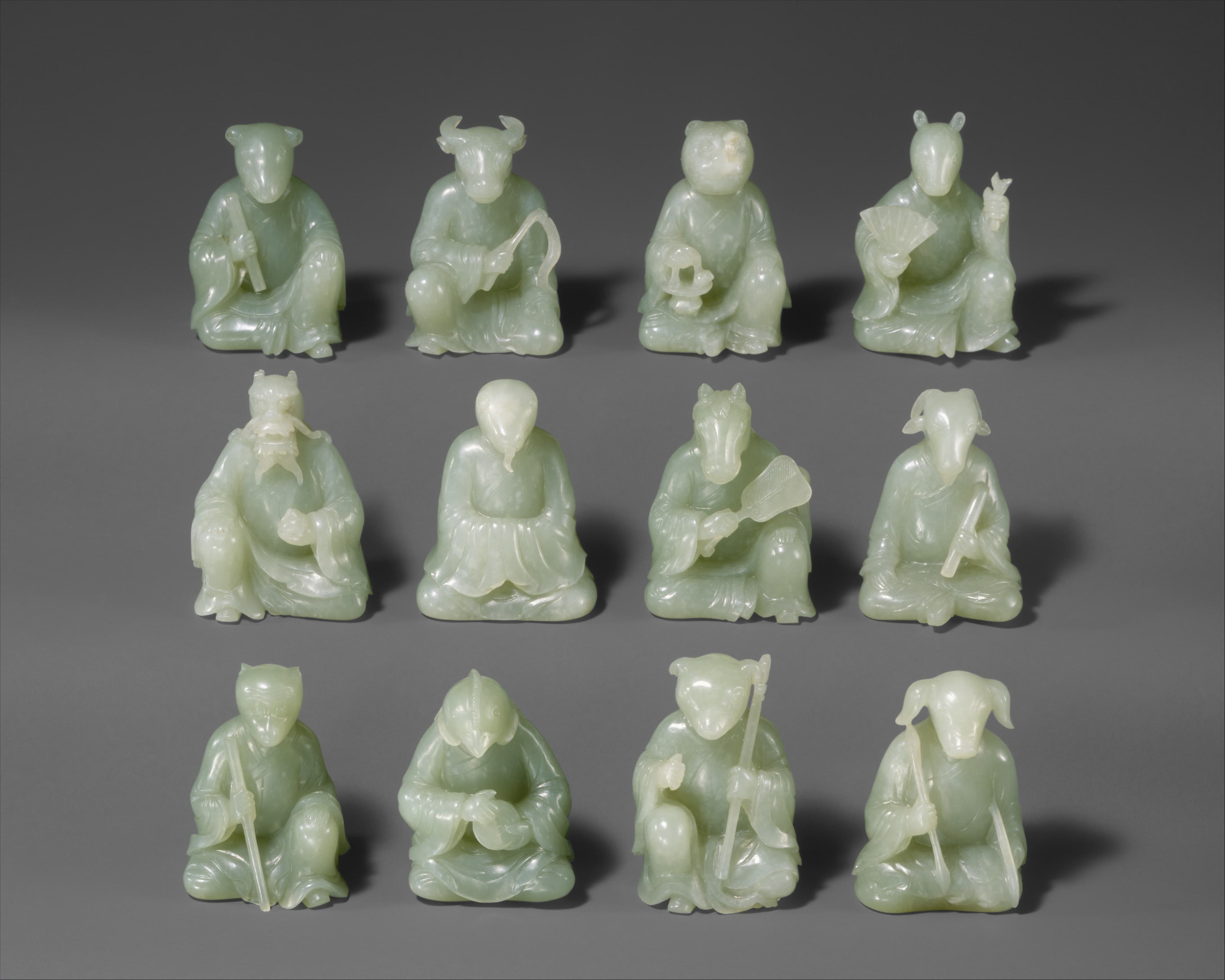
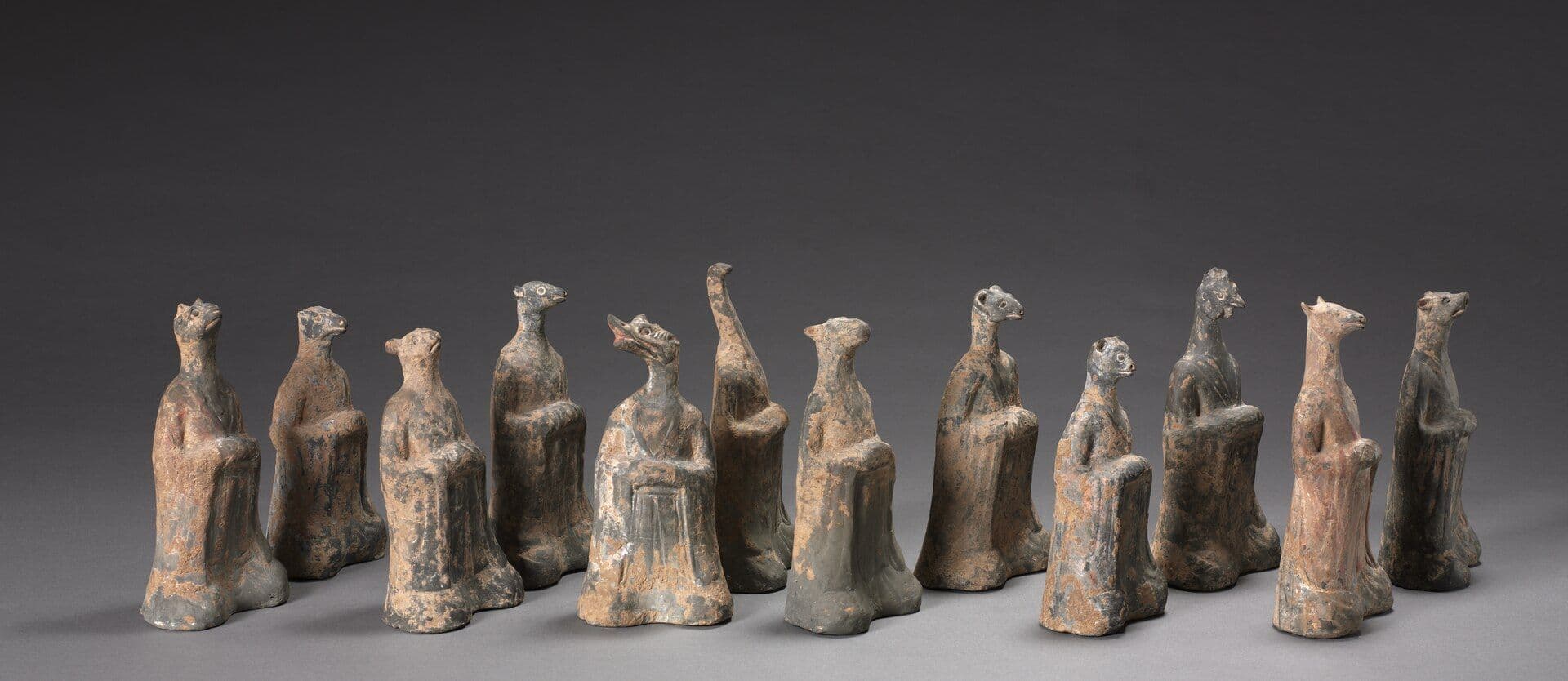
The twelve earthly branches are the familiar side of the system: they are the carriers of the twelve zodiac animals, from Rat to Pig, whose characters and legend of the great race we have detailed elsewhere. Each branch corresponds to an animal in a fixed order, and it is this correspondence that lets a branch name be read as an animal sign.
| Branch | Animal |
|---|---|
| 子 (zǐ) | Rat |
| 丑 (chǒu) | Ox |
| 寅 (yín) | Tiger |
| 卯 (mǎo) | Rabbit |
| 辰 (chén) | Dragon |
| 巳 (sì) | Snake |
| 午 (wǔ) | Horse |
| 未 (wèi) | Goat |
| 申 (shēn) | Monkey |
| 酉 (yǒu) | Rooster |
| 戌 (xū) | Dog |
| 亥 (hài) | Pig |
The twelve branches carry the twelve animals: their legend, their characters, and the mystery of the absent Cat are told in full in our article devoted to the zodiac.
The element brought by the stem colors the animal's temperament. A Fire Horse (the year 2026, 丙午, bǐngwǔ) is not a Water Horse: the first is thought fiery and impetuous, the second supple and intuitive. It is this combination, animal plus element plus polarity, that gives each year its singular hue and explains why no year exactly resembles the one twelve years before it.
From tortoise bones to today's calendars#
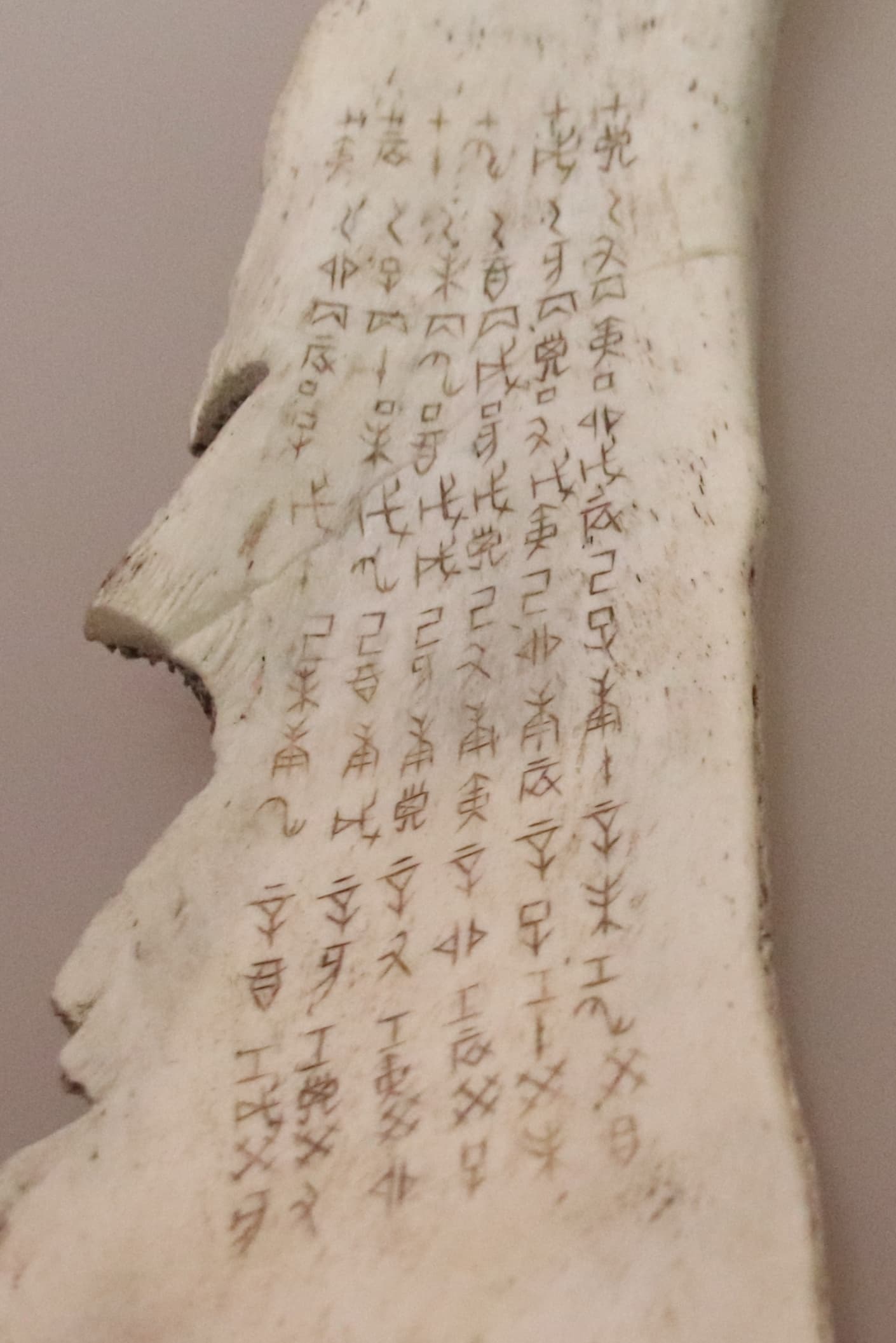
The ganzhi is no late invention: its characters already appear on the of the Shang dynasty, around the thirteenth century BCE. On these ox shoulder blades and tortoise plastrons, heated and then read in their cracks, diviners were already carving dates in stems and branches. Originally, the system served chiefly to number days, before extending to years.
This continuity makes the ganzhi one of the longest counting systems ever used without a break. Where the Gregorian calendar tallies years by a number that grows endlessly, the Chinese count makes them turn: the same label, 甲子 or 辛亥, comes around every sixty years, leaving context to specify which cycle is meant. The system served to number years, months, days, and even the twelve , those "double-hours" that split the Chinese day into twelve two-hour slices, each named after a branch.
The vocabulary of Chinese time falls into place once you know its characters: 干支 (gānzhī, the sexagenary cycle), 五行 (wǔxíng, the five elements), 天干 (tiāngān, the heavenly stems), and 地支 (dìzhī, the earthly branches). ChineseSRS is already live: learn to read hanzi and hundreds of everyday words with its spaced repetition.
The sixtieth birthday, across the Sinosphere#
To close a full cycle is to live long enough to see the exact year of your birth return, and that moment is celebrated. In China, the sixtieth birthday is called , an expression that also stands, by metonymy, for the age of sixty. The idea traveled across the whole Sinosphere, fitting itself to each language.
In Korea it is called hwangap or , a major celebration marking the return to the cycle's starting point. In Japan it is , where the honoree is given a red vest and cap, the , red standing at once for protection and a symbolic return to childhood. From one country to the next, the same intuition: at sixty, you have made a full turn and are, in a way, reborn.
Read alsoKorean age: why Koreans were one or two years olderThe Korean hwangap makes more sense once you know how Korea counts ages: our article on Korean age reckoning and its recent reform sheds light on this very particular arithmetic.
Years that carry a name in history#
The ganzhi does not only date births: it gave their names to major historical events, so that certain combinations instantly evoke a specific year for any Sinophone reader. To name a year by its ganzhi was to place it unambiguously within the cycle, and the practice survived all the way into history textbooks.
The Sino-Japanese War of 1894 thus remained the 甲午战争 (jiǎwǔ zhànzhēng), "the war of the jiawu year," after that year's stem-branch pair. The imperial modernization attempt of 1898 is called the 戊戌变法 (wùxū biànfǎ), "the reform of the wuxu year," those "Hundred Days' Reform" so abruptly cut short. And the 1911 revolution that toppled the last dynasty bears the name 辛亥革命 (xīnhài gémìng), "the revolution of the xinhai year." In each case, the pair of characters fixes the year like a fingerprint.
A civilization that names its wars and revolutions by pairs of characters rather than by numbers does not merely date its events: it sets them within a wheel that will, one day, bring back the same season of time.
A system shared by all of East Asia#
The ganzhi did not stay Chinese. It spread across the whole Sinosphere, to Japan, Korea, and Vietnam, each culture adapting it to its language while keeping the same characters and the same sixty-year mechanism. Korean, Japanese, and Vietnamese scholars dated their chronicles, their steles, and their official acts in stems and branches for centuries, and their major dates too are often known by their cycle names.
Even today, the ganzhi structures the Chinese lunisolar calendar and stays alive in divination. The , also called the "four pillars of destiny," sum up a person through the stems and branches of their year, month, day, and hour of birth: four pairs of characters, eight signs in all, which fortune-tellers read to divine a temperament or a future. The same system still guides the choice of a name or an auspicious date.
Feeling time as return#
What the ganzhi offers, at bottom, is not a way to measure time but a way to live it. Where the Gregorian year races toward an ever-larger number, never twice the same, the Chinese wheel comes back: the combination you were born under will return, and you can, if you live long enough, celebrate it. The grandfather in the red vest is not counting his years, he is completing an orbit.
Perhaps that is the true genius of the system: by pairing ten elements with twelve animals to make sixty notches, it turns time into a habitable circle, where every season of a life has already happened and will happen again. 2044 will bring back the 甲子 that opens the cycle, the stem-year your grandmother may have known; and somewhere, someone will shrug on a red vest with a smile, because the wheel has just struck noon again.
FAQ#
What is the sexagenary cycle ganzhi? The is the Chinese sixty-year cycle formed by combining ten heavenly stems (天干) and twelve earthly branches (地支). Each year carries a name made of a stem and a branch, such as 甲子 or 辛亥, and the cycle begins anew every sixty years.
Why does the cycle run sixty years and not a hundred and twenty? Because stems and branches advance together, an even-ranked stem falls only on an even-ranked branch, and vice versa. Only half of the hundred and twenty pairings occur. The cycle closes at the least common multiple of ten and twelve, which is sixty.
How do the stems relate to the five elements? The ten stems are the five elements (五行: Wood, Fire, Earth, Metal, Water), each in a yang and a yin form. Five elements times two polarities gives ten stems, from 甲 (yang Wood) to 癸 (yin Water).
What does the sixtieth birthday celebrate in East Asia? It marks the complete return of the ganzhi cycle, the exact year of one's birth coming back around. It is called in China, in Korea, and in Japan, where the honoree dons a red vest, the chanchanko.
Is the ganzhi still used today? Yes. It structures the Chinese lunisolar calendar, underpins divination, and survives in the names of historical events such as the 辛亥 revolution of 1911.
Photo credits: the images in this article come from Wikimedia Commons and are under a free license.
In this article
The cultural terms covered here, each with a short definition.
- Five Elements
- Chinese theory linking wood, fire, earth, metal and water to explain the world's cycles.
Why Vietnam has a cat where China has a rabbit
The same twelve-animal zodiac, three countries, three lists that do not match: the Vietnamese cat, the Japanese boar, and the linguistic explanation for the gap.
Cover image: Gary Lee Todd (photo), retouché par Kanguole · Gary Lee Todd / Kanguole, via Wikimedia Commons · CC0