Taekwondo: The History and Philosophy of the Korean Martial Art
The history of taekwondo, the Korean martial art: its origins after 1945, the unification of the kwans, the ITF/WTF rift, the belts, the poomsae and the Olympic path.
La rédaction Kotoba Interactive
Studio éditorial
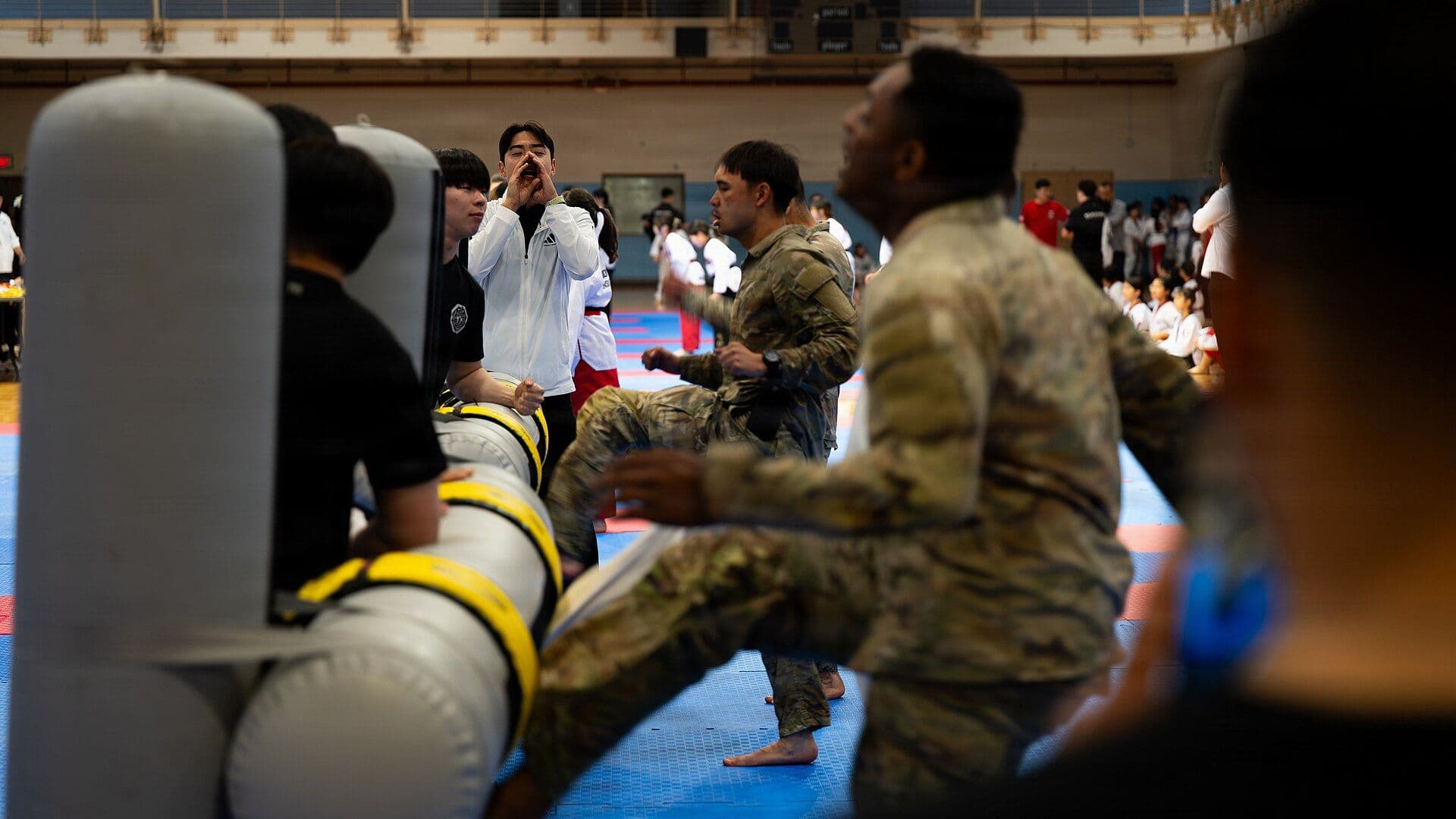
The foot snaps through the air at face height, faster than the eye can follow, then returns to the floor without a sound. In the dojang, twenty or so practitioners in white dobok repeat the movement in unison, in a broad rustle of fabric and a sharp shout, the kihap. The master corrects a hip angle, a shoulder line. Everything here aims at the leg: its height, its speed, its precision. That is the signature of taekwondo.
is Korea's national martial art, the most practiced in the world and an Olympic discipline since 2000. Famous for its spectacular kicks, it is also a school of discipline and self-control. But behind its modern, sporting image lies a recent, complex and long-disputed history, born of the reconstruction of a battered country.
Origins: a young art with ancient roots#
Contrary to a widespread legend, taekwondo in its current form is a recent martial art, structured after 1945. Korean martial arts existed long before (taekkyeon, a traditional leg game, or subak are attested for centuries), but modern taekwondo took shape in the South after Korea's liberation from Japanese occupation.
During the colonization (1910-1945), Japanese martial arts, including karate, had deeply marked Korean practitioners. At liberation, several schools, the , opened in Seoul, blending local heritage with Japanese and Chinese influences. It was from the fusion of these schools that taekwondo would be born.
Taekwondo is the child of a renaissance: a country that, after occupation, wanted to forge a martial art of its own, proudly national, both anchored in tradition and turned toward modernity.
The birth of a name#
The word taekwondo itself was coined in 1955, when a committee decided to unify the kwans under a common name. The name was proposed, according to tradition, by General Choi Hong-hi, a central and controversial figure in the discipline's early days.
breaks down into three characters: , and . Literally, "the way of the foot and the fist." The word says the essential: an art where the leg prevails over the hand, but which thinks of itself first as a path, a moral discipline.
The unification of the kwans led, in 1959, to the creation of a first Korean federation. But the history of taekwondo would soon split into two rival currents, for reasons as political as they were technical.
Every kick carries a Korean word: 도장 (dojang, the training hall), 품새 (pumsae, the codified forms) and 기합 (gihap, the shout that punctuates a strike). With KoreanSRS, spaced repetition will settle this vocabulary into your memory as surely as the master settles a movement into the body.
The great split: ITF versus WTF#
Taekwondo is divided today into two great families, inherited from a rupture of the 1960s-1970s.
Choi Hong-hi's ITF#
In 1966, Choi Hong-hi founded the International Taekwon-Do Federation (ITF). After tensions with the South Korean regime, he went into exile and spread his version of the art, notably in the Eastern bloc and North Korea. The ITF emphasizes the tul (forms), a fluid style and a "wave theory" in the production of power.
The WTF and the Kukkiwon#
In 1972, the , world headquarters of taekwondo, was inaugurated in Seoul, followed in 1973 by the founding of the World Taekwondo Federation (WTF), today simply World Taekwondo. It was this branch, sporting and backed by the South Korean state, that would become Olympic. It codifies the poomsae (forms) and a combat heavily focused on kicks and speed.
It is the World Taekwondo version that competes at the Olympic Games, with its electronic chest protectors counting the points. The ITF, for its part, organizes its own championships under distinct rules. Two federations, two styles, one name: a direct legacy of the Cold War.
Belts, forms and philosophy#
A practitioner's progress is read in the color of their belt (tti), from the beginner's white to the dan black, passing through a range of colors (the geup). Each color carries a symbolism: white for innocence, yellow for the earth where the seed germinates, green for the sprout, blue for the sky, red for danger and mastery, black for maturity.
| Belt (띠, tti) | Color | Symbolism |
|---|---|---|
| Beginner | White (흰색, huinsaek) | Innocence, the blank page |
| Intermediate geup | Yellow (노란색, noransaek) | The earth where the seed germinates |
| Intermediate geup | Green (초록색, choroksaek) | The growing sprout |
| Advanced geup | Blue (파란색, paransaek) | The sky one reaches toward |
| Advanced geup | Red (빨간색, ppalgansaek) | Danger and mastery |
| Dan | Black (검은색, geomeunsaek) | Maturity and starting anew |
Training is built around the , codified sequences against imaginary opponents, sparring (kyorugi), breaking techniques (kyokpa) and work on fundamentals. Beyond technique, taekwondo claims five tenets: courtesy, integrity, perseverance, self-control and indomitable spirit.
Read alsoLand of the Morning Calm: Why Korea Is Really the Morning BrightLike taekwondo, the image of Korea was built between claimed tradition and conquering modernity.
Taekwondo today: a global sport#
Taekwondo has accomplished a spectacular globalization. A demonstration sport at the Seoul (1988) then Barcelona (1992) Olympics, it became an official discipline in Sydney in 2000. There are today tens of millions of practitioners in more than 200 countries, and the Kukkiwon issues grades recognized worldwide.
This success does not erase the debates: between competition sport and traditional martial art, between real effectiveness and Olympic codification, between the rival legacies of the ITF and World Taekwondo. Taekwondo remains at once a tool of Korean soft power, a high-level sport and, for many, a school of life.
To learn taekwondo is to learn a little Korean and a certain idea of discipline: dojang, dobok, poomsae, kihap, do, all words that recall that, behind every kick, there is a way. And that this way, as tradition holds, always begins and ends with a bow.
FAQ#
Is taekwondo an ancient martial art? Not in its current form. It took shape after 1945 in South Korea, out of schools (the kwans) blending Korean traditions and Japanese influences. Its name dates from 1955.
What does the word taekwondo mean? It is made of tae ("to strike with the foot"), kwon ("fist") and do ("the way"): "the way of the foot and the fist." The name reflects the prominence of leg techniques.
What is the difference between ITF and World Taekwondo? The ITF, founded by Choi Hong-hi in 1966, emphasizes the tul and a fluid style. World Taekwondo (formerly WTF, 1973), linked to the Seoul Kukkiwon, is the Olympic branch, focused on kicking combat.
Is taekwondo Olympic? Yes. A demonstration sport in 1988 and 1992, it has been an official discipline of the Olympic Games since Sydney in 2000, under the aegis of World Taekwondo.
Photo credits: the images used in this article come from Pexels and Unsplash and are royalty-free.
The Starleague: how Korea invented the professional gamer
The PC bang as a laboratory, a television channel that created a profession, the state stepping in: the five reasons Korea's grip on e-sport has lasted.
Cover image: U.S. Air Force photo by Tech. Sgt. Desiree Ware · U.S. Air Force photo by Tech. Sgt. Desiree Ware, via Wikimedia Commons · Domaine public