Hongbao: the art of the red envelope in China
Everything about hongbao, the red envelopes of money given at Chinese New Year and other big occasions. Traditions, amounts, etiquette and the digital turn.
La rédaction Kotoba Interactive
Studio éditorial
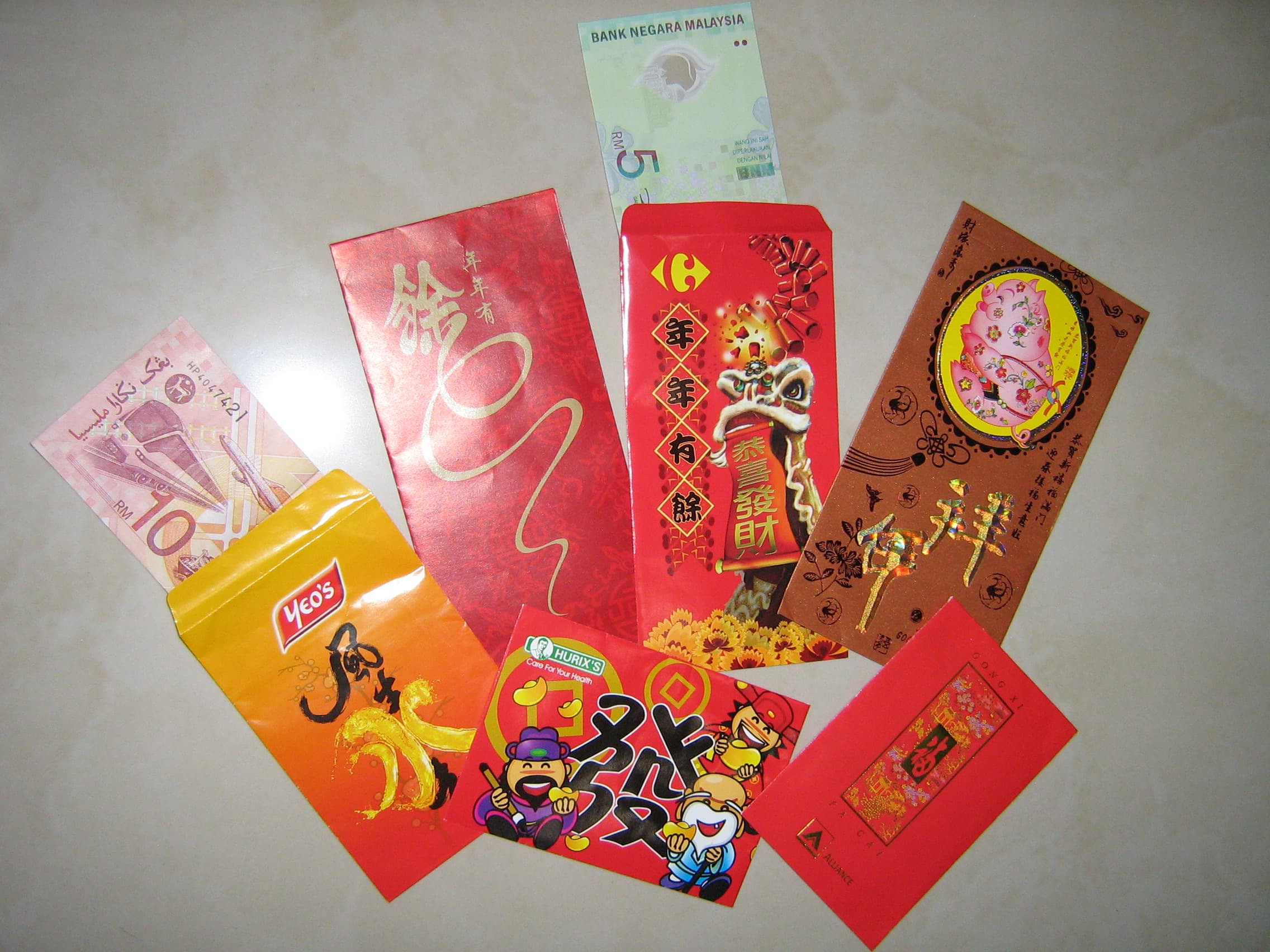
"恭喜发财!" (Gōngxǐ fācái, congratulations and prosperity!): that is the ritual greeting children in new red and gold clothes address to every grandparent, uncle and aunt as they do the family rounds on the first day of Chinese New Year. In return, adult hands slide small scarlet envelopes into theirs, decorated with golden dragons or auspicious characters. These are , literally "red packets", and they hold the most direct gift there is: money.
The hongbao sits at the centre of Chinese rituals of transmission and blessing. New Year, weddings, births, the start of a school year: every passage comes with these envelopes, which circulate according to precise rules and carry far more than their cash contents.
红包 (hóngbāo) combines 红 (hóng, red) and 包 (bāo, packet, envelope). Red, the colour of luck, joy and prosperity in Chinese culture, wraps a gift that expresses affection, respect or a wish for happiness. Money is the vehicle, but the meaning is in the gesture.
Mythical and historical origins#
Legend traces the hongbao back to a struggle against a demon named , who terrorised children on New Year's night. Parents are said to have placed eight coins wrapped in red paper beside their sleeping child's pillow. When the demon drew near, the coins turned into eight immortals who drove it away. The hongbao became a protective talisman.
Historically, monetary gifts go back to the Qin dynasty (221-206 BCE), when coins pierced with a square hole were threaded onto red cords. Under later dynasties the practice was codified: elders give to juniors, employers to employees, newlyweds to guests.
Intrigued by these "red packets" and their ritual wishes? Learn to read 红包 (hóngbāo, red envelope), 恭喜发财 (gōngxǐ fācái, congratulations and prosperity) and hundreds of everyday Chinese words with ChineseSRS and its spaced repetition.
When are hongbao given?#
Every major occasion has its own logic: who gives, who receives and what order of magnitude is expected. Here is an overview of the main cases.
| Occasion | Giver, recipient | Typical amount | Colour, note |
|---|---|---|---|
| New Year (春节, chūnjié) | Elders, unmarried children | 100 to 2,000 yuan | Red, even amount |
| Wedding (婚礼, hūnlǐ) | Guests, the couple | 200 to 1,000 yuan and up | Red, depending on closeness |
| Birth, full month (满月, mǎnyuè) | Relatives, new parents | 100 to 1,000 yuan | Red, protective virtue |
| Exams, new school year (高考, gāokǎo) | Elders, students | 88 to 888 yuan | Red, symbolic gesture |
| Funerals (葬礼, zànglǐ) | Relatives, bereaved family | Odd amount | White, never red |
Chinese New Year (春节, Chūnjié)#
This is the main occasion. Grandparents, parents, uncles and aunts give hongbao to the unmarried children of the family. The gesture comes with wishes: "学业进步" (xuéyè jìnbù, may your studies progress), "身体健康" (shēntǐ jiànkāng, good health).
Amounts vary with the relationship and the region. A well-off grandparent in Shanghai may give 1,000 to 2,000 yuan per child. A distant aunt in a rural province might give 100. What matters is consistency: you do not give more to a nephew than to your own child.
Weddings#
Guests give hongbao to the couple. It is a disguised subscription system: the sums received partly offset the cost of the banquet. Amounts depend on closeness to the couple: a colleague gives 200 to 500 yuan, a close friend 500 to 1,000, a family member 1,000 or more.
At a Chinese wedding, hongbao are received at the door by a "treasurer" who records every gift in a ledger. The couple keeps that book, because they will have to return an equivalent amount at the givers' own future weddings. It is a system of social reciprocity codified across decades.
Births#
When a baby is born, or at the "full month" (满月, mǎnyuè, celebrated thirty days after the birth), relatives give hongbao to the new parents. Red is protective here: it keeps evil spirits away from the infant.
School years and exams#
Before the gaokao, the university entrance exam, or an important new school year, hongbao may be given to wish success. The gesture is as symbolic as it is practical.
Hongbao etiquette#
The hongbao follows strict rules, and breaking them can give offence.
The numbers#
- Always even amounts: 50, 100, 200, 500, 1,000 yuan. Even numbers stand for harmony and completeness.
- Avoid four: the digit 4 (四, sì) is a homophone of "death" (死, sǐ). Never 40 or 400 yuan.
- Favour eight: 8 (八, bā) is a homophone of "prosperity" (发, fā). 88, 188 and 888 yuan are prized amounts.
- The funeral exception: gifts to bereaved families are in odd amounts, standing for rupture, and in white envelopes, never red.
The presentation#
- A hongbao is given and received with both hands, as a mark of respect.
- You never open a hongbao in front of the giver.
- The notes should be new and unfolded: Chinese banks supply fresh notes before New Year.
- The envelope must be closed, sometimes sealed.
Reciprocity#
The hongbao system is a moral economy. People remember who gave how much, and return the equivalent, or more if their situation has improved, on a future occasion. Failing to return is a serious fault. Giving less than you received signals a cooling relationship.
The idea of 礼尚往来 (lǐ shàng wǎng lái, "in ritual, going and coming are both due") sums up this economy of the gift. A hongbao is never a free present: it is an exchange deferred in time, which weaves and maintains the social network.
The digital hongbao#
In 2014, launched digital hongbao. Success was immediate. Users can send virtual red envelopes to their contacts or into group chats. In groups, a "grab" function (抢红包, qiǎng hóngbāo) creates a game where members race to click and receive a random share of the total.
The digital hongbao changed practice in three ways:
- Democratisation: even small amounts, one or two yuan, become acceptable between friends, where the paper hongbao imposed a threshold of dignity.
- Gamification: "grab" hongbao are addictive. Billions are exchanged every New Year.
- Marketing: companies distribute promotional hongbao through WeChat or Alipay. Some contain coupons, others real money.
Over Chinese New Year 2024, WeChat recorded more than twelve billion hongbao exchanged within a few days. The peak falls at midnight, when millions of people send each other wishes and money at the same moment.
Hongbao and society#
The hongbao reveals the tensions of contemporary Chinese society. Inflation in amounts creates financial pressure: modest families go into debt to keep up appearances at weddings or New Year. Press articles regularly denounce the "tyranny of the hongbao", which turns a gesture of blessing into an economic burden.
The hongbao is also a tool of veiled corruption. Giving a substantial envelope to an official, a doctor or a teacher can smooth the way. Xi Jinping's anti-corruption campaigns explicitly targeted such practices, but they persist in the shadows.
Finally, the digital hongbao has created new forms of social pressure. In company WeChat groups, declining to take part in a collective hongbao looks bad. The history of gifts is visible. Generosity becomes a public performance.
FAQ#
How much should you put in a wedding hongbao? As a rule, at least the estimated cost of your seat at the banquet: 200 to 500 yuan for a colleague, 500 to 1,000 or more for a close friend. In Beijing and Shanghai, amounts run higher than in the provinces.
Can you give a hongbao to someone older? Traditionally hongbao flow from elders to juniors. However, working adults may give hongbao to their elderly parents as a sign of filial piety, especially if those parents have modest incomes.
Are digital hongbao replacing paper ones? Not for formal occasions such as weddings or New Year with the family. The paper hongbao keeps its symbolic value. Digital ones are used rather between friends and colleagues, and for small amounts.
What do you do if you receive an overly generous hongbao? It is polite to make a show of refusing once or twice before accepting. If the amount is genuinely out of proportion, you can discreetly return the difference as a counter-gift.
Photo credits: freely licensed images, Wikimedia Commons.
The classical gardens of Suzhou: nature reinvented
Discovering the classical Chinese gardens of Suzhou: the Master of the Nets, the Humble Administrator, rocks, water, philosophy and UNESCO heritage.
Cover image: Craig · Craig, via Wikimedia Commons · Public domain