Japanese Toilets: Technology and the Culture of Hygiene
From TOTO's washlet to futuristic public restrooms, Japanese toilets embody a cultural obsession with comfort, cleanliness, and innovation.
La rédaction Kotoba Interactive
Studio éditorial
You push open the door of a stall in a Tokyo shopping mall. A motion sensor raises the lid on its own, the seat is warm, a wall-mounted panel displays a dozen indecipherable buttons, and a speaker plays the sound of running water. Welcome to Japan, the country where even toilets are an art form.
Japanese toilets are neither a gimmick nor a technological eccentricity: they are a cultural marker in their own right. Behind the heated seat and the water jet lie centuries of history, a philosophy of cleanliness rooted in Shinto and Buddhism, an industry worth billions, and a relationship with the body that has no equivalent in the West.
From Pit to Throne: A History of Toilets in Japan#
The Ancient Era and the Kawaya#
The earliest Japanese toilets bear a poetic name: . These rudimentary latrines, built over a stream or a pit, date back to the Jomon period (roughly 14,000 to 300 BCE): the current simply carried waste away.
Excavations at , Japan's imperial capital from 694 to 710, revealed latrines of surprising sophistication: wooden drainage channels, plank-lined pits, drainage fed by diverted waterways. By the eighth century, Japanese sanitary engineering had moved well beyond a simple hole in the ground. These findings were published by the Nara National Research Institute for Cultural Properties.
The most remarkable aspect is agricultural recycling. Human excrement, called , was systematically collected and used as fertilizer in rice paddies and vegetable gardens. While medieval Europe was tossing waste out of windows and spreading epidemics, Japan was turning its waste into a resource, closing the loop of organic matter with a rationality that modern circular economy advocates would readily endorse.
The Edo period (1603-1868) took this logic to its extreme. In Edo (present-day Tokyo), Osaka, and Kyoto, a genuine trade in human waste developed between urban and rural areas. Landlords sold their tenants' excrement to farmers, and prices varied by perceived quality: waste from wealthy neighborhoods, with their richer diets, fetched higher prices. Legal disputes even erupted over who owned a tenant's excrement, the landlord or the tenant. This economy is documented by historian Hanley Susan B. in Everyday Things in Premodern Japan.
Alongside this, Zen Buddhism developed its own approach. The , the latrines of Zen temples, was a codified space where the most mundane act became a meditative practice: monks entered in silence, followed a precise protocol (which foot to step in with first, how to clean themselves) and maintained full awareness throughout. A protective deity watched over it, , a fire god capable of purifying any defilement, whose image still adorns the toilets of many temples.
The Meiji Era and Western Influence#
The Meiji Restoration of 1868 upended every aspect of society, including the most intimate. The new government imported not only Western technologies but also sanitary standards: flush toilets, a British invention refined in the nineteenth century, appeared in government buildings, luxury hotels, and the residences of the elite.
The first ceramic toilets made in Japan date from the early twentieth century, but the transition was slow. For decades, two worlds coexisted: squat toilets, called , and seated Western-style toilets, called . Well into the 1960s and 1970s, the majority of households, schools, and public buildings still used washiki.
The shift came from the 1970s and 1980s onward, driven by urbanization and by one decisive invention: the Washlet. Today, over 90% of Japanese households are equipped with yoshiki toilets, with washiki surviving only in older buildings and a few rural schools. In two generations, Japan went from squatting to the most sophisticated throne on the planet.
TOTO and the Washlet Revolution#
The story of the Washlet is inseparable from . Founded in 1917 in Kitakyushu, in the north of Kyushu, by , TOTO is today the world's largest manufacturer of sanitary equipment. The name is an abbreviation of Toyo Toki.
Okura Kazuchika, son of industrialist and educated in Europe, understood that a modernizing Japan would need a domestic sanitary ceramics industry. He first established a sanitary division within the Noritake group (tableware porcelain), and the entity later became independent under the name Toyo Toki. From the outset, TOTO sought to adapt Western models to Japanese expectations rather than simply copy them.
TOTO's first major moment on the national stage came in 1964, during the Tokyo Olympics: the company supplied the sanitary equipment for the Olympic facilities, a global showcase that cemented its reputation.
In 1980, TOTO launched the , the world's first mass-market cleansing toilet seat: a seat with a retractable nozzle spraying warm water to clean the user, replacing toilet paper. "Washlet" is a registered trademark that became a generic term in Japan, much like "Kleenex" for tissues or "Band-Aid" for adhesive bandages.
The development of the Washlet is legendary. Engineers spent months testing the jets on themselves to determine the optimal spray angle, the ideal temperature (between 37 and 40 degrees Celsius), the right pressure, and the exact nozzle position. Over 300 employees voluntarily participated in the trials. The result: a water jet at a patented 43-degree angle that hits its target with no manual adjustment.
In Japanese industrial philosophy, perfection is not found in the spectacular. It hides in details nobody sees: in the angle of a water jet calculated to the exact degree, in the temperature of a seat calibrated so the body feels neither heat nor cold, only comfort.
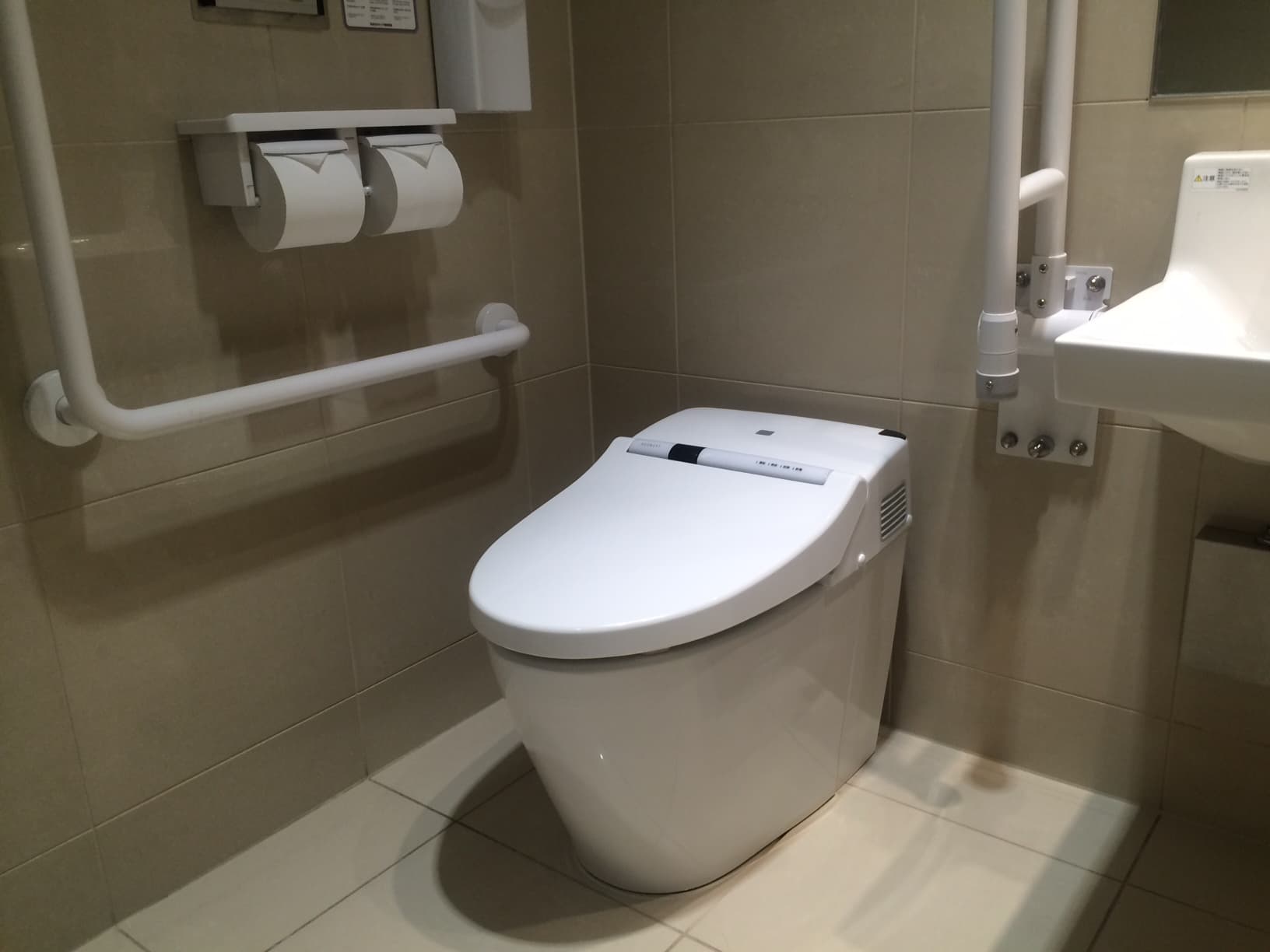
The modern Washlet, the product of over forty years of improvement, packs in the functions: a rear jet adjustable in position, pressure, and temperature; a gentler bidet jet for feminine hygiene; a warm air dryer; a heated seat; a catalytic deodorizer; a slow, silent self-closing lid; a motion sensor; and a self-cleaning nozzle, before and after use, with water sterilized through electrolysis.
The numbers are staggering. In 2023, over 80% of Japanese households were equipped with a cleansing seat, according to the Cabinet Office of Japan. Since 1980, TOTO has sold over 60 million units worldwide, employs more than 34,000 people, and generates annual revenue exceeding 600 billion yen (roughly four billion euros). In the Japanese market, TOTO dominates with about 60% share, ahead of INAX (part of the LIXIL group) and Panasonic. For Japanese people, Washlet and TOTO are synonymous.
The Symphony of Buttons: Decoding the Control Panel#
For foreign visitors, the Washlet's control panel is an object of fascination tinged with apprehension. Mounted on the wall or built into the armrest, it displays buttons with cryptic pictograms. Yet each one has a precise function.
| Button | Reading | Function |
|---|---|---|
| おしり | oshiri (posterior) | Main rear wash |
| ビデ | bide (bidet) | Gentle jet for feminine hygiene |
| 乾燥 | kansō (drying) | Warm air dryer |
| 音姫 | otohime (sound princess) | Running-water sound to mask noise |
| 止 | tome (stop) | Immediately halts any function |
The most common button shows a downward-pointing water jet with the characters おしり (oshiri, "posterior"): this is the main wash. A button marked ビデ (bide, "bidet") activates the feminine cleansing jet. A third, with a wind symbol, triggers the dryer. Plus and minus buttons adjust pressure and temperature. And the most important of all, the one the uninitiated frantically searches for in panic: the 止 (tome, "stop") button, which immediately halts any function.
The most revealing device is the . Invented by TOTO in 1988, it emits the sound of running water when pressed, to mask natural sounds. Before the Otohime, many Japanese women flushed continuously to avoid being overheard, wasting several thousand liters of water per person per year in some buildings. By providing a sound cover, the Otohime drastically reduced this consumption. The device now equips virtually all women's public restrooms in Japan.
Standardization of pictograms is more recent. Each manufacturer long used its own symbols, a source of confusion for tourists. In 2017, the adopted a common set: a stylized posterior for rear washing, a female silhouette for the bidet, waves for the dryer, a square for stop. This harmonization, motivated by the influx of tourists expected for the Tokyo 2020 Olympics, illustrates how seriously the country takes its toilets.
High-end models push the boundaries. TOTO's Neorest series, the brand's flagship, offers automatic hands-free opening and closing of the lid, a built-in LED night light inside the bowl, an automatic flush triggered simply by standing up, an ewater+ cleaning system using electrolyzed water, and, on certain models, a urine analysis function measuring sugar levels and transmitting data to a physician. The price can exceed $10,000, but there is no shortage of buyers.
Decoding a Washlet panel is already reading Japanese: おしり (oshiri, posterior), 音姫 (otohime, sound princess), and 止 (tome, stop). Learn to read these kanji and kana through spaced repetition with JapaneseSRS, and turn every stall into a vocabulary lesson.
Public Restrooms: When Architecture Gets Involved#
The cleanliness of Japanese public restrooms astonishes visitors. In JR railway stations, the Tokyo and Osaka subways, shopping malls, , and certain parks, they are cleaned multiple times a day, equipped with Washlets, stocked with toilet paper, sometimes fitted with changing tables and child seats. They embody a conception of public space radically different from that of Europe or North America.
This tradition reached its pinnacle with the , launched in 2020 by the : sixteen internationally renowned architects and designers created public restrooms in Tokyo's Shibuya district, to transform these neglected spaces into architectural works accessible to all.
The transparent restrooms by , Pritzker laureate in 2014, attracted worldwide attention. Installed at Yoyogi Fukamachi Park and Haru-no-Ogawa Park, these smart-glass cabins (blue, green, red depending on the location) let passersby see inside: they can check that the toilets are clean and available. The moment the user locks the door, an electric current turns the glass opaque. The concept resolves the two anxieties of public restrooms, filth and occupancy, through transparency that converts to opacity. Ban Shigeru, known for his humanitarian architecture (cardboard shelters after the 1995 Kobe earthquake), sees it as proof that architecture must serve everyone.
, Pritzker laureate in 1995 and master of exposed concrete, designed circular restrooms in Japanese cypress wood (hinoki, 檜) at Jingu-dori Park, whose round shape evokes a garden pavilion and blurs the line between the utilitarian and the sacred. , an interior designer, topped his Ebisu cabin with a bright red canopy. created a structure of translucent white columns that filter light while preserving privacy.
The Tokyo Toilet Project found an echo in cinema. In 2023, German filmmaker Wenders Wim (born 1945) directed Perfect Days, which follows Hirayama, a public restroom cleaner in Shibuya, played by . This former businessman performs his work with meticulous care. Yakusho Koji won Best Actor at the Cannes Film Festival, and the film was nominated for the Academy Award for Best International Feature Film. Perfect Days shows that dignity lies not in the prestige of a profession but in the attention one brings to what one does.
Train station restrooms deserve a mention. In major stations like Tokyo, Shinjuku, or Shin-Osaka, they are free, equipped with Washlets, and often feature a posted floor plan showing which stalls are free or occupied and the available amenities (changing tables, wheelchair accessibility, ostomy facilities). Some newer stations even offer "powder rooms" with illuminated mirrors and electrical outlets.
A Cultural Obsession With Cleanliness#
To understand why Japan elevated toilets to an art form, you need to look at the spiritual roots of its culture. Cleanliness here is not merely a matter of hygiene: it is a moral value, a spiritual practice, and a social bond.
, Japan's indigenous religion, rests on the opposition between and . Kegare is not simple physical dirt: it is spiritual disorder, a distance from the sacred whose sources include death, blood, illness, but also neglect. Kiyome restores harmony with the divine. At the entrance of every shrine, the , the basin where worshippers rinse their hands and mouths, materializes the transition from the profane to the sacred; purifying salt (mori-shio, 盛り塩) at restaurant entrances serves the same function. In Shinto, to clean is to pray.
This dimension manifests in education. is a daily practice in every Japanese school: each day after classes, students clean their own classrooms, hallways, staircases, and restrooms. This is neither a punishment nor a budget measure, but a deliberate educational pillar written into the curricula since the Meiji era. Soji teaches respect for shared spaces and the principle that nobody is above cleaning: principal, minister, or emperor, all have at some point scrubbed a toilet.
In Japanese thought, no place is beneath dignity. A school hallway, a subway station, a public restroom stall: every space deserves the same care, because every space reflects the people who inhabit it.
The connection to , total hospitality, is direct: anticipating another's comfort, creating an environment where they feel welcomed down to the smallest detail. Spotless restrooms tell the user, without a word, that their dignity has been thought of in advance; dirty restrooms are seen as an affront. In Japan, judging a restaurant by the state of its restrooms is a reliable indicator of the attention it pays to guests.
The relationship with toilet deities completes the picture. In Shinto, is associated with fertility and childbirth; in Buddhism, is the ultimate purifier. But a folk belief best captures the Japanese attitude: cleaning your toilets with care brings prosperity, health, and beauty. Widely shared, even among rational Japanese people, it functions less as literal truth than as a reminder of the attention owed to ordinary things.
This belief found a striking expression in 2010, when singer released . The nearly ten-minute track recounts how her grandmother told her that a beautiful goddess lived in the toilets and that cleaning them would make her beautiful. The song reached number three on the Oricon chart, was performed at the Kohaku Uta Gassen (the New Year's Eve music gala), and became a cultural phenomenon, with thousands of testimonials reporting the same family belief.
The Washlet Conquers the World#
For decades, the Washlet remained a Japanese phenomenon. Western tourists marveled at it and snapped photos of the control panel, but never considered installing one at home. It was seen as an exotic curiosity, much like vending machines for hot drinks or punctual trains.
TOTO tried early to break into international markets. As early as 1989, the company opened a showroom in New York on Madison Avenue. The reception was polite but reserved: the American market, attached to toilet paper and wary of any technology touching intimacy, resisted for years. The first adopters were celebrities, tech enthusiasts, and travelers returning from Japan.
The first market to fall outside Japan was China. Starting in the 2000s, Chinese tourists discovered the Washlet and brought them home by the thousands. The phenomenon earned its own name, , referring to the frenzied shopping of Chinese tourists in Japan. The Washlet ranked among the top five most-purchased products, alongside cosmetics, medicine, and electronics. TOTO, INAX, and Panasonic fought fiercely over this market. In 2015, economist published a viral essay, "The Chinese Go to Japan to Buy Toilet Seat Covers," sparking a national debate about Chinese industrial quality.
But an unforeseen event accelerated global adoption: the COVID-19 pandemic. In March 2020, a toilet paper shortage caused by panic buying hit the United States, Australia, and several European countries. The Washlet suddenly appeared not as a gadget but as a practical solution eliminating dependence on toilet paper. Sales of cleansing seats surged by over 200% in the United States in 2020, and brands like Tushy, BioBidet, and Brondell, offering adaptable bidets, saw revenues explode. TOTO rode the wave too.
Cultural resistance remains real. There is modesty first: the idea of a water jet on intimate parts is still uncomfortable for many Westerners. There is distrust of technology in intimate spaces. And there is cost: an entry-level Washlet runs between 300 and 500 euros, a high-end model can exceed 5,000 euros, and installation requires an electrical outlet near the toilet, uncommon in Western bathrooms.
Despite these barriers, the momentum seems irreversible. Brands like Geberit (Switzerland), Duravit (Germany), and American manufacturer Kohler have launched their own lines. Luxury hotels, from New York to Dubai to Paris, equip their suites with Japanese toilets. The global cleansing seat market, valued at about five billion dollars in 2023, is expected to surpass eight billion by 2030.
The ecological paradox deserves examination. The device consumes electricity (heating water and seat, dryer, nozzle), but this is modest (100 to 200 kilowatt-hours per year for a household) and must be weighed against the toilet paper savings. Japan uses about 70% less toilet paper per capita than the United States. And its production is a silent ecological disaster: millions of trees, massive quantities of water and energy, and emissions at every stage. The Natural Resources Defense Council estimated in 2019 that Americans consume more than 140 rolls per person per year. By cutting that consumption, the Washlet may be one of the simplest ecological choices the developed world could make.
Japanese toilets are not a gadget: they are the expression of a philosophy of care, respect for the body, and hospitality. From the kawaya above a river to the $10,000 Neorest, from shimogoe recycled into rice paddies to a water jet calibrated to the exact degree, from the Zen monk in the setchin to the restroom cleaner filmed by Wenders Wim, the same conviction has endured across centuries: there is no place beneath dignity, there is no trivial act, and the way a civilization treats its most intimate spaces says everything about it.
In this article
The cultural terms covered here, each with a short definition.
Gachapon: Japan's Capsule Toy Culture
The history and culture of gachapon, Japan's capsule-toy machines. Onomatopoeic origins, Bandai, Kaiyōdō, Fuchiko, and an industry worth hundreds of billions of yen.
Cover image: 浪速丹治 · Wikimedia Commons · CC BY-SA 4.0