Shanghai's Parent Marriage Market (相亲角)
Every weekend, Chinese parents 'sell' their single children at Shanghai's People's Park. Inside the 相亲角, its résumé sheets and its unwritten rules.
La rédaction Kotoba Interactive
Studio éditorial
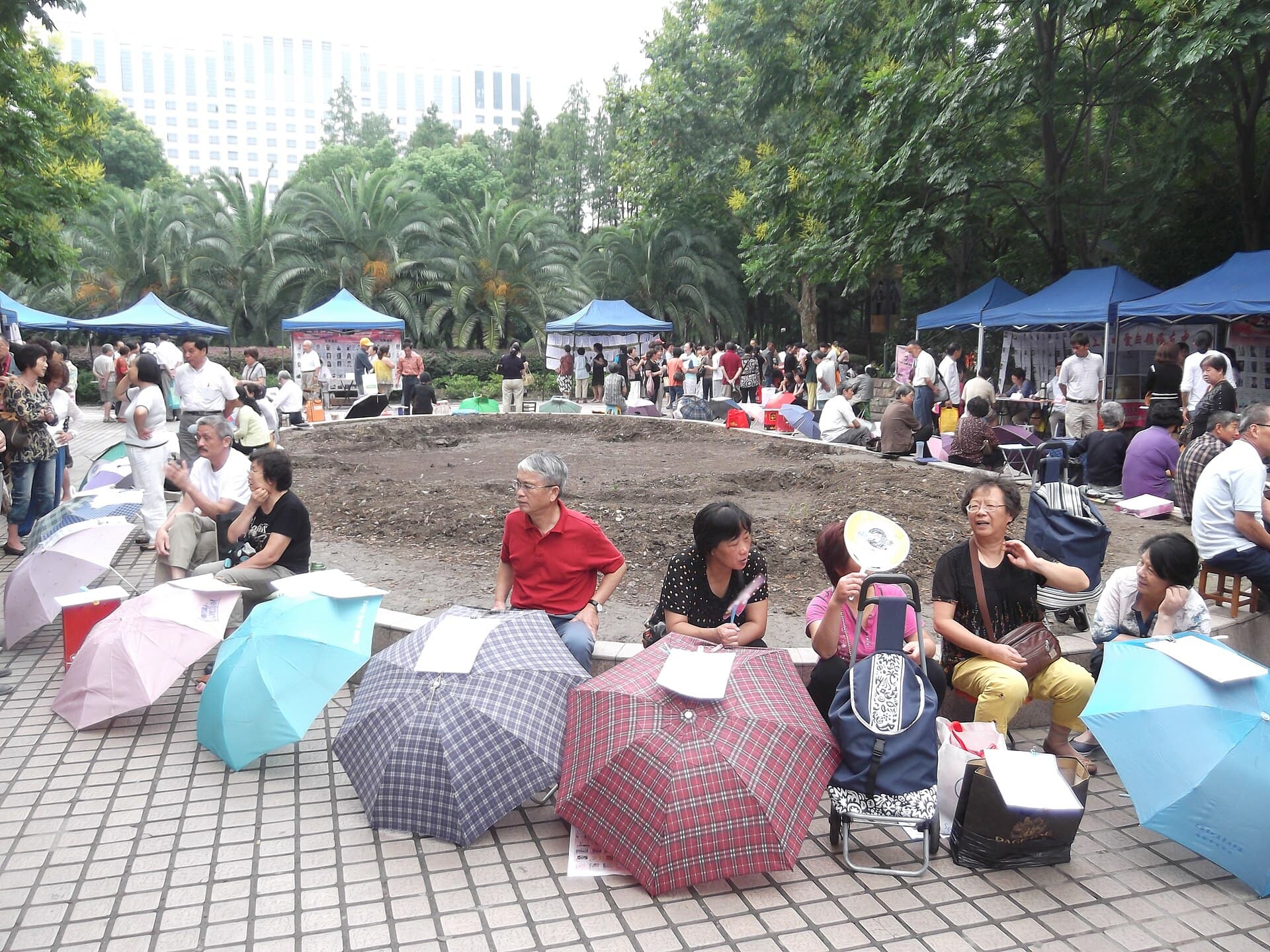
A folded umbrella is useless; opened and set on the ground, it becomes a matrimonial ad. Under the plane trees of , in central Shanghai, hundreds of laminated sheets hang from umbrellas lined up along the paths. Each lists an age, a height in centimeters, a monthly salary, a degree, the mention of an apartment, sometimes a zodiac sign. No photo, almost never a name. Behind every sheet stands a middle-aged man or woman who is not the person described: it is their father, their mother, more rarely an aunt or a grandmother.
The place has a name, the 相亲角 (xiāngqīnjiǎo), the "matchmaking corner." Since the mid-2000s, it has turned a stretch of Shanghai's largest central park into a marriage exchange every weekend, where parents negotiate the romantic future of their adult children, often without those children's knowledge. The marriage market is no folkloric curiosity: it is the point where Chinese demographics, housing prices, the 户口 (hùkǒu) system and the anxiety of an entire generation of parents all meet. In columns of figures, you can read a country's intimate history.
What the 相亲角 at People's Park is#
The 相亲角 is an informal gathering where parents post the "résumé" of their single child to find them a spouse. In Shanghai it takes place every Saturday and Sunday afternoon near the north entrance of People's Park, between the art museum and the People's Square metro station, along a band of shaded paths. It appeared spontaneously around the turn of the 2000s, with no organizer or official permit, simply by the aggregation of parents from nearby neighborhoods. Two decades later it draws families from across the municipality along with its share of onlookers, sociology students and photographers.
The word itself is worth pausing on. 相亲 (xiāngqīn) refers to the meeting arranged with marriage in view, the interview between two parties; 角 (jiǎo) means the corner, the angle, the nook. The 相亲角 is thus literally "the corner where matches are made," a public space diverted from its function to become a marketplace. In English it is called the marriage market, and the commercial translation is no exaggeration: what happens here is appraisal, comparison and bargaining.
相亲 (xiāngqīn) joins 相 (xiāng, "mutually, to look at") and 亲 (qīn, "close, to unite"). The term has long named the formal meeting between two families with a wedding in view. At the 相亲角, it is the parents who look each other over first; the young people themselves come, if they come, much later.
The sheet: a human being reduced to seven lines#
The sheet clipped to the umbrella fits into a few standardized fields, and their order says a great deal. It almost always carries the birth year or 年龄 (niánlíng, age), the 身高 (shēngāo, height), the 收入 (shōurù, income), the 学历 (xuélì, level of education), the ownership of a 房 (fáng, home), the 户口 (hùkǒu, residence status) and sometimes the 属相 (shǔxiàng, Chinese zodiac sign). Looks come after assets; character barely appears at all.
A typical sheet reads: "Woman, 1990, 165 cm, master's degree, engineer, annual income 300,000 yuan, Shanghai hùkǒu, apartment in Pudong district, seeks man born before 1988, height ≥ 175 cm, homeowner, Shanghai hùkǒu." It is all there: the age that frames the window of "value," the height measured to the centimeter, the diploma as a marker of background, the income as a promise of security, and above all the two decisive criteria of the metropolis, housing and hùkǒu. The person, meanwhile, stays invisible.
To grasp at a glance what each field weighs, here are the most common criteria on a sheet and what they reveal.
| Criterion (hanzi + pinyin) | What is stated | Why it matters |
|---|---|---|
| 年龄 niánlíng | Age or birth year | Frames the "window of value," narrower for women |
| 身高 shēngāo | Height in centimeters | The norm expects the man to be taller than his partner |
| 收入 shōurù | Income, often annual | A promise of security and living standard |
| 学历 xuélì | Level of education | A marker of background and of equal matching |
| 房 fáng | Ownership of a home | An almost mandatory prerequisite to marriage in Shanghai |
| 户口 hùkǒu | Official place of residence | A Shanghai hùkǒu opens the best schools to the child |
| 属相 shǔxiàng | Chinese zodiac sign | Used to test the couple's "compatibility" |
An entire generation is displayed in columns: centimeters, yuan, square meters. Feeling has no box on the sheet.
This formatting is no accident. It reflects a view of marriage as an alliance of resources as much as a meeting of persons, one that seeks a 门当户对 (méndānghùduì), the pairing of two families of equal standing, a principle inherited from imperial China. The sheet is the modern version of that ideal: a chart of social compatibility before it is an invitation to feeling.
Hùkǒu and 房: two criteria that govern everything#
In Shanghai, two lines on the sheet outweigh all the others: the local hùkǒu and the ownership of a home. The 户口 (hùkǒu) is the residence permit that ties each Chinese citizen to a place and conditions access to public schooling, healthcare and many urban rights. A Shanghai hùkǒu is worth its weight in gold: it opens the city's best schools to the child to come. Marrying a Shanghai hùkǒu holder means securing the next generation's schooling, and parents know it better than anyone.
The 房 (fáng), the home, is the other cornerstone. In a city where the price per square meter ranks among the highest on earth, owning an apartment has become, for a man especially, an almost mandatory prerequisite to marriage. The pressure is such that a popular phrase sums it up: without a 车 (chē, car) or a 房 (fáng, home), no union. Men's sheets therefore list the apartment as a central argument, and women's sheets often demand it in return.
Together these two criteria turn the 相亲角 into an X-ray of urban inequality. The holder of the right hùkǒu and the owner of the right apartment start with a considerable lead; the brilliant child from another province, without a local hùkǒu or a home, ends up marked down whatever their degrees. The market does not lie about what the city values.
剩女: the dread of "leftover women"#
The word 剩女 (shèngnǚ, "leftover woman") crystallizes the anxiety that drives so many parents to the park. Coined and popularized in the late 2000s, notably relayed by state media and the All-China Women's Federation, it labels urban, educated, single women past 27 or 28 as though they were unsold goods. The term is stigmatizing, and it targets precisely the profile most represented on the women's sheets of the 相亲角: urban, schooled, working, financially independent.
The paradox is cruel. It is often the most qualified women who struggle most to "settle down" by the market's codes, because the norm expects the man to be older, taller, better paid and better educated than his partner, a model called 男高女低 (nángāonǚdī), "man above, woman below." A woman at the top of the social ladder thus runs into a pool of "superior" men that thins the higher she climbs. High-status women's sheets, as their age advances, become the hardest to "place," and their parents the most faithful at the park.
The male counterpart, 剩男 (shèngnán, "leftover man"), exists but is far less used and far less shaming. Society brands late female singlehood with a harsh word; it lets male singlehood pass under a more indulgent silence.
The weight of the one-child policy and the sex imbalance#
The marriage market is partly the direct legacy of the one-child policy, in force from 1980 to 2015. By limiting most urban couples to a single child, it concentrated all family expectations, matrimonial ones included, on that lone offspring. For many parents, marrying their only child is not a preference but a duty: it secures the continuity of the line, the arrival of a grandchild, and their own security in old age in a country where retirement still rests largely on the family.
To this pressure a real demographic imbalance is added. The traditional preference for sons, combined with access to ultrasound and sex-selective abortion from the 1980s on, produced a surplus of men: China's census long showed around 115 to 118 boys born for every 100 girls, leaving tens of millions of marriage-age men without a potential partner. This imbalance weighs above all on rural and low-income men, while cities gather, conversely, educated women hard to match upward. The 相亲角 is the stage where these two tensions, a surplus of men at the bottom and a surplus of qualified women at the top, cross without necessarily resolving.
The vocabulary of the marriage market is written on the sheets: 相亲角 (xiāngqīnjiǎo, the matchmaking corner), 户口 (hùkǒu, the residence permit), 剩女 (shèngnǚ, "leftover woman"), 房 (fáng, the home). ChineseSRS already exists: learn to read these hanzi and hundreds of everyday Chinese words with its spaced repetition.
The bargaining, the taboo and the parents' 面子#
On site, the negotiation is hushed but very real. Parents read the sheets, pause, strike up low-voiced conversation, compare, exchange phone numbers. They size up the other party with the very criteria their own sheet displays: where the family is from, what it owns, whether the hùkǒu is good, whether the apartment is already paid off. Some raise zodiac or blood-type compatibility without hesitation. The tone stays courteous, but the logic is one of matching estates as much as persons.
One fact often unsettles the foreign observer: many of the "displayed" singles have no idea their parents frequent the park. The move is lived as a family affair, one where the initiative rightly belongs to the elders, and where the child is shielded from the humiliation of a failure by being kept out of it. This discretion also stems from 面子 (miànzi), "face," social standing. For a parent, having a child married on time is a source of face; having a lingering single child is a loss of it, felt before relatives and neighbors. To come to the 相亲角 is to act for the child, but also to defend one's own honor as a parent.
Read alsoMianzi: The Chinese Concept of Face and Its Social WeightThe 面子, "face," is at stake as much for parents as for children at the marriage market. This key concept of Chinese society explains much of the matrimonial pressure.
A reputation for very low effectiveness#
The best-documented paradox of the 相亲角 is its ineffectiveness. Journalists, sociologists and regular parents agree on one finding: very few unions actually come from the park. Sheets stay up for months, the same parents return year after year, and the rare meetings that lead to an introduction often run into a refusal from the very people concerned, never consulted in advance. Parents' values, hùkǒu, housing, income, do not always overlap with what their thirty-something children seek, more attentive to affinity than to assets.
Why, then, does the crowd not thin? Because the market fills a function other than the one it advertises. It gives parents a place to act, to gain a grip on an anxiety that overwhelms them, to meet other families in the same situation and feel less alone. The 相亲角 is as much a social outlet as a matrimonial agency, a community of parental worry where recipes, statistics and discouragements are shared. Its low marriage-success rate has never emptied it, precisely because its real product is not marriage but the relief of doing something.
Shanghai is not alone: a China of matchmaking corners#
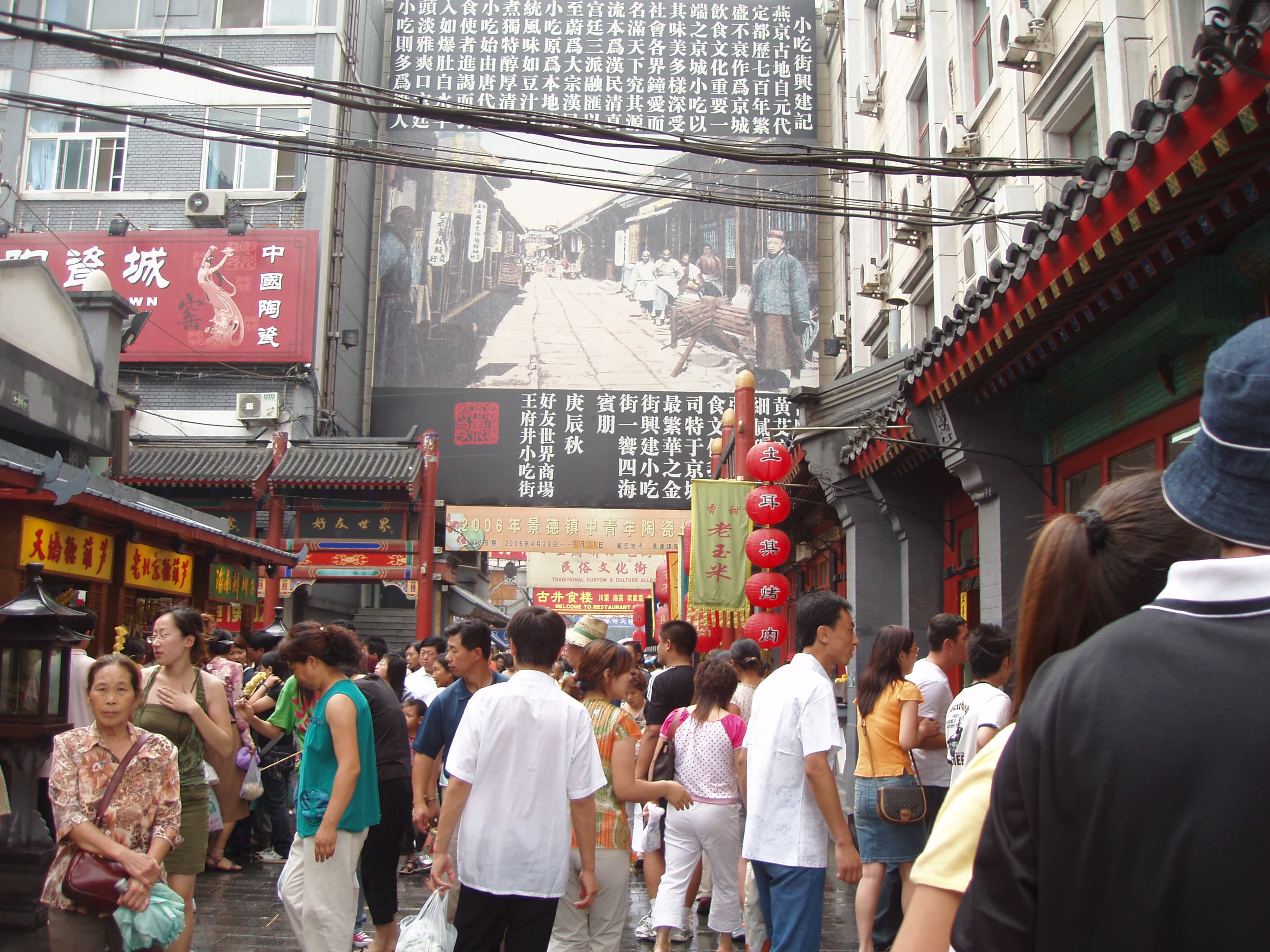
The phenomenon reaches far beyond Shanghai and spreads across China's big cities. In Beijing, a busy 相亲角 is held in , near the Forbidden City, as well as in Tiantan Park. Comparable gatherings exist in Guangzhou, Wuhan and Chengdu, each with its local codes, its posted terms and its faithful parents. The form varies, umbrellas here, stretched ropes and plastic sleeves there, but the grammar stays identical: a sheet, an age, a salary, a home, a hùkǒu.
This spread says something about an urban China pulled in two directions. On one side, a mobile, educated youth plugged into dating apps and ideals of chosen love; on the other, parents shaped in another era, for whom marriage remains a matter of families and calendars. The marriage market is the physical place where this gap becomes visible. What you read there is less the archaism of a custom than the anxiety of a transition, that of a country that moved in one generation from arrangement to love, without the parents having had time to truly consent.
An awkward love under the umbrellas#
It would be easy to see in the 相亲角 only a cynical fair where people are weighed like goods. The reality is gentler and sadder. These parents standing for hours under the plane trees, holding up the sheet of a child who often ignores their presence, act in the name of a real love, that of a generation that sacrificed everything for its only offspring and dreads above all leaving it alone. Their awkwardness is that of a vanished era facing a world that no longer runs by its rules. Shanghai's marriage market is not the museum of a tradition; it is the portrait of a very contemporary anxiety, written in centimeters and yuan on laminated sheets that the wind barely stirs.
FAQ#
What is Shanghai's 相亲角? It is an informal gathering at People's Park (人民公园) where, every weekend since the mid-2000s, parents post the "résumé" of their single child on open umbrellas to find them a spouse. In English it is called the marriage market.
Who comes to the marriage market, the singles or the parents? Almost always the parents, more rarely grandparents or aunts. Many of the "displayed" singles have no idea their family frequents the park, the whole thing being lived as a family affair led by the elders.
What is on a sheet? Age (年龄), height (身高), income (收入), education (学历), home ownership (房), hùkǒu residence status (户口) and sometimes the zodiac sign (属相). Rarely a photo or a name, almost never a description of character.
Why is the hùkǒu so important on the sheets? The 户口 (hùkǒu) conditions access to schooling, healthcare and urban rights. A Shanghai hùkǒu opens the best schools to the child to come: marrying a holder secures the next generation's future, hence its decisive weight.
Does the marriage market actually work? Very little. Journalists and sociologists agree on its matrimonial ineffectiveness: few unions come of it, and the children often refuse the chosen profiles. Its real role is to give parents a place to act on their anxiety.
Crédits photographiques : les images de cet article proviennent de Wikimedia Commons et sont sous licence libre.
China's One-Child Policy: 1980-2015, and After
China's one-child policy: what it actually prohibited, its rural exceptions, the birth sex imbalance, the children without household registration, and the demography it left behind.
Cover image: Jpbowen · Jpbowen, via Wikimedia Commons · CC BY-SA 4.0