Shūkatsu: Japan's Job Hunt, in a Black Suit
Shūkatsu (就活), the Japanese student job hunt: the official calendar, the recruit suit, the legal weight of a naitei, the entry sheet and the Rikunabi scandal.
La rédaction Kotoba Interactive
Studio éditorial
, short for 就職活動 (shūshoku katsudō, "job-hunting activity"), is the campaign Japanese students run to secure a job before they graduate. It usually starts in the spring of the third undergraduate year, more than a year before the degree, and follows a national calendar that everyone applies at the same time.
That simultaneity is the key to the system. Japanese companies practise 新卒一括採用 (shinsotsu ikkatsu saiyō), the bulk hiring of new graduates: an entire cohort starts work on 1 April, the same day, at hundreds of companies at once, often with no specific technical skill required at the point of hire.
The calendar, and who sets it#
Until 2018 the employers' federation published the rules of the game. That year it announced it would stop, and the government stepped in to keep a common framework.
| Stage | Reference date | What happens |
|---|---|---|
| Company briefings open | 1 March of year three | Fairs, information sessions, applications submitted |
| Selection interviews open | 1 June of year four | Formal interviews, written tests |
| Official job offers | 1 October | Ceremony awarding the 内定 (naitei) |
| Start date | Following 1 April | Company entrance ceremony (入社式) |
The calendar describes a norm, not a reality. Internships, so-called informal interviews and meetings with recruiters, the リクルーター面談, pull the process forward by several months. An agreement between three ministries reached in 2022 formalised the shift by allowing companies to use data gathered during certain longer internships for recruitment purposes, starting with the class graduating in 2025.
The uniform#
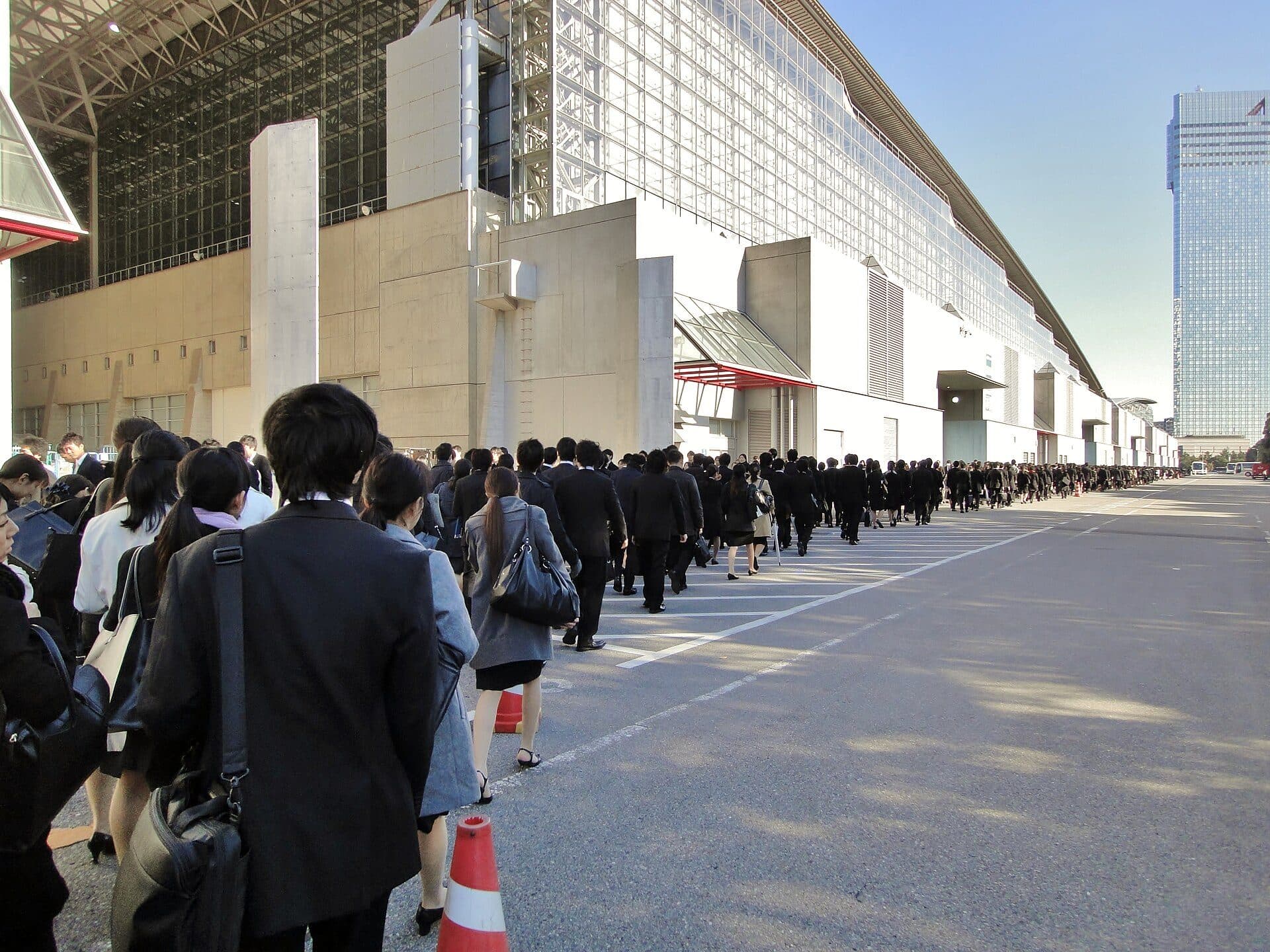
The リクルートスーツ (rikurūto sūtsu, "recruit suit") is a plain black suit, white shirt, black shoes, and a bag that stands upright on the floor. Nowhere is it written to be compulsory. Almost every candidate wears it.
Specialist chains sell it for around 30,000 to 40,000 yen, in a dedicated section, with the expected accessories. Guides set out acceptable skirt lengths, reasonable heel heights, the hair colour to adopt for the duration of the campaign, and the angle of a bow depending on who is receiving it.
The recruit suit is not there to make a candidate stand out. It is there to make them not stand out, which in this context is the intended message.
就活 contracts 就職 (shūshoku, "getting a job") and 活動 (katsudō, "activity"). The pattern spread: 婚活 (konkatsu, hunting for a spouse), 終活 (shūkatsu, preparing for one's own death, a perfect homophone of the first), 保活 (hokatsu, the race for a nursery place).
The entry sheet and self-analysis#
Applications go through the エントリーシート (entorī shīto, "entry sheet"), a form specific to each company, often filled in by hand. Three questions recur almost everywhere: the reason for applying (志望動機), personal strengths (自己PR), and what the student put their energy into during their studies, known by the abbreviation .
That last item explains part of Japanese school clubs and student volunteering: there has to be something to write in the box. It also explains the 自己分析 (jiko bunseki, "self-analysis") industry of books, workshops and personality tests designed to phrase one's own biography in the expected terms.
A student commonly applies to twenty or thirty companies, sometimes more, each with its own entry sheet, written tests and three to five interview rounds.
Japanese recruitment vocabulary is highly codified: 面接 (mensetsu, interview), 内定 (naitei, job offer), 御社 (onsha, "your company", the form used out loud in front of a recruiter). JapaneseSRS teaches these registers with the situations they belong to.
The naitei, a promise that binds#
The 内定 (naitei) is the job offer handed to a student before graduation. It is often translated as "informal offer", which is misleading.
Japan's Supreme Court settled the question in 1979, in a ruling concerning Dai Nippon Printing: a naitei constitutes a concluded employment contract, with a deferred start date and a limited right of termination. A company that withdraws a naitei is therefore dismissing an employee and must justify it as such. The waves of cancellations that followed the 2008 crisis produced litigation and ministerial guidance.
The student, on the other hand, remains free to decline. That asymmetry produced its own word: オワハラ (owahara), a contraction of 終われ ("end it!") and ハラスメント, for the pressure a company applies to make a candidate drop their other applications.
The Rikunabi scandal#
Two platforms structure the entire market: Rikunabi, from the Recruit group, and Mynavi. Students register there, submit applications and receive interview invitations.
In 2019 it emerged that Recruit Career had been selling client companies a predictive score of how likely a student was to decline their offer, calculated from browsing behaviour, without validly obtained consent. Japan's personal data protection commission issued corrective orders, the company suspended the service and apologised. The affair fed into the revision of Japan's personal data law.
The labour shortage has reversed the balance of power to the point of creating a new ritual, オヤカク (oyakaku, "checking with the parents"): companies contact a candidate's parents to make sure they approve of the choice, for fear the family will scupper the hire.
What the system costs, and what it holds together#
Its effectiveness deserves acknowledgement. The employment rate of Japanese graduates is among the highest in the developed world, close to 98% as of 1 April according to the joint surveys of the labour and education ministries. Youth unemployment is very low.
The criticism lies elsewhere. The calendar eats a year of study, since the job hunt happens during term. It punishes anyone who misses the window: a graduate without a post loses 新卒 (shinsotsu, "new graduate") status and drops out of the main recruitment channel, which marked the entire employment ice age generation of the 1990s. And it standardises profiles at precisely the moment companies say they are looking for diversity.
Failing at shūkatsu also carries a human cost: Japanese police classify several dozen suicides a year under the motive "failure in job hunting", a figure universities have watched closely since the 2010s.
FAQ#
When does shūkatsu really start? Officially in March of the third undergraduate year. In practice internships and preparatory meetings often begin the previous summer, nearly two years before the start date.
Is the black suit compulsory? No rule requires it. A few companies now advertise interviews in "free dress" (私服), a formula that leaves candidates unsure, with many turning up in a suit anyway.
What is a naitei worth legally? It is an employment contract with a deferred start date, under the Supreme Court's 1979 case law. A company can only break it under conditions comparable to a dismissal.
Can a foreigner take part in shūkatsu? Yes. International students enrolled at a Japanese university take part, with a change of residence status on hiring. Several job fairs are aimed specifically at them.
Read alsoJuken, bukatsu, randoseru: the Japanese school system explainedThe Japanese school path, from the compulsory club to the entrance exam, leading straight into this campaign.
Sources and further reading#
- Cabinet Office and Ministry of Health, Labour and Welfare, framework calendar for new graduate recruitment
- Supreme Court of Japan, Dai Nippon Printing ruling, 1979, on the legal nature of the naitei
- Personal Information Protection Commission (個人情報保護委員会), corrective orders concerning Recruit Career, 2019
- Ministries of Labour and Education, joint survey on graduate employment rates
Kabukichō Host Clubs: The Job, the Rankings, the Tab
Japanese host clubs: how a Kabukichō club works, the shimei system, the champagne call, the sales rankings, and the 2025 law that banned running a tab.
Cover image: Dick Thomas Johnson · Dick Thomas Johnson, via Wikimedia Commons · CC BY 2.0