Alipay, WeChat Pay: How China Abolished Cash
QR-code duopoly, technological leapfrogging, the red-envelope war and the digital yuan: the mobile payment rail that erased cash in China.
La rédaction Kotoba Interactive
Studio éditorial
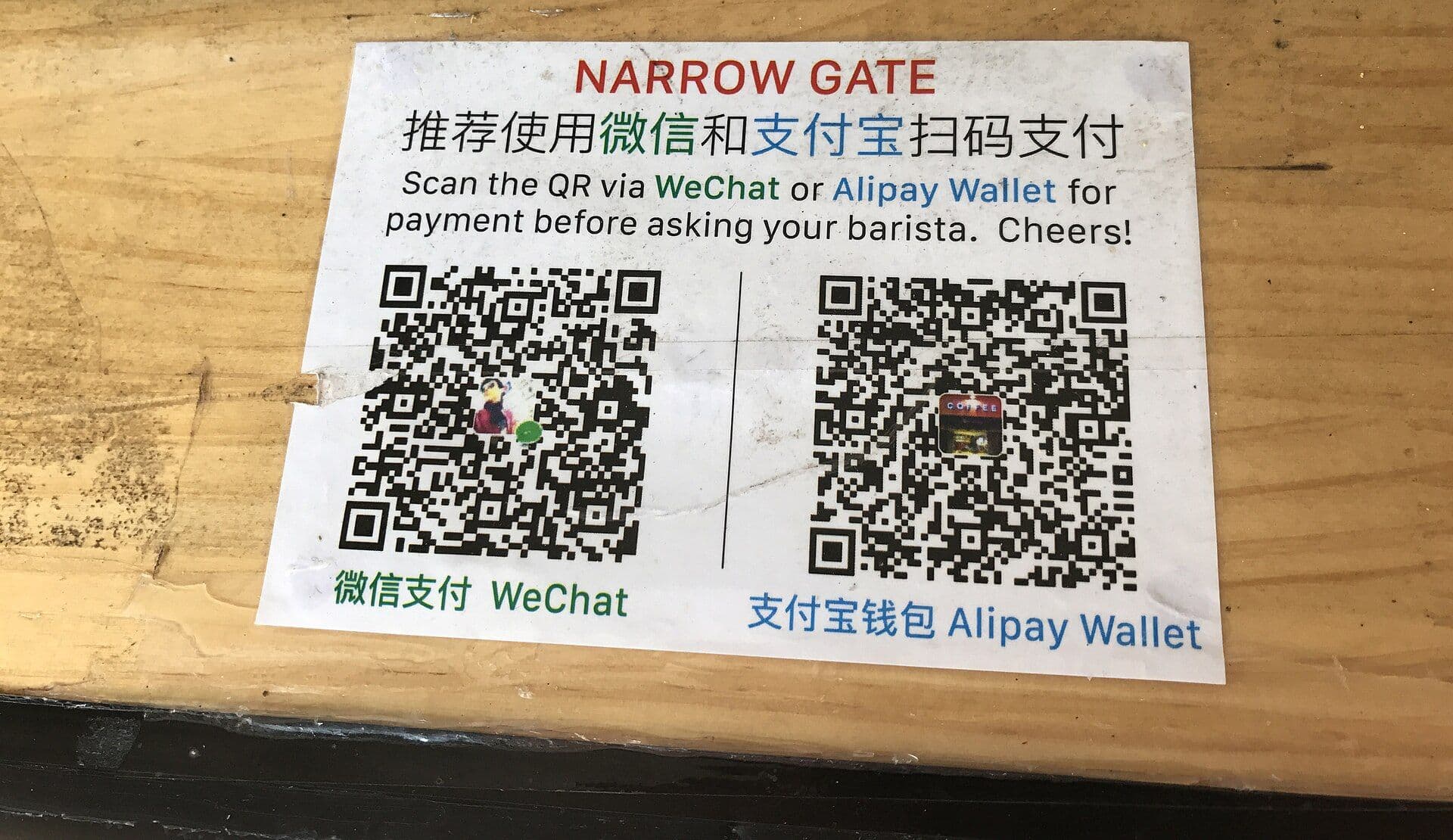
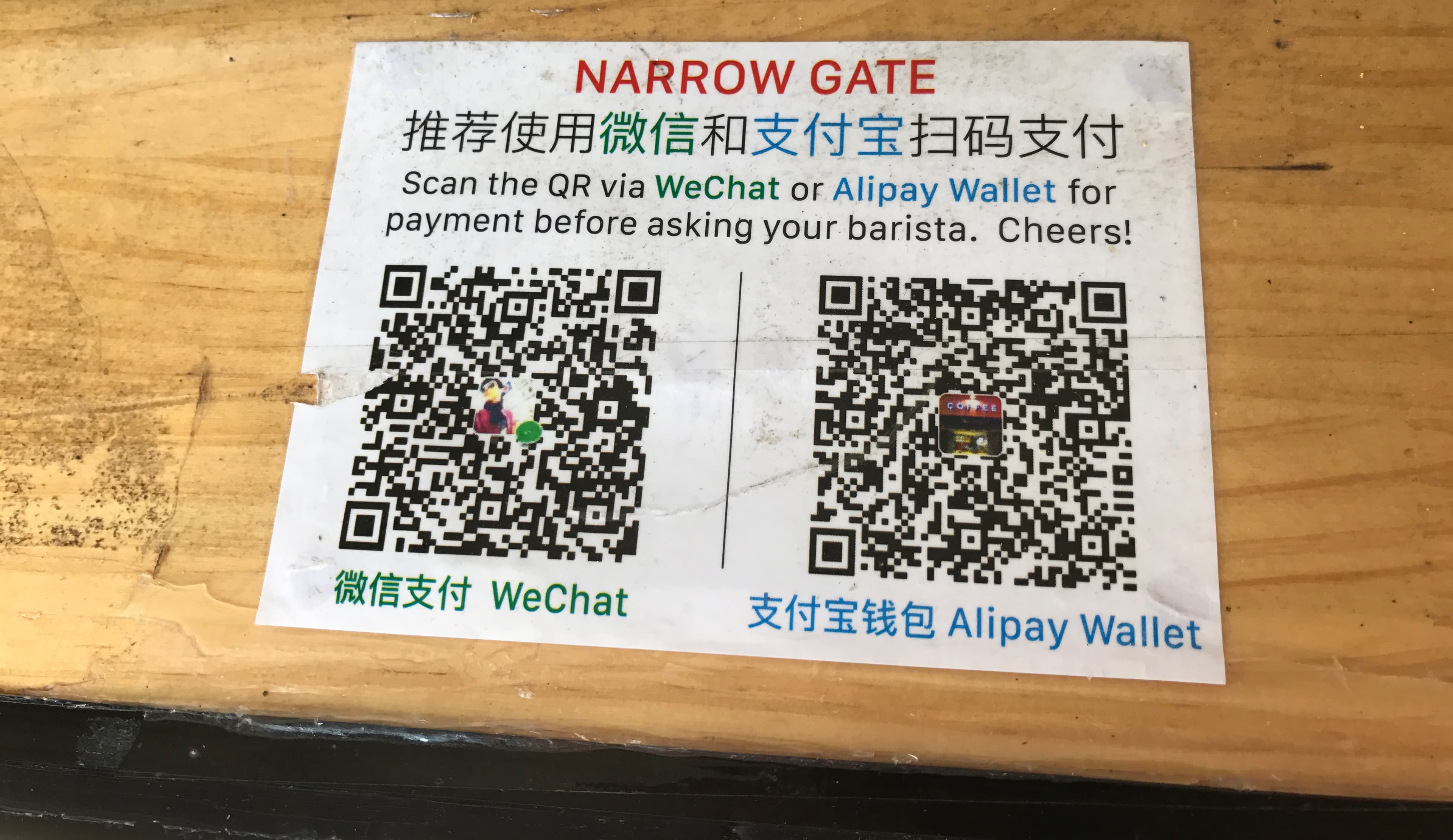
At a covered market in Chengdu, a tofu seller has just weighed out a portion worth the equivalent of three yuan. The customer does not reach for a wallet: he takes out his phone, aims the camera at the small black-and-white square taped to a jar of chili sauce, hears a synthetic "dīng" and a female voice announce the amount received. No note has changed hands. At the next stall, an old man selling bamboo shoots has pinned up two squares side by side, one blue, one green. Even a beggar, further along, holds out a laminated card with his own code. Cash, here, has all but vanished.
In a single decade, China became the first major cashless economy, not through the bank card, but through the phone. Two applications swallowed nearly all everyday transactions: , from the Ant Group tied to Alibaba, and , from Tencent. Their shared interface is a square: the , which you to pay for anything, anywhere. This article is not about the WeChat messenger, but about the payment rail itself: how it was built, how a duopoly emerged, how the state took back control, and what the has in store.
The QR Code, the Universal Interface of Payment#
The genius of the Chinese system lies in a technical choice of disarming simplicity: the . Where the West built its contactless payment on costly chip terminals, China made the printed square the sole point of contact between buyer and seller. A scrap of laminated paper is enough to take payment. No hardware, no terminal fee, no bank to persuade into installing a machine.
扫码 (sǎomǎ) joins sǎo (扫, "to sweep, to scan") and mǎ (码, "code"). The verb describes exactly the gesture that became a national reflex: passing the phone's camera over a square to trigger a payment. People also say sǎo yī sǎo (扫一扫), "give it a little scan."
Two directions of reading coexist. In scan-to-pay, the customer scans the code displayed by the merchant, enters or confirms the amount, and validates: this is the mode of small shops, where the seller need only print the square once and for all. In pay-by-QR, it is the reverse: the customer displays a dynamic barcode generated by their app, which the cashier scans with a handheld reader, as in a supermarket. The first mode brought mobile collection down to the humblest stall; the second smoothed the lines at supermarkets and chains.
The result is a coverage no card ever reached: taxis, street markets, temples for offerings, noodle vending machines, street performers, and even people asking for alms. The black-and-white square became the default economic gesture of a country of more than a billion people.
The Technological Leap: From Cash to Mobile Without the Card#
To grasp the scale of the phenomenon, you have to understand what China did not do: it never made the bank card widespread. In the early 2010s, the credit card remained rare, the terminal network sparse outside the big cities, and a large share of the population had only limited access to conventional banking services. Rather than catch up by rolling out decades of card infrastructure, the country bypassed it.
This is the phenomenon of the technological leap, leapfrogging: moving straight from an old technology to the newest one, skipping the intermediate step, the way some countries went directly to the mobile phone without ever deploying fixed lines. China thus went from the crumpled note to smartphone payment with no card stage, carried by a lightning adoption of the cheap phone and of a massive mobile internet.
China did not modernize the bank card: it skipped it. From the banknote to the QR code, never stopping at plastic.
The advantage is twofold. For the merchant, the cost of entry is nil or nearly so, whereas a card terminal implies a subscription and fees. For the consumer, the payment app is bolted onto a platform they already use every day, to chat, to order, to book. Payment is not a separate service: it is fused into the everyday use of the phone. This absence of a legacy to preserve made possible a switch that no economy matured around the card could have carried out so fast.
2014: The Digital Hongbao and Alibaba's "Pearl Harbor"#
The duopoly did not settle in without a battle, and its founding moment bears a festive name: the , the red envelope traditionally given filled with money at Chinese New Year. Alipay then dominated online payment without rival, an inheritance of its role as trusted third party for purchases on Alibaba. WeChat, a messaging app, had no credible payment weapon. Until New Year 2014.
That year, Tencent launched inside WeChat a digital hongbao feature: sending loved ones, within a conversation, a small sum in the form of a virtual red envelope, sometimes to be shared at random among the members of a group. The social game was irresistible. To receive the money, or to send it, you had to link your bank card to WeChat. In a few days of festivities, tens of millions of users took the step that had taken Alipay years to obtain.
Jack Ma, founder of Alibaba and figurehead of Alipay, is reported to have described the WeChat hongbao offensive as a surprise attack, a "Pearl Harbor." In a few days of celebration, a competitor he did not take seriously on payment had converted a messenger into a mass wallet.
This was the start of the "red-envelope war," renewed every year around the New Year television gala, the two giants showering users with billions of yuan in hongbao to capture their banking details. From this duel was born the balanced duopoly we know: WeChat Pay, strong in messaging and peer-to-peer payments; Alipay, strong in e-commerce and financial services.
Read alsoHongbao: the art of the red envelope in ChinaFrom the paper envelope to a transfer with one thumb: discover the hongbao, the ritual gift turned secret weapon of Chinese mobile payment.
Alipay Versus WeChat Pay: Anatomy of a Duopoly#
The two applications look alike in use, but their DNA differs. One was born of a marketplace, the other of a messenger, and those origins still dictate their strengths.
| 支付宝 Alipay | 微信支付 WeChat Pay | |
|---|---|---|
| Parent company | Ant Group (Alibaba galaxy) | Tencent |
| Origin | E-commerce trusted third party (2004) | Feature of the WeChat social network (2013) |
| Strong point | Financial services, credit, e-commerce | Peer-to-peer payments, social ubiquity |
| Gateway | Dedicated financial app | Embedded in everyday messaging |
| Ecosystem | Credit, savings, insurance, scoring | Mini-programs, shops, hongbao |
Alipay, launched in 2004, is first an escrow service: the buyer's money is held with the trusted third party until the goods are received, which solved the trust problem that had held back Chinese e-commerce. From this financial root, Alipay built a full ecosystem of credit, savings, and insurance. WeChat Pay, which appeared in late 2013 and was propelled by the 2014 hongbao, draws its strength from being wherever people chat: paying a friend, a restaurant, or a bill requires only staying inside the app that is already open all day.
Together, the two systems handle the overwhelming majority of the country's mobile payments. This extreme concentration, two private players holding the rail through which the money of a billion people flows, was to become a political issue of the first order.
Credit and Scoring: Huabei, Sesame Credit and the Controversy#
Payment was only a gateway. Bolted onto Alipay, the Ant Group rolled out a consumer-credit ecosystem of unprecedented scale. , whose name means roughly "go ahead and spend," works like a built-in credit reserve: a purchase can be paid on credit and repaid the following month, in the manner of a credit card, but housed inside the payment app and granted in seconds.
To assess creditworthiness, Ant created , a reputation score computed from payment history, spending habits, and other platform data. A high score gave access to concrete perks: no deposit required for renting bikes or power banks, lighter hotel deposits, simplified formalities.
Here caution is essential. Sesame Credit has often been confused, in the foreign press, with the Chinese state's "social credit system." These are two distinct things. Sesame Credit is a private commercial score, a loyalty and credit-risk tool run by a company, which you opt into by using Alipay. The state "social credit" project, for its part, is a far vaguer and more heterogeneous set of administrative mechanisms. Conflating the two has fed a myth of a single, all-knowing score that does not match the more fragmented reality of the systems actually in place.
A commercial loyalty score is not a state verdict. The confusion between Sesame Credit and social credit produced a myth sharper than the reality.
It remains true, however, that the concentration of payment, credit, and behavioral data in the hands of two private companies raised a question of power. A company able to rate the creditworthiness of a billion people and lend to them in one tap was becoming a systemic actor, on the edge of banking, but outside its regulatory frame.
The Crackdown: Ant Group's Aborted IPO#
In November 2020, Ant Group was about to carry out the largest stock-market flotation in history, straddling Shanghai and Hong Kong, at a dizzying valuation. A few days before listing, the operation was suspended by the authorities, in a thunderclap that stunned world markets. The IPO never took place in its planned form.
Shortly before, Jack Ma had delivered a resounding speech criticizing China's financial regulators and the timidity of the traditional banking system. He then largely disappeared from public life for months, and his empire was brought to heel. Ant Group was ordered to restructure as a financial company subject to banking supervision, to raise its capital, and to separate its credit activities more clearly. It was the most spectacular act of a vast antitrust crackdown waged in 2020 and 2021 against the giants of Chinese tech, from Alibaba to Tencent.
The message was clear: no private player, however popular its app, would lastingly hold the payment rail of a nation without the state having a hand in it. The duopoly survived, but curbed, reframed, and now closely watched.
The State's Answer: The Digital Yuan (e-CNY)#
Faced with a payment rail held by two private players, the state prepared its own electronic currency: the , often referred to by the acronym e-CNY, and known in its initial project as DCEP (Digital Currency Electronic Payment). It is not a decentralized cryptocurrency, nor a mere balance in a private app: it is central bank money, issued by the People's Bank of China, the direct digital equivalent of the banknote.
The distinction is crucial. When you pay with Alipay, you transfer a claim on a commercial bank via a private platform. The digital yuan, by contrast, is a debt of the central bank itself, like a dematerialized note. It pursues several goals: to offer a public alternative to the private duopoly, to keep the state in control of the payment system, to ease financial inclusion, and to give the authorities fine visibility into flows, this last point feeding concerns about surveillance.
Rolled out gradually in waves of trials in major cities, sometimes distributed as public hongbao to prime usage, the e-CNY remains, to date, a modest share of payments compared with the two private giants. But it embodies the ambition of a state determined not to let an infrastructure as strategic as everyday money slip entirely out of public hands.
Behind every payment lie keywords that recur everywhere: 扫码 (sǎomǎ, to scan), 支付宝 (Zhīfùbǎo, Alipay), 红包 (hóngbāo, red envelope) and 数字人民币 (shùzì rénmínbì, digital yuan). Learn to read the hanzi of everyday Chinese economics with ChineseSRS and its spaced repetition.
The Blind Spot for Foreigners, and Its Recent Opening#
For a long time, this system of prodigious fluidity was a wall for the foreign visitor. Alipay and WeChat Pay required a Chinese bank account to work fully, and opening such an account presupposes a local phone number, a Chinese ID document, or a long stay. The tourist found themselves paradoxically stranded in the most cashless country in the world: unable to scan a QR code, reduced to hunting for a cash no one wanted to handle anymore, and sometimes turned away by merchants who had no change to give.
This friction was eventually addressed. Both applications opened the possibility of linking international bank cards (Visa, Mastercard, and others) for visitors, with adapted limits and checks, to let the traveler pay by QR code without a Chinese account. The switch remains imperfect and sometimes temperamental, but it marks a recognition: a country that has gone cashless cannot remain inaccessible to those who visit it.
The most cashless country in the world was long the hardest for a foreigner to pay in. Without a Chinese account, a card, or cash accepted: an invisible wall behind every QR code.
This episode reveals a broader truth of the Chinese model: its strength, total integration into a national ecosystem, is also its limit. A system designed for a billion residents sits poorly with the passing visitor, and the opening to international cards was less a convenience than a necessity for a country seeking to stay connected to the rest of the world.
Read alsoWeChat: the super-app that does everythingPayment is only one facet of WeChat: explore the super-app that concentrates messaging, mini-programs, and services in a single interface.
The payment rail shows its full power one day a year: dive into Double Eleven, the largest shopping festival on the planet.
From the Chengdu market to the New Year gala, from Alipay's escrow to central bank money, China rewrote in a decade the most mundane mechanism of economic life: paying. It did so with a square of pixels rather than a piece of plastic, with a leap rather than a catch-up, and at the cost of a duopoly so powerful that it then had to be brought to heel. The little "dīng" that sounds on the stalls does not just announce a transaction: it signals a society that has made the phone the last gesture of money.
FAQ#
What is the difference between Alipay and WeChat Pay? Both let you pay by QR code, but their origins differ. Alipay (支付宝), from the Ant Group tied to Alibaba, was born of e-commerce escrow and developed a strong ecosystem of credit and financial services. WeChat Pay (微信支付), from Tencent, is embedded in the WeChat messenger and dominates peer-to-peer payments thanks to its social ubiquity.
Why does China barely use the bank card? The credit card had never become widespread in China before the rise of the smartphone. The country therefore made a technological leap (leapfrogging): it went straight from cash to mobile payment, bypassing the card stage, carried by mass adoption of the phone and the mobile internet.
What is the digital hongbao and why was it decisive? The hongbao (红包) is the red envelope of money given at New Year. In 2014, WeChat launched a digital version inside its conversations: to send or receive these envelopes, you had to link your bank card. In a few days of festivities, tens of millions of users fitted WeChat with a means of payment, something Jack Ma is said to have compared to a "Pearl Harbor" for Alipay.
Is Sesame Credit the Chinese "social credit system"? No, and the confusion is common. Sesame Credit (芝麻信用) is a private commercial score run by Ant, tied to the use of Alipay, which assesses credit risk and grants perks (no deposits, lighter hotel deposits). The state "social credit" project is a distinct and far more heterogeneous set of administrative mechanisms. Conflating them gives a misleading picture.
What is the digital yuan (e-CNY)? The digital yuan (数字人民币, e-CNY, formerly DCEP) is central bank money issued by the People's Bank of China, the direct digital equivalent of the banknote. Unlike an Alipay balance, which is a claim on a commercial bank via a private platform, the e-CNY is a debt of the central bank. It aims to offer a public alternative to the private duopoly and keep the state in control of payment.
Photo credits: images in this article come from Wikimedia Commons and are under free licenses.
WeChat: the super-app that does everything
The full history of WeChat, the Chinese super-app that redefined digital life. Messaging, mobile payment, mini-programs, social network: how one application became a social operating system.
Cover image: Harald Groven · Harald Groven, via Wikimedia Commons · CC BY-SA 2.0