Seoul's theme cafés: dalgona, bingsu and cat lounges
A country that runs on coffee: the café as living room and office, the galaxy of theme cafés, and how to order like a local.
La rédaction Kotoba Interactive
Studio éditorial
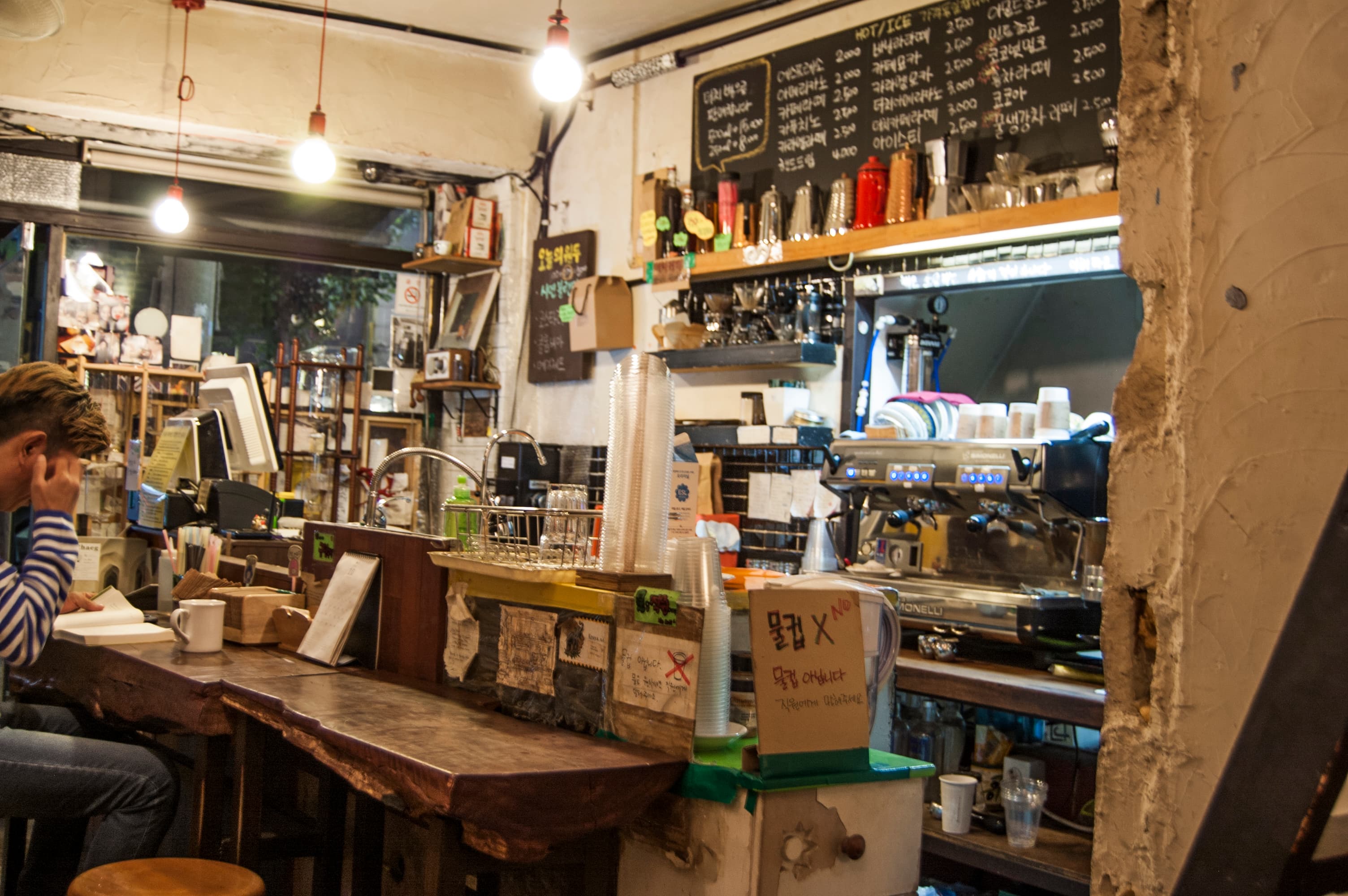
It is three in the afternoon in a back street of Seongsu-dong, in Seoul, and the café rises over three floors of raw concrete. On the ground floor, a barista draws a fern in the foam of a café latte; upstairs, a dozen students have colonized the long tables, earbuds in, screens glowing, chargers plugged into outlets clearly designed for them. A ginger cat, owner of the place more than tenant, threads between the chair legs and curls up on an empty cushion. Nobody bats an eye. Here, the café is not a pause in the day: it is the day's main setting.
South Korea replays this scene millions of times a day. The 카페 (kape, café) has become far more than a place to drink an espresso: it is a living room when the apartment is too small, an office when the company is too far, a library when home is too loud, and a social stage where people show themselves as much as they meet. To understand the Korean café is to read a whole society between the lines: its urban density, its relationship to work, its taste for shareable aesthetics, and its very particular way of inhabiting public space.
A country that runs on coffee#
South Korea ranks among the most café-saturated countries in the world, and Seoul in particular boasts one of the highest concentrations on the planet. In some neighborhoods of the capital, you can count several cafés per block, from giant chains to micro-roasters, not to mention the homegrown franchises that have spread even faster than the American brands. Coffee consumption per capita has exploded in a single generation, to the point of rivaling that of the great caffeinated nations.
The paradox is that Korea was long a country of tea. Coffee arrived at the end of the nineteenth century, tied to modernity and to foreign legations; himself is said to have acquired a taste for it. But it was instant coffee, the famous 믹스커피 (mikseu keopi, "mix coffee": instant coffee, sugar and powdered creamer bundled in a single sachet), that democratized the drink in the offices and homes of the later twentieth century. The specialty-coffee revolution, the one of freshly roasted beans and carefully styled spaces, is far more recent, driven by a young, connected urban class hungry for photogenic backdrops.
In Korea, coffee is not merely drunk: it is lived in, worked in, and above all photographed.
The café as living room, office and library#
To grasp the place of the café in Korean life, you have to leave behind the Western idea of the bistro where you linger for half an hour. Here, dwell time is measured in hours. The café is a third place in the fullest sense: neither home nor work, but an in-between space where people come to live out part of their day.
This function is rooted first in material realities. In a megacity where homes are often cramped and shared, where university libraries are packed as exams loom, the café offers what the apartment cannot: space, relative quiet, fast Wi-Fi, power outlets and generous air conditioning. For the price of an 아메리카노 (amerikano, americano), you are in fact renting a workstation for the afternoon.
The kagongjok, the tribe that studies at the café#
This way of life eventually earned a name. The 카공족 (kagongjok) are, literally, the "café-study tribe": the word fuses 카페 (café), 공부 (gongbu, study) and the suffix 족 (jok, tribe, people). These are the students and young professionals who settle in for hours, textbook open, laptop on, to revise, code, write a thesis or prepare for the exams that pace Korean life.
The phenomenon is so massive that it divides owners. Some cafés bless the kagongjok, who fill the rooms in slow hours and order regularly to justify their stay; others, exasperated by those who monopolize a whole table over a single coffee for five hours, post time limits, switch off the outlets, or ban laptops on weekends. This tension says a great deal about Korean academic pressure, the same pressure that fills the hagwon, those private evening academies: the café is not only a pleasure, it is an extension of the classroom.
Renting a chair for five hours on a single americano: the Korean café is the cheapest office in town.
The galaxy of theme cafés#
If the ordinary café is already everywhere, Korea's singularity lies elsewhere: in the depth of the concept. The market is so saturated that a merely good coffee no longer sets anyone apart. You need an idea, a set, an experience to be lived and posted. Out of this race to differentiate was born the galaxy of theme cafés, which turn the coffee break into a small attraction.
| Type of theme café | What you find there | Who it is for |
|---|---|---|
| Animal café | Cats, dogs, but also sheep, raccoons or meerkats to share the room with | Animal lovers who cannot keep a pet at home |
| Character café | The worlds of brands like Line Friends or Kakao Friends, mugs and cakes bearing the mascots | Fans, families, tourists |
| Book café | Shelves of books, enforced quiet, soft light, a reading-room spirit | The kagongjok and solitary readers |
| Dessert café | Spectacular pastries, giant bingsu, tables built for the photo | Groups of friends, couples on an outing |
| Study / 24-hour café | Long tables, outlets everywhere, all-night opening | Students cramming, night workers |
Animal cafés#
In a country where many homes forbid pets and where long workdays leave little time to care for one, the animal café answers an emotional gap. The 고양이 카페 (goyangi kape, cat café) was the pioneer, soon followed by dog cafés and then by more exotic venues peopled with sheep, raccoons or meerkats. You pay an entrance fee, often including a drink, to spend time with the animals under precise rules: wash your hands, do not wake a sleeping creature, do not force contact. The formula has spread worldwide, but it remains emblematic of Korean urban life.
Character and brand cafés#
Another local specialty: the character café, where a brand's entire universe is staged. The chains born of messaging apps, chief among them Line Friends and Kakao Friends, have opened giant cafés where the mascots become murals, latte art and cakes. People come less for the coffee than for the souvenir photo beside a life-size character. These venues, often attached to enormous shops, are as much cafés as merchandising showcases.
Book cafés, dessert cafés and the rest#
The rest of the catalogue tends toward the endless. The 북카페 (bukkape, book café) pairs caffeine and reading in a hushed, library-like mood. Dessert cafés bet on outsized pastries and monumental 빙수 (bingsu) to share. There are also flower cafés, cafés set in former factories or restored hanok, rooftop cafés, seasonal-theme cafés that redecorate for every holiday. Creativity seems limitless, pulled along by a single implicit rule: offer a setting people will want to show off.
What you drink: dalgona, bingsu and company#
Behind the sets, the drinks menu has its stars too. The most globally famous is surely 달고나커피 (dalgona keopi, dalgona coffee), that whipped coffee with a thick, caramelized foam, made by beating instant coffee, sugar and hot water at length before spooning it over cold milk. Locked down at home in the spring of 2020, the whole world began whipping it up in their kitchens, turning this Korean drink into a planet-wide viral phenomenon. Its name comes from 달고나 (dalgona), a caramelized sugar candy of Korean childhood, whose color recalls the coffee's foam.
In summer, the reigning café order lies elsewhere: it is 빙수 (bingsu), a mountain of finely shaved ice, drizzled and topped. The classic version, 팥빙수 (patbingsu), is heaped with sweet red beans, pieces of tteok (rice cake) and sometimes condensed milk; modern versions run to mango, strawberry, matcha or cream cheese. A bingsu is ordered for several and devoured with tiny spoons, forehead to forehead, in a summer ritual of sharing. Alongside these stars, the menu makes room for 에이드 (eideu, fizzy fruit ades) and flavored milks, often chosen more for their colors than their caffeine.
Ordering like a local#
That leaves the ordeal of the counter. Good news: the Korean café menu is largely written in phonetic hangeul, which makes it surprisingly accessible the moment you can read the alphabet. The country's default order, heard a thousand times a day, comes down to two syllables: 아아 (a-a), the casual abbreviation of 아이스 아메리카노 (aiseu amerikano, iced americano). Koreans drink their americano cold in all weather, deep winter included, so much so that the word 얼죽아 (eoljuga, "I would rather freeze to death than give up my iced americano") has taken hold to name this stubborn loyalty.
To order cleanly, a few markers suffice. You say 아이스 아메리카노 주세요 (aiseu amerikano juseyo, "an iced americano, please"), you specify 따뜻한 거 (ttatteutan geo, "a hot one") if you prefer it steaming, and you announce 포장 (pojang, to go) or 먹고 갈게요 (meokgo galgeyo, "I'll have it here") to steer the service. Tipping does not exist: you pay at the counter, pick up your cup when your number is called, and set off in search of the perfect table.
Reading the board of a 카페 (kape), ordering an 아아 (a-a, iced americano) or slipping in a 포장 (pojang, to go) becomes effortless the moment you can read hangeul. With KoreanSRS and its spaced repetition, you will learn the vocabulary of the café and the rest of Korean daily life, one word at a time.
After the café, the street. Discover the snacks eaten standing up on Korea's sidewalks, from molten hoddeok to warm gyeranppang.
Frequently asked questions#
What does 아아 mean in a Korean café? A-a (아아) is the casual abbreviation of 아이스 아메리카노 (aiseu amerikano), the iced americano. It is the country's most common order, called for in every season, deep winter included, a habit so stubborn it has its own word, eoljuga (얼죽아).
Why are there so many cafés in South Korea? Because the café has become a third place: a substitute living room, office and library in dense cities with cramped homes. Add to that a culture of sociability, a strong taste for photogenic settings, and an ultra-competitive market that pushes every venue to reinvent itself.
What is a kagongjok? A is someone who studies or works for hours at a café. The word combines 카페 (café), 공부 (study) and 족 (tribe). The phenomenon is so widespread that some cafés encourage it, while others cap dwell time or cut the power outlets.
What is bingsu? is an iced dessert made of finely shaved ice, topped and drizzled. Its classic version, patbingsu (팥빙수), combines sweet red beans, rice cake and condensed milk; modern versions run to mango, strawberry or matcha. It is shared among several people, above all in summer.
Jeonse: The Giant Deposit That Holds Up Korean Housing
Jeonse (전세): handing over 60% of a property's value and paying no rent. How this uniquely Korean system works, why it produced the deposit fraud crisis, and why it is retreating.
Cover image: jillllybean · jillllybean, via Wikimedia Commons · CC BY-SA 2.0