Hotteok, Gyeranppang: A Guide to Korean Street Food
Molten hotteok, egg-filled gyeranppang, spicy tteokbokki, winter bungeoppang: a hungry guide to Korea's street snacks and how to order them.
La rédaction Kotoba Interactive
Studio éditorial
It is minus five degrees at Namdaemun market, night falls early in January, and a greasy steam rises from an oiled cast-iron griddle. The vendor flattens a ball of dough with the back of her spatula, flips it, and the melted sugar inside begins to sizzle against the scorching metal. She slides the golden disc into a paper cup, hands it to you without a word, and you bite too soon: the brown-sugar syrup runs, burning, over your gloved fingers. It is a , and for a few small coins you have just understood why Koreans face winter with a smile.
The Korean street is eaten standing up, between errands, at the mouth of a subway station, or after class. It is not restaurant cooking, but it is not junk food either: it is a full culinary universe, with its own codes, seasons and classics that everyone knows by heart. Here is the guide to the snacks themselves, the ones you hold in the palm of your hand, from the sweetest to the spiciest.
Bunsik, a galaxy of little dishes#
In Korean, street food is 길거리 음식 (gilgeori eumsik), literally "food of the street." But the word you will hear most often is 분식 (bunsik), a broader category for cheap flour- and rice-based dishes served fast and without ceremony. Originally the term referred to the wheat dishes encouraged in the 1960s, when rice was scarce and the government pushed people toward imported flour. What began as a survival policy became, a generation later, a beloved popular cuisine.
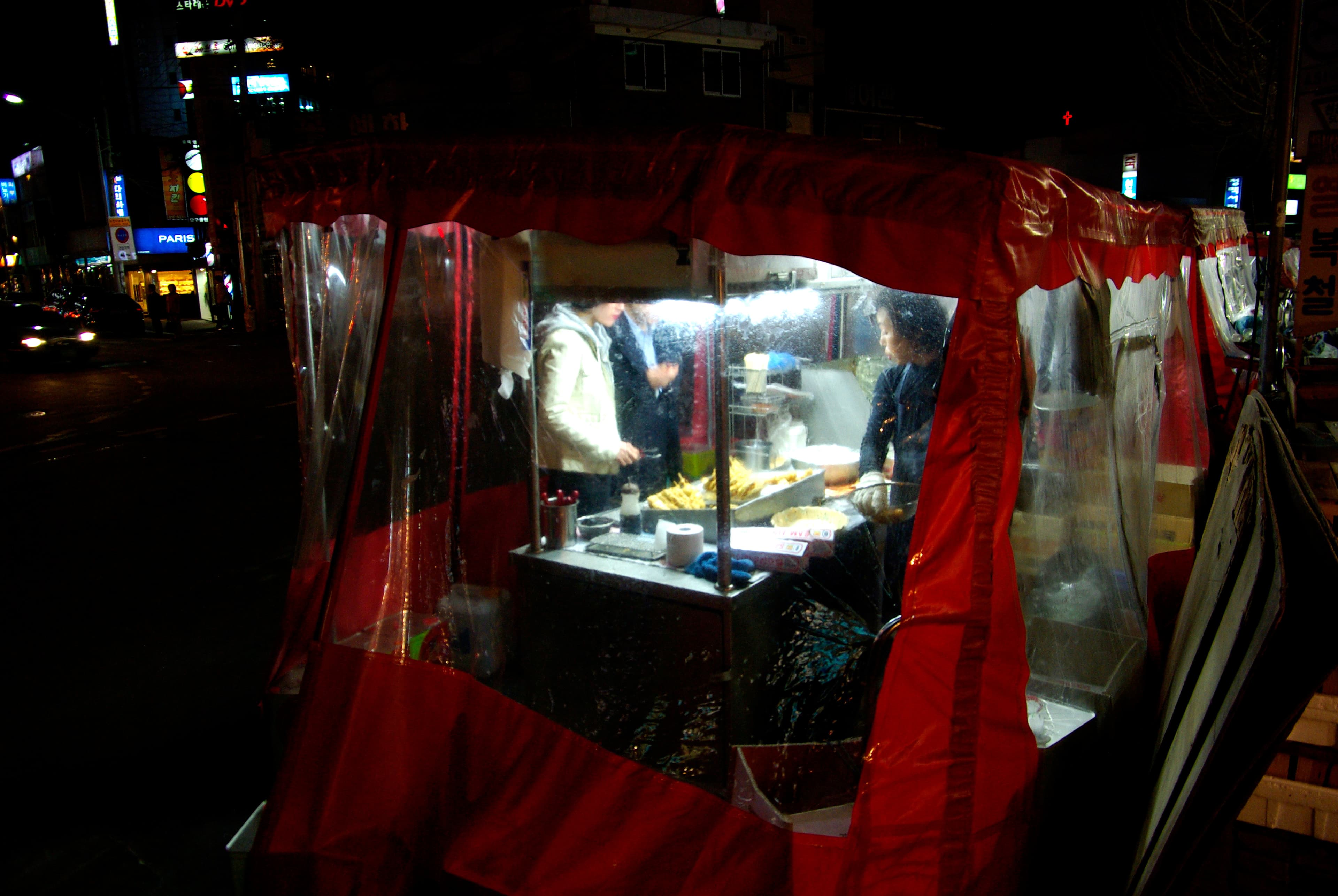
Bunsik is eaten in three settings. The first is the mobile stalls posted outside subway stations, high schools and markets. The second is the , those orange tarpaulin tents that light up at dusk and deserve a whole exploration of their own (see below). The third, quieter, is the small neighborhood shops, the bunsikjip, where you sit on a stool for a steaming plate of tteokbokki. The common thread: you eat hot, you eat fast, and you pay next to nothing.
Korean street food is not a stopgap snack. It is a shared collective memory, eaten among friends, gloved to the teeth, under a bare bulb and a winter sky.
The sweet stars of winter#
Some snacks have only one season: the cold. As soon as the temperature drops, they appear on street corners like fireflies, and vanish in spring.
Hotteok 호떡, the molten-hearted pancake#
The is the undisputed star of Korean winter. A leavened dough, filled with a mix of brown sugar, cinnamon and peanuts or crushed seeds, then pressed and fried on an oiled griddle until golden. At the first bite, the sugar has melted into a thick, hot syrup that threatens to scald you: haste is the only real danger of Korean street food.
Its history tells a story of movement across Asia. The hotteok is thought to have arrived with Chinese merchants in the late nineteenth century, before being fully adopted and transformed by Korea. In Busan, a famous variant, the , splits the half-cooked disc to stuff it with sunflower, pumpkin and sesame seeds: a Gukje market specialty that tourists photograph as much as they devour.
Bungeoppang 붕어빵, the fish that never swims#
The is a warm carp-shaped pastry, cooked in a hinged mold and traditionally filled with 팥 (pat, sweet red-bean paste). The name literally means "carp bread," but the fish has nothing to do with the taste: it is simply the shape of the mold, inherited from a very close Japanese cake, taiyaki.
It is sold by the bag of several pieces, piping hot, and there is now a whole parade of variants: custard, pizza, sweet potato. The bungeoppang has even become a small social metaphor: finding a bungeoppang vendor is, every winter, a treasure hunt that Koreans share online as the stalls grow scarcer.
Savory, from school to the last train#
The rest of the bunsik galaxy is eaten year-round, and this is where the true everyday classics live.
Gyeranppang 계란빵, the egg bread#
The 계란빵 (gyeranppang, "egg bread") is a small oblong bun, soft and slightly sweet, into which a whole egg is cracked before baking. It comes out golden, the egg set on the surface, halfway between a muffin and a fried egg. Filling, warm, easy to hold in one hand: it is the snack of the winter early morning, the one you grab while running for the subway. Some vendors add a pinch of cheese, parsley or ham.
Tteokbokki 떡볶이, the national spicy dish#
If one had to crown the king of bunsik, it would be 떡볶이 (tteokbokki): cylinders of rice cake, chewy and springy, simmered in a thick sauce of 고추장 (gochujang, fermented chili paste), red, glossy and sweet-spicy. It is often served with slices of 어묵 (eomuk, fish cake), hard-boiled eggs and spring onions.
Tteokbokki is inseparable from Korean youth: it is the after-school treat shared in a small stall, everyone dipping into the same pan. Its spin-off, rabokki, adds instant ramyeon noodles. Spicy, comforting, communal: it sums up the whole spirit of the Korean snack on its own.
Eomuk 어묵 and its free broth#
On nearly every stall sits a steaming vat of 어묵/오뎅 (eomuk/odeng, fish cake) skewers, dipped in a clear, hot broth. You pay for the skewer, eat it standing, and often help yourself, for free, to a cup of that anise-scented broth that warms the hands as much as the stomach. The word 오뎅 (odeng) is a borrowing from the Japanese oden; 어묵 (eomuk) is the purely Korean equivalent, increasingly preferred.
Gimbap, twigim, sundae and the rest#
The catalog does not stop there. 김밥 (gimbap) is a roll of rice and nori seaweed filled with vegetables and omelet, cut into bite-sized pieces, perfect to take away. 튀김 (twigim) refers to fried fritters, vegetables or seafood, often dipped in tteokbokki sauce. And 순대 (sundae), a blood-and-noodle sausage, is served by the tray with peppered salt, for the more adventurous palate.
| Snack | What it is | Sweet / Savory | Season |
|---|---|---|---|
| 호떡 (hotteok) | Fried pancake with a molten brown-sugar center | Sweet | Winter |
| 붕어빵 (bungeoppang) | Carp-shaped pastry with red-bean paste | Sweet | Winter |
| 계란빵 (gyeranppang) | Soft bun with a whole egg baked inside | Savory-sweet | Winter, morning |
| 떡볶이 (tteokbokki) | Rice cakes simmered in gochujang sauce | Savory, spicy | Year-round |
| 어묵 (eomuk) | Fish-cake skewers in hot broth | Savory | Year-round, mostly winter |
| 김밥 (gimbap) | Filled roll of rice and nori seaweed | Savory | Year-round |
| 튀김 (twigim) | Fried fritters of vegetables or seafood | Savory | Year-round |
When a vendor calls out 뜨거워요 (tteugeowoyo, "it's hot!") as they hand you a 호떡 (hotteok), catching it by ear changes everything. With KoreanSRS and its spaced repetition, you will learn the vocabulary of the stalls, the numbers to pay with and the words of Korean daily life, one 분식 (bunsik) at a time.
Where and when to hunt them down#
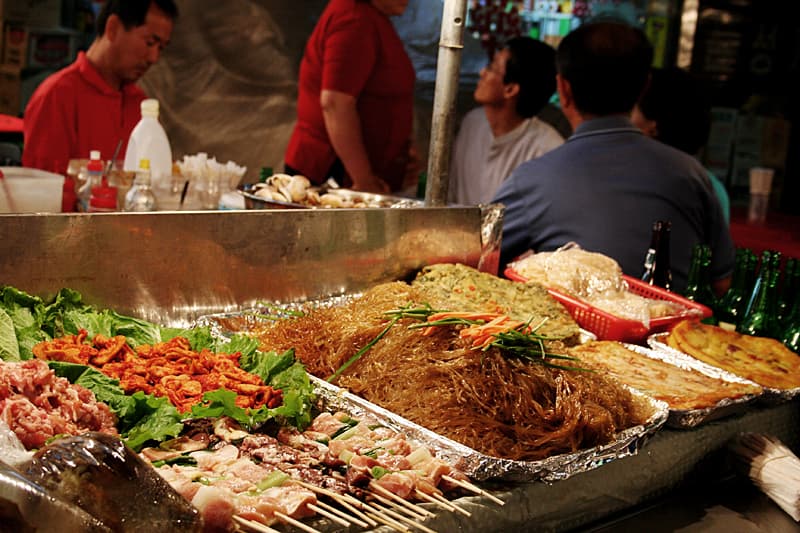
The geography of the Korean snack follows the crowds. Traditional markets like Gwangjang in Seoul, a temple of bindaetteok and gimbap, or Namdaemun, are open-air paradises. The student streets of Hongdae and Sinchon, the areas around high schools at closing time, and of course the night-time pojangmacha hold most of the offer. These orange tents, where you eat elbow to elbow around a counter, form a whole world of their own worth exploring in more detail.
Some snacks obey the calendar: hotteok and bungeoppang are creatures of winter, while tteokbokki, gimbap and eomuk are found in every season. For the traveler, winter remains the magic moment, when the steam of the stalls draws halos in the frozen air.
Ordering without stress#
You do not need to speak fluent Korean to feast. Most transactions come down to two phrases and a gesture. Point at what you want and say 이거 주세요 (igeo juseyo, "this one, please"). To learn the price, a simple 얼마예요? (eolmayeyo, "how much is it?") is enough. Bring small change: many stalls take only cash, and prices come to a few thousand won.
A few customs make life easier. You often eat on the spot, near the stall, and return your cup or skewer to the vendor. The eomuk broth is refilled freely in your cup. And if you share a tteokbokki with others, everyone dips into the common pan: that is the convivial heart of the ritual.
Read alsoSeoul's theme cafés: dalgona, bingsu and cat loungesTwo words, a pointed finger, a few coins: Korean street food is perhaps the warmest doorway into the country's language and life.
After the molten sweetness of the street, Korea cultivates another art of indulgence, sheltered from the cold: coffee. Discover the wild culture of Korean cafés and theme cafés.
Frequently asked questions#
What is hotteok? Hotteok (호떡) is a leavened-dough pancake, fried on an oiled griddle, whose center of brown sugar, cinnamon and seeds melts as it cooks. It is the emblematic street snack of Korean winter, eaten piping hot, watching out for the syrup that runs.
What is the difference between bungeoppang and gyeranppang? Bungeoppang (붕어빵) is a sweet fish-shaped pastry filled with red-bean paste, while gyeranppang (계란빵) is a soft savory-sweet bun with a whole egg baked inside. The first is a dessert, the second a heartier snack.
Is tteokbokki very spicy? Tteokbokki (떡볶이) ranges from moderately to frankly spicy depending on the stall, thanks to its gochujang sauce. Milder versions exist, made with soy sauce (ganjang tteokbokki) or cream, for sensitive palates.
How do I order without speaking Korean? Just point and say "이거 주세요" (igeo juseyo, "this one, please"), then "얼마예요?" (eolmayeyo, "how much is it?") for the price. Bring change, as many stalls only accept cash.
Ramyeon: Korea's Instant Noodle Culture
Ramyeon (라면) is not Japanese ramen: almost always instant and fiery. From Samyang in 1963 to the global Shin Ramyun and the ram-don of Parasite.
Cover image: LinasD · LinasD, via Wikimedia Commons · CC BY-SA 4.0