Chinese legends: Chang'e, the cowherd and the others
Chang'e on the moon, the cowherd and the weaver girl, the white snake, Meng Jiangnü: the origins, texts and survival of China's great legends.
La rédaction Kotoba Interactive
Studio éditorial
The probe that landed on the far side of the Moon in January 2019 is called Chang'e 4, after a woman who, in a story more than two thousand years old, swallows an elixir of immortality and floats up to that same body. It carried a small rover named Yutu, "the jade rabbit", the animal that pounds medicinal herbs beside her in old depictions. The relay satellite that handles communications with the far side is named Queqiao, "the magpie bridge", the one birds form once a year to reunite two lovers separated by the Milky Way.
A state space programme, in other words, borrowed its naming from two popular legends. That says plenty about what these stories are in China: not folklore relics but a shared stock of images, endlessly reused, from the festival calendar to the christening of rockets.
Myth, legend, tale: Chinese distinguishes three things#
Chinese critical vocabulary separates what English happily blurs.
is myth proper, of origins and deities: Pangu splitting heaven from earth, Nüwa patching the vault of the sky with five-coloured stones after a pillar of the world snapped.
is legend, attached to a place, a period or a figure assumed to have existed. is the folk tale, passed on orally, with no claimed historical anchor.
Most of the stories discussed here move between those categories. They change shape by century, by region and by medium, and that is exactly what keeps them alive.
The word is an early twentieth-century coinage, from 神 (shén, "deity") and 话 (huà, "speech, tale"), modelled on the Japanese term shinwa, itself minted to translate the European "mythology". Before that, classical Chinese had no single word for this body of stories.
Chang'e: ten suns, one elixir, a woman on the moon#
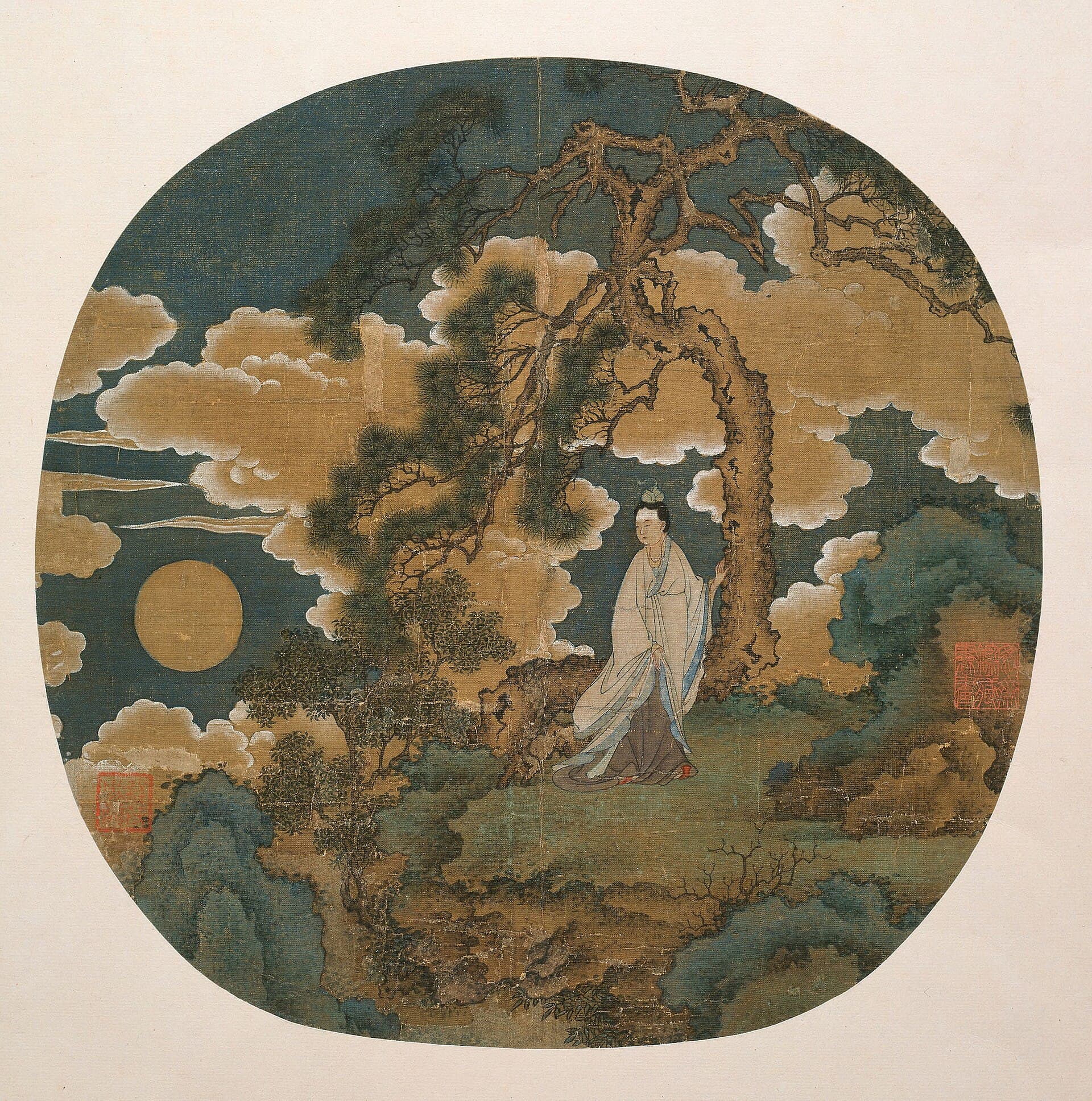
The core of the story is old and is recorded, among other places, in the Huainanzi, a philosophical compilation presented at the Han court around 139 BCE. There we read that Chang'e (嫦娥) stole the elixir of immortality her husband, the archer Yi (羿), had obtained from the Queen Mother of the West, then fled to the moon.
The episode preceding it is better known still. Ten suns appear together in the sky one day, burning the crops and drying the rivers. Yi, an archer of rare skill, shoots down nine of them with an arrow each and leaves the last, the one that lights us.
The versions then diverge, and that is the interesting part. In the oldest accounts, Chang'e acts out of greed and her flight looks like a betrayal. In later popular versions, she swallows the elixir to keep it from a treacherous disciple while her husband is away, and her ascent becomes a sacrifice. The same woman, depending on the century, is a thief or a heroine.
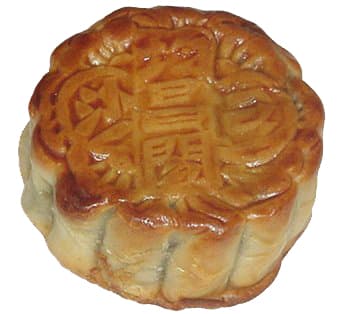
She is not alone on the moon: the endlessly pounds plants in a mortar, and , punished for a fault, hacks at a cassia tree that grows back with every stroke of the axe. The Mid-Autumn Festival, on the fifteenth day of the eighth lunar month, fixed the whole set in the calendar: you look up at the full moon and think of those who are away.
The cowherd and the weaver girl: a story written in the sky#
This legend is first of all a star chart. , the weaver girl, is Vega; , the cowherd, is Altair; and the Milky Way, the "silver river" (银河, yínhé), separates them.
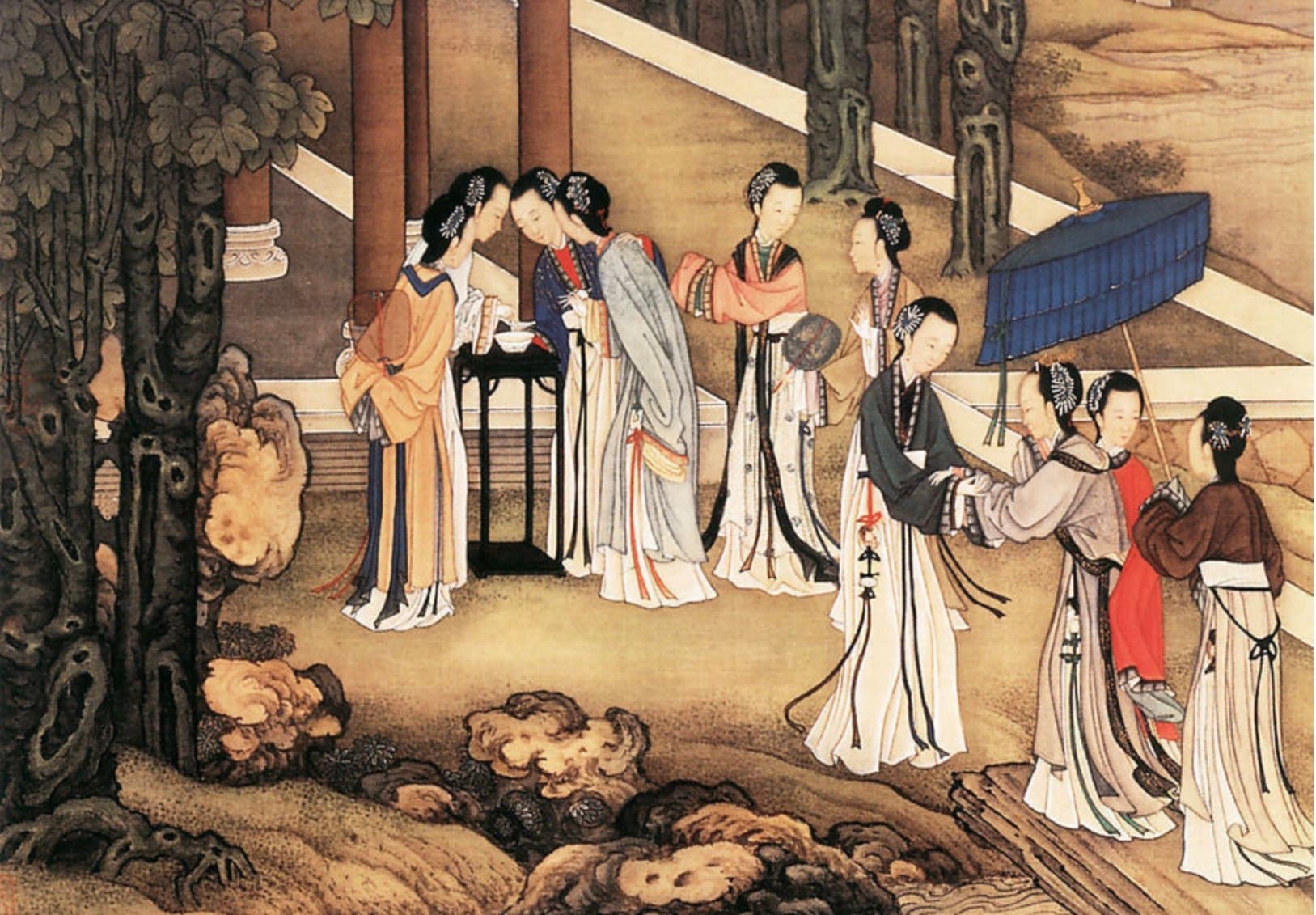
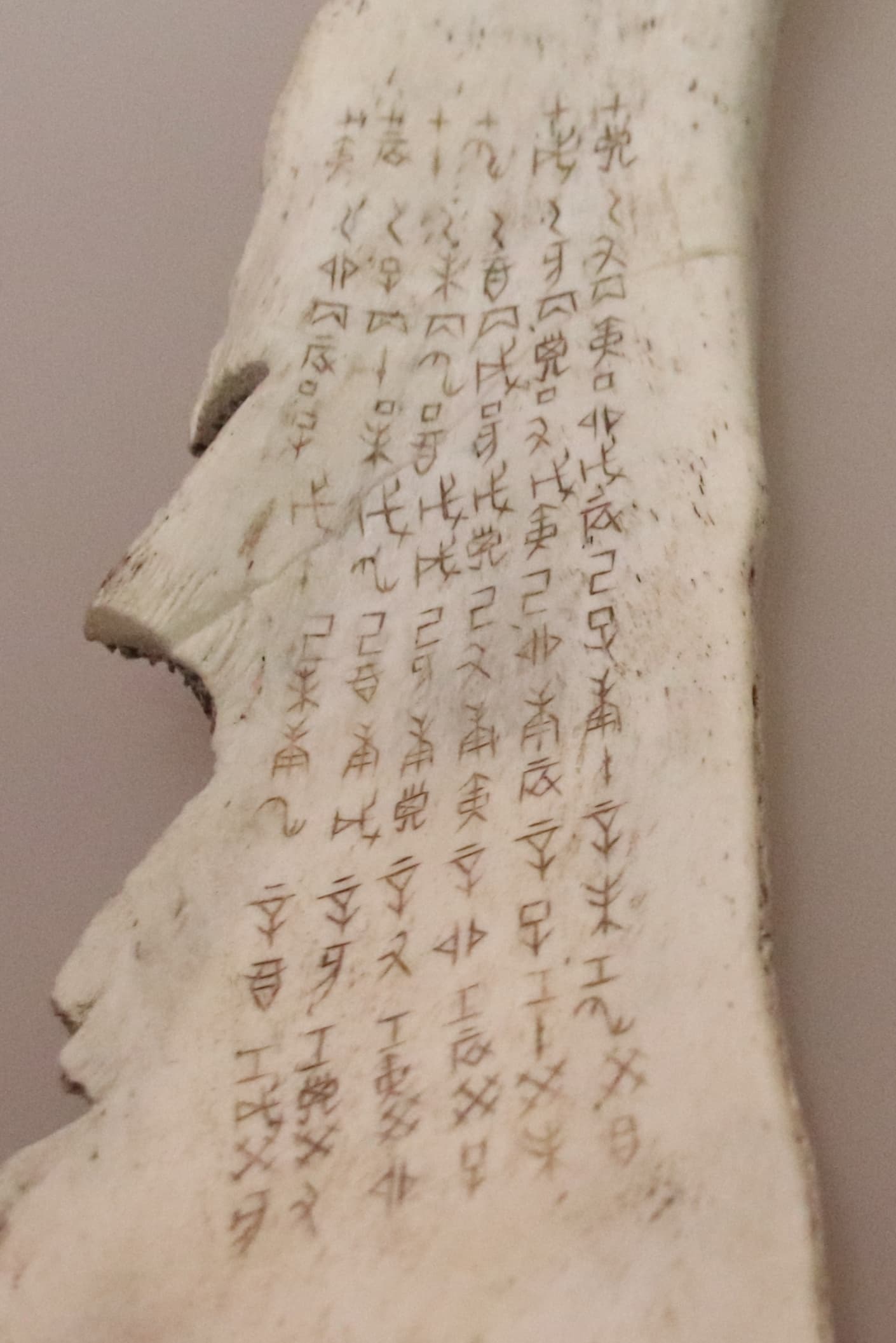
The pair of stars is named as early as the Classic of Poetry (诗经), the oldest poetic anthology in Chinese literature, whose pieces are dated between the eleventh and sixth centuries BCE. The full narrative takes shape under the Han: a daughter of Heaven comes down to bathe on earth, a young cowherd takes her clothes on the advice of his ox, they marry and have two children. The celestial grandmother recalls the weaver girl, traces the silver river with a stroke of her hairpin, and the cowherd, shod in the hide of his dead ox, cannot cross the water.
The compromise is famous: once a year, on the seventh day of the seventh lunar month, magpies form a bridge over the river and the lovers meet for one night. That date became the Qixi festival (七夕), reshaped since the 2000s into a commercial equivalent of Valentine's Day.
Two stars that will never meet produced the most durable love story in Chinese literature.
The four great folk legends#
Twentieth-century Chinese folklorists grouped four stories of thwarted love under the label "four great folk legends" (四大民间传说). The classification is modern; the stories themselves are centuries old.
| Legend | Chinese | Early attestation | What separates the lovers |
|---|---|---|---|
| The cowherd and the weaver girl | 牛郎织女 | Stars named in the Classic of Poetry | The celestial hierarchy |
| The butterfly lovers | 梁山伯与祝英台 | Tang-era notices on a Zhejiang couple | An arranged marriage |
| The legend of the white snake | 白蛇传 | Southern Song collections, fixed by Feng Menglong in 1624 | A monk and the natural order |
| Meng Jiangnü | 孟姜女 | A widow's story in the Zuo zhuan, moved to the Great Wall under the Tang | Imperial forced labour |
The butterfly lovers tells of Zhu Yingtai, a girl disguised as a boy in order to study, and her fellow student Liang Shanbo, who learns her sex too late. She is promised to another; he dies of it; on the wedding day the tomb opens as the procession passes, she throws herself in, and two butterflies fly out. The violin concerto composed in 1959 by He Zhanhao and Chen Gang made this the most played Chinese melody outside China.
The white snake stages Bai Suzhen, a snake spirit turned woman, her marriage to the scholar Xu Xian and the relentlessness of the monk Fahai, who imprisons her under Leifeng Pagoda beside the West Lake in Hangzhou. Rare for a legend, the monument exists, and its collapse in 1924 was a national event.
Meng Jiangnü sets out to find her husband, conscripted onto the Great Wall works. Learning of his death, she weeps so hard that a stretch of wall crumbles and uncovers his bones. The story is explicitly political: it does not mourn one man only, it indicts a state construction project.
The collapse of Leifeng Pagoda, on 25 September 1924, prompted a famous essay by Lu Xun, who welcomed it as the fall of a symbol of oppression. The pagoda was rebuilt in 2002, with lifts and escalators, above the remains of the old one.
What these stories say about the society telling them#
One thing leaps out when you line the stories up: in all four cases, two beings love each other and an authority separates them. The celestial hierarchy, the family, the Buddhist clergy, the building state. None of these legends ends in a happy, lasting marriage; all end in a metamorphosis, a regulated separation or a monument.
That explains their political longevity. Under the empire they offered an acceptable critique of family and administrative order, because it travelled through the marvellous. In the twentieth century they were reread as denunciations of feudalism, adapted into reformed operas and then films. Today they feed the xianxia series, in which immortals love each other against celestial prohibitions for fifty episodes.
These stories travel with a few recurring words: 月亮 (yuèliang, the moon), 仙 (xiān, the immortal) and 传说 (chuánshuō, the legend). ChineseSRS, our spaced repetition app, installs that vocabulary and the everyday Chinese that goes with it.
Where they live today#
The calendar is still their main support. The Mid-Autumn Festival carries Chang'e and the jade rabbit; Qixi carries the cowherd and the weaver girl, with an acknowledged gap between the original observance, which celebrated girls' skill at weaving, and today's largely commercial use.
Opera keeps them alive differently. The White Snake and Liang Zhu are among the most performed pieces in the kunqu, yue and jingju repertoires, with scenes the audience knows by heart, such as the battle of the waters in which Bai Suzhen floods the Jinshan monastery.
Then there are the unexpected uses, like those lunar probe and relay satellite names. A space agency that calls its rover "jade rabbit" is not merely winking: it writes a technical mission into a cultural continuity, and reminds us that in China the moon was never just a rock.
Read alsoMid-Autumn Festival: the full moon, mooncakes and Chang'eThe Mid-Autumn Festival gives Chang'e her annual appointment, with mooncakes and lanterns.
Qixi, the night of the magpie bridge, has become the lovers' festival of the Chinese calendar.
FAQ#
Is Chang'e a goddess? She became a divine figure through her ascent, but the old texts present her as a woman, wife of the archer Yi. She receives offerings at the Mid-Autumn Festival without having an organised cult comparable to that of the major Daoist deities.
Is Qixi really the Chinese Valentine's Day? That label is modern and commercial. The festival originally celebrated young women's domestic skills, as they prayed to the weaver girl for deftness with a needle. Its assimilation to a lovers' holiday dates mainly from the 2000s.
Are these legends Daoist or Buddhist? Neither exclusively. They mix successive layers: ancient cosmology, the Daoist pantheon, Buddhist figures such as the monk Fahai, and Confucian morals about family and duty.
Which adaptations should a newcomer watch? Filmed or staged versions of The White Snake are the most accessible, particularly in yue opera and Chinese series. For the butterfly lovers, the 1959 violin concerto offers a way in through music, with no dialogue to follow.
Is the moon rabbit Chinese or Japanese? Both cultures know it, with one clear difference: in China it pounds an elixir of immortality, in Japan it pounds rice to make rice cakes. The motif circulates across East Asia and its precise origin is still debated.
Photo credits: the images in this article come from Wikimedia Commons and are under free licences.
Qixi: China's Valentine's Day and what it used to be
On 19 August 2026, China celebrates Qixi. Astronomical origin, the cowherd and weaver girl legend, needle contests: the story of a festival that was never romantic.
Cover image: Artiste anonyme (Art Institute of Chicago) · Artiste anonyme, Art Institute of Chicago, via Wikimedia Commons · Domaine public