Qixi: China's Valentine's Day and what it used to be
On 19 August 2026, China celebrates Qixi. Astronomical origin, the cowherd and weaver girl legend, needle contests: the story of a festival that was never romantic.
La rédaction Kotoba Interactive
Studio éditorial
Two very bright stars face each other across the Milky Way, almost directly overhead above China in midsummer. Astronomers call them Vega and Altair. Chinese tradition calls them and , and for at least two thousand years has said they are a separated couple.
Out of that celestial arrangement came , literally "the evening of sevens", held on the seventh day of the seventh lunar month. In 2026 it falls on Wednesday 19 August. Brands treat it as a Chinese Valentine's Day, which has been broadly true for about twenty years. It was far less true for the twenty centuries before that, when the day belonged to young women and served to measure their skill.
A date that moves because the calendar moves#
Qixi follows the Chinese lunisolar calendar, the , not the Gregorian one. The seventh day of the seventh lunar month always lands between late July and late August, which shifts the date by about a month from one year to the next.
| Year | Gregorian date of Qixi |
|---|---|
| 2024 | 10 August |
| 2025 | 29 August |
| 2026 | 19 August |
| 2027 | 8 August |
| 2028 | 26 August |
The placement is not arbitrary. At that time of year Vega and Altair climb near the zenith after sunset, separated by the luminous band of the Milky Way, which Chinese texts call , the river of heaven, or , the silver river. The festival was an observation before it became a story.
The oldest love story in the Chinese sky#
Both star names appear as early as the , compiled between the eleventh and sixth centuries BCE, but with no plot: the weaver girl weaves and produces nothing, the cowherd pulls no cart. The love narrative takes shape under the Han, and one of the oldest texts carrying it is an anonymous poem from the Nineteen Old Poems (古诗十九首), which shows the weaver weeping by the celestial river, within earshot and out of reach.
The version handed down today runs in a few lines. Niulang, a poor orphan, lives with an old ox that turns out to be able to speak. On its advice he takes the robe of Zhinü, seventh daughter of the Queen Mother of Heaven, who has come down to bathe on earth with her sisters. Deprived of her garment she stays, marries him and bears two children. When the heavenly court discovers the mismatch, the Queen Mother recalls her granddaughter and draws the Milky Way between the spouses with a stroke of her hairpin. Magpies the world over then take up the habit of forming a bridge, the , one night a year, so the couple can meet.
If two hearts hold across time, what does it matter whether they are together morning and night?
The line is by , a Northern Song poet, in an eleventh-century lyric to the tune Queqiao xian (鹊桥仙). It remains the most quoted phrase on Qixi cards and advertisements, and it says something precise: separation does not invalidate attachment. That is a moral about patience, not an invitation to a date.
means "to beg for skill". 乞 is to beg, to ask humbly, and 巧 is manual dexterity, deftness, ingenuity. It is the historical name of the festival, long more used than Qixi: nobody asked for love that night, they asked to be good with their hands.
What people actually did on the evening of sevens#
The festival went by several names, none of them romantic: , the skill-begging festival, , the daughters' festival, or . Zhinü, celestial weaver, was the patron of needlework, and young women addressed her with a technical request.
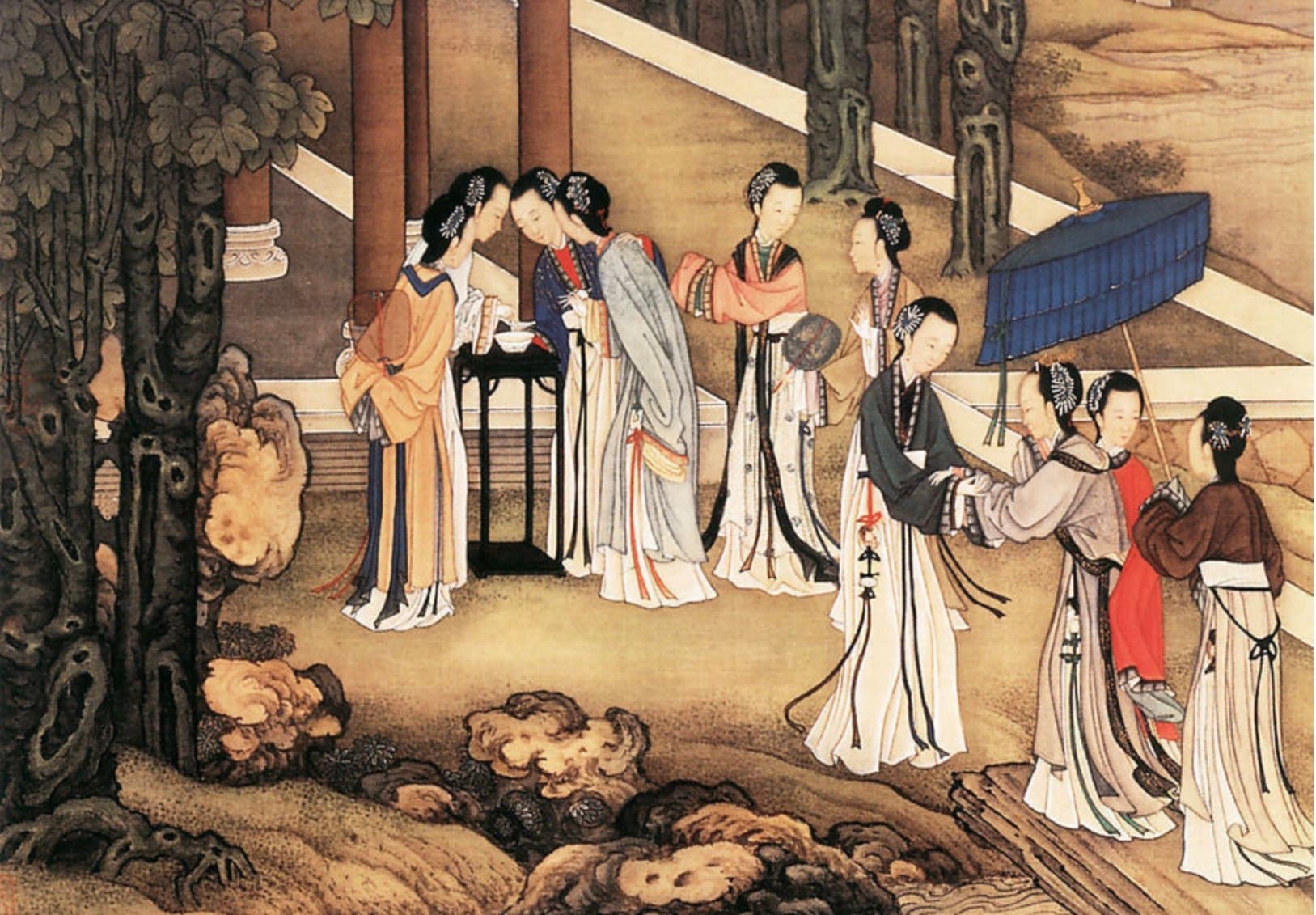
The threading contest. Attested under the Han by the Miscellaneous Records of the Western Capital (西京杂记), meant threading a seven-holed needle by moonlight or lamplight. The first to succeed was held to have received the weaver's skill.
The floating needle test. Under the Ming and Qing, took over. A bowl of water was left in the sun until a thin film formed on the surface, then a needle was laid on it. The shadow cast on the bottom of the bowl served as an oracle: a thin, even shadow foretold clumsiness, while one shaped like a flower, a cloud or a tool promised talent.
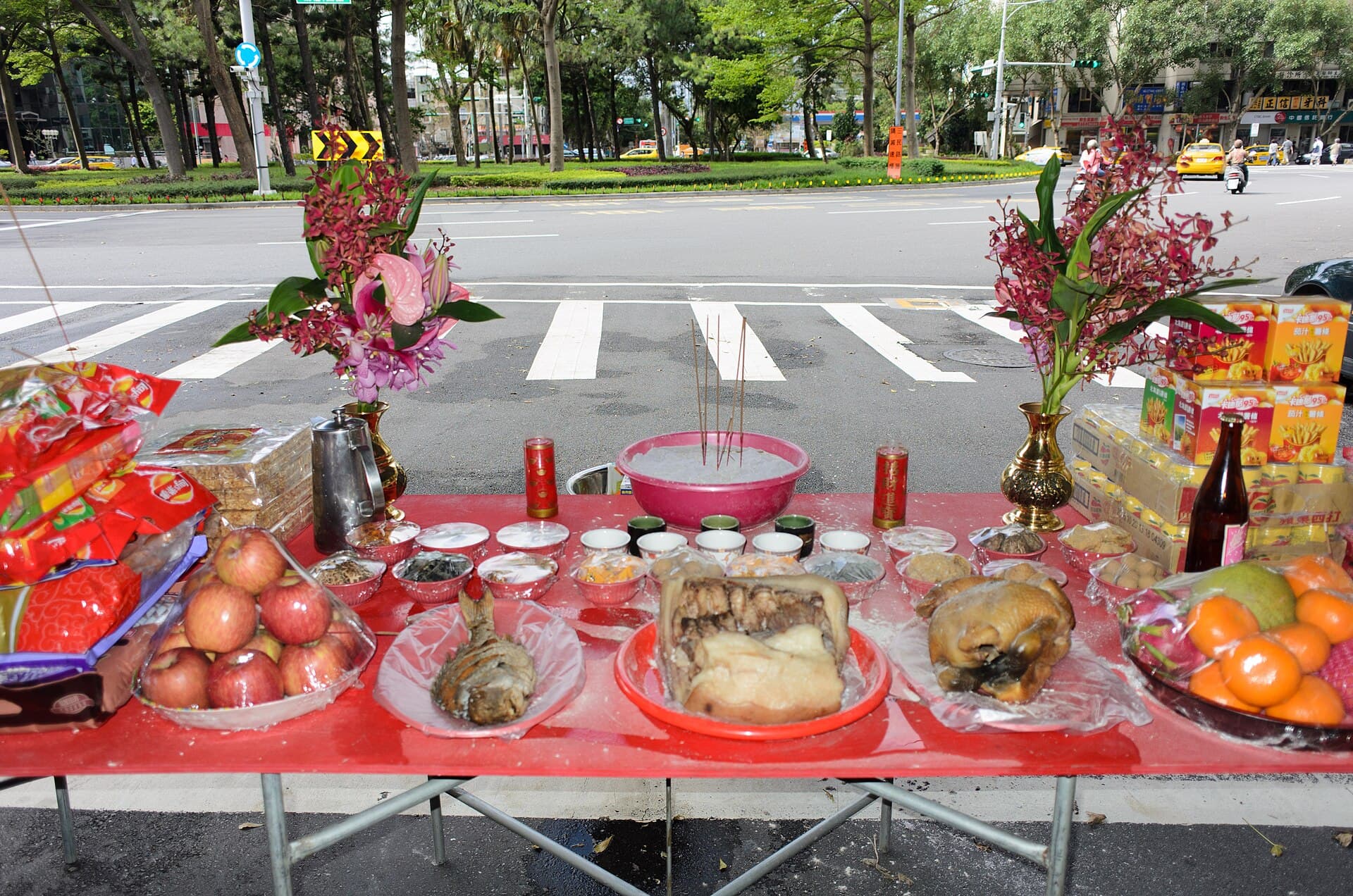
The offerings. A table was set in the courtyard with fruit, tea, rouge and powder, and the household knelt before the weaver star. , small fried biscuits of flour, sugar and sesame, were shared between neighbours and are still given in parts of Shandong and Zhejiang.
The other customs. Women washed their hair that day in water believed to come down from heaven, and spiders shut in a box were given a divinatory role: a dense, even web spun overnight counted as a good omen.
The vocabulary of the festival#
| Term | Characters | Pinyin | Meaning |
|---|---|---|---|
| The festival | 七夕 | qīxī | The evening of the seventh day |
| Historical name | 乞巧节 | qǐqiǎojié | The skill-begging festival |
| The cowherd | 牛郎 | niúláng | Altair, in the constellation Aquila |
| The weaver girl | 织女 | zhīnǚ | Vega, in the constellation Lyra |
| The Milky Way | 银河 | yínhé | The silver river |
| The magpie bridge | 鹊桥 | quèqiáo | The crossing formed one night a year |
| The biscuits | 巧果 | qiǎoguǒ | Fried pastries offered that evening |
| The Queen Mother | 王母娘娘 | wángmǔ niángniáng | The one who draws the celestial river |
| I love you | 我爱你 | wǒ ài nǐ | The formula on modern cards |
| Happy Qixi | 七夕快乐 | qīxī kuàilè | The customary greeting |
Three words are enough to read a Chinese shop window in mid-August: 七夕 (qīxī, the festival), 鹊桥 (quèqiáo, the magpie bridge) and 快乐 (kuàilè, happy). Learn Chinese with ChineseSRS, our spaced repetition app, and decode seasonal signage instead of photographing it.
How a seamstresses' festival became a lovers' one#
The shift is recent and traceable. After decades of fading through the twentieth century, Qixi returned to Chinese public life around the turn of the 2000s, carried by two distinct movements that reinforced each other.
The first was institutional. In 2006 the State Council placed Qixi on the first national list of intangible cultural heritage, alongside other traditional festivals. The move belonged to a wider policy of promoting lunar-calendar festivals, at a moment when 14 February was settling into large Chinese cities.
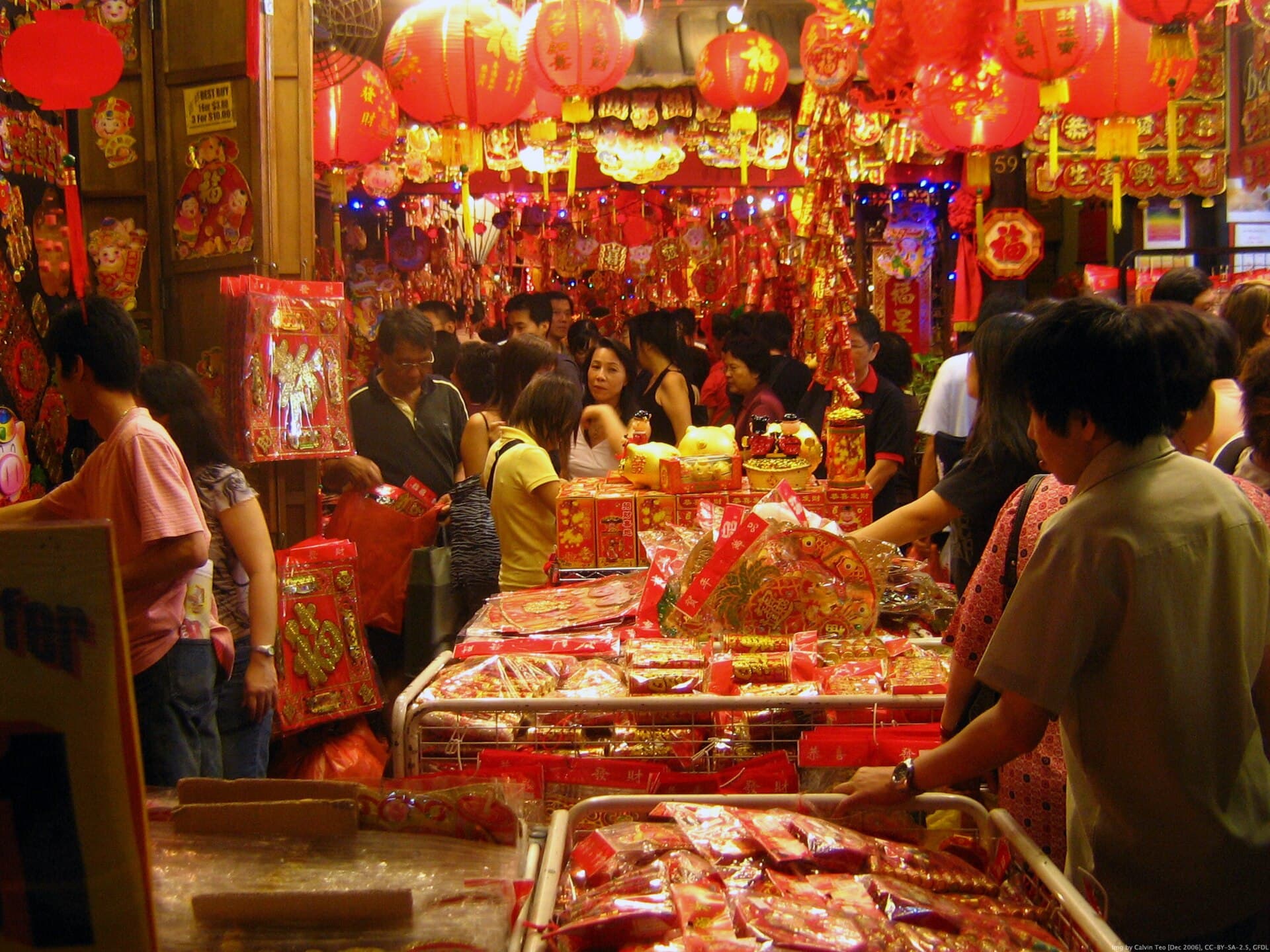
The second was commercial. Luxury, cosmetics and jewellery brands found in Qixi a date specific to the Chinese market, free of international competition, and equipped it with capsule collections, special packaging and digital campaigns. E-commerce platforms followed, with dedicated operations that make mid-August one of the annual peaks for flowers, chocolate and jewellery.
The result is a crowded Chinese romantic calendar. 14 February persists, Qixi occupies late summer, and 20 May has been added since the 2010s for a purely phonetic reason: 520 reads wǔ èr líng, close to wǒ ài nǐ (我爱你), "I love you". A couple so inclined therefore has at least three annual occasions to spend.
The festival traditionally linked to romantic encounters in China was not Qixi but the , on the fifteenth day of the first lunar month. It was one of the rare evenings when young women went out unchaperoned, and classical poetry made it the setting for urban love at first sight.
The Chinese calendar's real courting night came fifteen days after New Year, lantern in hand.
The same night in three countries#
The cowherd and weaver story travelled with Chinese characters, and the three countries that received it made different festivals of it.
In Japan, the festival is written with the same characters 七夕 but read Tanabata, through contamination with a Japanese word for a ritual weaver. It is usually held on 7 July in the Gregorian calendar, sometimes 7 August depending on the region, and its central gesture is writing a wish on a paper strip, the , tied to a bamboo branch. The romantic dimension is secondary.
In Korea, falls on the same lunar day. Tradition links it to the last rains of the season, said to be the tears of reunion, and to eating wheat pancakes, the year's flour being then at its best.
In China, the festival kept the name Qixi and the romantic use. Three calendars, one legend, three ways of putting it into practice.
Read alsoValentine's, White Day, Black Day: Love Across East AsiaFebruary, March, April: Japan and Korea built a three-act romantic calendar, with one day reserved for the single.
What survives, in the countryside and elsewhere#
Older practices have not entirely gone. The town of Xihe, in Gansu, holds a seven-day festival whose ritual structure has been documented by intangible heritage surveys. In Shandong and Zhejiang, home-made qiaoguo are still handed down. In Guangzhou, where the festival went by the Cantonese name qiqiao, domestic altars laden with miniature figurines and paper flowers have been the object of preservation campaigns since the 2000s.
These survivals say something simple. Qixi changed addressee, moving from young women to couples, and changed content, moving from skill to sentiment. What has not moved is the date, dictated by two stars that come close every summer without ever meeting.
FAQ#
When is Qixi in 2026? Wednesday 19 August 2026. The festival falls on the seventh day of the seventh month of the Chinese lunisolar calendar, which places it between late July and late August in the Gregorian calendar each year.
Is Qixi a public holiday in China? No. It is a widely celebrated traditional festival, listed as national intangible cultural heritage since 2006, but it carries no day off, unlike Chinese New Year, the Mid-Autumn Festival or the Dragon Boat Festival.
What do people give for Qixi? Today: flowers, jewellery, chocolate and beauty products, often in limited editions designed for the date. Historically nobody gave anything to a lover: young women shared qiaoguo biscuits and set offerings before the weaver star.
Are Qixi and Tanabata the same festival? They share the same Chinese origin, the same characters 七夕 and the same legend. Japan adapted it as Tanabata, holds it on 7 July or 7 August depending on the region, and centred it on written wishes rather than on the couple.
Why does China have several lovers' days? 14 February spread through large cities from the 1990s, Qixi was revalued in the 2000s as a traditional equivalent, and 20 May was added through a numerical pun, 520 sounding like "I love you". The three dates coexist, with different audiences and budgets.
Photo credits: the images in this article come from Wikimedia Commons and are under a free license.
Chongyang: The Double Ninth Festival and Chinese Autumn
On the 9th day of the 9th lunar month, China celebrates Chongyang: climbing the heights, chrysanthemum wine, Wang Wei's poem, and honoring the elderly.
Cover image: Chen Mei (陳枚) · Chen Mei (陳枚), via Wikimedia Commons · Public domain