C-drama fashion: from guzhuang to the Chinese street
Chinese series costumes, the mamianqun skirt, xiuhefu wedding outfits: how the c-drama wardrobe became a very real fashion industry.
La rédaction Kotoba Interactive
Studio éditorial
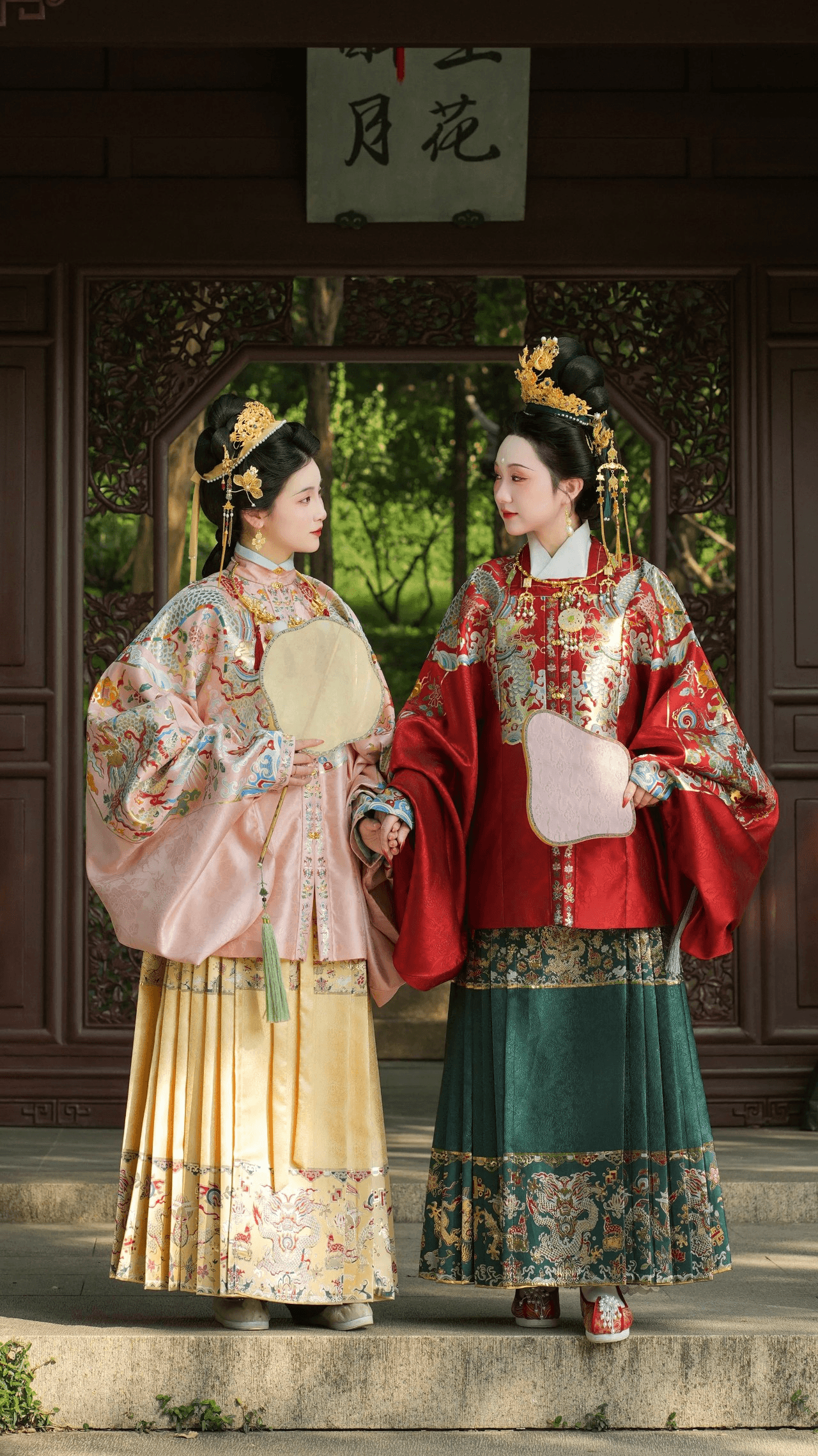
In July 2022, a mid-length pleated skirt shown by a French fashion house set off a controversy in China: Chinese students demonstrated outside the brand's boutiques, in Paris and Seoul alike, arguing that the cut reproduced that of the , the "horse-face skirt" worn under the Ming and the Qing. Two years later the same skirt is everywhere on the streets of Chengdu and Hangzhou, worn over trainers, and it was not the fashion houses that put it there. It was the series.
The c-drama wardrobe is no longer scenery. It is a complete chain, from the shooting stage to the workshops of Shandong, producing measurable trends and selling garments by the million.
Guzhuang: a series costume is not a historical garment#
The word to know is , literally "ancient dress". It names the stage and screen costume, not period clothing. It is a production convention with codes of its own: layered chiffon, oversized sleeves, washed-out palettes, wigs and hairpieces, belts that hold nothing together.
, by contrast, aims at reconstruction: a documented cut, an identified dynasty, an assembly justified by sources. The confusion between the two fuels much of the online argument, in which reenactors accuse the series of passing fantasy off as history.
Xianxia series, those tales of immortals and cultivation, have pushed the convention to its limit: floating white robes, loose hair, almost no visible seams. Nobody was ever dressed like that; it is a dream costume, designed for slow motion and wind machines.
breaks down into 古 (gǔ, "ancient") and 装 (zhuāng, "dress"). The word belongs to the vocabulary of performance: a costume drama is a guzhuangju (古装剧). , conversely, is a term of cultural assertion that took its current meaning in the early 2000s.
When a production takes accuracy seriously, viewers notice#
Not every series plays the same tune. Some productions built their reputation on documentary precision, and the Chinese audience noticed.
Story of Minglan (知否知否应是绿肥红瘦, 2018) was praised for its reconstruction of Song domestic life: whisked tea, incense arrangements, sober clothes in muted colours, far from the usual gilding of palace drama. Ruyi's Royal Love in the Palace (如懿传, 2018) put forward its Qing-inspired embroidery and researched hairstyles, against the grain of court series that favour effect.
The shift comes from a change in the audience. Chinese viewers now discuss costumes on Weibo and Xiaohongshu, compare them with museum pieces, spot anachronisms of cut or dye. A botched coat is now worth a controversy, which has turned accuracy into a commercial argument.
The face counts as much as the clothes#
A costume-drama character is recognised first by the hair. Productions employ whole teams of wigmakers, and actresses wear heavy hairpieces built on frames that sometimes take two hours to fit before the first shot of the day.
Make-up follows the same conventions. Eyebrows drawn like willow leaves, an evenly pale complexion, lips reduced to a central heart, and sometimes the , the motif painted or stuck in the middle of the forehead that comes from Tang court fashion. None of these elements is neutral: they are signals of rank, of assumed period and of temperament, read in a second by a practised audience.
Those codes left the set long ago. "Guzhuang style" make-up tutorials are among the most watched formats on Chinese video platforms, and the photo studios of the old towns sell the hair and the face along with the outfit.
From set to street: the same-style loop#
The commercial mechanism has a Chinese name: , "the same model". As soon as an episode airs, e-commerce search engines see queries spike along the lines of "that character's dress", and sellers put affordable versions online within days.
That responsiveness rests on a highly concentrated industrial base. in Shandong specialised first in stage costumes, then in hanfu, to the point of supplying a considerable share of the national market and being mockingly nicknamed "the centre of the universe". Live-stream selling, Hangzhou workshops and rental shops in Xi'an and Luoyang complete the chain.
The most visible result plays out in tourist sites. In Xi'an, in Luoyang, in the old towns of the Jiangnan, studios rent out a full outfit, hairstyling, make-up and a photo session for half a day. People come to dress as a series character, not as a Tang-dynasty resident.
| Piece | Chinese | Reference period | Where you see it today |
|---|---|---|---|
| Horse-face skirt | 马面裙 | Ming and Qing | Street, offices, graduations |
| Cross-collar robe and skirt | 交领襦裙 | Han to Ming | Series, hanfu outings, photos |
| Round-collar robe | 圆领袍 | Tang and Song | Male roles, historical cosplay |
| Xiuhefu wedding outfit | 秀禾服 | Late Qing inspiration | Weddings, photo sessions |
| Dragon and phoenix jacket | 龙凤褂 | Cantonese tradition | Southern and Hong Kong weddings |
| Immortal's white robe | 仙侠白衣 | None | Xianxia series, conventions |
Weddings, the testing ground for drama fashion#
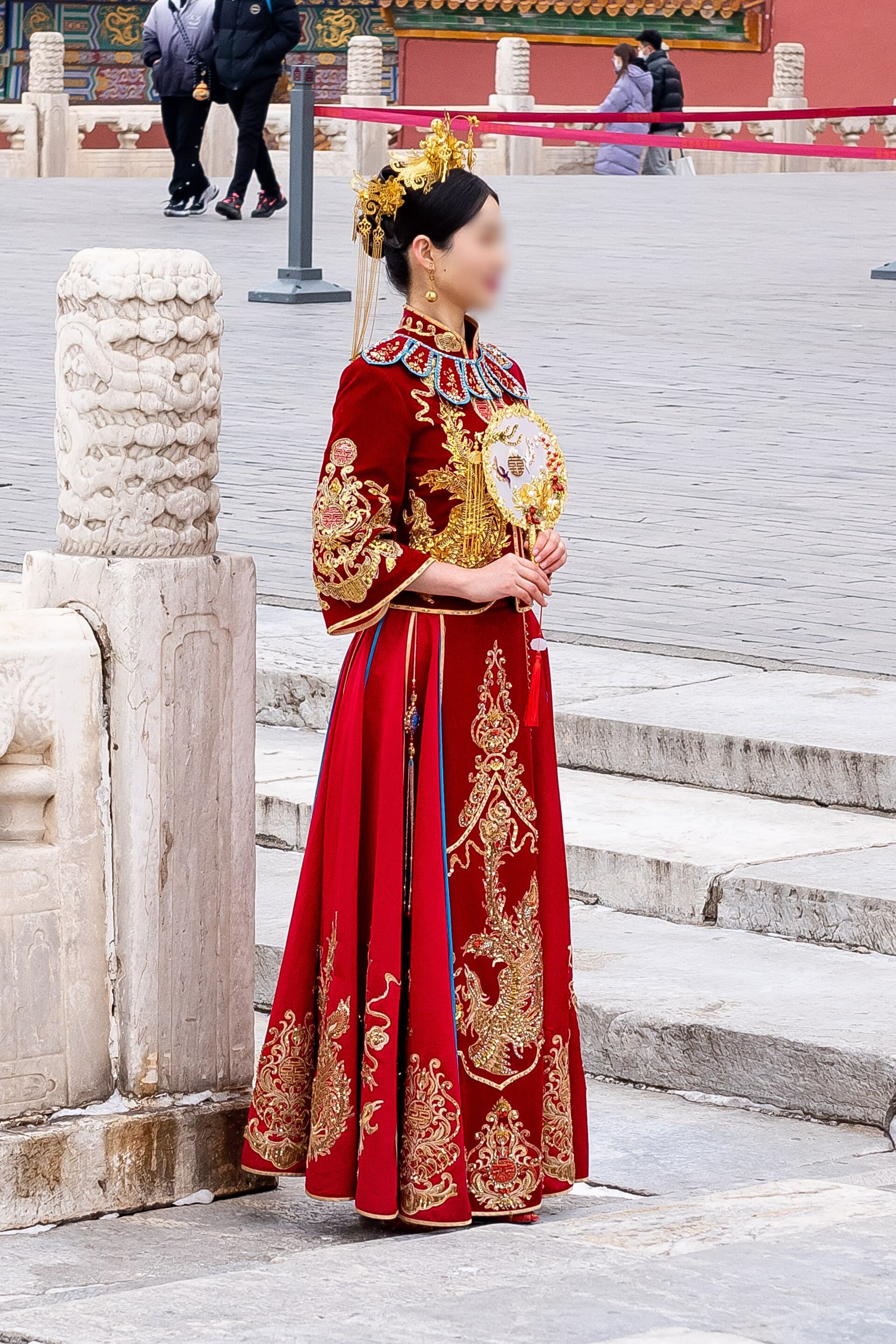
It is at weddings that the influence of series reads most clearly. The , the embroidered jacket-and-skirt set worn today by tens of thousands of Chinese brides, has no direct dynastic root: it takes its name from a television character, Xiuhe, played by Zhou Xun in an early-2000s series whose costumes struck the audience.
The average urban Chinese wedding now runs through several changes of outfit in a single day: a Western white dress for the ceremony, xiuhefu or dragon and phoenix jacket for the toasts, an evening gown for the end. Photo studios rent the full set, and the choice of traditional outfit often follows whatever was on screen the previous year.
The name xiuhefu comes from no costume treatise: it comes from a fictional character. No late-Qing bride would have recognised the word, which does not stop the outfit from being seen today as "the" traditional Chinese wedding dress.
The rules of the game: regulation, national pride, accuracy#
The costume genre operates within a moving frame. Broadcasting regulators have repeatedly restricted the transmission of historical series and dynastic fantasies, notably in spring 2019, accusing productions of distorting history or celebrating court extravagance. Studios answered by moving their stories into imaginary kingdoms, which paradoxically freed costume designers from any documentary constraint.
In parallel, the movement, the "national wave" that champions Chinese brands and motifs, has made traditional dress a marker of pride. A mamianqun worn to the office is no longer fancy dress but an aesthetic position, and the major e-commerce platforms have made it a category of its own.
The series does not copy history: it produces an image that the street adopts, and that people end up taking for history.
Following fashion talk in Chinese takes three recurring words: 古装 (gǔzhuāng, period costume), 同款 (tóngkuǎn, "the same model") and 穿搭 (chuāndā, the outfit, the look). ChineseSRS, our spaced repetition app, installs that vocabulary and the everyday Chinese that goes with it.
Contemporary series as open catalogues#
The phenomenon is not confined to period dress. Contemporary c-dramas work as shop windows: placed brands, identifiable bags, watches held in frame, official accounts posting the list of items worn after each episode.
The series Nothing But Thirty (三十而已, 2020) provided the textbook case. A scene in which a group photograph among well-off wives betrays a hierarchy of handbags set off weeks of online debate about social status and consumption, reaching the business press. Clothing there becomes an explicit narrative device, and the audience read it as such.
Between an immortal's robe that never existed and a bag that ranks its owner socially, the c-drama does the same thing: it dresses characters so they can be recognised in a second. That millions of people would then want to wear those clothes in real life was not in the script, but it has become the real product.
Read alsoHanfu: the spectacular return of traditional Chinese clothingThe hanfu movement, born on forums in the early 2000s, pursues a different goal from that of television costume designers.
To decide where to start with Chinese series, genre by genre, the c-drama guide sorts them out.
FAQ#
Is guzhuang historically accurate? Rarely, and that is not its purpose. It is a performance costume, built for framing and movement. Some recent productions aim at careful reconstruction, but they remain a minority against the dominant convention.
Can non-Chinese people wear a mamianqun? Yes, no rule forbids it, and Chinese sellers export widely. The custom is simply that you should know what you are wearing: it is an identified Chinese garment, not a fancy-dress accessory.
Where can you buy outfits seen in the series? Chinese platforms offer versions at every price, from cheap stage costume to workshop hanfu. Quality varies enormously, and made-to-measure pieces often take weeks to produce.
What is the difference between hanfu, qipao and xiuhefu? Hanfu covers Han clothing predating the Qing; the qipao, or cheongsam, is a straight dress derived from Manchu wear and modernised in Shanghai in the 1920s and 1930s; the xiuhefu is a modern wedding outfit of late-Qing inspiration popularised by television.
Do actors keep their costumes? No, with rare exceptions. Principal pieces are reused from one production to the next, rented from specialist companies or kept by the studios, and some have been circulating between series for years.
Photo credits: the images in this article come from Wikimedia Commons and are under free licences.
Hanfu: the spectacular return of traditional Chinese clothing
The hanfu movement in China: how millions of young Chinese have revived Han traditional dress, between cultural pride, social media and the fashion industry.
Cover image: N509FZ · N509FZ, via Wikimedia Commons · CC BY-SA 4.0