Korean variety shows: Running Man and the school of yeneung
Running Man, Infinite Challenge, the Na PD shows: how Korean variety invented its own grammar, its forfeit games and its conquest of Netflix.
La rédaction Kotoba Interactive
Studio éditorial
Five grown men, among them a film actor and a singer, chase each other through an underground car park to rip a velcro rectangle off each other's shoulder blades. Whoever loses their tag is out, and a voice-over announces their theatrical death. This is Sunday evening on SBS, it has been running since 2010, and it is one of South Korea's most efficient cultural exports.
Korean televised entertainment goes by a name with no exact English equivalent: . It is not the talk show, not reality TV, not the game show, but a genre that has absorbed all three and added a grammar of its own. Understanding that grammar explains why a programme about friends chasing each other ended up being watched in Jakarta, São Paulo and Paris.
Yeneung is not a show, it is a slot#
The word first describes a place in the schedule: the big weekend family appointment that Korean networks have been fighting over since the 1990s. KBS, MBC and SBS each programme a two to three hour block there, often cut into segments, with recurring hosts and a rotating cast of guests.
What is distinctly Korean is the status of those hosts. They are not called presenters but , and the best of them hold a position British and American television has largely lost: Yoo Jae-suk, nicknamed the "national MC" (국민 MC), has fronted Sunday shows for over twenty years, and his name alone can sell a format to a network.
Around him sits a fixed cast, the , literally "the fixed ones". That is where the pleasure of yeneung comes from: you are not following a plot, you are watching characters you know inside out react to a new situation. It is a sitcom without a script, in which the writing has moved from the dialogue to the set-up.
is built from the characters 藝 (ye, "art, talent") and 能 (neung, "ability"). The term originally covered the performing arts in general. It narrowed over the 1990s to name non-fiction televised entertainment, as opposed to , scripted fiction.
2005, the year the camera went out into the street#
The shift to what Koreans call "real variety" (리얼 버라이어티) has a date: April 2005, when MBC launched a segment called inside a Saturday programme.
The premise is close to absurd. Six men the show describes as "below average" take on stupid physical challenges, fail, and the edit embraces the failure rather than hiding it. Infinite Challenge quickly became the most talked-about programme in the country, and lasted until March 2018, thirteen years later.
Two years after its launch, KBS answered with , a road trip through the Korean provinces in which celebrities sleep in tents and compete for the right to eat dinner. The show popularised , a draw of lots that decides who eats and who fasts, who sleeps indoors and who sleeps outside. The device has since powered the comedy of dozens of programmes.
Both shows established the same move: the camera leaves the studio, follows the participants into real places, and the audience watches famous people be cold.
Running Man: fifteen years of tag hunting#
Running Man (런닝맨) launched on SBS on 11 July 2010, in the Sunday block. The network filed it under a category invented for the occasion, "urban action variety": the cast takes over a landmark in Seoul, completes missions there and faces off in a final race.
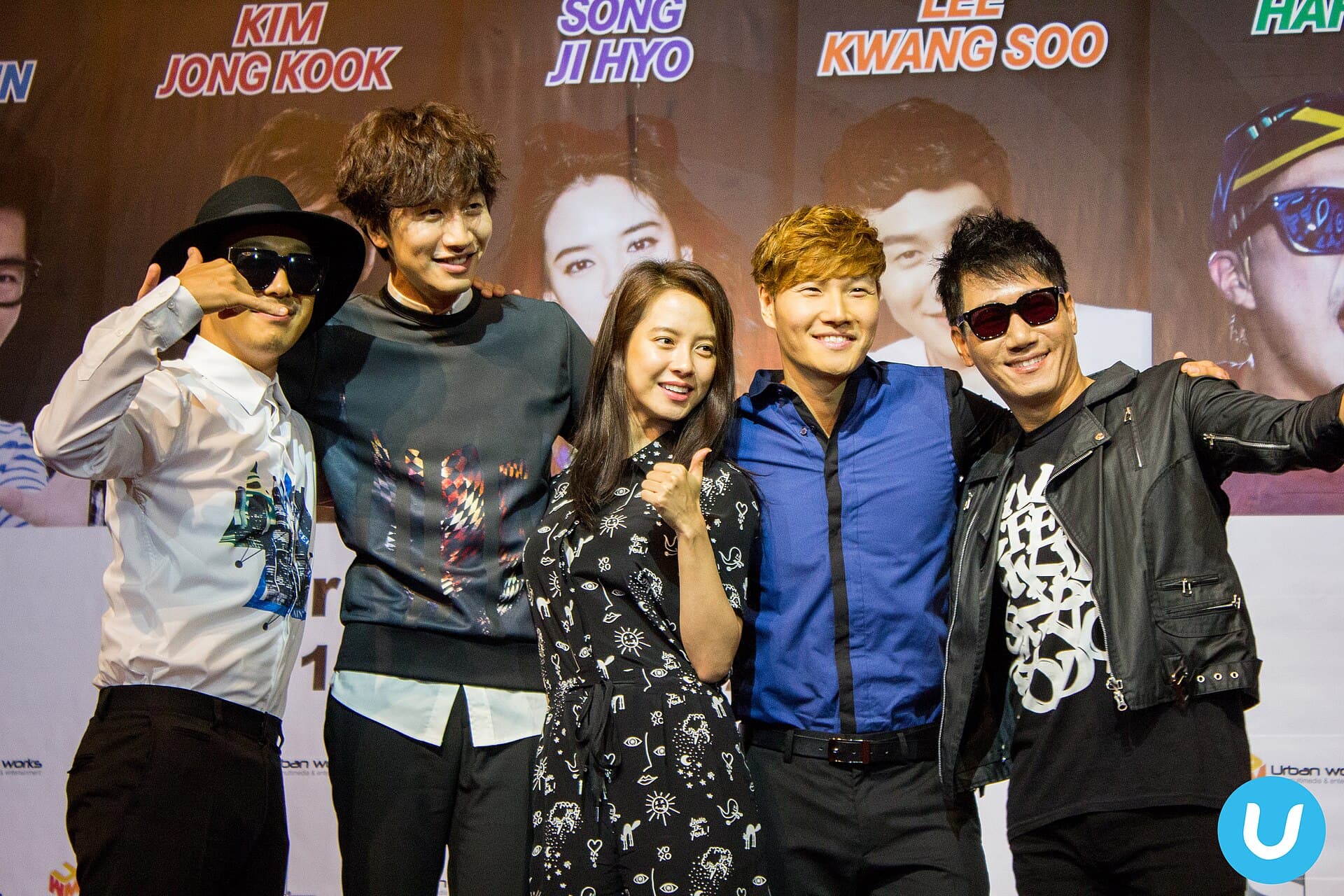
The original line-up brought together Yoo Jae-suk, Ji Suk-jin, Kim Jong-kook, Haha, Lee Kwang-soo, Song Joong-ki and Gary. Each was handed a comic role that would stick to them: the clumsy "giraffe", the unbeatable strongman, the permanent traitor. Song Joong-ki left as early as 2011 for an acting career that would take him to Descendants of the Sun, Gary left in 2016, Lee Kwang-soo in 2021 after an injury.
The game that travelled the world is called , name tag ripping. It is simple, visual, requires no Korean at all, and is understood within ten seconds on a phone screen on the other side of the planet. That is exactly what let the format travel where talk shows stalled.
A game you can follow without subtitles crosses borders faster than a song.
The Chinese version, Hurry Up, Brother (奔跑吧兄弟), launched by Zhejiang TV in 2014, became one of the decade's biggest hits on Chinese television and spawned spin-off films. Adaptations followed in Vietnam, the Philippines and Indonesia.
The grammar of the screen: the caption is a character#
Watch thirty seconds of yeneung with the sound off and you will still catch half the jokes. That is the product of a post-production craft Korea has pushed further than anyone else: , the graphic caption.
These overlays do not transcribe dialogue. They comment, contradict, exaggerate, add an onomatopoeia, underline a hesitation with a wobbling typeface. The edit adds sound effects, slow motion, zooms on a face falling apart. An ordinary line becomes funny because the screen has decided it is.
That writing-in-the-edit explains the genre's real workload: a twelve-hour shooting day yields ninety minutes of broadcast, and the post-production team often works until the eve of transmission.
The closing credits of many Korean shows list writers, the , even though the programme has no script. Their job is to build the situations, prepare the questions, research the guests and design the forfeits. Yeneung is not improvised: it is written before and after, never during.
The PD as author: when a director becomes a brand#
In Korea the television director holds the title of and signs a show the way a filmmaker signs a film. Na Young-seok, known to the public as Na PD, is the clearest example.
He learned his trade on 1 Night 2 Days at KBS, then joined the cable channel tvN in 2013. There he set up a recognisable method: few participants, a single location, a slow pace, no humiliation. Grandpas Over Flowers (꽃보다 할배, 2013) sends four actors in their seventies abroad with a younger actor to carry the bags. Three Meals a Day (삼시세끼, 2014) films celebrities cooking three meals a day in the countryside, and nothing else.
| Show | Korean title | Network | Debut | Premise |
|---|---|---|---|---|
| Infinite Challenge | 무한도전 | MBC | 2005 | Absurd challenges, six fixed comedians |
| 1 Night 2 Days | 1박 2일 | KBS2 | 2007 | Provincial road trips, draws of lots |
| Running Man | 런닝맨 | SBS | 2010 | Urban missions, name tag ripping |
| Grandpas Over Flowers | 꽃보다 할배 | tvN | 2013 | Actors in their seventies travelling |
| New Journey to the West | 신서유기 | Naver TV then tvN | 2015 | Quizzes and forfeits, born on the web |
| Knowing Bros | 아는 형님 | JTBC | 2015 | Fake high school, guests as transfer students |
New Journey to the West deserves a separate note: launched in 2015 straight onto the Naver TV Cast platform before landing on tvN, it proved a Korean programme could be born online and become a national fixture, five years before the terrestrial networks accepted the idea.
Yeneung watches well with subtitles, and far better once you catch the words that come back every episode: 예능 (yeneung, entertainment), 벌칙 (beolchik, the forfeit) and 대박 (daebak, "amazing!"). KoreanSRS, our spaced repetition app, installs that vocabulary and the everyday Korean that goes with it.
Netflix changed the destination, not the recipe#
Korean variety had long been exported as formats for sale. Since 2023 it has been exported as it is.
Physical: 100 (피지컬: 100), released by Netflix on 24 January 2023, was the first unscripted Korean programme to reach number one on the platform's global non-English TV chart. The premise fits in a sentence: a hundred trained bodies, raw feats of strength, one survivor.
Culinary Class Wars (흑백요리사), released in September 2024, went further still by spending three consecutive weeks at the top of that same chart, with a contest pitting twenty starred chefs against eighty anonymous cooks. The device is pure yeneung: a visible hierarchy, a forfeit, a camera that lingers on faces.
What Netflix brought was not a new kind of writing but a budget and a runtime. What the platform removed is subtler: the weekly appointment, the guests turning up to promote a film, the complicity built over ten years. Terrestrial shows keep that advantage.
Behind the set#
Korean entertainment television has its scandals too. The heaviest concerns the audition shows: in 2019, an investigation revealed that public votes on Mnet's Produce 101 series had been manipulated to assemble the winning line-ups. Director Ahn Joon-young was sentenced to two years in prison, a sentence upheld by the Supreme Court, and his executive producer to one year and eight months.
Working conditions draw regular criticism as well: fifteen-hour days, physical forfeits in the cold, accidents. Lee Kwang-soo left Running Man after the aftereffects of a car accident in 2020, and several shows have revised their challenges since.
Even so, the genre keeps producing something few television cultures still manufacture: familiar figures, seen every week, whose ageing the audience follows in real time. That may be the real subject of yeneung, underneath the forfeits and the ripped tags.
Read alsoHallyu: How the Korean Wave Conquered the WorldThe Korean wave was exported first through fiction, before entertainment took over.
FAQ#
Where can I watch Korean variety shows legally? Netflix titles are subtitled from release. For terrestrial programmes such as Running Man, the broadcasters offer English-subtitled versions on their official YouTube channels and on specialist platforms; other languages usually depend on fan communities.
Do I need to know the guests to follow along? Not for game shows such as Running Man or Physical: 100, whose mechanics are visual. Partly yes for talk shows such as Knowing Bros, whose humour rests on the guests' careers and on references to Korean television.
Why are there so many captions on screen? Jamak is part of the writing. It comments on the action, adds jokes absent from the dialogue and drives the comic timing. The practice began in Japanese television and was pushed much further in Korea.
How long is an episode? Between seventy and a hundred minutes for terrestrial shows, often split into two parts. Netflix formats run around fifty to sixty minutes per episode.
Are idols required to appear on them? There is no formal obligation, but a variety appearance is part of promoting a group or a film. It is often where the public discovers an artist's personality, and a good appearance can restart a career.
Photo credits: the images in this article come from Wikimedia Commons and are under free licences.
K-drama: the beginner's guide that actually helps
Sixteen episodes, one season, an ending written in advance: how a Korean series works, where to start according to your taste, and which narrative codes to know.
Cover image: Vernon Chan · Vernon Chan, via Wikimedia Commons · CC BY 2.0