Kodokushi: Dying Alone in Japan, and the Industry That Follows
Kodokushi (孤独死): dying alone and going undiscovered. National police figures, the word's origin in Kobe, specialist cleaning crews and so-called stigmatised properties.
La rédaction Kotoba Interactive
Studio éditorial
is the Japanese term for dying alone at home and going undiscovered for some time. It is not a medical category: it is an administrative and journalistic one, born from field observation, and tracked by the National Police Agency since 2024.
That first national count gives the order of magnitude. In the first quarter of 2024 alone, police recorded 21,716 people living alone who died at home, of whom 17,034 were aged 65 or over, putting the annual total for seniors alone at around 68,000. Roughly one body in ten was found more than a month after death.
Where the word comes from#
The term had circulated since the 1970s, but it entered public debate in 1995, after the Great Hanshin earthquake. Kobe residents rehoused in temporary units (仮設住宅) had lost their neighbourhood along with their homes: elderly people died alone there, sometimes discovered weeks later, and the Japanese press put a word to it.
Government bodies often prefer 孤立死 (koritsushi, "death of isolation"), which shifts the emphasis: it is not chosen solitude that kills, but the severing of social ties. The distinction matters in official reports, less so in everyday use.
is built from 孤独 (kodoku, "solitude") and 死 (shi, "death"). The first character, 孤, originally denoted an orphan. The administrative variant 孤立死 (koritsushi) swaps 孤独 for 孤立 (koritsu, "isolation"), a condition endured rather than a feeling.
What the numbers describe#
Three data series overlap without ever measuring quite the same thing, since there is no single legal definition.
| Source | What it measures | Order of magnitude |
|---|---|---|
| National Police Agency (since 2024) | People living alone who died at home | About 68,000 a year among those 65 and over |
| Tokyo Medical Examiner's Office | People 65+ living alone found dead at home, 23 wards | More than 4,000 a year |
| National Institute of Population Research (IPSS) | Elderly one-person households | 7.4 million in 2020, projected above 10 million by 2050 |
Two constants stand out in the police data. Men are heavily over-represented, particularly between 50 and 70: divorced, with no children nearby, cut off from the sociability the workplace once provided. And discovery times vary enormously: most bodies are found within days, only a minority after weeks, yet it is that minority which defines the phenomenon in the public mind.
Why now#
Ageing alone does not explain it, since other countries are ageing too. Three specifically Japanese factors compound it.
The first is household composition. Japan moved within a few decades from the three-generation home to the single-person household: people living alone are now the most common household type, and the share of over-65s living alone keeps rising.
The second is workplace sociability. For one generation of men, social life and the company were the same thing: colleagues, nomikai, team trips. Retirement cuts the network in a single stroke, with no neighbourhood friendships to take over.
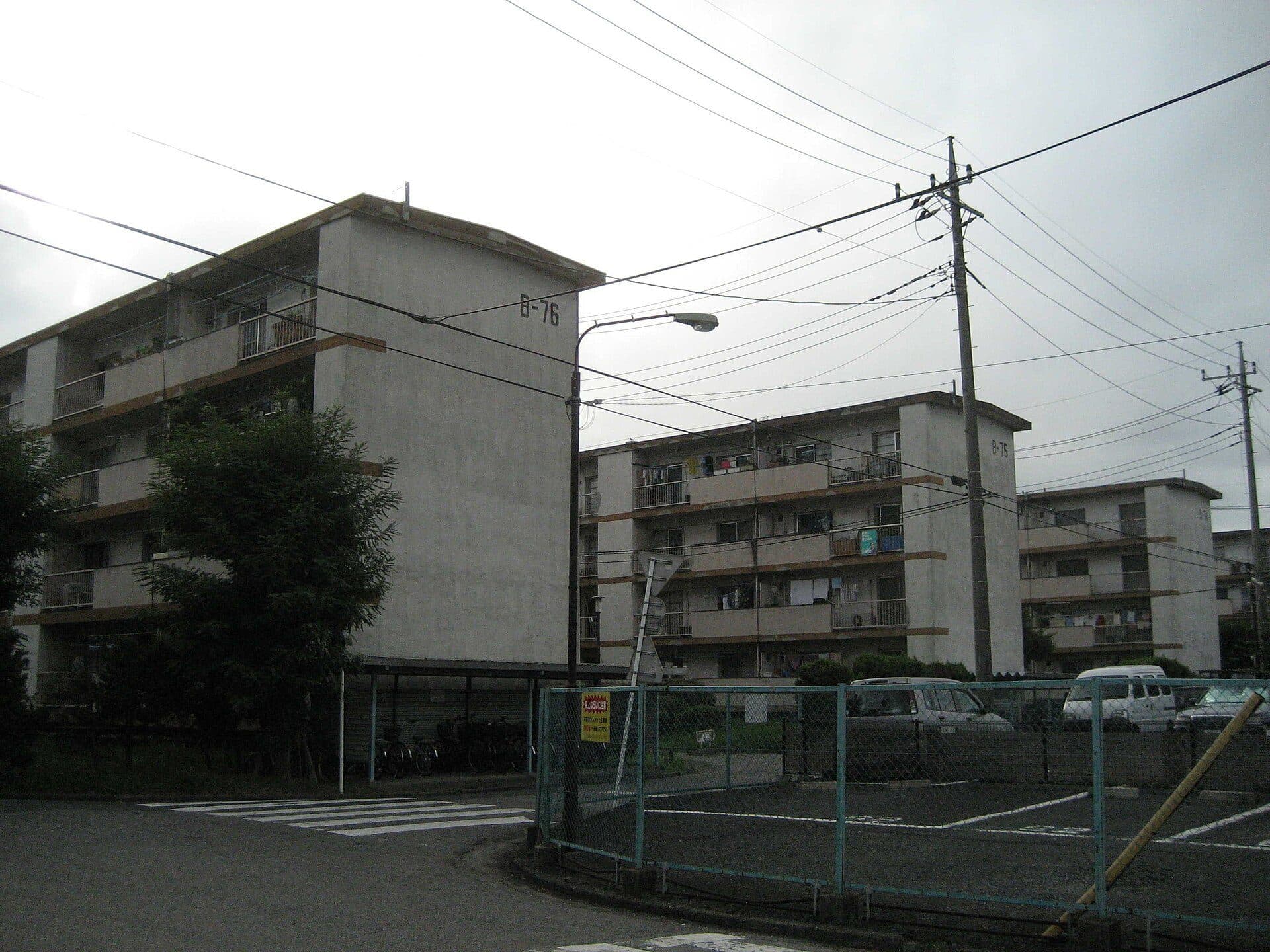
The third is urban planning. The large housing estates built in the 1960s and 1970s, the 団地 (danchi), have aged along with their residents. A whole block may house nothing but pensioners, with no shops at street level and no active residents' association, in flats designed for couples with children.
Kodokushi does not measure how many people die alone. It measures how long it takes for anyone to notice.
Specialist cleaning#
A trade has organised itself around these deaths: 特殊清掃 (tokushu seisō, "specialist cleaning"). These firms move in once the body has been removed, when a flat has become uninhabitable: decontamination, stripping of soaked floors and partitions, odour neutralisation, insect control. Published rates range from tens of thousands of yen for a light intervention to several hundred thousand for a whole apartment.
A second occupation sits alongside it, the 遺品整理士 (ihinseiriji, "estate organiser"), who sorts the deceased's belongings, returns them to relatives, resells or disposes of them. The association awarding the certification was founded in 2011 and has since trained tens of thousands of professionals, a sign of demand that has become routine rather than exceptional.
The vocabulary of Japanese officialdom recurs in every public document: 孤独 (kodoku, solitude), 高齢者 (kōreisha, elderly person), 世帯 (setai, household). JapaneseSRS teaches them in context, kanji and readings included.
"Incident properties"#
A death that goes undiscovered changes the legal status of the dwelling. In Japanese property vocabulary it becomes a 事故物件 (jiko bukken, literally "incident property"), a category that also covers suicides and homicides.
In October 2021 the Ministry of Land, Infrastructure and Transport published guidelines clarifying a long-standing grey area: a seller or landlord must disclose a death that occurred in the dwelling, with a practical three-year rule for rentals in the case of a natural death discovered late, and no time limit at all when the prospective buyer asks directly. A natural death found promptly need not be disclosed.
The economic consequences are real: rents discounted by 20 to 30%, difficulty finding new tenants, and the growth of a dedicated insurance product, 孤独死保険, taken out by landlords to cover cleaning and lost rent. Some landlords simply refuse isolated elderly tenants, which public authorities try to offset with guarantee schemes.
The website 大島てる (Oshima Teru), online since 2005, maps dwellings where a death occurred, address by address, across the whole of Japan. It became the property market's unofficial reference before the ministry ever set disclosure rules.
What the state has put in place#
Japan appointed a minister responsible for loneliness and isolation in February 2021, the second country in the world to do so after the United Kingdom, against a backdrop of pandemic and rising suicides.
An act promoting measures against loneliness and isolation (孤独・孤立対策推進法), passed in May 2023, came into force on 1 April 2024. It requires local authorities to set up coordination between social services, voluntary organisations and neighbours.
On the ground the responses are more mundane and often more effective: electricity or water meter readings that flag inactivity, connected thermos flasks, delivery rounds by drink vendors and newspaper carriers, agreements between municipalities and konbini to report a regular customer who stops showing up.
FAQ#
Is kodokushi unique to Japan? The phenomenon is not, the word and the statistical tracking are. South Korea adopted a related term, 고독사 (godoksa), and has published its own national report since 2022.
How long before a body is found? Most are found within three days. The widely reported cases, discovered after weeks or months, are a minority of the situations police record.
Who pays for the cleaning when there is no family? The cost falls first on the heirs; failing that, on the landlord, which is why dedicated insurance products have spread.
Must a death in a dwelling be disclosed? In several cases, yes, under the 2021 guidelines: an unnatural death, or a natural death discovered late that required specialist cleaning.
Read alsoHikikomori: The Social Withdrawal That Is Ageing With JapanProlonged social withdrawal, the other face of Japanese isolation, ageing along with the people who live it.
Sources and further reading#
- National Police Agency (警察庁), first statistical release on at-home deaths of people living alone, 2024
- Tokyo Medical Examiner's Office (東京都監察医務院), annual data for the 23 wards
- Ministry of Land, Infrastructure, Transport and Tourism, guidelines on disclosing deaths in residential property, October 2021
- National Institute of Population and Social Security Research (IPSS), household projections
The 8050 Problem: Parents in Their 80s, Children in Their 50s
8050 mondai (8050問題): in Japan, octogenarian parents support a withdrawn child in their fifties. Official figures, the term's origin, the "after we are gone" question and the support system.
Cover image: Ebiebi2 · Ebiebi2, via Wikimedia Commons · Public domain