Mianzi: The Chinese Concept of Face and Its Social Weight
Understand mianzi (面子), Chinese 'face': giving, losing, and saving face, and its ties to guanxi, renqing, and Confucianism in everyday life.
La rédaction Kotoba Interactive
Studio éditorial
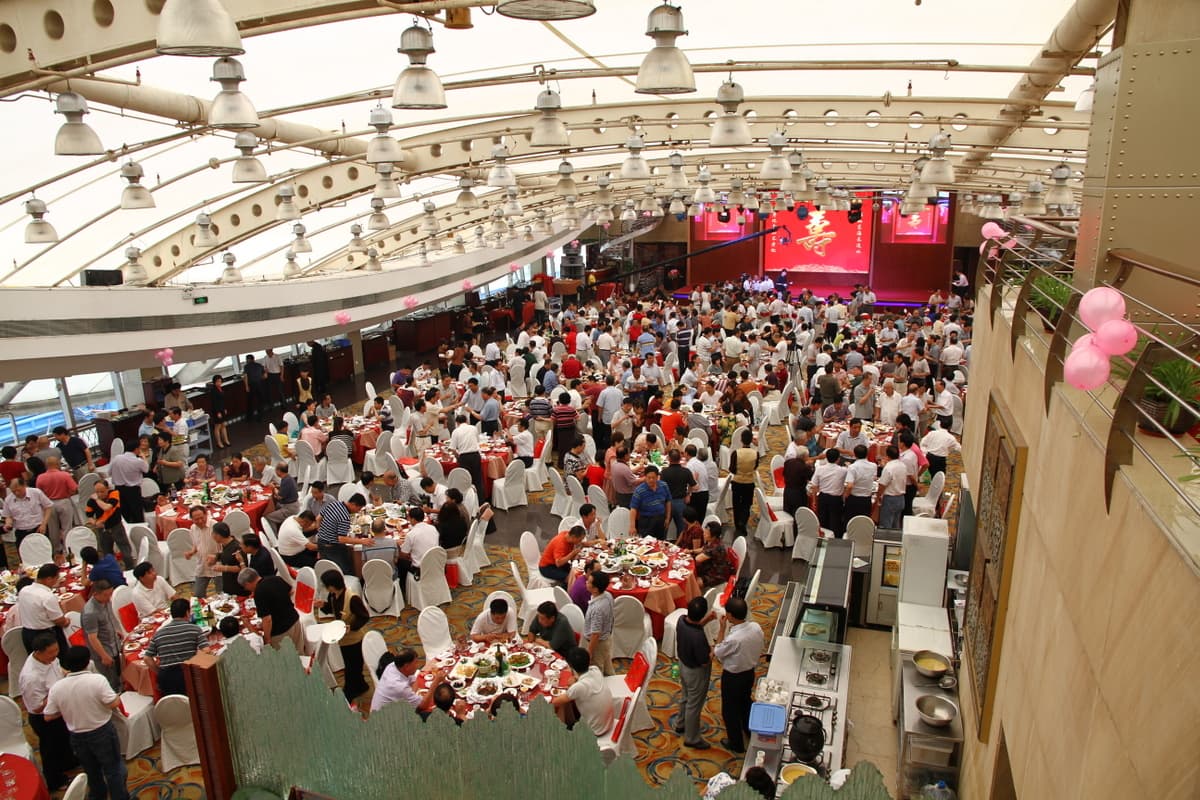
The waiter sets a final dish on the turntable, a whole steaming fish, its head turned toward the guest of honor. The host rises, lifts his glass, says a few words, and the first "gānbēi" (干杯, "empty the glass") rings out. Everyone drinks to the bottom. What plays out around this round table is not merely a dinner: it is a meticulous piece of theater in which every gesture (who orders, who pays, who toasts whom, and in what order) distributes and redistributes an invisible yet imperious currency, face.
This currency has a name: . To understand Chinese society without understanding mianzi is like watching a game of chess without knowing the rules: you see the pieces move, but their logic escapes you. Face is neither mere politeness nor vanity; it is a form of social capital, a system of relational credit that structures the family, the company, negotiation, and even politics. It explains why a Chinese executive will almost never say "no" head-on, why a public disagreement can ruin a business relationship, and why giving the wrong gift can wound more surely than an insult.
Two Words for a Single "Face": Mianzi and Lian#
Chinese distinguishes two notions that English folds into a single word. refers to social prestige, the reputation accumulated through success, rank, wealth, or connections; refers to moral integrity, the fundamental dignity that any decent person possesses simply by belonging to the community. One can have a great deal of mianzi and very little lian, or the reverse.
combines miàn (面, "face," "surface") with the nominal suffix zi (子). Literally "the face," the word denotes the reputation and prestige that others grant you: a social value negotiated from the outside, as opposed to liǎn (脸), the moral face one owes to oneself.
The anthropologist was the first, in an article that became a classic when it was published in 1944, to theorize this duality for Western readers. She showed that losing one's lian is far more serious than losing one's mianzi: the former signals a moral failure, an exclusion from the social body of "respectable" people, whereas the latter is merely a setback in prestige, one that can be repaired. To say of someone "bù yào liǎn" (不要脸, "he wants no face"), is to accuse him of being shameless, an insult of extreme violence. To reproach a lack of mianzi is infinitely gentler.
The sociologist Erving Goffman, who in the 1950s popularized the concept of face in Western social science, himself acknowledged his debt to Chinese descriptions. But where the West tends to see face as an individual, momentary performance, the Chinese tradition embeds it in a lasting relational fabric: my face depends on yours, and vice versa.
Giving, Losing, Saving: The Grammar of Face#
Face functions as a verb as much as a noun, and three expressions sum up its everyday mechanics. One , one , and one is constantly at work saving face, one's own and that of others.
| Action | Expression (pinyin) | What happens | Social effect |
|---|---|---|---|
| Giving face | 给面子 (gěi miànzi) | Publicly enhancing another's prestige | Creates a debt of gratitude |
| Refusing face | 不给面子 (bù gěi miànzi) | Declining a toast, ignoring an introduction | An affront that can end the relationship |
| Losing face | 丢面子 (diū miànzi) | A weakness is exposed to the eyes of others | Humiliation, above all in public |
| Saving face | 留面子 (liú miànzi) | Offering the other an honorable way out | Preserves the group's harmony |
Giving face means publicly enhancing another person's prestige: praising a colleague in front of their superiors, letting an elder speak first, accepting an invitation, complimenting a host's home. It is a symbolic gift that creates a reciprocal debt. To refuse this gift (declining a toast, ignoring an introduction) amounts to , a stinging affront that can end a relationship.
To give someone face is to deposit money in their social account; to make them lose it is to bankrupt them in front of witnesses.
Losing face occurs the moment a weakness, an error, or an inferiority is exposed to the eyes of others. The decisive element is publicity: a criticism whispered in private causes almost no loss of face, while the same criticism voiced in a meeting can be devastating. This is why Chinese culture has developed a consummate art of indirect communication, of innuendo and intermediaries. A refusal is expressed as "that will be difficult" (bù tài fāngbiàn, 不太方便) rather than as a "no" that would expose the other person to the failure of their request.
Saving face, for oneself or, more nobly, for others, is the oil that keeps the social machine from seizing up. A good Chinese negotiator will always offer his counterpart an honorable way out; a shrewd superior will correct a subordinate without witnesses; a host will insist on paying the bill with a theatricality that lets everyone protest politely without actually reaching for their wallet. Making someone lose face deliberately is a weapon, sometimes used, but always costly: it turns a partner into a lasting enemy.

Fascinated by this social grammar of face? Learn to read and pronounce 面子 (miànzi, face), 给面子 (gěi miànzi, to give face), and 丢面子 (diū miànzi, to lose face) with ChineseSRS and its spaced repetition, and grasp China in its own words.
Guanxi and Renqing: Face at the Heart of a Network#
Face never circulates alone: it is interwoven with two other notions without which it would be incomprehensible, and . Together, these three concepts form the operating system of Chinese relationships.
refers to the personal network of reciprocal ties that an individual cultivates throughout their life: family, classmates, colleagues, people from the same village. It is not a simple address book: it is living capital, maintained through exchanges of services, meals, gifts, and favors. To have guanxi is to be able to mobilize resources (a job, a contract, a hospital bed, a recommendation) that the anonymous market does not provide.
is the moral debt that circulates within this network. Rendering a service creates a renqing: the other person now "owes" you something, not a fixed sum but a diffuse obligation, meant to be honored one day, at an opportune moment. Not repaying a renqing means losing face and disqualifying oneself from the network. Face is the system's guarantee here: it is because people care about their reputation that they repay their relational debts, in the absence of any court to enforce them.
The glass turntable at the center of Chinese restaurant tables, often called a "Lazy Susan" in English, is neither Chinese in origin nor particularly old. Popularized in the twentieth century, it took hold at banquets precisely because it lets everyone reach the dishes without standing up or reaching across a neighbor, thereby preserving the smoothness and apparent equality that face demands at the table.
Want to decipher these characters? Learn 面子 (miànzi), 关系 (guānxi), and hundreds of everyday Chinese words, with pinyin and pronunciation, on ChineseSRS (chinesesrs.com).
A Confucian Root#
If face weighs so heavily in China, it is because its roots run more than two millennia deep into Confucian thought. does not speak of "mianzi" (the term comes later), but his entire moral philosophy prepares the ground: a harmonious society rests on hierarchical roles and rites (lǐ, 礼) that govern each person's conduct according to their place.
The codified by Confucian tradition (ruler and subject, father and son, husband and wife, elder and younger, between friends) define a web of mutual obligations. Within this framework, the individual exists fully only through their relationship to others, and their worth is measured by the respect they inspire and the respect they return. Face then becomes the barometer of this reciprocity: to play one's role well, to honor one's obligations, to "do honor" to one's family is to accumulate face; to fail at this is to lose it, and to make one's entire lineage lose face.
The concept of , harmony, completes the edifice. Preserving a group's harmony often comes before the raw expression of individual truth. This is not hypocrisy but a hierarchy of values: social peace and each person's dignity outweigh the pleasure of being right in public. It becomes easier to understand, then, why head-on disagreement, so prized in Western cultures, is perceived in China as an assault on the very fabric of the group.
Read alsoConfucius and Confucianism: the thought that shaped AsiaFace extends into everyday life the ethics of roles and rites inherited from Confucius: to grasp its foundations, go back to the source.
Face at the Table, in Business, and in Gifts#
Nowhere does face unfold with such intensity as at the , the ritual scene par excellence of Chinese social life. Everything there carries meaning. Seating obeys an invisible geography: the seat of honor, generally facing the entrance and backing the wall, goes to the most important or the eldest guest; the host sits near the door, in a serving position. To take the wrong seat, or to give up too quickly a seat that is offered to you, is to play a delicate score.
The bill is a moment of high, choreographed tension. It is good form to fight for the privilege of paying, because to pay is to give face to one's guests and assert one's status. Weakly proposing to split the check, Western-style, can be felt as a lack of generosity, and therefore of face. Toasts, for their part, follow a strict hierarchy: you first toast the elder or the superior, taking care to hold your glass slightly lower than theirs as a sign of deference.
The Gift and the Red Envelope#
The gift extends this economy of face beyond the table. To give is to give face and create renqing; the value of the present must be calibrated with care: too modest, it dishonors the giver as much as the receiver; too lavish, it places the receiver in a crushing debt or evokes corruption. Form matters as much as substance: a gift is ritually refused once or twice before being accepted, and is not opened in front of the giver, so as not to expose one's reactions.
Cash, taboo in many cultures, is on the contrary given freely in China, provided it is slipped into a . Red, the color of luck and joy, transfigures the transaction into an affectionate gesture. The amounts obey their own grammar of face: even, auspicious numbers are favored, 4 (sì, 四) is avoided as a homophone of "death" (sǐ, 死), and the sum is adjusted to the degree of closeness and to rank.
In business, these same rules govern negotiation. Business cards are exchanged with both hands, with a slight bow, and the card received is contemplated with respect before being placed on the table, never shoved into a back pocket. A Chinese "yes" often means "I hear you" rather than "I agree." Cornering a partner publicly, demanding a clear-cut answer, flaunting one's technical superiority: all of these are ways to make someone lose face that scuttle a deal that everything else should have closed.
Neither Hypocrisy nor Cunning: Clearing Up the Misunderstandings#
Seen from the West, the culture of face feeds two symmetrical misunderstandings. The first sees hypocrisy in it: what is the point of all these circumlocutions, these disguised refusals, these obligatory compliments? The second detects a form of cynical manipulation. Both readings miss the essential point.
Face is not a mask meant to deceive, but a mechanism of mutual respect and the preservation of harmony. Communicating indirectly, offering the other an honorable way out, avoiding public humiliation: these behaviors protect everyone's dignity in a society where the individual is inseparable from their network. What a Westerner perceives as a lack of frankness is, from the Chinese point of view, a higher form of consideration: one does not tell a brutal truth any more than one delivers a slap.
The reverse misunderstanding also awaits Chinese visitors to the West, who may read direct frankness as rudeness, individualism as selfishness, or splitting the bill as stinginess. Neither culture is wrong: they obey different social grammars. Recognizing face, giving it generously, avoiding making someone lose it inadvertently: that is the key for anyone who wants to work, travel, or forge lasting friendships in China.
It would be wrong, finally, to believe face is frozen in tradition. The urban, connected China of the twenty-first century reinvents it ceaselessly: the number of followers on social media, the brand of one's phone, the photo from one's latest trip have become vectors of mianzi as eloquent as seating at a banquet. Face has changed its stage, not its nature. It remains that mirror society holds up to each person, and in which, in China more than anywhere else, no one can afford not to recognize themselves.
FAQ#
What is the difference between mianzi (面子) and lian (脸)? Mianzi (面子) is social prestige (reputation, rank, wealth, connections) granted by others and repairable in the event of a setback. Liǎn (脸) is the fundamental moral dignity of any person of integrity. Losing one's lian signals a moral failure far more serious than losing one's mianzi.
What does "giving face" (给面子) mean? "Giving face" (gěi miànzi, 给面子) means publicly enhancing someone's prestige: accepting their invitation, complimenting them in front of others, letting them take precedence. This gesture creates a reciprocal debt of gratitude. Refusing to do so (bù gěi miànzi, 不给面子) constitutes a serious affront.
How are face, guanxi, and renqing related? Guānxi (关系) is the network of personal relationships; rénqíng (人情) is the debt of favor that circulates within it. Face guarantees the system: because people care about their reputation, they repay their relational debts, in the absence of any written contract to enforce them.
Why should you never criticize a Chinese partner in public? Because public criticism causes a loss of face, a humiliation that can lastingly destroy the relationship. The same remark, made in private and tactfully, is acceptable. Chinese culture favors indirect communication to preserve everyone's dignity and the group's harmony.
Does the notion of face exist outside of China? Yes: kindred concepts structure all of East Asia, such as Korean nunchi or the subtle reading of social situations in Japan. Face even inspired Western sociology through Erving Goffman. But few cultures give it as central and as codified a weight as China does.
Read alsoNunchi: The Korean Art of Reading the RoomKorea cultivates a cousin art: nunchi, the ability to read the mood of a room and what goes unsaid, the other face of the same East Asian social grammar.
Photo credits: images in this article come from Wikimedia Commons and are under free licenses.
In this article
The cultural terms covered here, each with a short definition.
- Confucianism
- Moral and social thought stemming from Confucius, shaping hierarchy and duty across East Asia.
Guanxi: the web of relationships that keeps China running
Renqing, mianzi, banquets, favour debts: what guanxi (关系) really covers, where the line with corruption runs, and what has changed since 2012.
Cover image: Hophobe Markerz Peterpeam · Hophobe Markerz Peterpeam, via Wikimedia Commons · CC BY-SA 4.0