Korean shamanism: muism, the mudang and the gut ritual
Discovering Korean shamanism (muism): the mudang, the gut ritual, the spirits, its prehistoric roots, its survival and its presence in today's Korea.
La rédaction Kotoba Interactive
Studio éditorial
To the sound of drums and cymbals, a woman in a dazzling costume whirls, brandishes a blade, then freezes: her voice has changed. It is no longer she who speaks, they say, but a spirit come from beyond, addressing the family gathered around her. For hours, between trance, songs and offerings, she will bridge the living and the dead. Welcome to the world of Korean shamanism.
Korean shamanism, or , is undoubtedly the oldest spiritual stratum of the peninsula, predating both Buddhism and Confucianism. Long despised, sometimes repressed, it never disappeared. To understand muism is to touch an underground Korea, that of spirits, ancestors, and an uninterrupted dialogue between worlds.
At the roots: a prehistoric spirituality#
Muism sinks its roots into Korean prehistory, long before the arrival of the great religions from China. Before Buddhism penetrated the peninsula in the 4th century, before Confucianism ordered its society, the inhabitants of the peninsula already honored spirits of nature, of mountains and of ancestors, through figures able to communicate with the invisible.
This tradition never constituted itself as an organized religion, with a dogma or a sacred scripture. It remained a living practice, transmitted locally, made of rituals, songs and gestures. It is precisely this flexibility that allowed it to cross the centuries, coexisting with other beliefs rather than opposing them.
Muism has neither a central temple, nor a holy book, nor a unified clergy: its strength lies precisely in this absence of framework, which let it slip into the interstices of all the other Korean beliefs.
The mudang: mediator between worlds#
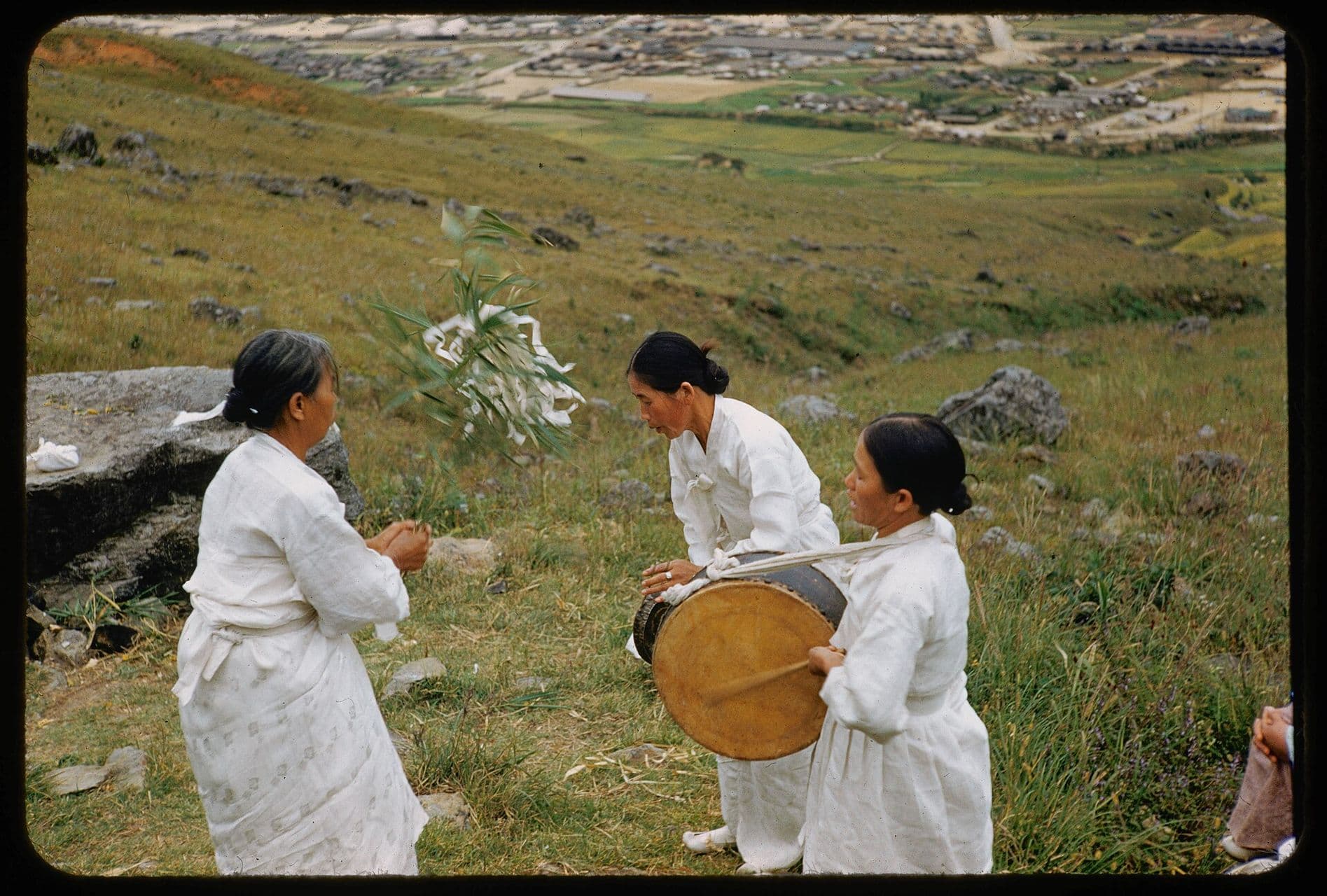
At the heart of muism stands the , the shaman, for they are, overwhelmingly, women. Her function is to establish contact between humans and the world of spirits: deities, nature spirits, souls of the deceased. She is consulted to heal, to appease a dead person, to ward off misfortune or to know the future.
The vocabulary of muism opens a door onto a deeper Korea: 무당 (mudang, the shaman), 굿 (gut, the ritual) and 무속 (musok, shamanism itself). With KoreanSRS and its spaced repetition, you will lastingly memorize these words and the 한글 (hangeul, the Korean alphabet) that writes them.
Two main paths into this function are traditionally distinguished. Some mudang become so by inheritance, the office being transmitted within the family. Others are called to it by an initiatory crisis, the sinbyeong (신병), the "spirit sickness": an unexplained suffering that ceases only when the chosen one accepts her vocation and is enthroned by a ritual.
The word designates the Korean shaman. Muism itself is called musok (무속), from mu (무, 巫), the character that designates the shaman throughout the Far East, and sok (속), "custom, usage." Literally, it is therefore "the custom of shamans."
The gut: the great ritual#
The most spectacular practice of muism is the , the shamanic ritual. Blending music, dance, songs, food offerings and shimmering costumes, it can last from a few hours to several days. Over the course of the ceremony, the mudang enters a trance and lets the spirits speak through her, transmitting their messages, their reproaches or their consolations to the assembled family.
| Type of gut | Goal sought | Occasion |
|---|---|---|
| 병굿 (byeonggut) | Heal a sick person | Illness, unexplained suffering |
| 씻김굿 (ssitgimgut) | Purify the soul of the deceased | Mourning, funerals |
| 재수굿 (jaesugut) | Draw luck and prosperity | Household, business |
| 풍어굿 (pungeogut) | Ensure an abundant catch | Fishing villages |
| 내림굿 (naerimgut) | Enthrone a new mudang | Vocation, sinbyeong |
There are many types of gut, depending on the goal sought: to heal a sick person, to ensure a good harvest or a fruitful catch, to appease the soul of a deceased so that it peacefully reaches the other world, or to draw prosperity onto a household or a business. The gut is as much a religious act as a cathartic theatre, where the community stages its fears and its hopes.
Certain forms of gut are today recognized as intangible cultural heritage of South Korea and protected as such. The ritual, once despised as superstition, is now studied and preserved as a total art blending music, dance and theatre.
Contempt, repression and survival#
The history of muism is also that of a long contempt. Under the Joseon dynasty (1392-1897), deeply Confucian, shamans were marginalized, relegated to the bottom of the social ladder, their practice judged vulgar and irrational. In the 20th century, colonization and then modernization campaigns still sought to eradicate what was held to be a backward superstition.
Yet muism survived everything. Discreet, adaptable, anchored in people's concrete needs (sickness, money, love, mourning), it continued to answer anxieties that neither Confucianism nor the imported religions addressed in the same way. Its resilience lies in this closeness to the everyday and the intimate.
Read alsoHallyu: How the Korean Wave Conquered the WorldSpirits, mudang and gut rituals nourish countless films and K-dramas today, where shamanism becomes a driver of fiction.
Muism today: a persistent presence#
Far from having disappeared in hypermodern Korea, muism remains astonishingly alive. People still consult a mudang before a marriage, the opening of a business, an important exam or a major decision, to secure the favor of the spirits and ward off misfortune. This practice rubs shoulders, without friction, with the smartphones and skyscrapers of Seoul.
Shamanism also powerfully irrigates popular culture: cinema and K-dramas teem with mudang, rituals and spirits, which fascinate a global audience through the Korean wave. What was once shameful has become a strong aesthetic and identity motif.
To discover Korean shamanism is to meet a Korea older and more mysterious than that of K-pop and semiconductors: a country where, behind modernity, the dialogue with spirits never ceased. To learn Korean is also to learn these words, mudang, gut, musok, that express a unique way of linking the living and the dead.
FAQ#
What is Korean shamanism? Korean shamanism, or muism (무속), is the oldest spiritual tradition of the peninsula. It rests on communication with spirits through a shaman, the mudang, during rituals called gut.
What is a mudang? A mudang (무당) is a Korean shaman, most often a woman, who serves as an intermediary between humans and spirits. One becomes one by family inheritance or following an initiatory crisis, the sinbyeong.
What is a gut? The gut (굿) is the Korean shamanic ritual, blending music, dance, songs and offerings. During the ceremony, the mudang enters a trance to let the spirits express themselves and answer the family's needs.
Is shamanism still practiced in Korea? Yes. Despite centuries of contempt, muism remains alive: people still consult a mudang before a marriage, an exam or the opening of a business, and it widely inspires cinema and K-dramas.
Photo credits: the images used in this article come from Pexels and Unsplash and are royalty-free.
The Korean wedding: the pyebaek, the hall and the envelope
A thirty-minute ceremony, the pyebaek rite, congratulatory cash envelopes, dowries and a marriage rebound: how South Korea gets married today.
Cover image: Rijksmuseum · Rijksmuseum, via Wikimedia Commons · CC0