The Korean wedding: the pyebaek, the hall and the envelope
A thirty-minute ceremony, the pyebaek rite, congratulatory cash envelopes, dowries and a marriage rebound: how South Korea gets married today.
La rédaction Kotoba Interactive
Studio éditorial
A six-storey building, six ceremony halls, and on every door a screen listing the couple's names and their time slot. The second-floor ceremony starts at noon, the third floor at half past. Each couple has roughly thirty minutes to get married before the hall is handed to the next pair and the guests head down to the buffet, ticket in hand.
A South Korean wedding almost always happens in two acts on the same day: a white-dress ceremony, public and timed to the minute, then a Confucian rite in hanbok, private, in which the newlyweds bow to their elders. The overlay is not a clumsy compromise. It compresses a century of Korean history into a single morning.
The wedding hall is an industry of its own#
The venue is called a , literally "ceremony place". It is a private business, often occupying a whole building, that runs weddings back to back all Saturday and Sunday, sometimes eight in one hall.
The package covers the room, the officiant, the music, the photographer, the outfit rental and a buffet billed per head. The ceremony itself is short: the couple's entrance, an elder's address, the vows, a bow to both families, group photographs. The more distant guests sometimes leave without having seen the bride up close, which locally is no slight at all.
At the entrance, a table staffed by relatives records arrivals and receives the , the congratulatory envelope. It holds banknotes, never a gift, and the amount follows a precise custom: a colleague from the office gives less than a university friend, who gives less than a cousin. A ledger notes who gave how much, because the Korean wedding runs on long reciprocity: what you pay in today comes back the day your own son marries.
The word names traditional marriage as a rite, as opposed to , marriage as civil status and social fact. You attend a gyeolhonsik (결혼식), the ceremony; you study hollye in ethnography books.
What a Joseon wedding actually required#
Under the Joseon dynasty (1392-1897), a union followed a protocol codified by Confucian manuals, built around several stages of negotiation between the two houses: exchange of birth charts, choice of an auspicious date, sending of gifts, then the ceremony itself.
One important and often forgotten detail: the ceremony took place at the bride's home, not the groom's. The groom rode there on horseback and presented his mother-in-law with a wild goose, replaced in common practice by a . The bird was chosen for its reputation of fidelity to a single mate.
The couple then bowed to each other across a table laid with fruit and fowl, drank from a gourd cut in two whose halves had to fit back together, and spent their first nights in the bride's parents' house. Only after a variable delay, sometimes several months, did the young woman move permanently into her husband's family.
The two halves of the ritual gourd come from a single fruit split in two. They fit no other gourd in the world, which is what gives the gesture its weight: the cup becomes whole again only by finding exactly its own half.
The pyebaek, the rite's lone survivor#
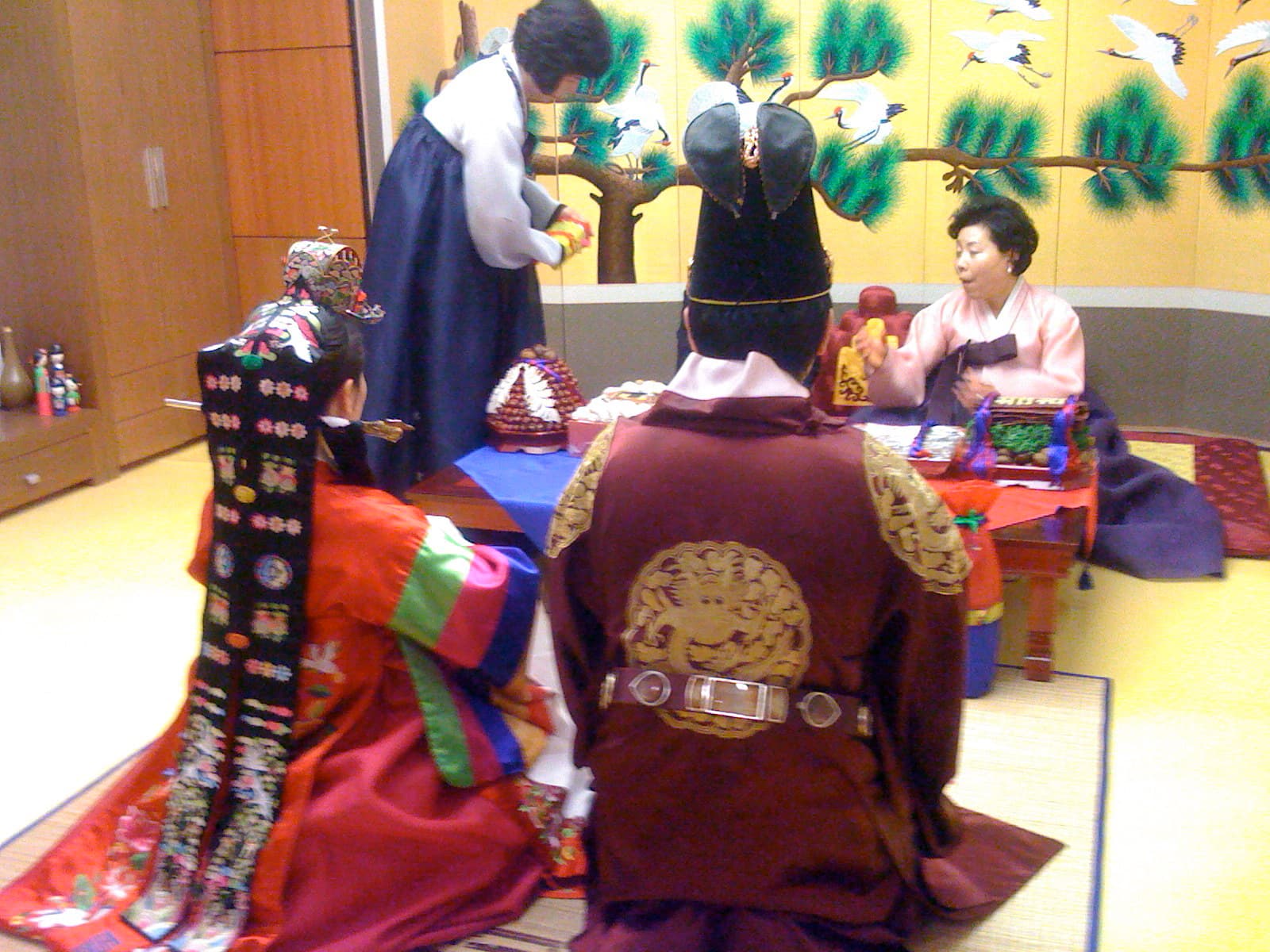
The is today the most alive traditional element of a Korean wedding. It takes place after the main ceremony, in a small adjoining room, in front of close family only.
The couple change clothes for it. The bride wears a or a , a long embroidered robe with colour-banded sleeves, and a headpiece; the groom puts on the court officer's costume, . They bow deeply to the parents, first the groom's, now often to both families, which was not the custom fifty years ago.
The elders then offer jujubes and chestnuts, and , throwing them towards the bride. She catches them in a cloth stretched between her hands and her husband's. The count of caught fruit was traditionally read as a prediction of children to come, jujubes standing for sons and chestnuts for daughters.
The groom's father finally hands over an envelope, and rice liquor is served. The whole thing lasts twenty minutes and gets photographed a great deal.
| Term | Hangul | What it is |
|---|---|---|
| Sanggyeonnye | 상견례 | First formal meal between the two families, before the engagement |
| Ham | 함 | Chest of gifts sent by the groom's family before the wedding |
| Yedan | 예단 | Gifts from the bride's family to her in-laws |
| Honsu | 혼수 | Furniture and equipment for the future home |
| Yesikjang | 예식장 | The commercial wedding hall |
| Chugui-geum | 축의금 | Cash envelope handed over by guests |
| Pyebaek | 폐백 | Rite of homage to elders in hanbok, after the ceremony |
| Honin singo | 혼인신고 | Marriage declaration at the town hall, the only legal act |
Money is the real protocol#
There is an unwritten rule, still widespread and increasingly contested: the groom's family provides the housing, the bride's family furnishes it. In a country where Seoul property prices long rose faster than wages, that split weighs heavily on negotiations between families.
The is its most folkloric remnant. This chest of fabrics, jewellery and letters was once carried to the bride's house by the groom's friends, who pretended to auction it off and refused to move until they were given money or drink. The scene, loud and well lubricated, is fading in the cities, where the chest often arrives by courier.
The most argued-over item remains the , the bride's gifts to her in-laws, long converted into cash. Korean magazines regularly run features on the conflicts it causes, and many couples now inform both families that they are dropping it, which is in itself a statement.
A Korean wedding invitation runs on a handful of recurring words: 결혼 (gyeolhon, marriage), 신랑 (sillang, the groom) and 신부 (sinbu, the bride). KoreanSRS, our spaced repetition app, installs that vocabulary and the everyday Korean that goes with it.
What the numbers say#
Korean marriage went through a decade of steady decline, then a sharp reversal. According to the marriage and divorce statistics published by the national statistics office, South Korea recorded around 222,000 marriages in 2024, a rise of 14.8 percent in one year, the steepest increase since that data series began in 1990, and the highest level since 2019.
The average age at first marriage keeps climbing all the same: 33.9 for men and 31.6 for women in 2024. International marriages reached roughly 20,800 unions, rising for the third year in a row.
Part of the rebound is catch-up after the pandemic years, when ceremonies were postponed because guests could not gather, and part comes from housing support measures for young couples. It says nothing, however, about marriage returning as a compulsory stage of life: the word , "non-marriage", has since the 2010s named a deliberate choice of lasting singlehood, claimed in particular by graduate women.
In Korea, getting married is still a matter for two families; not getting married has become a personal one.
Marrying differently#
Several alternatives are gaining ground as the industrial ceremony wears thin. The "small wedding" (작은 결혼식, jageun gyeolhonsik) gathers a few dozen guests in a public garden, a traditional hanok house or a museum, often with help from local authorities that lend venues cheaply. Other couples marry abroad, or shoot a photo session in wedding clothes without holding any ceremony at all.
One point the staging tends to obscure deserves a mention: under Korean law, no ceremony creates a marriage. Only the declaration at the town hall, the , has legal force, and some couples delay it for months after the party, or avoid it to keep housing benefits.
Same-sex marriage is still not recognised. A landmark Supreme Court decision handed down in July 2024 nonetheless granted a man dependant status on his same-sex partner's health insurance, on the grounds of equal treatment with unmarried couples. The ruling does not create a marriage, but it opened a gap that campaigners are trying to widen.
Between the timed Saturday hall and the wooden goose set on a table, the Korean wedding lives entirely in that juxtaposition: you change costume in the middle of the day to salute, for twenty minutes, a family order whose rules nobody quite follows any more.
Read alsoHanbok: The History and Symbolism of Korea's Traditional DressThe pyebaek hanbok is not the one worn on ordinary formal occasions: colours, headpiece and embroidery follow a precise code.
In China, marriage pressure plays out elsewhere: in a Shanghai park where parents display their children's résumés.
FAQ#
How much goes in the congratulatory envelope? Common practice runs around 50,000 won for a work relationship, 100,000 won for a close friend, more for family. The amount accounts for the buffet meal you will eat, and mid-range sums are given in odd numbers of notes.
Should guests wear hanbok? No. Hanbok is for the couple and close parents, notably during the pyebaek. Guests wear sober city clothes, and white is best avoided, as in the West, since it is the bride's colour.
Is the pyebaek compulsory? No, it is the families' choice. It remains very common, including among couples who follow no other traditional custom, because it concentrates the salute to elders and some fine photographs into a few minutes.
Why are the ceremonies so short? Because wedding halls run several ceremonies a day and bill by the slot. That commercial constraint fixed a format of about thirty minutes, buffet excluded, which most guests know and expect.
Do religious weddings exist in Korea? Yes. A share of ceremonies take place in churches or temples, South Korea having large Protestant, Catholic and Buddhist communities. The pyebaek can follow the service, and the town hall declaration remains in all cases the only legal act.
Photo credits: the images in this article come from Wikimedia Commons and are under free licences.
Kimjang: Korea's great collective winter kimchi rite
Every autumn, families and neighbors salt dozens of cabbages together. Meet kimjang, the communal kimchi-making listed by UNESCO in 2013.
Cover image: halfGoku · halfGoku, via Wikimedia Commons · CC BY-SA 2.0