Xiangqi: Chinese chess, from the river to the scandal
Rules, pieces, origins and scandals of xiangqi, Chinese chess: the river across the board, the cannon that needs a screen, and the lifetime bans of 2024.
La rédaction Kotoba Interactive
Studio éditorial
On a xiangqi board, the pieces do not sit in the squares but on the intersections, and an empty band crosses the board down the middle. Two columns of characters are printed there: 楚河 漢界, "the river of Chu, the border of Han". Every game is therefore played on either side of a front line drawn from a civil war that ended in 202 BCE.
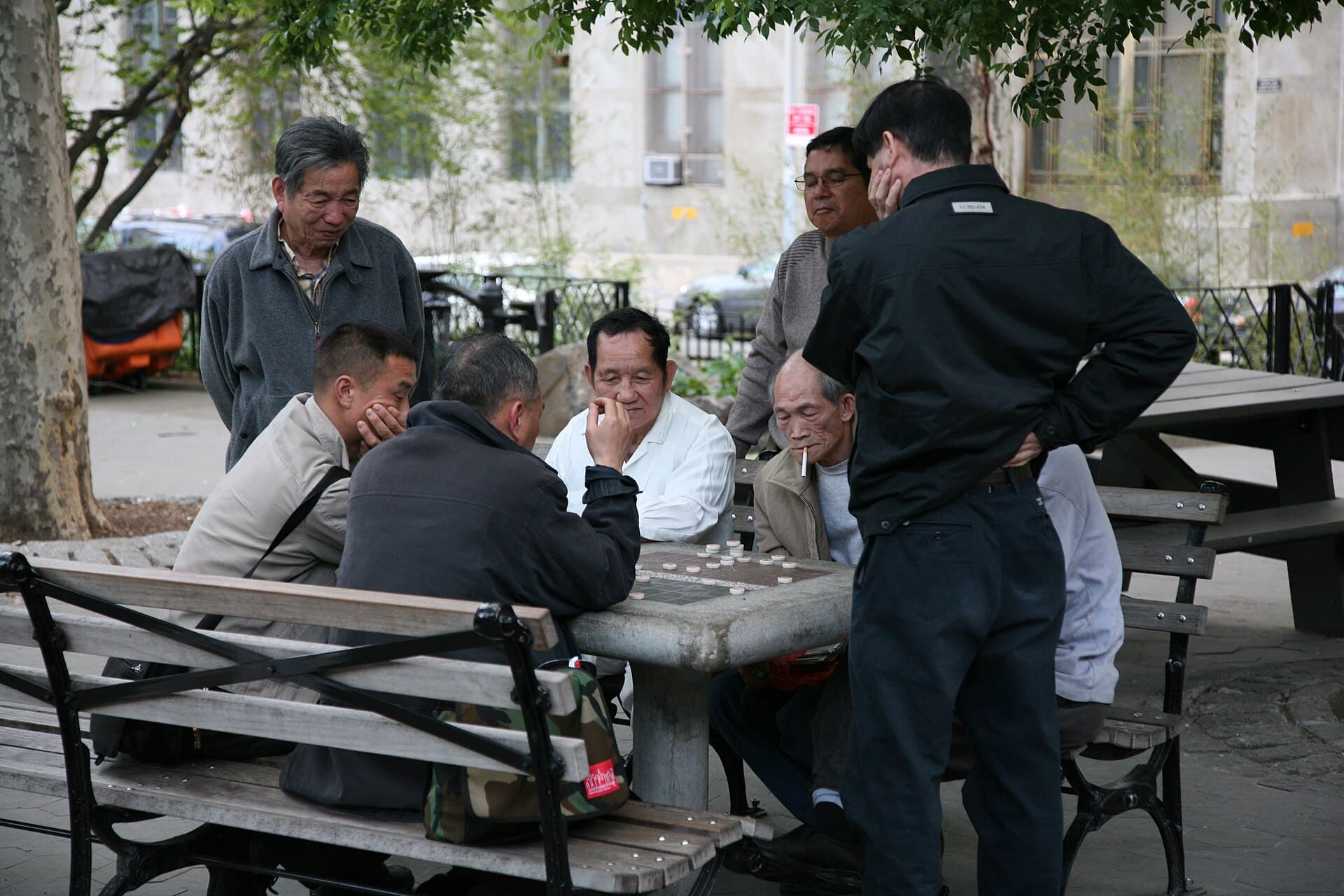
Chinese chess is the most played board game in China, far ahead of go, whose scholarly reputation masks its actual reach. People play it in parks, on folding stools, with an audience that comments out loud and fights over the right to advise.
A board that tells a war#
The board has nine vertical lines and ten horizontal ones, making ninety intersections. It is cut in two by the river, which some pieces cannot cross.
At each end, a square of nine points crossed by two diagonals marks out the . The general and his two guards never leave it: the entire game consists of getting a threat inside that three-by-three enclosure.
The river's name refers to the struggle between Xiang Yu, lord of Chu, and Liu Bang, future founder of the Han dynasty. Their conflict ended in 202 BCE and left, besides an empire, the median line of every xiangqi board sold since.
is written with the characters for "elephant" and "board game". The origin of the first is still debated: it may name the elephant piece, present in chess games across Asia, or a homophone meaning "figure, image", which would make xiangqi a "game of figures". Both readings have their defenders.
Seven pieces, seven logics#
Each side lines up sixteen pieces, flat discs bearing a character. The names differ between the red and black camps for the same function, which throws beginners but changes nothing in the rules.
| Piece | Red / Black | Movement | Own constraint |
|---|---|---|---|
| General | 帥 / 將 | One point, orthogonal | Confined to the palace |
| Guard | 仕 / 士 | One point, diagonal | Confined to the palace |
| Elephant | 相 / 象 | Two points diagonally | Never crosses the river |
| Horse | 傌 / 馬 | One straight step then one diagonal | Blocked if the first step's point is occupied |
| Chariot | 俥 / 車 | In a line, unlimited | None, it is the strongest piece |
| Cannon | 炮 / 砲 | In a line, unlimited | Captures only by jumping over one piece |
| Soldier | 兵 / 卒 | One step forward | Gains sideways movement after crossing the river |
The cannon is the piece with no equivalent anywhere else. It moves like a rook, but to capture it needs a screen: exactly one piece, friend or enemy, between it and its target. That mechanic changes everything, since a piece that shields can become an accomplice.
Two more rules give the game its edge. The horse can be "hobbled": if the point it must cross first is occupied, it does not move, which makes it a piece you can neutralise without threatening it. And the two generals may never face each other down an open file, a prohibition players call the "bare-faced general", which serves as a mating motif in its own right.
An origin nobody has settled#
The game's history is a battleground between two theses. The first attaches it to the chess family that came from India, chaturanga, spreading west to Persia and east to China. The second argues for local invention, out of older Chinese military simulation games.
The textual milestones are few and disputed. A treatise entitled Xiangjing is attributed to Emperor Wu of the Northern Zhou in the sixth century, but nothing proves it describes the present game. A Tang-era fantastical tale stages a miniature battle with chariots, horses and a general, which implies a recognisable ancestor. It is under the Song, between the tenth and thirteenth centuries, that the modern form settles: the scholar Chao Buzhi describes a game of thirty-two pieces, exactly today's number.
One material detail supports that dating. The cannon appears in the sources at the time gunpowder enters Chinese warfare, and its character is first written with the stone radical, 砲, that of the projectile-throwing engine, before being written with the fire radical, 炮. The game followed the weaponry.
The street, the park, the shade of a tree#
Xiangqi is played everywhere and fast. A street game rarely lasts more than twenty minutes, the pieces snap down, and the audience's commentary is part of the game, to the point that a proverb tells onlookers to keep quiet, precisely because nobody does.
That ubiquity explains a common Western misreading, in which go passes for the Chinese game par excellence. has the prestige, the philosophical weight and the manuals; xiangqi has the players. A set costs a few yuan, the rules take half an hour to learn, and neighbourhood tournaments are organised without any federation.
There is a training variant in which one player removes a chariot, a horse or a cannon before starting, a handicap practice comparable to go's handicap stones. In the parks, an elderly player who offers to remove one of his own pieces is not being modest: it is a warning.
Three words are enough to follow a game in a park: 将军 (jiāngjūn, "check to the general"), 马 (mǎ, the horse) and 炮 (pào, the cannon). ChineseSRS, our spaced repetition app, installs that vocabulary and the everyday Chinese that goes with it.
The professional circuit and its hierarchy#
Xiangqi has had a national individual championship since 1956 and a team league that structures careers. The game's tutelary figure is , national champion at fifteen in 1960, titled fourteen times across four decades, a player whose games still serve as teaching material.
The discipline remains overwhelmingly Chinese, with a strong presence in Vietnam, where the game is called cờ tướng, and in the South-East Asian diasporas. International federations run world championships, but the level is set in China, and the national title counts for more there than a world title.
2024, the year the federation banned its best players#
The affair that shook the milieu is recent. From 2023, recordings circulated online implicating several grandmasters in fixed results. The investigation run by the Chinese Xiangqi Association concluded in autumn 2024: , China's number one since 2014 and national champion in 2012, and were banned for life for match-fixing and bribery, with other players sanctioned to varying degrees. The association described conduct spread over time, repeated, and of a gravity it called extreme.
The 2023 national champion had already been stripped of his title a few months earlier through a separate disciplinary procedure. For a game that lives on a reputation for popular honesty, the run of cases hurt: it showed that professionalisation had brought xiangqi the same temptations as other mind sports, prize money included.
China's most popular game discovered at the same moment that it had become a market.
Xiangqi, chess, shogi: three cousins#
| Xiangqi | Chess | Shogi | |
|---|---|---|---|
| Board | 9 × 10 intersections | 8 × 8 squares | 9 × 9 squares |
| Pieces per side | 16 | 16 | 20 |
| Unique piece | The cannon, which jumps to capture | None | Dropping captured pieces back in |
| King | Confined to the palace | Free, castling possible | Free |
| Draws | Frequent at top level | Frequent | Rare |
The deepest difference is not in the rules but in the posture. In chess the king runs; in xiangqi the general stays shut in and watches the battle come to him, inside a square of nine points he will never leave. The whole game lies in that immobility.
Read alsoWeiqi: the Chinese game of go, the art of encirclingChinese go, weiqi, plays on territory where xiangqi plays on direct capture.
China's other great social game is played by four, noisily, and is nothing like a duel.
FAQ#
Is xiangqi easier than chess? The rules are learned faster, but the difficulty is comparable. The cannon and the hobbled horse create tactics chess players take time to see, and xiangqi endgames are reputed to be especially technical.
Can you play without reading Chinese? Yes. The pieces are told apart by their starting position and by the shape of the characters, memorised within a game or two. Pictogram sets exist for beginners as well.
Where can you play online? Chinese and international apps offer rated games and daily puzzles. The game is also played live on Chinese video platforms, where professionals commentate on their own games.
How does it differ from Vietnamese cờ tướng? It is the same game. The piece names are written in Chinese characters on identical boards, and international competitions bring both countries together with no rule adaptation.
How long is a game? Around twenty minutes in street play, several hours in competition at long time controls. Professional tournaments use fast controls in the preliminary rounds, which makes the game very watchable.
Photo credits: the images in this article come from Wikimedia Commons and are under free licences.
Guanxi: the web of relationships that keeps China running
Renqing, mianzi, banquets, favour debts: what guanxi (关系) really covers, where the line with corruption runs, and what has changed since 2012.
Cover image: Daniel Schwen · Daniel Schwen, via Wikimedia Commons · CC BY-SA 4.0