Macau: How a Trading Post Became the Gambling Capital
Macau (澳門) is the world's largest gambling hub, far ahead of Las Vegas. Baccarat, VIP rooms, mega-resorts: anatomy of a casino machine.
La rédaction Kotoba Interactive
Studio éditorial
In 2013, a Chinese peninsula of thirty square kilometres took in roughly 45 billion dollars in gambling revenue, nearly seven times what the entire Las Vegas Strip earned that same year. That territory is , and it has held a record no one has contested for twenty years: the largest gambling market on the planet.
Macau is the only place in China where casinos are legal, and it is where an outsized share of the money wagered on Earth changes hands. It is a city whose tax revenue, employment and public budget depend on a single industry to a degree with no equivalent anywhere else. This article sets aside the Portuguese lanes and the pastéis de nata to tell the other Macau: the casino machine, born from the end of a forty-year monopoly, fuelled by high rollers from the mainland, then shaken by corruption, COVID and Beijing's push to change its very nature.
Macau overtook Las Vegas back in 2006#
Macau overtook Las Vegas in gambling revenue in 2006 and never surrendered the top spot again. That year, the peninsula's casinos took in slightly more than those on the famous Nevada Strip, an event the business press promptly framed as the world's centre of gravity for gambling shifting toward Asia. The gap only widened afterward.
The 2013 peak captures the excess. That year, Macau's gross gaming revenue reached around 45 billion dollars, while the entire Las Vegas Strip hovered around six to seven billion. A single territory, smaller than many city districts, thus produced several times the result of the historic capital of American gambling. The comparison long served as journalistic shorthand: Macau was said to be "seven Las Vegases."
literally means "the gate of the bay," from and . The territory was a Portuguese trading post from 1557 to 1999 before becoming a of China, with its own laws. It is this special status that permits, on this one patch of Chinese soil, what remains banned everywhere else in the country: the casino.
The only legal casino in all of China#
Gambling is banned across mainland China, and Macau stands as the single exception. On the mainland, only two forms of public betting are tolerated, the sports lottery and the welfare lottery, both state-run; casinos are illegal. Hong Kong permits horse racing and some betting, but no casinos either. Macau therefore remains the only territory under Chinese sovereignty where you can legally push chips across a table.
This legal singularity explains almost everything. For hundreds of millions of potential players in a country of 1.4 billion, Macau is the nearest gateway, the easiest to reach and the only one that speaks their language. The peninsula is linked to the neighbouring city of Zhuhai by a simple border crossing, and since 2018 to the Pearl River Delta by the longest sea bridge in the world. Geography made Macau China's designated casino.
The end of Stanley Ho's monopoly (2002)#
Modern gambling Macau was born in 2002, with the end of a monopoly held for forty years by a single man: Stanley Ho. As early as 1962, the businessman and his company had secured the exclusive gaming concession in Macau. For four decades, every casino in the territory belonged to his empire, earning Ho the nickname "the King of Gambling" and a vast fortune.
In 2002, three years after the handover to China, the government of the Special Administrative Region ended the monopoly and opened the market to international competition. Three main concessions were awarded, soon subdivided into six operators: the local heir SJM (successor to STDM), America's Las Vegas Sands, Wynn, MGM, the local Galaxy and Melco. Within a few years, the groups that had built Las Vegas arrived with their capital and expertise, determined to turn a hushed market into an industrial machine.
Stanley Ho had made Macau a monopoly; the 2002 liberalisation turned it into a global market. In a decade, the peninsula went from a handful of discreet casinos to the densest concentration of gaming tables on the planet.
The Cotai Strip: Las Vegas risen from the sea#
To house its mega-resorts, Macau literally manufactured land between two islands. The territory was short of space: the old peninsula was saturated. Operators and government therefore reclaimed the stretch of sea separating the islands of and , creating from scratch a district named , a contraction of the two names. On this soil won from the water, an American-style "Strip" was to rise.
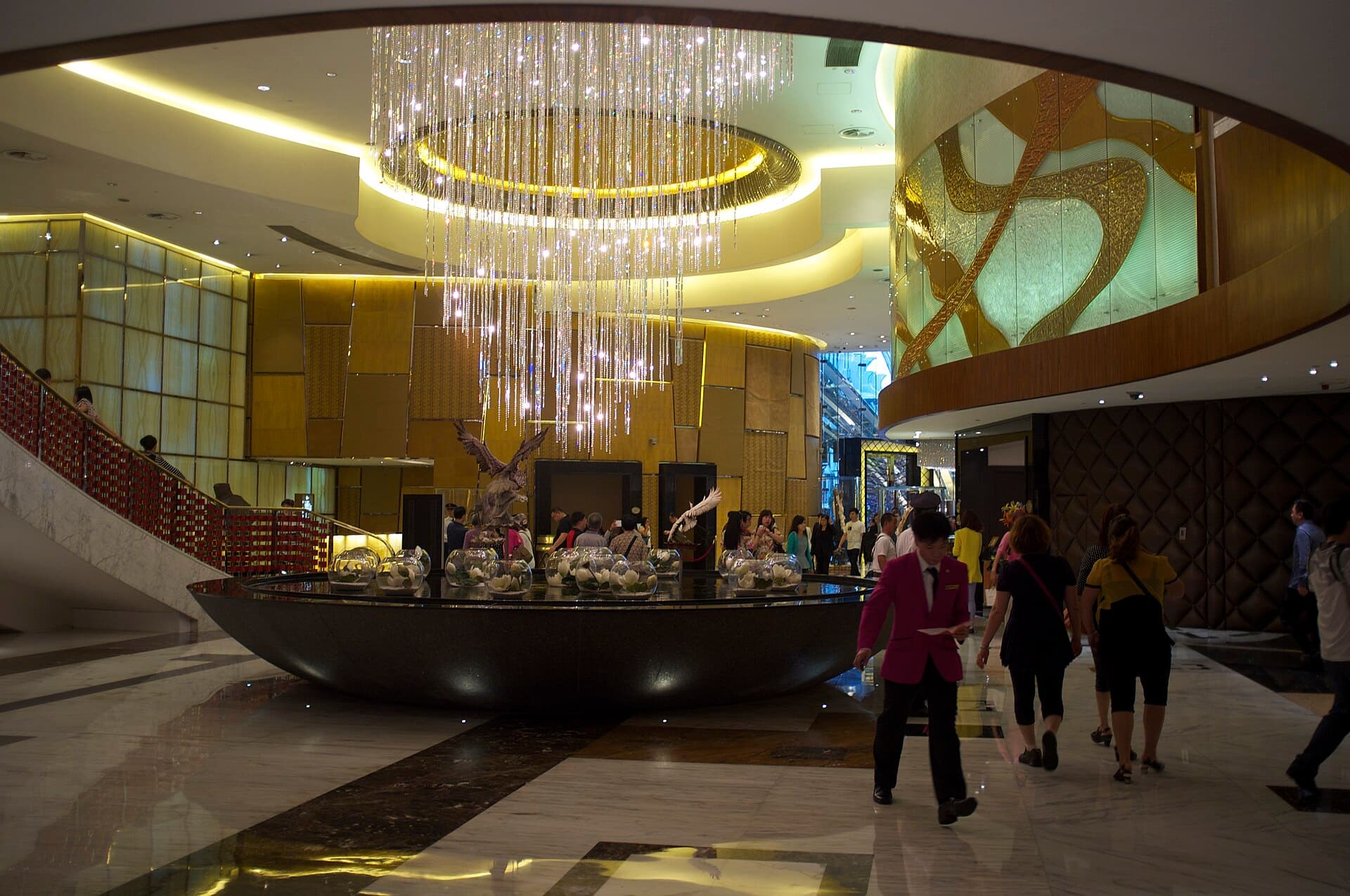
The Venetian Macao, opened in 2007 by Las Vegas Sands, became its flagship: indoor canals, gondolas, ceilings painted like a false sky, and one of the largest gaming floors in the world under a single roof. In its wake rose Galaxy Macau, City of Dreams, Studio City, the Parisian with its half-scale Eiffel Tower, and Wynn Palace. The Cotai Strip copied Las Vegas in form, while departing from it radically in economics.
Baccarat, absolute king of the tables#
A single game concentrates the overwhelming majority of Macau's casino revenue: baccarat. accounts for roughly 88 % of the peninsula's table-game revenue, a dominance with no equivalent in Las Vegas, where earnings spread across slot machines, blackjack, roulette, poker and shows. In Macau, roulette and blackjack exist, but stay marginal beside the baccarat table.
The game owes its reign to its very nature. Baccarat pits the "player hand" against the "banker hand" with almost no decision to make: you bet on one of the two, the cards fall, you win or you lose. Little strategy, a fast pace, and stakes that can be colossal: the format suits high rollers eager to commit large sums in few rounds. Where Las Vegas sells variety and entertainment, Macau sells baccarat at scale.
Intrigued by Macau? Learn to read 澳門 (Àomén, Macau), 賭場 (dǔchǎng, casino), 百家樂 (bǎijiālè, baccarat) and 貴賓廳 (guìbīntīng, VIP room), then hundreds of everyday Chinese words with ChineseSRS and its spaced repetition.
Junkets and VIP rooms: the hidden engine#
For years, most of the money wagered in Macau passed not through the public floors but through private salons reserved for the very biggest players. These ran thanks to a system unique to Macau, that of the . These companies recruited high rollers on the mainland, advanced them gaming credit, arranged their travel and handled debt collection, a delicate function where casinos could not legally move money out of China.
At their height, these VIP rooms accounted for more than half, sometimes close to two-thirds, of Macau's gaming revenue. The system solved a structural problem: China's strict capital-outflow rules limited how much a player could legally carry to Macau. The junkets, by advancing credit on site and collecting repayment inside China, worked around the obstacle. This discreet mechanism was long the true financial engine of the peninsula.
The collapse of the junkets after 2014#
The model tipped from 2014, when Beijing's anti-corruption campaign dried up the flow of high rollers. President had launched a sweeping drive against corruption, and officials and wealthy businessmen alike suddenly grew wary of flaunting spectacular stakes in Macau. Gaming revenue, after the 2013 peak, fell heavily in the following years, dragged down by the collapse of the VIP segment.
The final blow came from the Suncity affair and its boss . Suncity was Macau's largest junket operator. In late 2021, Alvin Chau was arrested, and in 2023 sentenced to eighteen years in prison for organising illegal betting and money laundering. A second major junket, Tak Chun, fell soon after. Within months, the ecosystem of intermediaries that had built Macau's fortune almost entirely collapsed, and the VIP rooms emptied.
An economy on a gambling drip#
In Macau, gambling is not part of the economy: it is the economy. In the boom years, gaming revenue represented roughly half of the territory's gross domestic product and the overwhelming majority of public tax receipts. The gaming tax, levied at a rate of around 39 % on casinos' gross revenue, single-handedly funded almost the entire budget of the Special Administrative Region.
This windfall has concrete effects on residents' lives. Thanks to budget surpluses fed by the casinos, the Macau government pays a cash handout each year to every permanent resident, a direct redistribution of gambling profits introduced in the late 2000s. Health, education, transport: a large share of public services rests on casino taxation. Few territories are so entirely dependent on a single industry, which makes Macau's prosperity as much as its fragility.
Since 2008, Macau has paid an annual cash handout to its residents, funded by casino profits. The amount, revised regularly, runs to several thousand patacas per person. To live in the gambling capital of the world is to collect, without wagering a single chip, a small share of the house's winnings.
The COVID shock and the 2022 turning point#
The pandemic exposed the fragility of that dependence by hitting Macau head-on. From 2020, China's "zero COVID" policy closed borders and cut off the flow of mainland visitors, on whom almost all of the peninsula's tourism depends. The casinos, starved of players, saw revenue collapse to a level unseen since the market opened. For an economy resting on a single industry and a single clientele, closed borders were an existential crisis.
In late 2022, in this context, the government renewed the six operators' concessions for ten years, but on its own terms. Beijing, long uneasy about a Chinese city living off gambling, has since pushed for non-gaming diversification: conventions, shows, family tourism, culture. The new contracts require casinos to invest heavily outside gambling and to attract an international clientele beyond Chinese punters alone. The instruction is clear: Macau must become less a baccarat hall and more a destination.
Macau versus Las Vegas: two opposite models#
Macau and Las Vegas share the look of casinos but rest on inverse logics. Las Vegas built its revival on mass entertainment: shows, concerts, celebrity restaurants, shopping, conventions, to the point where gambling now makes up only a fraction of the Strip's revenue. People go for the weekend, with family or friends, and bet on the side. The American model sells an all-round experience.
Macau, for a long time, sold almost only gambling, and above all the baccarat of high rollers who came to stake big and leave fast. The non-gaming share stayed low, the clientele overwhelmingly Chinese, the stay often short. It is precisely this imbalance that the 2022 turning point seeks to correct, pushing Macau toward the diversification model that saved Las Vegas. Whether the gambling capital of the world can stop being one without losing what made it unique remains to be seen.
Here is a snapshot of these two opposite models, with figures at Macau's peak:
| Criterion | Macau | Las Vegas (Strip) |
|---|---|---|
| Gaming revenue at peak (2013) | Around 45 billion dollars | Around 6 to 7 billion dollars |
| Baccarat share | Around 88 % of table games | Marginal, revenue spread out |
| Gambling's weight in the economy | Around half of local GDP | A fraction of Strip revenue |
| Gaming tax | Around 39 % of gross revenue | Markedly lower |
| Dominant clientele | VIP high rollers, mostly Chinese | Mass tourism, families |
| Legal status | Only legal casino in China | One legal casino state among many |
The other face of Macau, its Portuguese lanes, its azulejos and its Luso-Chinese heritage listed by UNESCO, far from the baccarat tables.
To understand the Chinese relationship with gambling and tiles, the history of mahjong sheds light on a national passion far older than the casinos.
FAQ#
Why is Macau the gambling capital of the world? Because it is the only place in China where casinos are legal. For hundreds of millions of Chinese players, it is the nearest gateway. Since 2006, Macau has taken in more gambling revenue than Las Vegas, and its 2013 peak, around 45 billion dollars, was several times the Strip's.
Is gambling legal everywhere in China? No. Casinos are banned on the Chinese mainland, where only two state lotteries are tolerated. Macau, a Special Administrative Region with its own laws since 1999, is the exception: the sole territory under Chinese sovereignty where casinos are allowed.
Who was Stanley Ho? was Macau's "King of Gambling." His company STDM held the casino monopoly from 1962 to 2002. The end of that monopoly opened the market to foreign operators such as Las Vegas Sands, Wynn and MGM, turning the peninsula into an industrial gambling hub.
What is the Cotai Strip? It is a district of mega-resorts built from scratch on reclaimed land, a stretch of sea won between the islands of Coloane and Taipa. The name combines the two. It hosts the Venetian Macao, the Parisian and Wynn Palace, modelled on the Las Vegas Strip.
Why did Macau's revenue fall after 2014? Because of Beijing's anti-corruption campaign, which scared off high rollers, then the collapse of the junkets that fed the VIP rooms, symbolised by the arrest of Alvin Chau (Suncity) in late 2021. COVID, from 2020, dealt a second blow by closing the borders.
Photo credits: the images in this article come from Wikimedia Commons and are under a free licence.
China's One-Child Policy: 1980-2015, and After
China's one-child policy: what it actually prohibited, its rural exceptions, the birth sex imbalance, the children without household registration, and the demography it left behind.
Cover image: Aleksandr Zykov · Aleksandr Zykov, via Wikimedia Commons · CC BY-SA 2.0