The Hungry Ghost Festival: China's Ghost Month
Gates of hell flung open, spirit money burned, meals left for wandering souls: inside Zhongyuan, China's ghost month and its rites.
La rédaction Kotoba Interactive
Studio éditorial
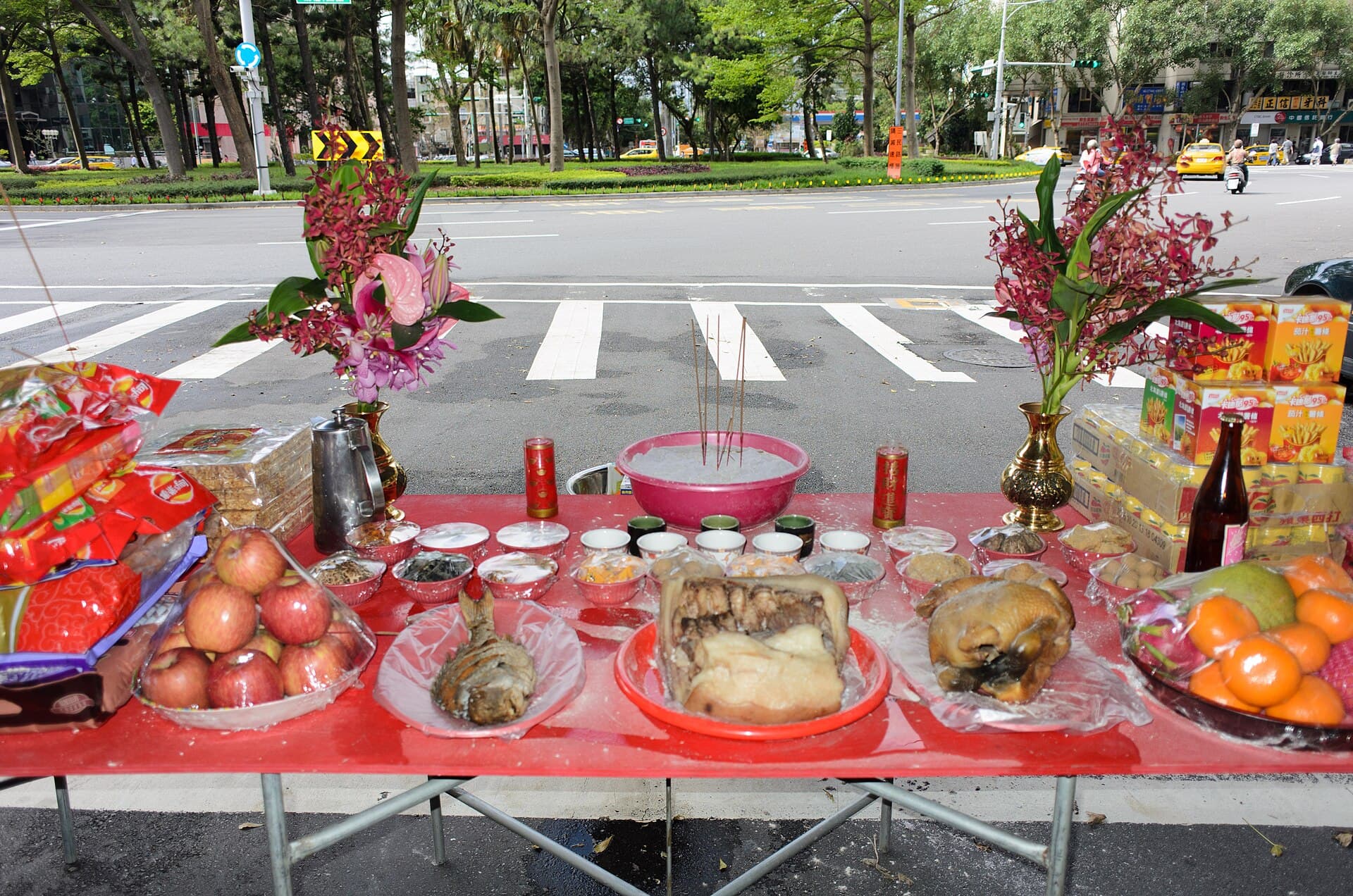
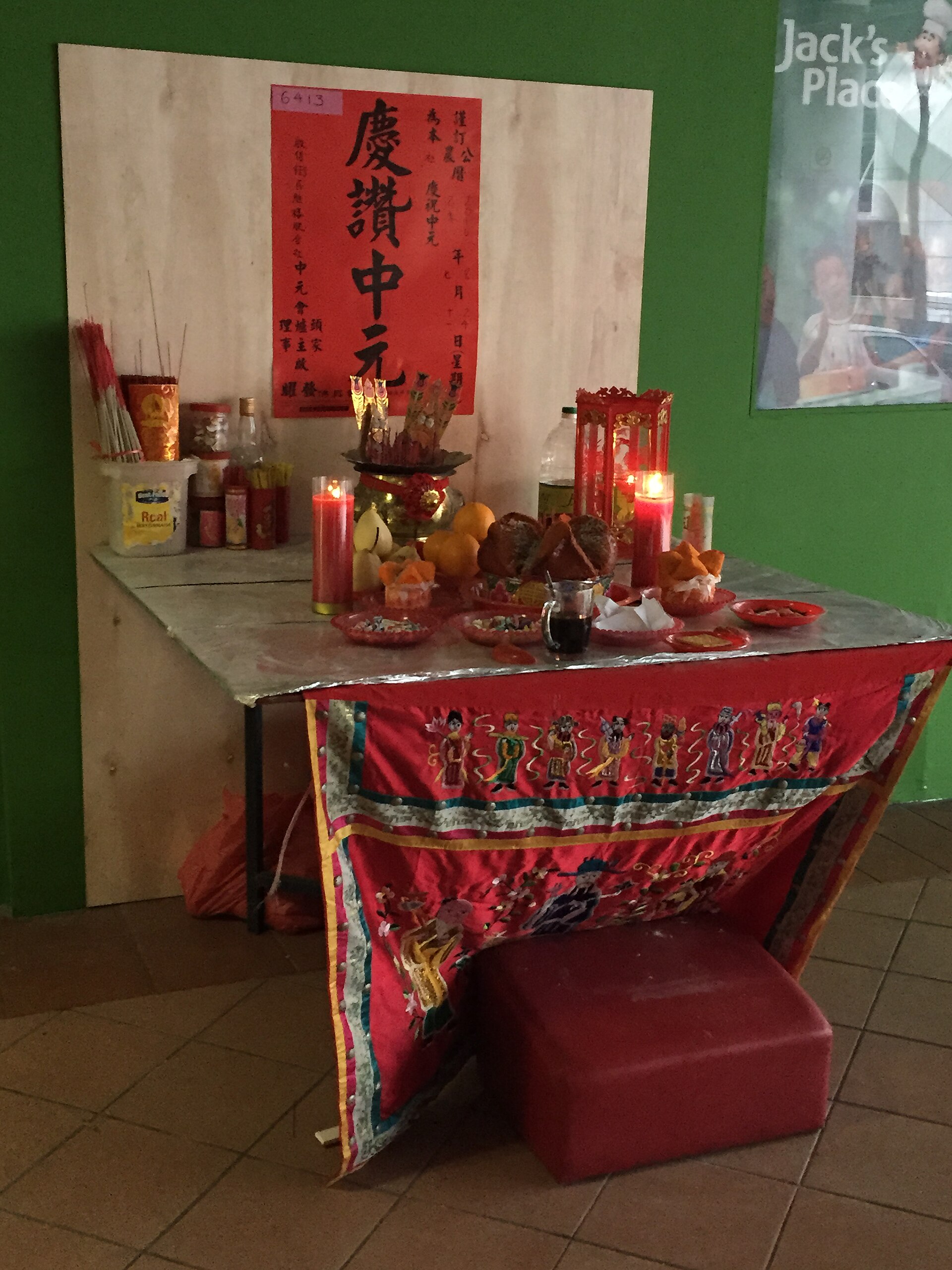
Night falls over an alley in Taipei, and folding tables appear on the sidewalks as if by magic. On them sit fruit, rice cakes, bottles of tea, cigarettes, sometimes a cold can of beer. In front of every shop door, a metal bucket smokes: handful after handful, wads of fake banknotes are tossed in, curling into orange ash that rises toward an August sky heavy with heat. No one prays aloud. Each person performs these gestures with the quiet seriousness of someone welcoming guests they cannot see.
Those guests are the dead. Throughout the entire seventh month of the lunar calendar, a belief more than fifteen centuries old holds that the gates of hell swing open and let a crowd of spirits rise back among the living: the ancestors one honors, but also the wandering souls, without family and without a grave, whom hunger makes dangerous. The and the Buddhist Ullambana) is not a Western-style horror carnival. It is a vast enterprise of piety, of tamed fear and of family memory, in which the dead are fed so that the living may stay at peace.
The seventh month, when hell opens its gates#
The Hungry Ghost Festival unfolds during the , which the Chinese bluntly call the , and peaks on the fifteenth day, at the full moon. In 2026, that fifteenth day falls in late August; like all festivals on the lunar calendar, its date slides each year within the Gregorian calendar. According to popular belief, on the first day of the month the open: the dead are granted a full month of freedom to return to the world of the living, and on the last day those gates close again, sending everyone back to their condition.
Not all these returning spirits are equal. First there are the ancestors, spirits domesticated by the family cult, welcomed as one would welcome grandparents on a visit. Above all there are the wandering : the dead with no descendants to feed them, victims of drownings, accidents or violence, souls no altar claims. These are the true "hungry ghosts." Given over to an inextinguishable hunger, they roam, and tradition teaches that a hungry, neglected spirit takes revenge, hence the immense care lavished on satisfying them.
juxtaposes guǐ ("ghost, spirit of a deceased person") and yuè ("month, moon"): literally "the month of ghosts." The character 鬼 originally depicted a human figure crowned with a grimacing mask, an image of the dead returning in a disquieting form.
The category that gives the festival its popular name comes from Buddhism: the hungry ghost proper, or , the Chinese translation of the Sanskrit preta. In Buddhist cosmology, the preta is a being condemned to be reborn with an enormous belly and a throat thin as a needle: it sees food, craves it, but can never swallow or ease its hunger. This figure of absolute hunger, the punishment for past greed, merged in China with the wandering spirits of the Taoist and folk background to produce the festival's central character.
Two origins for a single festival: Zhongyuan and Ullambana#
The Hungry Ghost Festival is a striking example of syncretism: it overlays a Taoist tradition and a Buddhist tradition which, falling on the same day, ended up blending in practice. This double origin explains why it carries several names and why its rites mix Taoist, Buddhist and folk registers without troubling anyone.
| Taoist festival | Lunar month | Official (element) | Function |
|---|---|---|---|
| Shàngyuán (上元, shàngyuán) | First month | Official of Heaven (天官, tiānguān) | Dispenses happiness: the Lantern Festival |
| Zhōngyuán (中元, zhōngyuán) | Seventh month | Official of Earth (地官, dìguān) | Judges souls and pardons faults |
| Xiàyuán (下元, xiàyuán) | Tenth month | Official of Water (水官, shuǐguān) | Wards off misfortune |
On the Taoist side, the festival is , one of the three yuán that punctuate the year. Taoism honors three Officials or , masters respectively of Heaven, Earth and Water. The first lunar month, , celebrates the Official of Heaven who dispenses happiness: it is the Lantern Festival. The tenth month, , honors the Official of Water who wards off misfortune. And the fifteenth day of the seventh month, Zhōngyuán, belongs to the , whose duty is to judge souls and pardon faults. It is on this day that the celestial tribunal examines the dead and clemency may lighten their sentence: the living pray and burn offerings to plead the cause of their departed.
On the Buddhist side, the same date hosts the Ullambana, in Chinese , the festival of the salvation of the dead. The word, a transcription of a Sanskrit term often rendered as "hanging upside down," evokes the torment of the damned that the living come to relieve. Its founding legend is one of the most famous in Buddhist Asia: the story of saving his mother.
The Chinese calendar overlays the Taoist festival of the Three Origins and the Buddhist festival of the salvation of the dead on the same fifteenth day of the seventh month. Far from fighting over the date, the two traditions merged: in a single temple, you can see Taoist priests and Buddhist monks officiating just a few meters from one another.
Mulian in hell: the legend that founds the Ullambana#
A disciple of the Buddha renowned for his supernatural powers, one day searches for his deceased mother across the six paths of rebirth. He finds her fallen among the hungry ghosts, reduced to a skeleton, unable to swallow a single bite: every grain of rice he holds out to her turns to burning coal the moment it nears her lips. Powerless despite his gifts, Mulian implores the Buddha. The Buddha reveals that his mother is too heavily burdened with faults to be saved by one man alone: it takes the combined strength of the entire monastic community.
The Buddha then teaches him to prepare, on the fifteenth day of the seventh month (the day the monks complete their rainy-season retreat), a great banquet of offerings presented to the assembly of the religious. Through the merit thus accumulated and transferred, Mulian's mother is at last delivered. From this episode is born the rite of the Ullambana: feeding the monks and the dead to free souls in torment. The legend, carried by texts and by an entire theatrical genre, made the Ghost Festival a moment of as much as of dread.
One does not feed ghosts out of superstition, but out of a very old conviction: a dead person who is forgotten becomes a dead person who is hungry, and a dead person who is hungry ends up returning to knock at the door of the living.
Feeding the dead: offerings, spirit money and burned effigies#
The heart of the festival lies in a single gesture: giving food and money to spend to those who have nothing left. All the ritual of the seventh month is organized around this hospitality toward the invisible, and it mobilizes three great registers of offerings: real food, the money of the dead, and paper objects.
Fascinated by the Ghost Month and its offerings? Learn to read 鬼 (guǐ, ghost), 祭 (jì, ritual offering) and 紙錢 (zhǐqián, spirit money) with ChineseSRS and its spaced repetition, so you can decipher the characters that recur across every Chinese festival.
On the altars set up in front of homes, shops and temples, dishes pile high. Families prepare a banquet of offering, the : cooked dishes, fruit, rice cakes, pure tea (淨茶, jìngchá), and often the , traditionally pork, chicken and fish. For the wandering spirits who have no one to pamper them, everyday objects are also laid out: basins, soap, towels, cigarettes, drinks. The idea is not to abandon food, but to invite: the souls are left to feast on the essence of the dishes, after which the living consume what remains, for nothing is wasted.
Spirit money: a bank for the beyond#
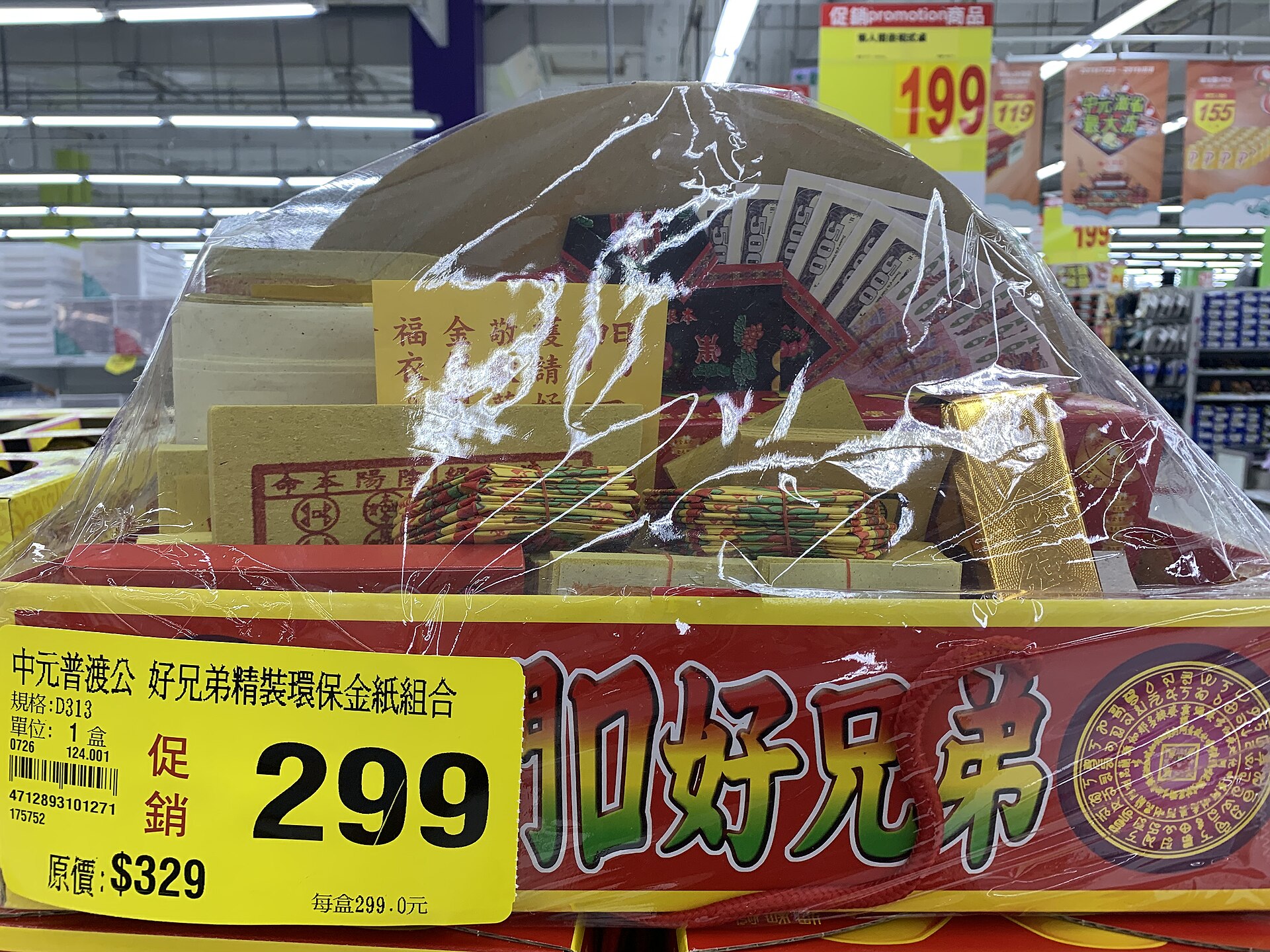
The most spectacular offering is fire. Everywhere, people burn , also called "ghost money" or "hell banknotes" (冥幣, míngbì). The principle rests on a clear belief: the beyond works like an administration where the dead need money to live, pay their debts, bribe the infernal officials and improve their lot. By burning these papers, one transfers their value to the other world; the smoke is the channel, the fire the post office.
This fake money comes in infinite variety: sheets marked with a gold or silver square, imitations of real banknotes, and above all the famous , giant bills denominated in the millions and signed by the "Emperor of Hell." The English word "Hell," born from a mistranslation of the word designating the abode of the dead, has stuck: it connotes no damnation, only the world below.
means, word for word, "paper money": zhǐ ("paper") and qián ("money"). The object has value only once burned: it is the combustion, not the bill, that "sends" the wealth to the dead. You do not store it, you do not collect it: you consume it in flame.
Paper effigies to equip the afterlife#
The logic of spirit money extends to anything that might be lacking in the other world. Artisans craft mounted on a bamboo frame: entire multi-story houses, luxury cars, servants, clothing, and (a sign of the times) mobile phones, computers and designer bags. All of it goes up in smoke to furnish the deceased with comfort equal to that of the living, or even greater. Piety is also measured by generosity: offering a beautiful paper villa to a departed relative is to affirm that they have not been forgotten.
These objects sustain a genuine craft industry, and their manufacture is recognized as an expertise in its own right. In Hong Kong, in Taiwan, across the Chinese diasporas, specialized shops sell this trousseau for the afterlife all year round, with sales exploding as the seventh month approaches.
Want to decipher these characters on the altars and the banknotes of the beyond? Learn 紙錢 (zhǐqián), 鬼 (guǐ) and 500 everyday Chinese words with ChineseSRS (chinesesrs.com).
A month of caution: the taboos of the seventh month#
Since the world of the dead spills into that of the living, the seventh month comes with a long list of meant to avoid attracting the attention of the spirits or inviting bad luck. These taboos, taken more or less seriously depending on families and generations, still strongly shape behavior, especially in Taiwan, Hong Kong, Singapore and Malaysia.
First, one avoids big commitments. The Ghost Month is reputed to be inauspicious for getting married, moving house, buying a home, signing an important contract or launching a business: the presence of the dead would cast a shadow over any new venture, and wedding halls and real-estate agencies alike record a marked dip in activity each year during this period. It is also said that one should not undergo surgery without necessity, nor travel without reason.
At night, vigilance redoubles. Belief advises against swimming (especially at night) because the spirits of the drowned, seeking a replacement to take their place so they can finally be reincarnated, would drag the living to the bottom. One avoids lingering outside late in the evening, drying laundry at night (the outline of a garment might tempt a spirit to slip inside), whistling or calling out one's own name in the dark, which would amount to signaling oneself to the ghosts.
Respect for the offerings imposes another series of taboos: do not step on or knock over the spirit money burning on the sidewalks, do not stick your chopsticks upright in a bowl of rice (a gesture that evokes the incense planted for the dead and invites bad luck), do not pick up money found on the ground during the month, since it may have been "offered" to the spirits. This grammar of caution is not only fear: through gesture, it reminds everyone daily that they temporarily share the space with the invisible.
Theater for the dead: open-air opera and getai in Southeast Asia#
Feeding the spirits is not enough: they must also be entertained. Throughout the Chinese world, the seventh month is the season of shows offered to the ghosts, staged on temporary platforms erected facing temples and street altars. The rule is unchanging: the front row of seats stays empty, reserved for the guests of honor from the other world. To sit there would bring misfortune.
For centuries, this show was , and notably, in Taiwan, Hakka or Taiwanese opera, performed in the open air, with its shimmering costumes, its percussion and its edifying tales, among which precisely the deeds of Mulian saving his mother. The theater is not mere entertainment: by re-enacting filial piety and triumph over hell, it fulfills a ritual function, appeasing the dead through example as much as through pleasure.
In Southeast Asia (Singapore, Malaysia), this tradition gave birth to a popular and boisterous form, the . On neon-lit stages, singers chain together hits in Hokkien, Mandarin and dialects, mixing bawdy humor, variety acts and lotteries, in the atmosphere of a nocturnal fair. Here too, the front row stays unoccupied. The getai, today threatened by the aging of its audience and the competition of screens, embodies the festival's remarkable plasticity: a millennia-old funerary rite become, under the tropics, a neighborhood show.
Read alsoQingming: China's Tomb-Sweeping Festival of the DeadIn spring, the Qingming festival also honors the departed, but people go to them, to sweep and flower their graves: the exact mirror of Zhongyuan, where it is the dead who return to us.
The Three Origins, the Official of Earth and the tribunal of souls take on their full meaning within Taoist cosmology, whose foundations are laid out here.
A month after Zhongyuan, the same autumn full moon this time gathers families around mooncakes: the other great Chinese lunar occasion.
A living festival, between faith, memory and modernity#
Far from fading, the Hungry Ghost Festival remains, in the 21st century, one of the great fixtures of the calendar in the Chinese world, though with very different faces depending on the place. In mainland China, where the Cultural Revolution had fought "superstitions," the practice quietly endured and has regained vigor: spirit money is burned at city crossroads, often after dark, within circles drawn in chalk so the money reaches the right recipient.
It is, however, in Taiwan, Hong Kong, Singapore and Malaysia that the festival unfolds in its fullest and most spectacular form. In Hong Kong, the Yulan of the Chiu Chow (Teochew, 潮州) community, with its mountains of offerings and its gigantic paper Ghost King, has been inscribed since 2011 on China's national list of intangible cultural heritage. In Taiwan, the mobilizes entire neighborhoods, temples and associations, in a deployment of altars that turns the streets into tables open onto the invisible.
Modernity negotiates with the rite. Ecological concerns have led some municipalities to install collective incinerators to burn spirit money without smoking out the cities, or even to offer "digital" offerings. Younger generations, less devout but often just as attached to family memory, reinterpret the gestures. But the essential remains: every seventh month, millions of people take a moment to feed those who came before them and to think of those whom no one claims anymore.
There is, in this festival, a lesson of unexpected gentleness beneath its unsettling exterior. The Ghost Month does not celebrate the fear of death: once a year, it organizes the reconciliation of the living with their dead, including the most anonymous. To feed a spirit without family is to refuse that a single deceased remain in oblivion, and to affirm, through a handful of fake banknotes drifting away in smoke, that memory is a form of nourishment.
FAQ#
When does the Hungry Ghost Festival take place? It lasts the entire seventh month of the lunar calendar (the "Ghost Month") and peaks on the fifteenth day, at the full moon. In the Gregorian calendar, this generally falls in August or early September, with the date varying each year.
Why is spirit money burned? Because belief holds that the beyond works like the world of the living: the dead need money there. Burning this fake money (紙錢, zhǐqián) "transfers" it to the departed through the smoke, so they can pay their debts and improve their lot.
What is the difference with the Qingming festival? At Qingming, in spring, the living travel to the graves to clean and flower them. At Zhongyuan, it is the dead who return among the living: they are welcomed and fed at home, without going to the cemetery.
What should you absolutely not do during the Ghost Month? Tradition advises against getting married, moving house, swimming at night, lingering outside very late, whistling in the dark or picking up money found on the ground. Sticking chopsticks upright in rice is also avoided.
Is it a Taoist or a Buddhist tradition? Both. The festival overlays the Taoist Zhongyuan (the day of the Official of Earth who judges souls) and the Buddhist Ullambana (the salvation of the dead, born from the legend of Mulian saving his mother). Falling on the same day, the two traditions merged.
Photo credits: images in this article come from Wikimedia Commons and are under free licenses.
Qixi: China's Valentine's Day and what it used to be
On 19 August 2026, China celebrates Qixi. Astronomical origin, the cowherd and weaver girl legend, needle contests: the story of a festival that was never romantic.
Cover image: 玄史生 · 玄史生 / Wikimedia Commons · CC0