Hanakotoba: The Secret Language of Flowers in Japan
Funereal camellia, graveyard lycoris, fleeting cherry blossom: in Japan every flower carries a coded message you had best read before offering a bouquet.
La rédaction Kotoba Interactive
Studio éditorial
In late June, under a fine, warm rain, the hills of Kamakura fill with blue and mauve hydrangeas that seem to drink the water of the sky. At the same time, a few weeks later, along the banks that border the rice paddies, thousands of blood-red flowers with long curled stamens will burst forth in a single surge, without a single leaf. Passers-by stop, take photographs, marvel. Few think that each of these flowers carries, in the Japanese tradition, a precise message, sometimes tender, sometimes funereal, that goes unspoken yet everyone knows.
This coded language has a name: . It is a system of assigning symbolic meanings to flowers, specific to Japan, that ties each species, and often each color, to an emotion, a virtue, or a warning. A cousin of Victorian floriography but reinvented according to the sensibility of the archipelago, hanakotoba pervades floral art, seasonal gifts, manga and anime. To know its grammar is to learn to read a bouquet like a letter, and never to offer the wrong flower at the wrong moment.
What Is Hanakotoba?#
refers to the whole body of symbolic meanings attached to flowers in Japanese culture. Each species is lent one or more senses, and color often modulates the message: a red camellia does not say the same thing as a white one, a blue hydrangea differs from a pink one. This tacit vocabulary makes it possible to express, through the mere choice of a flower, what words would only convey clumsily: restrained love, gratitude, mourning, waiting.
joins hana (花, "flower") and kotoba (言葉, "word, speech, language"). The term literally means the "language of flowers": the idea that a flower can hold forth, can say something the mouth leaves unspoken.
This system is not a fixed code set down in a single manual. It has settled over the centuries from multiple sources: classical poetry, Buddhist and Shinto associations, the observation of the seasons, and, in the nineteenth century, a Western contribution grafted onto an already rich soil. The result is a diffuse knowledge, passed on through use, that every Japanese person masters in part without ever having learned it formally, the way one knows the meaning of a proverb.
Origins: Meiji and Crossed Floriography#
The idea of assigning a language to flowers did not arise in Japan. In Europe, and especially in Victorian England, floriography (the art of sending coded messages through bouquets) enjoyed an immense vogue in the nineteenth century. Dictionaries of flowers were published, and a suitor could declare his passion or signal a refusal by the mere choice of an arrangement.
It was during the Meiji era (明治, 1868-1912), a period of feverish opening of Japan to the West, that this European floriography entered the archipelago. But it did not take root on virgin ground. Japan already possessed an immense tradition of floral symbolism, nourished by waka poetry, the aesthetics of the seasons, and religious associations. The Japanese therefore adopted the idea of a language of flowers but reinterpreted the meanings according to their own sensibility, replacing the Western senses with those that resonated with their culture.
Hanakotoba is a reinvented borrowing: Japan received the Western idea of a language of flowers, then rewrote its entire vocabulary in its own way.
Thus hanakotoba as we know it today is a hybrid: the form (assigning a word to a flower) comes from Europe, but the substance (the meaning assigned) is overwhelmingly Japanese, rooted in a sensibility where the fleeting, restraint, and the relationship to the seasons prevail over explicit declaration.
The Table of Flowers and Their Meanings#
Before going into detail, here is a summary of the main flowers and their meaning in hanakotoba. The Japanese reading (romanization) is given for each entry.
| Flower | Japanese reading | Meaning in hanakotoba |
|---|---|---|
| 桜 (cherry) | sakura | Fleeting beauty, mono no aware |
| 椿 (camellia) | tsubaki | Discreet love; a warrior's noble death |
| 菊 (chrysanthemum) | kiku | Longevity, nobility; mourning |
| 梅 (plum) | ume | Perseverance, nobility of soul, spring |
| 彼岸花 (red lycoris) | higanbana | Death, farewell, painful memories |
| 紫陽花 (hydrangea) | ajisai | A changing heart; family gratitude |
| 藤 (wisteria) | fuji | Tenderness, welcome |
| 牡丹 (peony) | botan | Bravery, honor |
| 蓮 (lotus) | hasu | Purity, Buddhist awakening |
| 桃 (peach) | momo | Charm, longevity |
This table does not tell all: each color modulates the meaning, and the context (celebration, mourning, a lover's gift) orients it further. The sections that follow develop the flowers most laden with meaning.
The Cherry: Fleeting Beauty and Mono no Aware#
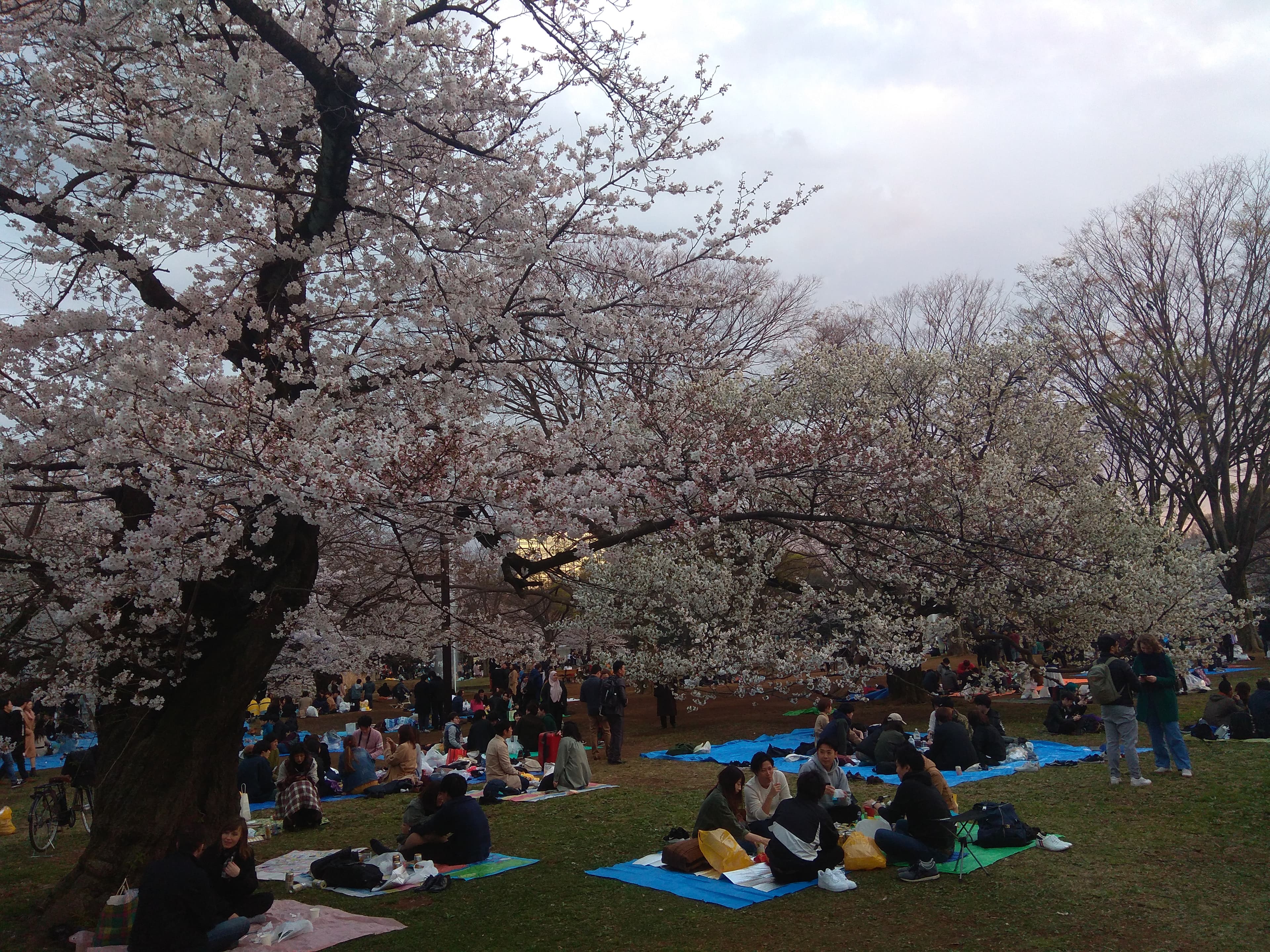
No flower embodies Japan like the . Its massive, brief blossoming, a few days at most before the wind carries off the petals, has made it the absolute symbol of fleeting beauty. Hanakotoba lends it beauty and spiritual gentleness, but above all what the cherry means without anyone needing to spell it out: the awareness of impermanence.
This sensibility has a name, , often translated as "the poignant melancholy of things." It is the bittersweet emotion born of the awareness that all beauty is passing, and that its very transience makes it precious. The sakura, radiant then at once withered, is its perfect emblem: one loves it not despite its brevity but because of it. To contemplate the cherry trees is to celebrate, in a single emotion, splendor and its loss.
The kamikaze pilots of the Second World War sometimes bore the image of the cherry blossom, and their squadrons borrowed its name. The regime had twisted the mono no aware of the sakura, the beauty of a brief life falling at its peak, into a glorification of the soldier's death. Japan's most tender flower had been conscripted.
The Camellia: Restrained Love and the Image of Beheading#
The , a winter flower with thick, glossy petals, perfectly illustrates the ambivalence of hanakotoba. In its amorous sense, it expresses a discreet love, a reserved flame that does not declare itself loudly; the red camellia says love, the white one waiting, the yellow one languishing desire. It is a courtly flower, offered with modesty.
But the tsubaki also carries a funereal reputation that stems from the way it dies. Unlike almost all flowers, the camellia does not shed its petals one by one: the whole corolla detaches at once and falls to the ground intact. For the warrior class of the Edo period, this clean fall evoked a precise and dreaded image, that of a head severed with a single stroke. Samurai made it the symbol of a noble, swift death, preferable to a slow decline, but at the same time avoided cultivating the camellia near their dwellings, so strongly did its fall recall a beheading.
The camellia falls in one block, without shedding: the warrior read in it both the ideal of a clean death and the ominous portent of a rolling head.
This double reading, restrained love and portent of death, makes the camellia one of the most delicate flowers to offer. The gesture depends entirely on context, and a poorly chosen bouquet can be read the wrong way.
Chrysanthemum, Plum, Lotus: Nobility and Virtue#
Three flowers embody, each in its own way, the ideal of nobility and virtue that hanakotoba celebrates.
The means longevity and nobility. The autumn flower par excellence, it is the emblem of the imperial house: the sovereign sits on the "Chrysanthemum Throne," and the imperial seal depicts a sixteen-petaled flower. But the kiku is also, by a contrast typical of hanakotoba, the flower of funerals: it covers the graves and altars of the dead. To offer white chrysanthemums to a living person would be a blunder, so strongly are they tied to mourning.
The blooms at the end of winter, often under the snow, even before the cherry. From this early, courageous flowering, hanakotoba drew the senses of perseverance, nobility of soul, and the announcement of spring. The ume is the flower of the one who holds firm in adversity, who blooms while all is still frozen.
The carries an obvious Buddhist charge. Rooted in the mud of ponds, it raises above the water an immaculate flower: it embodies purity rising from the impure, and by extension the spiritual awakening that is born at the heart of a defiled world. It is the flower of the Buddha, omnipresent in religious iconography.
The Flowers Not to Offer: Higanbana and Funereal Connotations#
Some flowers are so closely linked to death that one never offers them to a living person without risking a grave misunderstanding. The most emblematic is the .
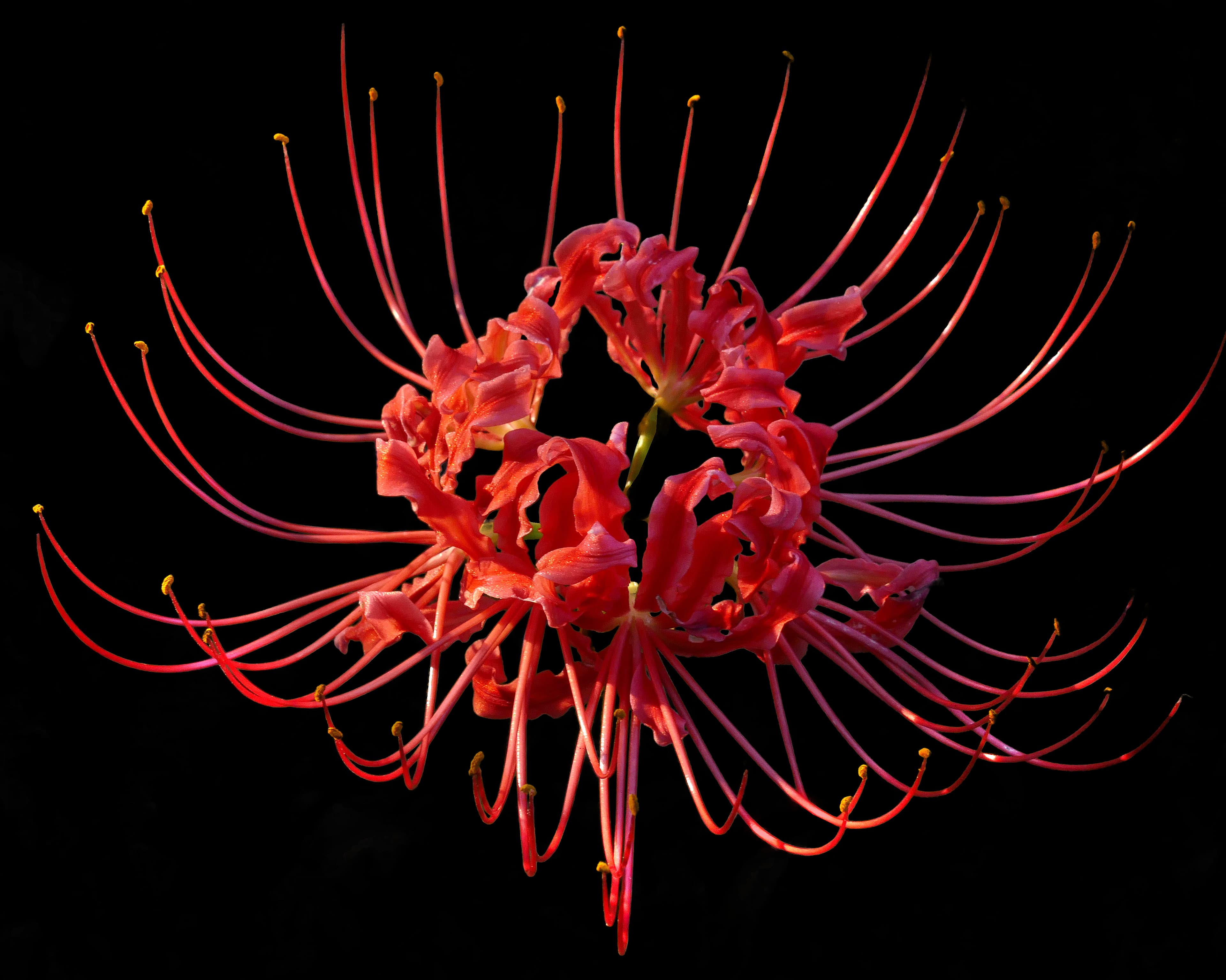
This scarlet flower surges up in autumn, around the equinox, springing from the ground leafless, in flaming sheaves along the rice paddies, the paths, and above all the cemeteries. Its very name dooms it to death: higan (彼岸) designates "the other shore," that is, the world of the dead in Buddhism, and the equinox period when the departed are honored. Hanakotoba lends it death, farewell, painful memories. It is also nicknamed the "flower of the beyond." Once planted around graves and fields, partly because its toxic bulb kept rodents away, it has become inseparable from the threshold between the worlds.
The higanbana bears another striking name, manjushage, and a belief holds that the red flowers line the road followed by the souls of the departed. In manga and anime, a field of higanbana on screen is an almost universal signal: someone is about to die, or the story is nearing the world of the dead.
Other flowers call for the same caution. The white chrysanthemum, as we have seen, is reserved for mourning. More generally, one avoids offering potted flowers to a sick person (the root "takes" the illness, it is said, and roots the affliction in place), or flowers whose name sounds ill-omened. Knowing these prohibitions is an integral part of hanakotoba: the language of flowers is read as much in what one offers as in what one refrains from offering.
Behind each flower name lies an eloquent play of kanji: 彼岸花 (higanbana, "flower of the other shore"), 物の哀れ (mono no aware, "the melancholy of things"), or 花言葉 (hanakotoba, "the language of flowers") yield their meaning as soon as you can decipher them. Learn to read them with JapaneseSRS and its spaced repetition.
The Hydrangea and the Changing Heart#
The illustrates a final mechanism of hanakotoba: meaning drawn from an observed behavior. The flower changes color over the course of its bloom and according to the acidity of the soil, shifting from blue to pink or mauve. From this chromatic instability, the language of flowers deduced the changing heart, inconstancy, the fickleness of feelings. A hydrangea offered could thus pass for a veiled reproach of infidelity.
But hanakotoba is never one-sided, and the hydrangea has gained over time a second, warmer reading. Because its little flowers press together in a dense ball, it is also lent the sense of family reunion, gratitude, and the harmony of loved ones. The blue hydrangea, in particular, says in certain contexts "thank you for understanding my feelings." A flower of the rainy season, inseparable from June and its showers, it embodies at last a melancholy, humid beauty, proper to that period when Japan lives under the clouds.
This plurality, a fickle heart on one side, family gratitude on the other, is a reminder that hanakotoba is not a fixed dictionary but a living language, in which color, season, and intention redirect the meaning.
Hanakotoba in Ikebana, Gifts, and Manga#
The language of flowers does not live in books: it takes shape in daily practices and in popular culture.
In , the choice of flowers is never purely aesthetic. To compose an arrangement is also to state a message, to match the flower to the season, the place, and the occasion. An ikebana master knows hanakotoba as a poet knows the meaning of words: he avoids the camellia at a wedding, reserves the lotus for the spiritual register, marries species to weave a coherent message.
Seasonal gifts obey the same tacit rules. To offer flowers in Japan requires knowing what they say: one does not visit a sick person with a pot of flowers, one does not bring white chrysanthemums to a housewarming, one chooses the plum to wish courage and the peony (牡丹, botan, a symbol of bravery and honor) to salute a success.
It is perhaps in manga and anime that hanakotoba survives most vividly today. Authors use flowers there as an implicit visual language: a field of higanbana announces death or the entry into the world of the departed; a falling camellia evokes an abrupt end; flying cherry petals mark the passage of time and nostalgia. The Japanese viewer decodes these signs instantly, where the foreign audience sees only a backdrop. Hanakotoba has thus become a narrative grammar, a way of saying without saying.
Read alsoHanami: The Japanese Art of Cherry Blossom ViewingThe cherry does not merely symbolize the fleeting: it gathers the whole country beneath its petals. Extend the walk beneath the blossoms of hanami.
Every flower has its season, and Japan carved out seventy-two of them: discover the calendar of micro-seasons that paces the year.
The flower chosen for the tokonoma speaks volumes about the spirit of a gathering: step into the refined art of the tea ceremony.
From the rain-soaked hydrangea hill to the red lycoris bank in autumn, Japan has made an alphabet of its flowers. Each one speaks, and the same corolla can whisper love or announce death depending on its color, its fall, or the season in which it opens. To learn hanakotoba is not to memorize a list: it is to learn to look at a garden, a bouquet, or a manga panel as a text to be deciphered, where nothing that blooms is ever quite silent.
FAQ#
Is hanakotoba the same as the Western language of flowers? No. The idea of assigning meanings to flowers arrived from Europe in the Meiji era, but Japan already possessed its own symbolic tradition. Hanakotoba took up the form while rewriting the vocabulary according to Japanese sensibility, so that the meanings often differ from Victorian floriography.
Which flowers should never be offered in Japan? The red lycoris (higanbana) and the white chrysanthemum are associated with death and mourning: one does not offer them to a living person as a token of affection. The camellia is also avoided in certain contexts, because of its image of beheading, as are potted plants for a sick person, reputed to "root" the illness in place.
Why is the camellia linked to the death of samurai? Because it falls in a single block, the whole corolla, instead of shedding its petals one by one. This clean fall evoked for the warrior class of Edo a severed head. The camellia therefore symbolized a noble, swift death, but people avoided planting it near samurai dwellings.
What does the hydrangea mean in hanakotoba? Two senses coexist. Because it changes color, the hydrangea symbolizes the changing heart and inconstancy. But because its flowers press into a ball, it also evokes family reunion and gratitude. Color and context decide between these opposing readings.
What is mono no aware, associated with the cherry? It is the sensitivity to the impermanence of things, the gentle melancholy born of the awareness that all beauty is passing. The cherry, splendid then at once withered, is its emblem: its very brevity makes it precious, and to contemplate it is to celebrate beauty and its loss in a single emotion.
Photo credits: images in this article come from Wikimedia Commons and are under free licenses.
Hanami: The Japanese Art of Cherry Blossom Viewing
A complete guide to hanami in Japan: its thousand-year history, the cultural meaning of sakura, the best viewing spots, picnic etiquette, and blossom forecasts.
Cover image: Jim Evans · Jim Evans, via Wikimedia Commons · CC BY-SA 4.0