Chinese numbers: why 4 frightens and 8 sells
The 4 that sounds like death, the 8 that sounds like wealth: how homophony governs floors, licence plates, gifts and prices in China.
La rédaction Kotoba Interactive
Studio éditorial
On 8 August 2008, the opening ceremony of the Beijing Olympics began at eight minutes and eight seconds past eight in the evening. Four eights, to the second, in front of some four billion viewers. No press release had to explain why: in China everyone understood.
This arithmetic is not a vague belief. It rests on a precise linguistic mechanism, homophony, and it has measurable effects on property prices, on the value of licence plates and on the size of wedding gifts.
The mechanism: 谐音, the approximate sound#
Chinese is a language of short, tonal syllables, in which countless words sound almost alike. The name of a digit therefore resembles another word, and that resemblance is enough to load the digit with meaning.
The process has a name, 谐音 (xiéyīn), "matched sound". It structures a good part of Chinese culture: New Year decorations show fish because 鱼 (yú), fish, sounds like 余 (yú), surplus; you wish someone "fish every year" to say "may you have money left over every year".
四 (sì), four, is pronounced almost like 死 (sǐ), to die. Only the tone differs, fourth against third. In Cantonese the gap is even thinner: sei3 against sei2. That closeness, not any abstract symbolism, explains the whole of Chinese tetraphobia.
The map of the digits#
| Digit | Pronunciation | Sounds like | Status |
|---|---|---|---|
| 一 | yī | 要 (yào), to want | Neutral |
| 二 | èr | Nothing specific | Ambiguous, "stupid" in northern slang |
| 三 | sān | 散 (sàn), to scatter | Unfavourable in Cantonese |
| 四 | sì | 死 (sǐ), to die | Strongly avoided |
| 五 | wǔ | 无 (wú), without | Neutral, sometimes negative |
| 六 | liù | 流 (liú), to flow, or 溜 (liū), smooth | Favourable |
| 七 | qī | 齐 (qí), together | Broadly favourable |
| 八 | bā | 发 (fā), to grow rich | The most sought after |
| 九 | jiǔ | 久 (jiǔ), lasting | Imperial, very favourable |
The 8 owes its fortune to Cantonese as much as to Mandarin. In Cantonese, baat and faat are so close that the link with 發財 (faat coi), "to make a fortune", is heard immediately. Hong Kong and Guangzhou largely exported that preference to the rest of the country.
The 9 belongs to another register. As the highest odd digit, it was reserved for the emperor: the gates of the Forbidden City carry nine rows of nine studs, and the phrase 九五之尊 (jiǔ wǔ zhī zūn), "the dignity of nine and five", designated the sovereign.
What it changes inside a building#
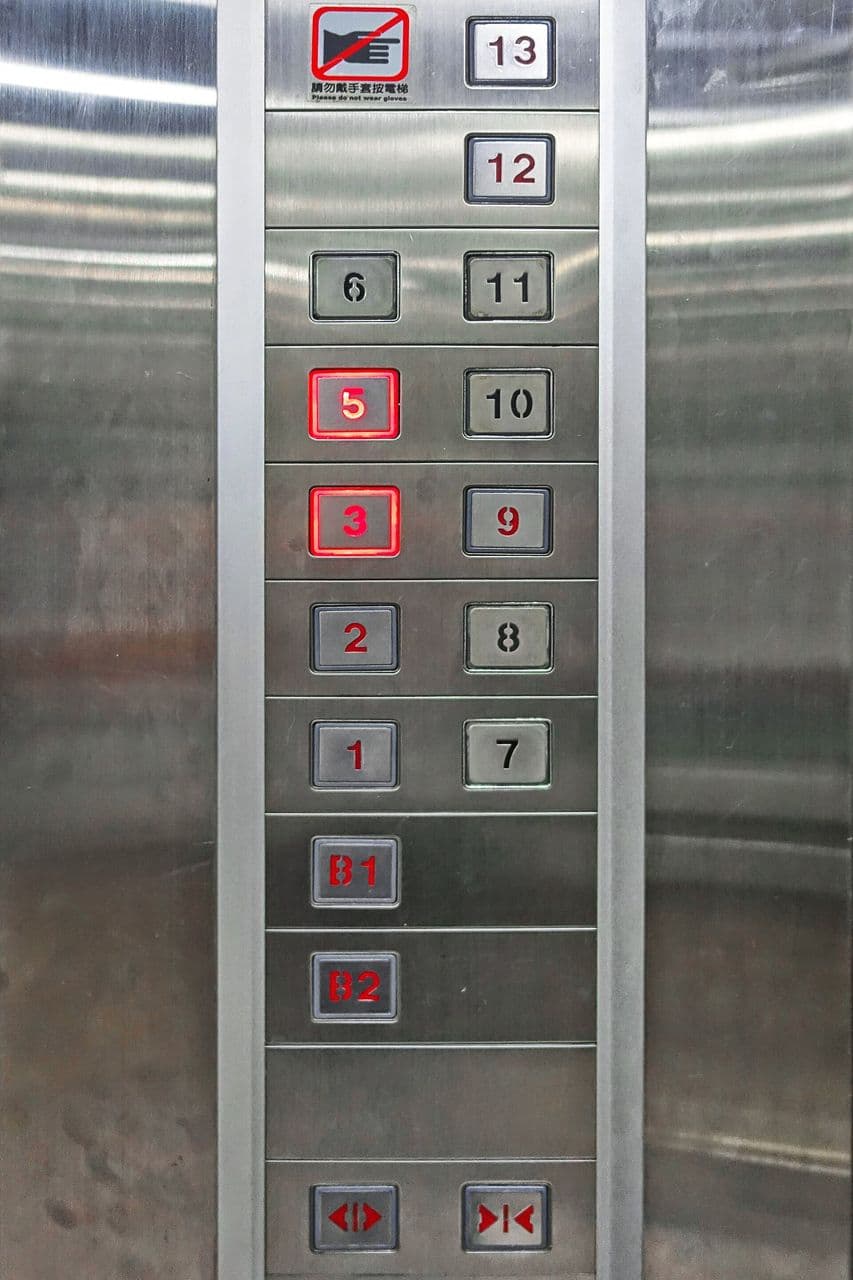
In a Chinese lift, the button 4 is often missing. Depending on the building, the numbering jumps straight from 3 to 5, or writes 3A. Floors 13, 14 and 24 sometimes vanish too: 14 sounds roughly like 要死 (yào sǐ), "about to die", and 24 like 而死 (ér sǐ).
The consequences are economic. Studies of the property market in several Chinese and Hong Kong cities have found real price gaps between identical flats on different floors, upward for 8, downward for 4. Hospitals, hotels and car parks apply the same avoidances.
A superstition that moves property prices has stopped being a superstition: it is a market variable.
Plates, phone numbers, price tags#
Numbers are sold. In China, licence plates with repeated digits are allocated by lottery or auction depending on the city, and a plate reading 88888 reaches sums beyond the price of the car.
The most cited case remains Sichuan Airlines, which paid around 2.33 million yuan in 2003 for the phone number 8888 8888. The story, carried by international news agencies at the time, has served ever since as the benchmark in any discussion of the subject.
Retail prices follow the same logic. A product at 88 yuan sells better than at 85, and promotions readily settle on 168 (yī lù fā, "prospering all the way") or 518 (wǒ yào fā, "I want to get rich").
Three words are enough to understand these games of sound: 发 (fā, to grow rich), 死 (sǐ, to die) and 谐音 (xiéyīn, homophony). ChineseSRS, our spaced repetition app, installs that vocabulary and the everyday Chinese that goes with it.
The amounts you give, and the ones you never give#
The amount in a red envelope is never random. For a wedding you choose an even number, a symbol of the couple, preferably rich in eights: 888, 1,888, 8,888 yuan. The 1314, which evokes 一生一世 (yīshēng yīshì), "a whole lifetime", slips readily into lovers' amounts, alongside 520 (wǔ èr líng, close to 我爱你, "I love you").
For a funeral the rule reverses: the amount is odd, and the envelope is white, not red. A digit 4 in any sum given is to be avoided in every case.
Two gifts remain forbidden by the same mechanism. Giving a clock, 送钟 (sòng zhōng), sounds exactly like 送终 (sòng zhōng), "to see someone through to their death". Giving a pear to share, 分梨 (fēn lí), sounds like 分离 (fēnlí), "to separate". So you give whole pears, or none at all.
The number 250 (èrbǎiwǔ) is a common insult in Chinese: it means "idiot". The explanation most often offered links it to an old monetary unit, the diào, half a batch of which was worth 250 coins, half of next to nothing. No shopkeeper displays a price of 250 yuan.
What is not superstitious in all this#
Two received ideas deserve correcting. First, 13 has no negative value of its own in China: its absence from lifts that skip it comes from Western influence, not from local tradition. Second, the attachment to 8 is not immemorial: it spread massively from the 1980s onward, with economic opening and the relay role played by Hong Kong.
Finally, these preferences say nothing about the credulity of those who apply them. A developer who skips the fourth floor does not necessarily believe the digit brings bad luck: he knows his buyers will think of it, and that alone makes it a rational calculation.
Read also4 and 8 across Asia: the map of lucky and unlucky numbersA comparison of lucky and unlucky digits across China, Japan and Korea.
The other great system for orienting domestic and property decisions.
FAQ#
Is 4 avoided everywhere in China? In housing, hospitals and hotels, very widely. In administration, transport and official documents, no: numbering follows its order there. The avoidance is a commercial practice more than a rule.
Why is 8 worth money? Because it is pronounced like 发 (fā), the first character of 发财, "to make a fortune", and that closeness is sharper still in Cantonese. Plates and numbers rich in eights can be resold, which gives them real value.
Is 7 unlucky in China? Not particularly. The seventh lunar month is the month of ghosts, which colours it, but the digit itself is often read as 齐 (qí), "together", and is therefore favourable for a couple.
Can you give a watch as a gift? A wristwatch, yes, it is not affected. It is the clock, 钟 (zhōng), that is a problem, through homophony with 终, the end. If in doubt, custom has the recipient hand over a symbolic coin in return, turning the gift into a purchase.
Are these beliefs fading among young people? They shift rather than fade. The same homophony mechanisms now feed digital slang, where 520 and 1314 serve as declarations of love and 88 as a goodbye.
Photo credits: the images in this article come from Wikimedia Commons and are under free licences.
The Dragon Boat Festival: when China paddles for Qu Yuan
History and traditions of the Dragon Boat Festival (端午节 Duanwu) in China: dragon boat races, zongzi, Qu Yuan, and rituals of the fifth lunar month.
Cover image: Mk2010 · Mk2010, via Wikimedia Commons · CC BY-SA 4.0