The Cat in Japan: Maneki-neko, Bakeneko and Cat Islands
From the lucky maneki-neko to feline yōkai bakeneko, from cat islands to cat cafés: a journey through a Japan that both worships and fears the cat.
La rédaction Kotoba Interactive
Studio éditorial
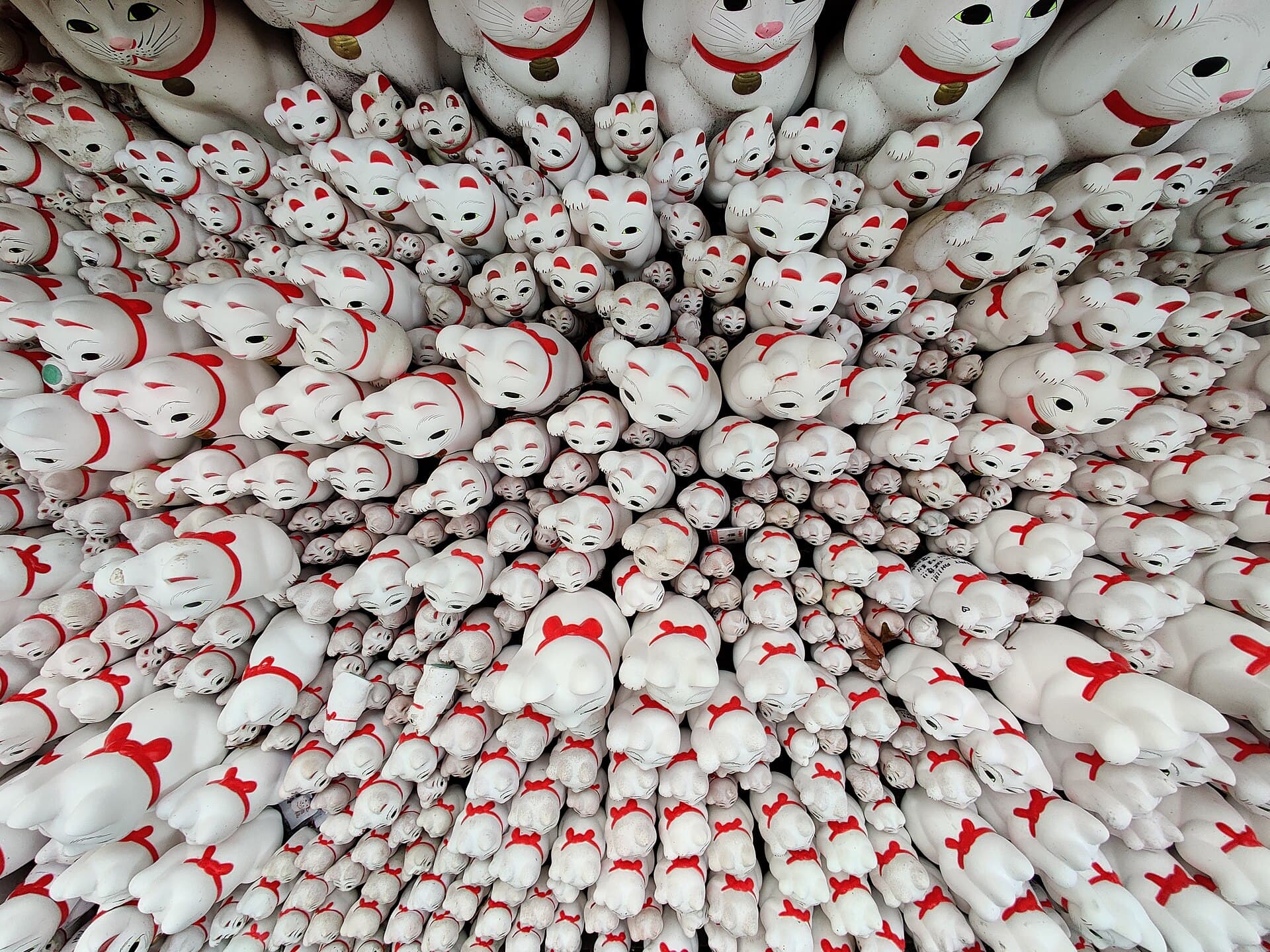
Rain falls over Setagaya, and behind an earthen wall at Gōtoku-ji temple, thousands of small white ceramic cats raise a paw in the mist, lined up by the hundred on shelves of grey wood. Some are barely three centimeters tall, others the size of a child; all make the same gesture, that right paw raised to ear height, frozen in a motionless salute. A visitor sets down a new one, murmurs a prayer, and leaves. The next day, another will come.
In Japan the cat holds a place few animals attain in any culture: at once a commercial good-luck charm displayed at the entrance of tens of thousands of shops, a supernatural creature able to dance on its hind legs and devour its own mistress, the hero of a satirical novel and a planetary mascot of kawaii. To understand the Japanese cat is to travel through a thousand years of ambivalence: the archipelago has always loved and feared this animal in a single motion, and that tension explains both the raised paw of the and the forked tail of the .
The Maneki-neko, the Cat That Invites#
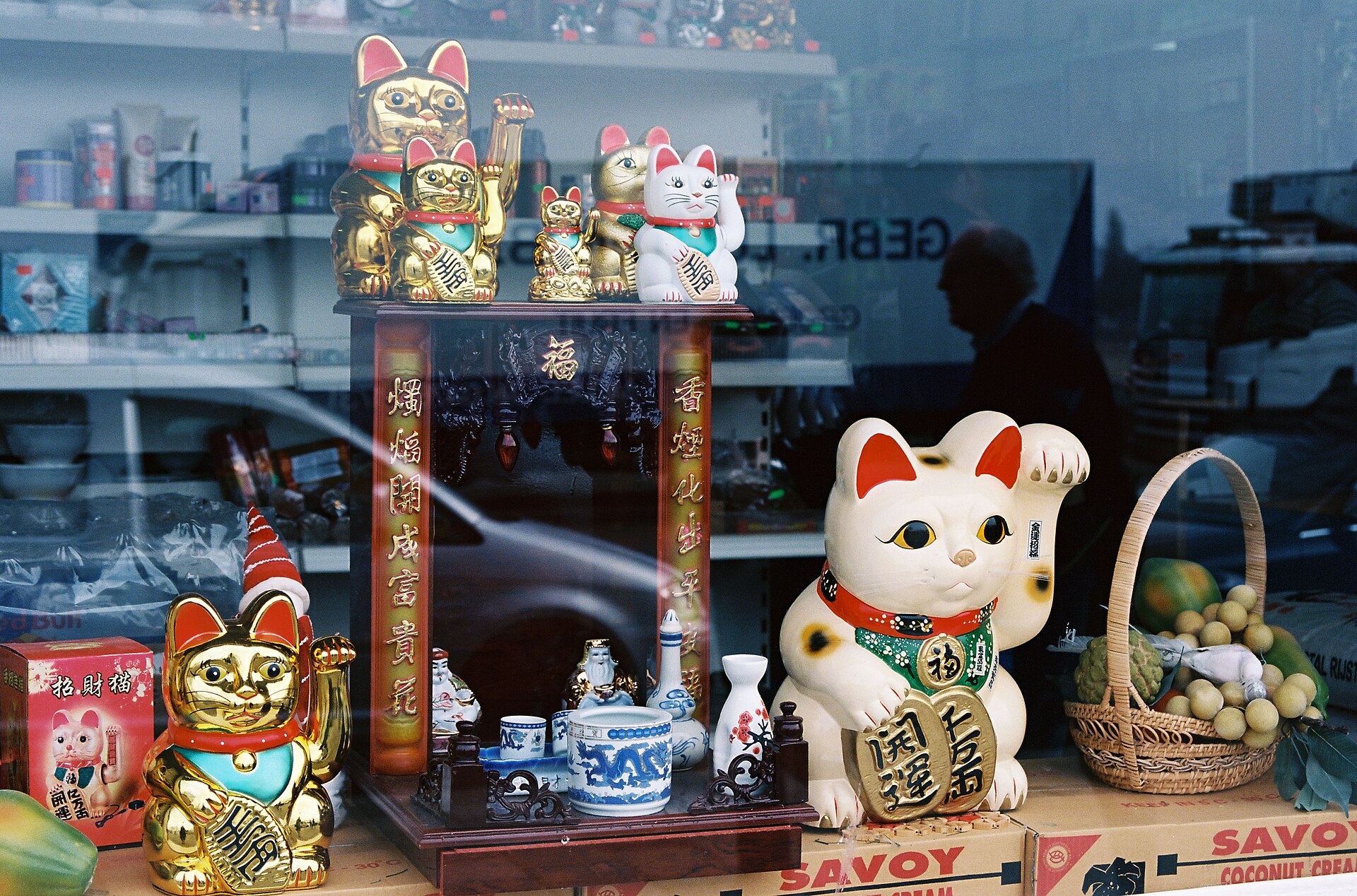
The is a figurine depicting a seated cat with one paw raised in a gesture of summons, placed at the entrance of shops to draw luck and customers. The gesture is not a Western wave: in Japan, you beckon someone closer with the palm facing down and the fingers curling inward, exactly the position of the cat's paw. What the West long took for a cat saying "goodbye" is in fact a cat saying "come in."
joins maneki (a form of the verb maneku, 招く, "to invite, to beckon with a gesture") and neko (猫, "cat"). The name literally describes the figurine's action: a cat waving you closer.
The object appears in its recognizable form during the late Edo era, in the nineteenth century, in an urban merchant society where shops were multiplying and every tradesman sought a propitious sign for his storefront. The earliest clay depictions from Imado, a potters' district in the north of Edo (present-day Tokyo), fixed the model: a spotted white cat, seated, paw raised. Its success was dazzling. By the Meiji era (1868-1912), the maneki-neko was an established commercial fixture, and it has never stopped populating the entrances of restaurants, public baths, and shops, and today, cash registers as far away as California and Bangkok.
Where Does the Lucky Cat Come From?#
The origin of the maneki-neko is disputed, and two rival legends contest its paternity: one aristocratic, the other of the people. Neither is proven, but both say something true about the Japanese relationship with the cat.
The most famous places the birth of the maneki-neko at Gōtoku-ji temple (豪徳寺), in what is now the Setagaya ward of Tokyo. Legend has it that in the early seventeenth century, the lord , daimyō of the Hikone domain, riding past this then-impoverished temple, spotted the monk's cat sitting on the threshold and seeming to beckon him inside with a movement of its paw. Intrigued, he approached; at that very instant, lightning struck the spot he had just left. Saved by the cat, Naotaka made the ruined temple the funerary temple of his clan, securing its fortune. When the animal died, it was buried with honor, and Gōtoku-ji became the sanctuary of the maneki-neko, where the faithful today leave votive cats by the thousand in gratitude for a wish fulfilled.
The second legend, more plebeian, unfolds in Imado, a working-class potters' district, and features an old woman so poor she had to abandon her beloved cat. The animal appeared to her in a dream and told her to model its likeness in clay; she made a figurine, sold it, made another, and so escaped her misery. The Imado statuette, born of this story, embodies the maneki-neko as a talisman of the humble: a folk remedy for poverty rather than a lord's ornament.
Two legends, one animal: in one, the cat saves a lord from lightning; in the other, it lifts an old woman out of poverty. The maneki-neko is the good-luck charm of a Japan that never chose between the aristocrat and the pauper.
Historians lean toward a composite origin: the gesture of the paw, the figurines of Edo's potters, and the iconography of the protective cat (already present in silkworm farms, where it hunted the rodents that threatened the silkworms and thus textile wealth) converged in the nineteenth century into a single object. The cat that protected the silk became, by a slow shift, the cat that summons money.
The vocabulary of the lucky cat becomes clear once you can read the kanji: 招き猫 (maneki-neko, "beckoning cat"), 小判 (koban, the oval gold coin) and 福 (fuku, "happiness, luck") recur throughout Japanese culture. Learn to decipher them with JapaneseSRS and its spaced repetition.
Reading a Maneki-neko: Paw, Color, Objects#
Everything about a maneki-neko is meaningful, and a knowing eye reads a figurine the way one reads a coat of arms. Three elements carry the message: the raised paw, the color of the coat, and the object held.
| Color | Japanese term | Wish drawn |
|---|---|---|
| Tricolor calico | 三毛 (mike) | Supreme luck, a living talisman |
| White | 白 (shiro) | Purity and happiness |
| Black | 黒 (kuro) | Protection against evil spirits |
| Gold | 金 (kin) | Wealth and prosperity |
| Red / pink | 赤 (aka) | Health, warding off illness, love |
The Raised Paw#
The raised paw does not carry the same meaning whether it is the right or the left. The raised right paw draws money, prosperity, and good fortune: this is the cat of merchants concerned with takings. The left paw calls in customers, people, passing trade: it is preferred in high-traffic places, restaurants and bars. Some models raise both paws to combine money and clientele, but purists deem such excess vulgar, and note that a cat with both paws in the air looks like it is surrendering. The height of the paw matters too: the higher it is, the farther away the luck it draws comes from.
The Colors#
The color of the coat encodes a precise wish. The , white spotted with russet and black, is the most traditional and most prized: it reproduces the coat of the Japanese lucky cat par excellence, the male mike being so genetically rare that it passed for a living talisman. White evokes purity and happiness; black wards off evil spirits and, in some regions, protects women from harassers; gold draws wealth specifically; red or pink drives away illness and, more recently, favors love. This chromatic grammar is not fixed: contemporary marketing has added green (academic success) and blue (road safety).
The Attributes#
The objects the cat holds or wears complete the message. The , the oval gold coin of the Edo period, often engraved with the words senryō (千両, "a thousand ryō," a fabulous sum), is the most common attribute: the cat literally offers up a fortune. The red collar adorned with a bell recalls the pampered cats of the well-to-do households of the Edo era. One also comes across the magic mallet , which makes riches rain down, or the carp, a symbol of abundance. Each merchant thus composes, not always knowing it, a bespoke wish.
Bakeneko and Nekomata: The Cat That Frightens#
The same animal that summons fortune can, in Japanese folklore, transform into a monster. The and the are two feline that have haunted the imagination of the archipelago since the medieval period: the shadow side of the lucky cat.
The belief rests on a domestic observation. The cat was held to be an animal capable of abnormal longevity, with eyes that glow in the night, a silent step, illegible where the dog is loyal and readable. From this strangeness came the idea that a cat, past a certain age or a certain weight, ceases to be a mere animal. It was said that a cat living more than thirteen years, or whose tail grew too long (hence the real custom of cutting the tails of kittens to prevent the transformation, at the origin of the short-tailed Japanese cat, the kazoku-neko or bobtail) would turn into a bakeneko.
The short tail of the Japanese cat, the famous Japanese Bobtail, owes part of its reputation to the fear of the nekomata: cutting or shortening a kitten's tail was thought to keep it from becoming a forked-tailed yōkai. Selective breeding fixed the trait, and a medieval superstition left its mark on a feline breed.
The bakeneko is a household cat that, over the years, acquires powers: it walks on its hind legs, speaks the language of humans, lights lamps and licks their oil (the fish-oil lamps of Edo explain this recurring image of a cat lapping the flame), takes on the appearance of its own mistress after devouring her, or animates the dead. The tales of the Edo era abound in stories of courtesans or old women revealed to be bakeneko, as well as feline vendettas: the avenging cat of a murdered master that haunts and destroys the culprits, a central motif of the and soon of kabuki theater, which turned it into a whole genre, the bakeneko-mono.
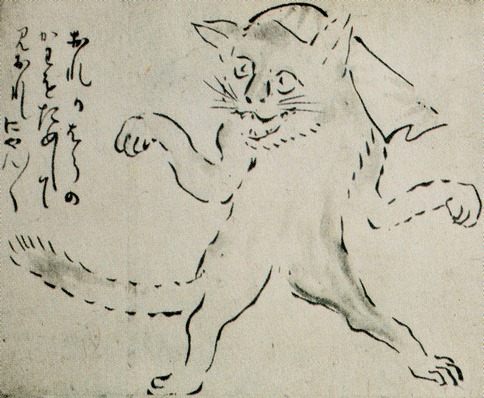
The nekomata is the higher rung, a cat become a full-fledged demon. Its name, often glossed by its forked tail (mata, 又, "fork"), designates a two-tailed being, sometimes of enormous size. The monk and essayist mentions it as early as the fourteenth century in the Tsurezuregusa (徒然草, "Essays in Idleness"), evoking a mountain beast that devours men; later tradition distinguishes the wild nekomata, a predator of the deep forests, from the domestic nekomata, a former house cat that has crossed to the other side. A necromancer, a manipulator of the living and the dead, it embodies the point where the intimacy of the home tips over into terror.
The Cat in Literature and the Print#
The cat did not remain confined to folklore: it seeped into high Japanese culture, from the satirical novel to the masterpieces of the woodblock print. The most striking proof is a novel that hands the floor to the animal itself.
In 1905, the writer , a major figure of modern Japanese literature, published . Its narrator is a nameless cat, taken in at the home of a clumsy, cultivated schoolteacher, who observes with an ironic eye the little world of Meiji-era intellectuals, their pretensions, their manias, and Japan's forced-march Westernization. The opening line, "I am a cat. As yet I have no name," is one of the most famous in Japanese letters. The choice of a cat is no accident: only a domestic animal, present everywhere and never taken seriously, could offer this viewpoint at once intimate and detached on human beings. The novel, first serialized in the magazine Hototogisu, was an immediate success and remains a classic read in every school.
"I am a cat. As yet I have no name." With this sentence, Natsume Sōseki made a nameless feline the most clear-sighted observer of a Japan in the throes of modernization.
Half a century earlier, the ukiyo-e print (浮世絵) had already made the cat one of its favorite motifs, and one artist raised it to the summit. , a master of the Utagawa school, was a notorious cat lover: he is said to have worked surrounded by dozens of them and sometimes kept one nestled in his kimono. His prints teem with cats: household cats sketched from life, ghostly cats of the theater, and above all his famous series where felines parody the postures of kabuki actors or spell out, with their intertwined bodies, the characters of a word. Under Kuniyoshi, the cat becomes a subject in its own right in Japanese art, by turns tender, comic, and unsettling. The lineage continues into the twentieth century and beyond, from the painter , who made the cat his signature in Paris, to contemporary manga.
Cat Cafés, Cat Islands#
Contemporary Japan invented, or popularized, two institutions that extend this passion: the cat café and the cat island. Both answer to an urban reality: many Japanese live in cramped housing where animals are forbidden.
The is an establishment where, for an hourly fee, you enjoy a drink in the company of free-roaming cats you can pet and observe. The first of its kind opened in Taipei in 1998, but it was in Japan that the concept exploded from 2004-2005, with the opening of several venues in Osaka and then Tokyo. Its success is explained by the lack of space and the frequent ban on animals in rental leases: the cat café offers a parenthesis of animal contact to a population deprived of it. Several hundred exist today across the archipelago, some specializing in rare breeds, others turning into shelters where the cats are offered for adoption.
More surprising still, the are small islands where the feline population far exceeds the human one. The most famous, , off Ishinomaki in Miyagi prefecture, counted in the 2010s a handful of elderly inhabitants against a cat colony many times larger. The cats there descend from animals once introduced to protect the silkworm farms from rodents; the fishermen fed them, seeing them as good-luck charms that heralded good catches, and the island even shelters a small shrine dedicated to the cat, the . , in Ehime prefecture, gained worldwide fame around 2015 when photos of its dozens of cats greeting the rare visitors went around the social networks. These islands, often aging and depopulated, owe part of their economic survival to the feline tourism they inspire.
Want to decipher 招き猫, 化け猫 or 吾輩は猫である in the original text? JapaneseSRS (japanesesrs.com) is preparing a method for learning Japanese through spaced repetition. Join the waitlist to be notified at launch.
Hello Kitty, Kawaii, and Today's Cat#
The most famous Japanese cat on the planet, however, has no mouth and, officially, is not even a cat. Hello Kitty, created by the company Sanrio in 1974 and designed by Yūko Shimizu, is presented by its maker as a little London girl named Kitty White, a commercial fiction few people remember, so strongly does the image evoke a white kitten with a red bow. No matter the civil status: Hello Kitty has become the global face of , that aesthetic of cuteness which structures an immense share of Japanese visual culture and is worth billions. She embodies on an industrial scale what the maneki-neko represented on the scale of the shop: a stylized, reassuring cat, a bearer of good cheer and fortune, endlessly reproduced on everyday objects.
Read alsoSanrio and Hello Kitty: The Global Empire of Japanese KawaiiFrom Kitty White to the global empire of cuteness: how Sanrio built an aesthetic civilization around a mouthless kitten.
This lineage of the cute cat runs through all of contemporary pop culture, from municipal mascots to video game characters. But the flesh-and-blood cat has never been so present in real Japan: long ranked second behind the dog among pets, it overtook the dog in the mid-2010s, carried by an aging urban population, cramped housing, and a way of life in which the cat, more independent, copes better with absence. People speak of a : feline YouTube channels with millions of subscribers, dedicated magazines, island and café tourism, and a cat economy that analysts have nicknamed, punningly, .
Read alsoYokai: The Supernatural Bestiary That Haunts Japan's ImaginationThe bakeneko and the nekomata are but one entry in a vast bestiary: come meet the yōkai that people the Japanese imagination.
The lucky cat, the cherry blossoms in bloom: Japan has made an art of the fleeting and the small. Extend the walk beneath the petals of hanami.
From the silk-farm cat to the YouTube kitten, from the bakeneko that terrified the wakes of Edo to the maneki-neko enthroned on the registers, Japan has never ceased to project onto this animal its desires and its fears. Loved for its mystery, feared for that same mystery, it remains the mirror-animal of a culture that never wished to reduce it to a mere companion. Perhaps that is why, at Gōtoku-ji, under the rain, the thousands of little ceramic cats keep raising a paw: not to say goodbye, but to invite, again, something we dare not name.
FAQ#
Does the maneki-neko say hello or goodbye? Neither: it invites. The paw gesture, palm down and fingers curled, is the Japanese way of beckoning someone closer. What the West reads as a farewell wave is in fact an invitation to enter, addressed to customers and to luck.
Should you choose a maneki-neko with the right or left paw raised? The raised right paw draws money and prosperity; the left paw calls in customers and visitors. A high-traffic business favors the left, an activity concerned with takings the right. Two-paw models combine both wishes but are seen as a little excessive.
What is the difference between a bakeneko and a nekomata? The bakeneko is a household cat turned supernatural with age: it speaks, walks upright, takes human form. The nekomata is the higher rung, a forked-tailed demon, larger and more powerful, able to manipulate the dead. The nekomata may be wild (of the mountains) or born from an old house cat.
Can you visit Japan's cat islands? Yes. Tashirojima (Miyagi) and Aoshima (Ehime) are the best known and reachable by ferry, but they are genuine living places, often inhabited by a few elderly people. Visitors are asked to respect local rules: feeding only in the designated areas, no dogs, discretion.
Why is the calico (mike) the most prized maneki-neko? The tricolor calico coat reproduces that of the traditionally lucky Japanese cat. The male calico being genetically very rare, it passed for a living talisman, reputed to protect sailors and households. The figurine inherits this prestige, which makes the mike the most classic coat of the maneki-neko.
Photo credits: images in this article come from Wikimedia Commons and are under free licenses.
In this article
The cultural terms covered here, each with a short definition.
- Hello Kitty
- Sanrio's kawaii character, a small white cat that became a global icon of cuteness.
Cosplay: From American Sci-Fi to Japanese Pop Culture Phenomenon
From 1930s American science fiction conventions to a multi-billion dollar global phenomenon, the complete history of cosplay, its Japanese transformation, major events, and worldwide cultural impact.
Cover image: Niwrat · Niwrat, via Wikimedia Commons · CC0