The Legend of Zelda: the story of a cult saga
The full history of The Legend of Zelda, from the 1986 Famicom to Tears of the Kingdom: Miyamoto, Hyrule, the Triforce and the DNA of Nintendo.
La rédaction Kotoba Interactive
Studio éditorial
On 21 February 1986, a yellow disk slid into a beige drive plugged into a Famicom. On the screen, an old man in a cave held out a sword to a silent character: "It's dangerous to go alone! Take this." That moment, etched into the memory of millions of players, launched The Legend of Zelda (ゼルダの伝説, Zeruda no Densetsu), a game that dropped scores and limited lives to offer something else: an open world to comb through, a map to unroll on your own, the thrill of not knowing where to go.
Forty years later, the series remains one of Nintendo's creative pillars and one of the rare video game objects whose every new installment redefines what the medium can do. Zelda was never the best seller in the catalog (that honor belongs to Mario), but it is the laboratory, the place where the company tests its boldest ideas before spreading them elsewhere. To understand its history is to understand how we went from the 1986 sandbox to the dizzying world of 2017.
A childhood garden turned kingdom#
The Legend of Zelda was born from a memory. Miyamoto Shigeru (宮本茂), born in 1952 in Sonobe, near Kyoto, has recounted several times, notably in the interviews compiled by Nintendo, how his childhood explorations in the countryside (rice paddies, caves, a lake stumbled upon by chance) fed the idea of a game where adventure means, first of all, venturing out. With Tezuka Takashi (手塚卓志), his partner on Super Mario Bros. released a few months earlier, he designed a title built on curiosity rather than reflexes.
The first Zelda came out on 21 February 1986 on the Famicom Disk System, the floppy disk peripheral that let players save their progress, a decisive novelty for a long game. The NES cartridge reached the West in 1987, with its famous golden shell. The player takes on the role of Link (リンク, Rinku), a young hero clad in green tasked with saving Princess Zelda and reassembling the Triforce (トライフォース, Toraifōsu), a sacred relic split into fragments.
Zelda (ゼルダ) owes her name to Zelda Fitzgerald, wife of the writer F. Scott Fitzgerald. Miyamoto has explained that he found the name "pleasant and significant," a quality he wanted for his princess. The title character is therefore not the hero you play: this lasting confusion is part of the series' folklore.
The stroke of genius lies in the structure: a kingdom, Hyrule, laid out in a grid of screens you explore freely, dotted with nine dungeons packed with puzzles and guardians. At the end of the road waits Ganon, the piglike lord of evil who would become the recurring antagonist. The game says almost nothing, offers no guidance, lets the player burn bushes and set bombs against walls at random to uncover secret passages. This freedom, radical for its time, would become the bedrock of the series' identity.
The years that set the formula#
In 1991, The Legend of Zelda: A Link to the Past came out on the Super Famicom and crystallized the grammar of the series. A return to the top-down view, but with a new depth: two parallel worlds, the Light World and the Dark World, between which the player switches to solve puzzles that stretch from one dimension to the other. The structure of "get an item in a dungeon, which opens access to the next dungeon" found its canonical form here. Many players and critics still consider it the definitive 2D Zelda.
The major turning point came on 21 November 1998. The Legend of Zelda: Ocarina of Time, on the Nintendo 64, brought the series into 3D and invented technical solutions along the way that would spread across the whole medium. The automatic aiming system dubbed "Z-targeting," which locks the camera onto an enemy during combat, solved a problem no one had managed to fix cleanly in three dimensions. The game earned historic scores: the magazine Edge gave it its first 10 out of 10, and the aggregator site Metacritic still credits it with one of the highest averages in its history.
Ocarina of Time did not just bring Zelda into 3D: it wrote the manual the rest of the industry went on to use.
Right after, in 2000, Majora's Mask pushed experimentation even further with its three-day time loop, its grimacing moon ready to crash down, its anxious tone. This divisive game, darker and more demanding, remains one of the most discussed in the series for its atmosphere and narrative density.
The saga is also best savored in its original version: ゼルダの伝説 (Zeruda no Densetsu, "the legend of Zelda"), リンク (Rinku, Link written in katakana) and the トライフォース (Toraifōsu, the Triforce). Learn the kana, the kanji and the vocabulary with JapaneseSRS, the spaced repetition that anchors each character for good.
The era of aesthetic reinventions#
Every console pushes the series to reinvent itself visually. In 2002 in Japan, The Wind Waker adopted cel-shading, a cartoon-style rendering with vivid colors, featuring a Link with big expressive eyes and a world covered by the ocean that you sail across in a boat. The choice, poorly received at its announcement by a part of the audience expecting realism, established itself over time as one of the most timeless graphically: its style has barely aged.
The answer arrived in 2006 with Twilight Princess, darker and more mature, a Link able to transform into a wolf, developed partly to satisfy players disappointed by the cartoon aesthetic. In 2011, Skyward Sword bet on the motion recognition of the Wii MotionPlus to turn every sword strike into a gesture, while telling the origins of the Master Sword and the curse that binds Link, Zelda and Ganon across the ages.
The official chronology of the series, published by Nintendo in 2011 in the book Hyrule Historia, splits into three distinct time branches, one of which assumes that the hero of Ocarina of Time fails and dies. This convoluted tree, long demanded by fans, mostly confirmed that it was assembled after the fact: the developers admitted they had not planned the games in this order from the outset.
This question of chronology has been debated for decades. The games do not follow the order of their release, they reuse the same names (Link, Zelda, Ganon, Hyrule) across different eras, and Nintendo long kept things vague. The internal logic the series embraces rests less on strict continuity than on a mythological cycle that replays itself: a legend passed down, reincarnated, as the very title suggests, "the legend of Zelda."
The open world revolution#
On 3 March 2017, The Legend of Zelda: Breath of the Wild launched alongside the Nintendo Switch and reshuffled the deck. After three decades of locked dungeons to open in order, the team led by Fujibayashi Hidemaro (藤林秀麿) wiped the slate clean: an immense Hyrule, entirely open from the first minutes, where you can in theory walk straight toward the final boss. Free climbing of almost any surface, paragliding, simulated physics and chemistry (fire spreads, metal draws lightning, water puts out flames), the game sets freedom of action as a founding principle.
The critics were unanimous: Breath of the Wild joined the club of the best-rated games in history and swept up numerous game of the year 2017 titles. Commercially, it quickly became the best-selling Zelda, passing twenty million copies, a figure long out of reach for the series. Its influence spilled beyond Nintendo: many studios reconsidered their approach to the open world, until then often saturated with icons and to-do lists.
The direct sequel, Tears of the Kingdom, appeared on 12 May 2023 on Switch. It reuses the same map while multiplying it toward the sky and the depths, and adds building powers (assembling vehicles, fusing objects) that turn the player into a tinkerer. Selling more than ten million copies in three days, the adventure confirmed that the open formula had become the new standard for the series.
Forty years of history come down to a few milestones:
| Year | Installment | Defining contribution |
|---|---|---|
| 1986 | The Legend of Zelda | an open world to comb through, saved progress |
| 1991 | A Link to the Past | two parallel worlds, the series' canonical grammar |
| 1998 | Ocarina of Time | the leap to 3D, the invention of "Z-targeting" |
| 2000 | Majora's Mask | a three-day time loop, an anxious tone |
| 2002 | The Wind Waker | cartoon-style cel-shading, an ocean world |
| 2011 | Skyward Sword | sword strikes as gestures via MotionPlus, origins of the Master Sword |
| 2017 | Breath of the Wild | total freedom, more than twenty million copies |
| 2023 | Tears of the Kingdom | building powers, ten million copies in three days |
A soundtrack and a legacy#
It is impossible to talk about Zelda without naming Kondo Koji (近藤浩治), Nintendo's in-house composer and also the author of the Mario themes. The main Zelda theme, written in 1986, remains one of the most recognizable melodies in video games, to the point of being regularly performed by touring symphony orchestras. The music here is not decorative: in Ocarina of Time, playing melodies on the ocarina is a full gameplay mechanic, one that teleports you, summons rain or turns day into night.
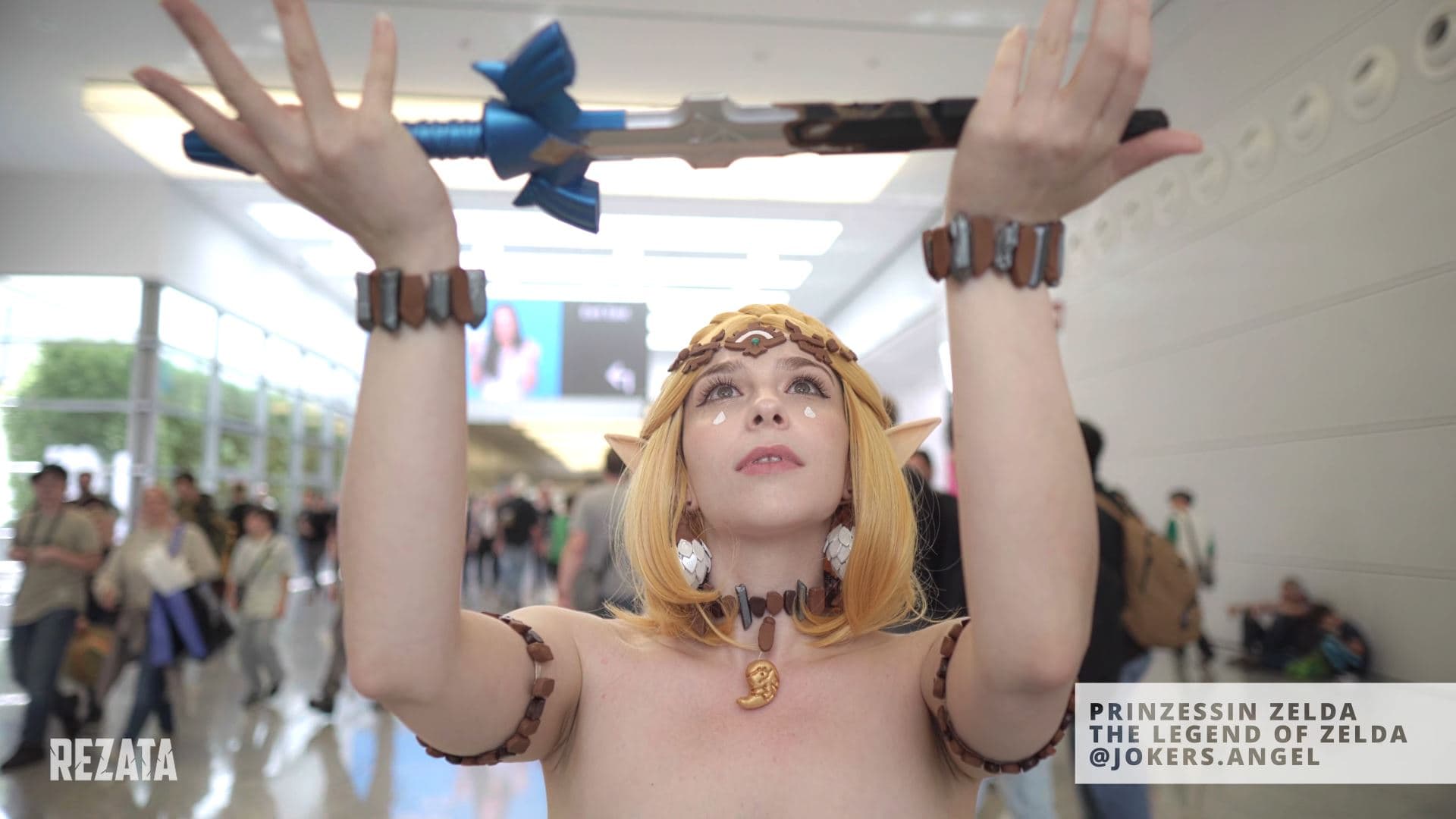
The cultural legacy goes beyond the game itself. Link and the Master Sword have become icons recognizable at first glance, spun off into plush toys, amiibo figurines, replicas, orchestras, cosplay at conventions all over the world. For Nintendo, the series holds a place apart: it embodies the company's creative ambition where Mario embodies its universality. When Nintendo wants to prove that a genre can be reinvented, it is often Zelda that gets the mission.
Read alsoPokémon: The Story of Japan's Greatest Pop PhenomenonNintendo built its empire on several sagas: discover how Pokémon became the global phenomenon we know today.
Before Hyrule, there were playing cards: the full history of Nintendo, from hanafuda to consoles.
Facing Nintendo, a relentless rival: the rise and fall of Sega, the other Japanese giant of video games.
FAQ#
Who created The Legend of Zelda? The series was created by Miyamoto Shigeru and Tezuka Takashi at Nintendo, with music by Kondo Koji. Miyamoto drew inspiration from his childhood explorations in the countryside near Kyoto. The first game came out on 21 February 1986 on the Famicom Disk System in Japan.
Is Zelda the character you play as? No, that is a common confusion. The playable hero is called Link (リンク); Zelda is the princess of Hyrule he must protect. Her name comes from Zelda Fitzgerald, wife of the American writer F. Scott Fitzgerald. In a few games, you can nonetheless control Zelda occasionally.
In what order should you play the Zelda games? There is no set order: each installment tells a largely self-contained story. The official chronology, published in 2011, splits into three branches, but it was reconstructed after the fact. Most players start with a recent title like Breath of the Wild or a classic like Ocarina of Time.
What is the best Zelda game? The debate stays open. Ocarina of Time (1998) is often cited among the best games of all time for its influence, while Breath of the Wild (2017) dominates recent rankings. A Link to the Past remains the reference in two dimensions. The choice mostly depends on your sensibilities.
How many Zelda games are there? The series counts around twenty main games since 1986, not counting the remakes, the remasters and the spin-offs like Hyrule Warriors. The canonical installments cover almost every Nintendo console, from the Famicom to the Switch, with Tears of the Kingdom as the latest major entry in 2023.
From a childhood garden imagined near Kyoto to a kingdom that tens of millions of players have wandered, Zelda has told the same thing for forty years: the pleasure of setting off without a map, and of drawing it yourself.
Photo credits: images in this article come from Wikimedia Commons under free licenses.
Comiket: The World's Largest Fanzine Fair
Comiket (コミックマーケット): 32 tables in 1975, 35,000 today. The history of Tokyo's dōjinshi fair, how it runs, its legal grey zone and its parallel economy.
Cover image: REZATA · REZATA, via Wikimedia Commons · CC BY 3.0