Purikura: The Japanese Photo Booths That Invented the Selfie
Purikura, the Japanese sticker-photo booths born in 1995, invented digital beautification long before SNOW. History, culture and vocabulary.
La rédaction Kotoba Interactive
Studio éditorial
A teenage girl in Osaka leans toward a touchscreen, stylus in hand, and scribbles pink stars over her best friend's face. The machine behind her has already smoothed their skin, enlarged their eyes and brightened the background before they even touched the screen. The year is 2007, but this gesture has existed since 1995, and it predates Instagram by fifteen years.
Purikura (プリクラ) are not ordinary photo booths. They are cabins that retouch, decorate and transform in real time, and they laid the aesthetic foundations of the global selfie before the word "selfie" even existed. To understand purikura is to understand why a Japanese high schooler in the 1990s already expected a photo to make her look better, a demand the whole world eventually adopted.
A 1995 Invention by Atlus and Sega#
The first purikura, called Print Club (プリント倶楽部, Purinto Kurabu), launched in February 1995. It was developed by the game publisher Atlus with help from the arcade giant Sega. The idea is credited to Sasaki Miho (佐々木美穂), an Atlus employee who proposed it as early as 1994.
Sasaki started from a teenage memory: at school, girls stuck stickers of cute characters on their notebooks and swapped photos among friends. She imagined a machine that merged the two, a photo booth that printed snapshots as decorated stickers. Her male superiors dismissed the idea as pointless and shelved it for over a year. Atlus finally produced it in 1995.
The success went beyond anything Atlus had anticipated. The trade magazine Game Machine ranked Print Club as Japan's most profitable non-video arcade product in early 1996, then as the single highest-grossing arcade game of all categories that year. The popular tipping point also came from the J-pop group SMAP, who handed out purikura prints to their TV audience, drawing idols and celebrities into the trend.
The context of the era matters to understand this explosion. Mid-1990s Japan was the Japan of the keitai, the mobile phone spreading among young people, and of a highly visual female teen culture built on fashion magazines, mascot characters and collectible objects. Purikura landed right in that moment: it offered a physical, cute, customizable object to trade like a form of social currency. Within a few months, the booths left the arcades alone and spread to train stations, fast-food outlets, karaoke bars and bowling alleys, wherever high school girls gathered.
Purikura (プリクラ) is a contraction of purinto kurabu (プリント倶楽部), the Japanese transcription of the English "print club." The word became so common that it now refers to the booth, the session and the sticker itself.
How a Booth Works, from Flash to Stylus#
A purikura session unfolds in two stages, in two separate spaces within the booth. First the shoot: the group steps into a box lit by an overpowering ring light, a light that flattens shadows and erases imperfections. The machine captures a series of poses in a few seconds, against a white or decorated background, guided by cheerful voice prompts.
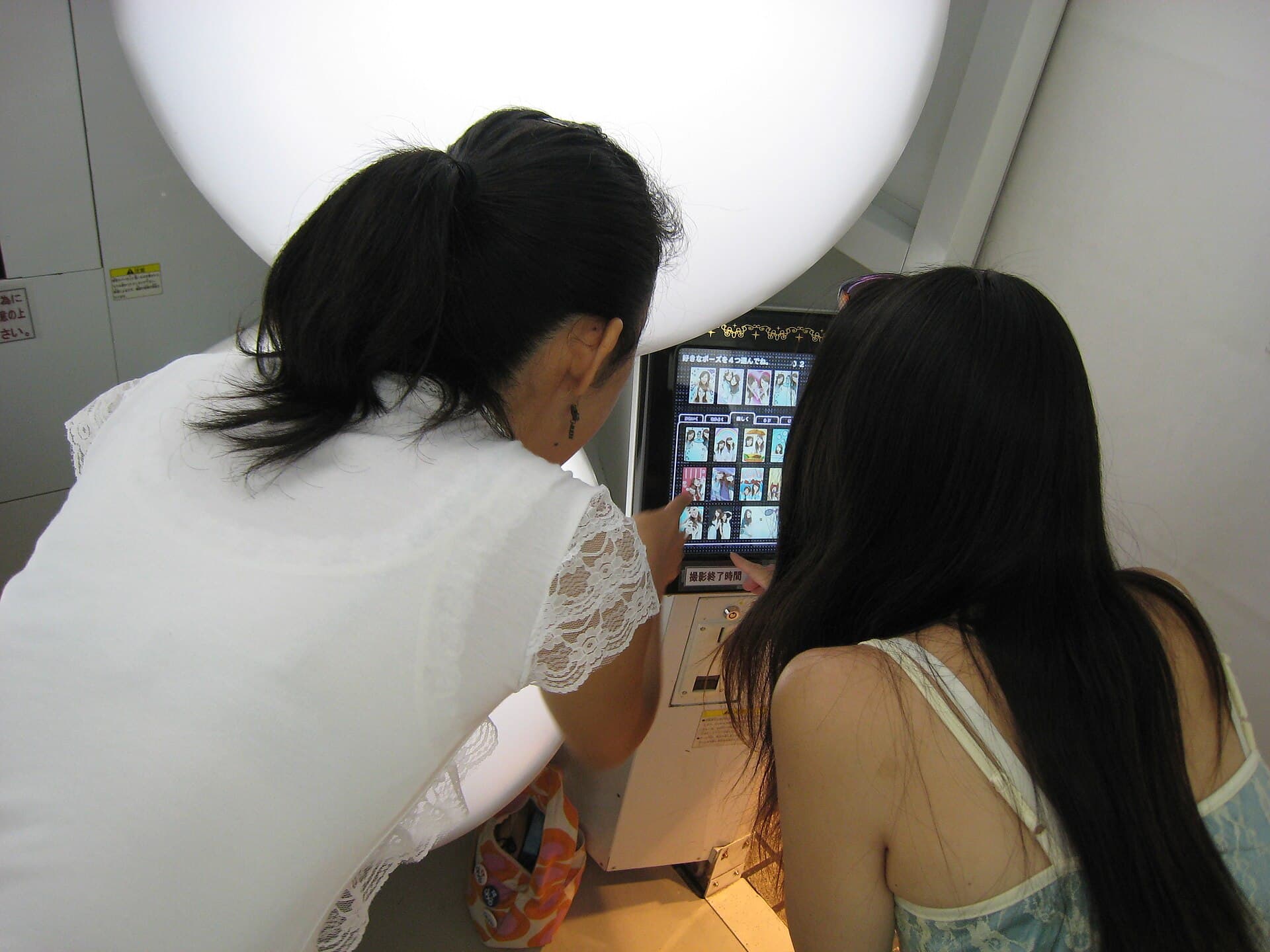
Then comes the step that sets purikura apart from any Western photo booth: the retouching. The group moves to the back of the booth, in front of a large touchscreen, and has a limited amount of time to decorate each shot. You enlarge the eyes, add a pink flush to the cheeks, add text, stamps, glitter. This digital doodling has a name, rakugaki (落書き), literally "graffiti" or "scribbling." The final sheet is printed as a page of stickers that the participants share, and increasingly sent to a smartphone.
Automatic beautification grew more refined across generations of machines. Recent models smooth the skin, whiten the teeth, lengthen the legs and, above all, enlarge the eyes to an extreme, up to a manga-character look. This desire to exaggerate flatteringly has its own verb: moru (盛る), which means "to pile up," "to garnish," and by extension "to embellish" or "to lay it on thick" in a photo.
The vocabulary of purikura fits in a handful of words you come across everywhere, from arcades to social media:
| Term | Romanization | Meaning |
|---|---|---|
| プリクラ | purikura | The booth, the session and the sticker, all in one word |
| プリント倶楽部 | Purinto Kurabu | "Print Club," name of the first machine (1995) |
| 落書き | rakugaki | "Scribbling," the stylus decoration on the touchscreen |
| 盛る | moru | "To pile up, to lay it on": deliberately embellishing a photo |
| 可愛い | kawaii | "Cute," the aesthetic ideal that permeates the booths |
Purikura does not photograph who you are. It photographs the version of yourself you would have wanted to show.
Do you keep running into プリクラ (purikura), 落書き (rakugaki) and 盛る (moru) in Japanese pop culture? Learn to read these everyday words in their original script with JapaneseSRS, the spaced repetition platform that anchors kana and kanji for good.
High School Girls, Gyaru Culture and a Ritual Among Friends#
Purikura was first and foremost a matter of kogyaru, those 1990s high school girls who wore shortened uniforms, loose socks and artificial tans. The booth gave them a pocket photo studio, a place to freeze friendship, group belonging and the style of the moment. The sheets were pasted into notebooks, swapped like cards, taped inside flip phones.
This social use remains the heart of the practice. You rarely make a purikura alone: it is a collective rite, between friends, between couples, between classmates before a farewell. The photo is not an end in itself, it is a pretext to spend a moment together in an enclosed, joyful space, then to leave with tangible proof of the bond. The kawaii (可愛い) aesthetic, the cult of the cute, permeates every detail, from the backdrops to the fonts to the heart-shaped stamps.
Many purikura arcades post an explicit rule: access is reserved for women, or for men accompanied by a woman. This policy, born to protect the female teen clientele from harassment, still survives in many Japanese arcades today.
This gendered dimension shaped the entire industry. The backdrops, the beautification features, the music played inside the booths are aimed primarily at a female teen audience, and the manufacturers design their machines with that in mind.
Read alsoAsian Nail Art: The Manicure as a Fine ArtThe same taste for decorative detail and unabashed cuteness: discover how nail art turns the manicure into an aesthetic language in Japan and Korea.
Furyu, the Arcades and an Economy of the Image#
The Japanese purikura market is today dominated by Furyu (フリュー), a company that took over this activity from the corresponding division of Omron before becoming the sector's benchmark. Its machines occupy entire floors of arcades like those of Taito or Sega, often grouped in a dedicated space with pastel walls, fitted with mirrors, accessory lockers and sometimes makeup stations.
Each new generation of booths reignites the technical race: better sensors, finer beautification algorithms, larger screens, instant transfer of images to smartphones through subscription services. The business model rests as much on per-session payment as on these digital services, which extend the life of the photo well beyond the paper sticker. Purikura has thus shifted from a print industry to an industry of the shared image.
This aesthetic travels. Purikura arcades have opened in Seoul, Taipei and Bangkok, in the shopping districts of Europe and North America, carried by the fascination with Japanese pop culture. Flattering retouching has mixed with other influences, notably Korean K-beauty and its ideal of smooth, luminous skin, blurring the boundaries between national aesthetics.
Read alsoThe ten-step Korean routine: the order and role of each productThe ideal of perfect skin that runs through the Japanese booths also comes from Korea: dive into the K-beauty routine and its quest for a radiant complexion.
From Booth to Smartphone: The Legacy on the Selfie#
Photo-editing apps drew directly on the visual grammar of purikura. When SNOW, B612 or SODA enlarge your eyes, smooth your skin and set animated cat ears on your face, they reproduce, on a smartphone, what the Japanese booths had been offering since the 1990s. The beauty filter was not born with front-facing cameras: it already existed in an arcade box in Osaka.
This lineage explains why purikura is sometimes described as the ancestor of the selfie. Long before phones turned back toward their user, these machines had established the idea that a photo of oneself should be retouchable, decorable and instantly shareable. The normalization of beautification, now global and sometimes criticized for its effects on self-image, has one of its roots in these booths.
Still, purikura keeps what the smartphone has lost: the materiality of the sticker and the collective ritual. Making a purikura means going somewhere, entering a space as a group, decorating together under the pressure of a timer, then leaving with a physical object to share. It is this shared experience, as much as the technology, that explains its longevity.
The question of beautification is also a matter of debate. Some observers see in the oversized eyes and uniform skin a problematic aesthetic pressure, while others read it as a knowing game, a joyful caricature that users wield fully aware of what they are doing. The verb moru (盛る), with its connotation of deliberate exaggeration, leans rather toward the second reading: no one is unaware that the photo lies, and that is precisely the pleasure sought. This ambivalence, between flattery and tongue-in-cheek play, has accompanied purikura since its beginnings.
Read alsoDoujinshi: the amateur manga that shaped JapanThe same culture of personal expression and sharing among enthusiasts drives the world of doujinshi, Japanese amateur manga.
FAQ#
What does the word purikura mean? Purikura (プリクラ) is short for purinto kurabu (プリント倶楽部), meaning "print club" in English, the name of the first machine released in 1995. The term now refers to the booth, the photo session and the decorated sticker that results, all rolled into a single word that has entered everyday Japanese.
Who invented purikura? The idea is credited to Sasaki Miho (佐々木美穂), an employee of the publisher Atlus, who proposed it as early as 1994. The Print Club machine was developed by Atlus with help from Sega and released in February 1995. The concept drew on the cute stickers that Japanese schoolgirls stuck on their notebooks.
Why do purikura enlarge the eyes? The booths apply automatic beautification that smooths the skin and enlarges the eyes to approach a kawaii ideal close to a manga character. This desire to lay it on has a name in Japanese, moru (盛る), "to embellish" or "to exaggerate." Apps like SNOW later took up this same principle.
Can men use purikura? In many Japanese arcades, access to the booths is reserved for women or for men accompanied by a woman. This rule, created to protect the female teen clientele, remains common. Outside Japan and in certain mixed venues, these restrictions generally do not apply.
Is purikura the ancestor of the selfie? In part, yes. As early as 1995, these booths offered a photo of oneself that was retouchable, decorable and shareable, the very features of the modern selfie. Smartphone beauty-filter apps take up this visual grammar directly. Purikura, however, keeps what the selfie has lost: the physical sticker and the collective ritual.
Thirty years after its birth in an arcade, purikura has not merely survived the internet: it wrote in advance the rules by which the whole world would photograph itself.
Photo credits: images in this article come from Wikimedia Commons under free licenses.
Comiket: The World's Largest Fanzine Fair
Comiket (コミックマーケット): 32 tables in 1975, 35,000 today. The history of Tokyo's dōjinshi fair, how it runs, its legal grey zone and its parallel economy.
Cover image: Syced · Syced, via Wikimedia Commons · CC0