Korean Family Names: Kim, Lee, Park and the Clans
Why Kim, Lee and Park cover 45% of Koreans: bon-gwan clans, jokbo genealogies, the Gabo Reform and the ban on same-clan marriage.
La rédaction Kotoba Interactive
Studio éditorial
In a university lecture hall in Seoul, a professor who calls out "Mr. Kim" sometimes gets three students answering at once. This is not comedic exaggeration: the surname Kim (김) is borne by roughly one South Korean in five, more than ten million people. Add Lee (이) and Park (박), and you already cover close to 45% of the peninsula's inhabitants. Where a French phone book lists tens of thousands of distinct names, Korea has barely 250 to 300 in common use.
This extreme concentration is no demographic accident. It tells a story of social hierarchy, fake genealogical registers and brutal reforms: the story of a country where, until the end of the nineteenth century, having a family name was a privilege the majority of the population did not possess. To understand Korean names is to understand the clan (본관, bon-gwan), the genealogy (족보, jokbo) and the way a Confucian society codified ancestry all the way into marriage law.
Three Names for Half a Country#
Kim, Lee and Park together account for roughly 44.6% of the South Korean population. The 2015 census (Statistics Korea) puts Kim at 21.5% (more than 10.6 million people), Lee at 14.7% (7.3 million) and Park at 8.4% (4.1 million). Add Choi (최) at 4.7% and Jeong (정), and you approach half the population with just five surnames.
| Name | Hangul | Share of the population (2015 census) |
|---|---|---|
| Kim | 김 | 21.5%, more than 10.6 million people |
| Lee | 이 | 14.7%, 7.3 million |
| Park | 박 | 8.4%, 4.1 million |
| Choi | 최 | 4.7% |
The Korean family name, the 성씨 (seongssi), fits into a single syllable. It always precedes the given name, which is usually made up of two syllables: in "Kim Yeon-a," Kim is the family name and Yeon-a the given name. This structure, inherited from the Chinese model, partly explains why surnames are so scarce, since each name most often corresponds to a single Chinese character (hanja).
The total stock remains modest. The 2015 census counts 5,582 family names, but that inflated figure includes 4,075 forms written in hangul only, often carried by recent naturalized citizens; only 1,507 rest on a traditional hanja character. Koreans readily sum up this dominance with a single portmanteau: 김이박 (Kim-Lee-Park), the three names that turn up everywhere.
In a country of fifty million people, three syllables are enough to name one person in two.
A useful note for the English-speaking reader: Lee is in fact pronounced "I" in standard South Korean (이), and Park is closer to "Bak" (박). The spellings Lee, Rhee, Yi, Bak or Pak are romanization choices, not different names.
The Bon-gwan, or Why Two "Kims" Are Not Related#
A single family name can cover completely distinct lineages, and it is the clan seat that separates them. This seat is called the 본관 (bon-gwan, 本貫): it designates the place of origin of the ancestor who founded the lineage. Two people named Kim can thus belong to unrelated clans, identified by their town of origin.
The surname Kim alone has more than 300 bon-gwan. The largest, the Kim of Gimhae (김해 김씨), gathers about 4.5 million members and traces itself to King Suro, the legendary founder of the Geumgwan Gaya kingdom. Next come the Kim of Gyeongju (경주 김씨), the Kim of Andong (안동 김씨) and the Kim of Gwangsan (광산 김씨). In a traditional setting, a Korean therefore does not introduce themselves simply as "a Kim," but as "a Kim of Gimhae" or "a Kim of Andong."
Genealogy as an Identity Document#
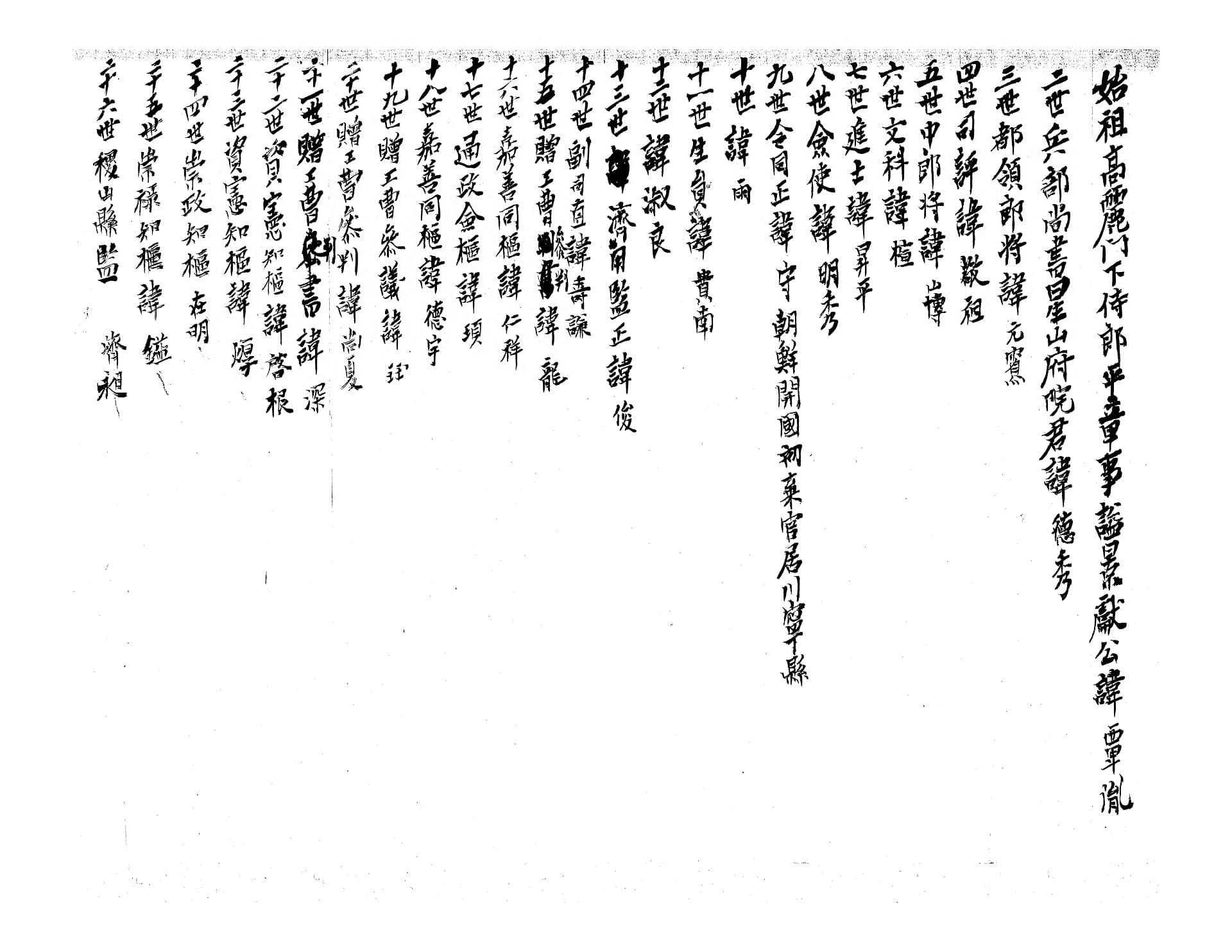
The memory of these lineages rests on the 족보 (jokbo), the clan's genealogical book. These registers, once calligraphed in hanja and copied out from generation to generation, record the complete tree of a common ancestor's descendants, sometimes across several dozen generations. The Hyeon family manuscript reproduced at the top of this article, written in 1915 and held at the Korean Heritage Library of the University of Southern California, traces twenty-six generations in this way.
The jokbo is no dusty curiosity. It long served to verify membership in a clan, to organize the ceremonies honoring ancestors and, as we will see, to establish who could marry whom.
To read a 족보 (jokbo, the genealogical register) yourself, spot a 본관 (bon-gwan, the clan seat) or decipher a 성씨 (seongssi, the family name), everything begins with hangeul. KoreanSRS teaches you the alphabet and the Korean kinship lexicon through spaced repetition.
Bon-gwan (본관, 本貫) literally "origin of the stock": 本 (ben) designates the root or foundation, 貫 (guan) the place of registration. The term fixes the locality of the founding ancestor and tells apart lineages that nonetheless carry the same name.
When Most Koreans Had No Name#
Until the end of the nineteenth century, the vast majority of Koreans simply had no surname. Under the Joseon dynasty (1392-1897), the family name was in practice reserved for the aristocracy, the 양반 (yangban). Commoners, slaves (노비, nobi) and the lower classes were identified by their given name alone, sometimes rounded out with a nickname or a place.
The shift came with the Gabo Reform (갑오개혁), launched in 1894. It abolished the hereditary class system, freed the slaves and, in theory, opened the right to bear a name to everyone. Modern civil registration truly took shape afterward, with the registers established from 1909 onward, then systematized under the Japanese occupation. It was at this moment that millions of families chose, for the first time, a surname.
The choice was not neutral. Many of the newly registered adopted the names of the most prestigious clans, Kim, Lee or Park, in order to attach themselves, really or fictitiously, to a noble ancestry. This rush toward the elite's surnames largely explains the current concentration: the prestige of a name was worth, socially, its weight in gold.
Toward the end of Joseon, yangban status could be bought. Newly wealthy families and ambitious commoners purchased titles, bribed scribes or had genealogies (jokbo) forged to slip into a noble lineage, escape taxes and military service. A prestigious name was manufactured as much as it was inherited.
The statistics must therefore be read with caution. That one Korean in five is named Kim does not mean that a fifth of the population descends from the same royal family: some of these Kims owe their name to a choice made a little more than a century ago, when everyone finally had to give themselves one.
Saseong: The Name Granted by the King#
In ancient Korea, a family name could be bestowed by the sovereign, a practice designated by the term 사성 (saseong, 賜姓), literally "granting of a surname." The character 賜 (sa) means "to grant, to bestow from above," and 姓 (seong) the clan name: it is a name conferred by royal favor, often as a reward for a service rendered to the throne.
The old chronicles keep a record of it. The Samguk sagi (삼국사기), compiled in 1145, reports that King Yuri of Silla is said to have assigned family names to the six tribal chiefs of Saro, among them the surname Lee (이). Modern historians receive this account with reservation: the widespread use of Confucian-style names would rather date from the fifth century and beyond, as the Three Kingdoms adopted the Chinese model. The saseong nevertheless remains a key to understanding certain bon-gwan, in particular those of lineages of foreign origin who were integrated into the court and given a Korean name by the king.
The spelling "sajae" in the present article is an approximate romanization; the correct historical concept is indeed saseong (賜姓). Distinguishing it avoids a frequent confusion: not all the great clans go back to a single, proven ancestor; some stem from a royal grant, others from a late adoption of the name, others still from a genealogy reconstructed after the fact.
Marrying Someone From Your Own Clan, Long Forbidden#
For decades, two people carrying the same name and the same bon-gwan had no right to marry. This rule, called 동성동본 (dongseong-dongbon, "same name, same origin"), forbade a union between members of one lineage, even without any demonstrable close kinship. Rooted in the Confucian tradition of preserving family integrity, it was codified in article 809 of the Korean Civil Code in 1957.
Concretely, a Kim of Gimhae could not marry a Kim of Gimhae, even when their common ancestors were lost in the mist of thirty generations. Given the size of the great clans, the rule blocked tens of thousands of couples and caused very real dramas: unregistered unions, children with no proper civil status, departures abroad to marry.
The lock came off in two stages. On 16 July 1997, the Constitutional Court of Korea declared the article unconstitutional. The National Assembly then voted an amendment, which took effect on 31 March 2005, restricting the ban to genuinely close relatives alone. Marriage between distant same-name, same-clan partners is now allowed, turning a page centuries old.
A Kim of Gimhae and a Kim of Gimhae waited until 1997 for the legal right to love each other.
Another peculiarity is worth noting: in Korea, a woman keeps her family name after marriage. A wife born Park remains Mrs. Park all her life, including on official documents, while the children traditionally carry the father's name. This custom, often perceived as modern, in fact follows the logic of the clans: the name marks belonging to a lineage, and one does not leave one's lineage by marrying.
FAQ#
Why are so many Koreans named Kim, Lee or Park? Because bearing a family name was reserved for the aristocracy under Joseon. When the Gabo Reform of 1894 and then modern civil registration opened it to everyone, many commoners adopted the surnames of the most prestigious clans, Kim, Lee and Park, to attach themselves to a noble ancestry. The result: these three names cover close to 45% of the population.
Are two Koreans who share the same name necessarily related? No. The family name is paired with a clan seat, the bon-gwan (본관), which designates the locality of the founding ancestor. The single name Kim has more than 300 distinct bon-gwan. Two Kims from different clans have, in principle, no kinship: it is the pair of name plus bon-gwan that truly identifies a lineage.
What is a jokbo? The jokbo (족보) is a clan's genealogical book. It records the complete tree of a common ancestor's descendants, sometimes across dozens of generations, once calligraphed in Chinese characters. It served to prove membership in a lineage, organize the ancestral rites and verify permitted marriages.
Does a Korean woman change her name when she marries? No. In Korea, the wife keeps her family name from birth, including on official documents. The children traditionally carry the father's name. This custom follows the logic of the clans: the name marks belonging to a lineage, which one does not leave through marriage.
Is marriage between people with the same name still forbidden? No, not since 2005. The dongseong-dongbon rule forbade a union between partners of the same name and clan. The Constitutional Court judged it unconstitutional on 16 July 1997, and a reform that took effect on 31 March 2005 restricted the ban to genuinely close relatives alone.
Behind three syllables that repeat endlessly hides one of the most elaborate systems of family memory in the world: where the West reads a name, Korea reads a clan, a town of origin and a tree of twenty-six generations.
Read alsoHangeul: The Korean Alphabet Invented by King SejongTo decipher a family name or a clan sign, everything begins with the alphabet invented by King Sejong.
Knowing whom to call "Mr. Kim" and how: nunchi, that Korean art of reading social situations.
The clan is not only a matter of civil status: jeong, that deep emotional bond, runs through Korean family relationships.
Photo credits: images in this article come from Wikimedia Commons under free licenses.
Jeonse: The Giant Deposit That Holds Up Korean Housing
Jeonse (전세): handing over 60% of a property's value and paying no rent. How this uniquely Korean system works, why it produced the deposit fraud crisis, and why it is retreating.
Cover image: Auteur inconnu · Auteur inconnu, via Wikimedia Commons · Public domain