Doujinshi: the amateur manga that shaped Japan
Doujinshi (同人誌), self-published manga made by circles of enthusiasts, fuels Comiket and launched CLAMP and Type-Moon. Inside a counter-economy of drawing.
La rédaction Kotoba Interactive
Studio éditorial
On December 21, 1975, thirty-two amateur circles and around seven hundred visitors crowded into a meeting room in Tokyo's fire prevention building. This low-key gathering, named Comic Market, would become the largest comics event in the world. Half a century later, in December 2025, its 107th edition drew nearly 300,000 people over two days at Tokyo Big Sight, according to Anime News Network.
Between these two dates unfolds an entire slice of Japanese culture that the official manga industry long eyed sideways, without ever daring to crush it. Doujinshi (同人誌), the self-published drawn fanzine, is no marginal phenomenon: it is the underground laboratory where some of the greatest names in Japanese illustration were formed, an economic ecosystem in its own right, and a legal grey zone that everyone has an interest in preserving. To understand doujinshi is to understand how Japan manufactures its talents and sustains its collective passion for drawn storytelling.
What the word doujinshi actually covers#
A doujinshi (同人誌) is a self-published work, printed and distributed by its creators outside commercial publishing channels. The term breaks down into doujin (同人), literally "the same people," meaning a group sharing a common taste, and shi (誌), the suffix for magazines and periodicals. Historically, as far back as the Meiji era, the word referred to literary journals produced by circles of writers; it began to apply to manga in the 1960s and 1970s.
These creators almost never work alone. They band together into circles, the saakuru (サークル), the basic unit of the whole ecosystem: a circle may consist of a single person or a dozen collaborators, and it is the circle, not the individual, that books a booth at conventions. The circle carries a name, a graphic identity, sometimes a reputation passed down from one edition to the next.
Doujinshi (同人誌) from doujin (同人), "people who share the same interest," and shi (誌), "periodical publication." The word first referred to amateur literary journals of the Meiji era before shifting toward manga in the 20th century.
The great dividing line separates two families of works. On one side, original creations, with characters and worlds invented from scratch. On the other, and this is the most visible output, niji sosaku (二次創作), "secondary creation": parodies, imaginary sequels, invented love stories between existing characters, drawn reinterpretations of hit series. A circle may print a run based on a shonen popular at the moment, then release an entirely personal story in the next edition. This porosity between homage and original work defines the whole doujin (同人) culture.
The vocabulary of this culture runs through the entire article:
| Term | Script | Meaning |
|---|---|---|
| Doujinshi | 同人誌 | Work self-published by a circle of amateurs |
| Doujin | 同人 | "The same people," a group sharing a common taste |
| Saakuru | サークル | Circle of creators, the basic unit of the ecosystem |
| Komike | コミケ | Comic Market, the great biannual convention |
| Niji sosaku | 二次創作 | "Secondary creation": parodies and derivative works |
| Doujin insatsu | 同人印刷 | Printers specialized in fanzines |
Comiket, the cathedral of the fanzine#
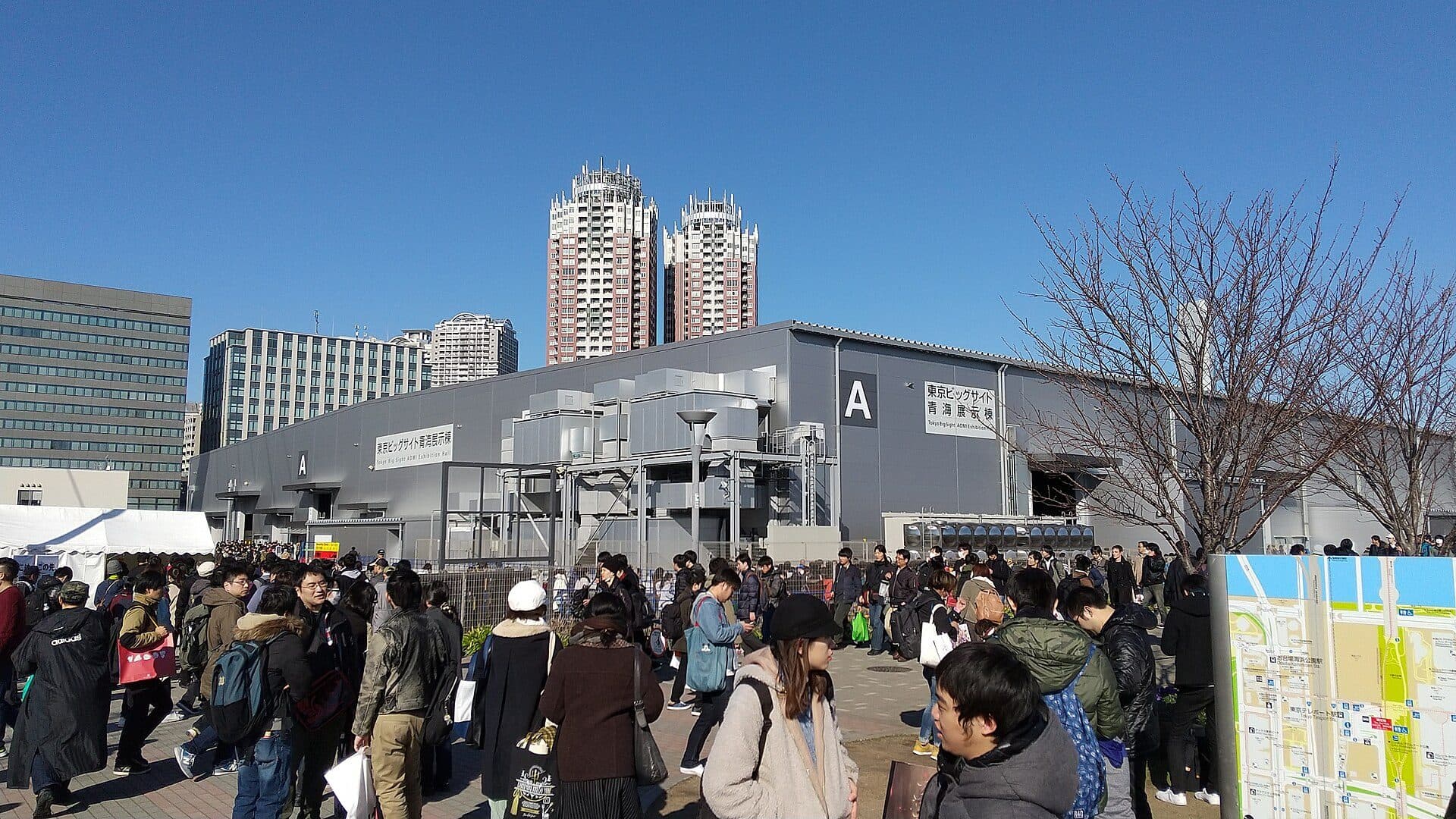
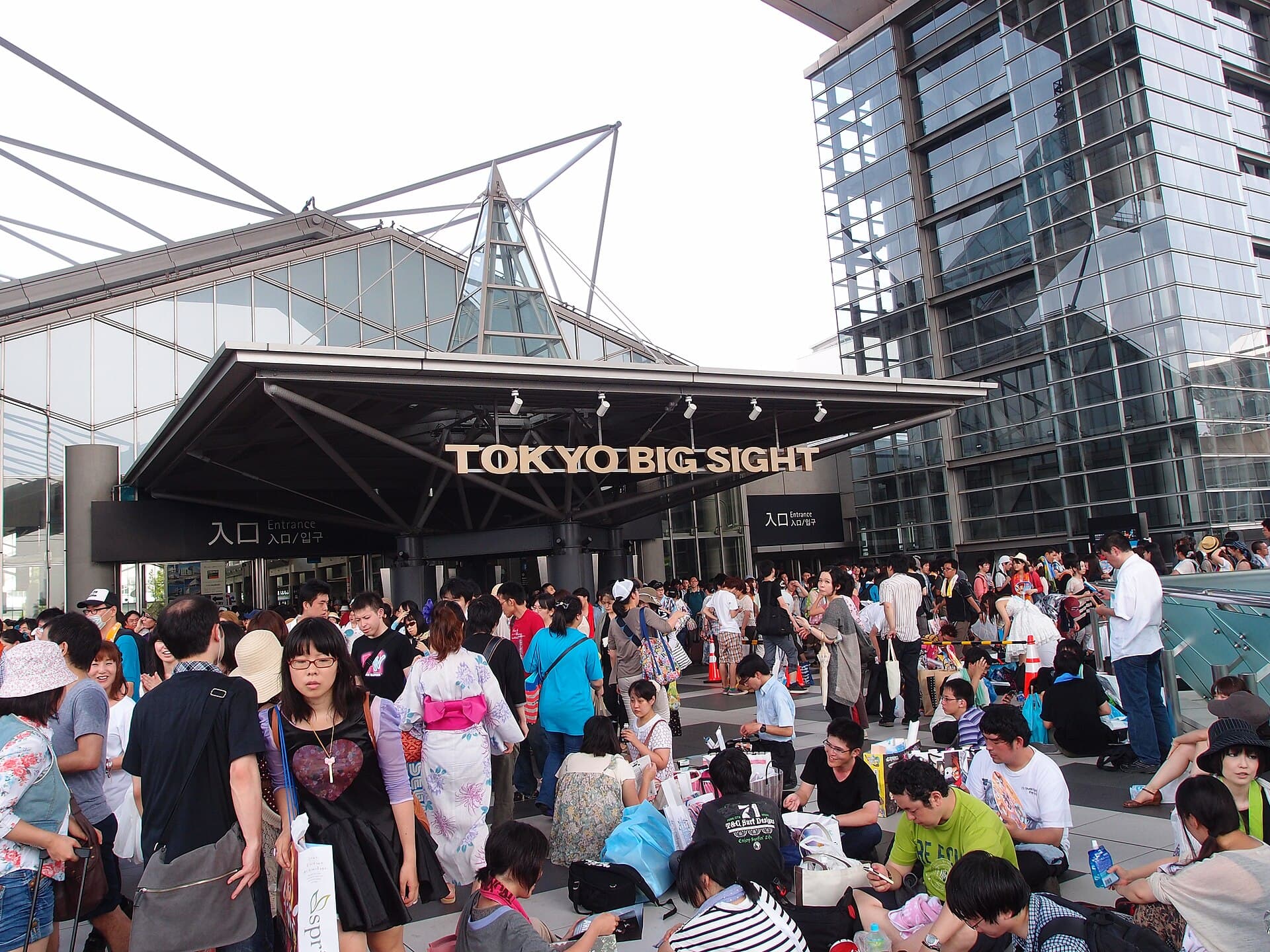
Comiket, a contraction of Comic Market and commonly called komike (コミケ), takes place twice a year, in summer and winter. Founded on December 21, 1975 at the initiative of a small group led by the critic Yoshihiro Yonezawa, the event changed venues several times before settling in 1996 at Tokyo Big Sight, the huge exhibition center on Tokyo Bay recognizable by its four inverted pyramids.
The scale is dizzying. The 500,000-visitor mark was passed for the first time at the August 2004 edition, and the big pre-pandemic years saw more than half a million people flow in over three or four days. Guinness World Records recognizes Comiket as the largest comics festival on the planet. Tens of thousands of circles exhibit there, lined up at identical tables in air-conditioned halls, while the queues form before dawn.
At Comiket, the author sells their book to the very person who reads it: between the two, no middleman, no distributor, no editorial committee.
The organization rests almost entirely on volunteers, with meticulous flow rules to manage the crowds. Comiket does not stand alone: it coexists with specialized fairs like Comitia, reserved for original works, and thematic events centered on a single franchise. But it is Comiket that sets the tempo, its two annual dates pacing the entire production calendar of the circles.
Three words open the doors of this culture: 同人誌 (doujinshi, the self-published fanzine), サークル (saakuru, the circle of creators) and コミケ (komike, the Comic Market). Learn to read kana and kanji and anchor this vocabulary for good with JapaneseSRS, the spaced-repetition method dedicated to Japanese.
A carefully maintained legal tolerance#
Niji sosaku (二次創作) rests on an openly acknowledged contradiction: the majority of derivative doujinshi, in theory, violate the copyright of the works they rework. Japanese law protects characters and worlds, and nothing would compel a publisher to let amateurs sell parodies of its flagship series. And yet tolerance prevails, and it is a long-standing one.
This leniency is far from naive. Rights holders have understood that circles work like a giant free promotional machine: a doujinshi sustains fans' attachment between two volumes, extends the life of a series after it ends, and spots future talent. As long as production stays small-scale and artisanal, in short print runs, without directly competing with official products, most rights holders look the other way. The red line lies in industrial volume, the counterfeiting of official merchandise, or damage to a brand's image.
In 2014, the publisher Nintendo had an unauthorized Pokémon doujin event shut down, a reminder that tolerance remains a revocable favor and not an acquired right. Most studios, however, prefer to publish guidelines specifying what they allow circles to do.
Since the 2010s, several publishers and studios have formalized this grey zone through public "derivative work" guidelines, setting down in black and white the accepted uses. This partial institutionalization protects amateur creators and brands alike, and confirms that the doujin ecosystem has become too precious to be merely tolerated with reluctance.
Read alsoCLAMP: Four Women Who Redefined MangaFour female artists trained in amateur circles built one of manga's greatest collectives: discover the trajectory of CLAMP.
From amateur to professional: the legendary trajectories#
Some of the greatest names in Japanese illustration started booth after booth, at Comiket. The CLAMP collective formed in the mid-1980s as a doujinshi circle, before pivoting to original creation in 1987 and then achieving worldwide success with works like Cardcaptor Sakura and xxxHOLiC. Their first print runs were parodies of series popular at the time, squarely in the logic of niji sosaku.
The most striking example remains Type-Moon. Before becoming a major commercial studio in 2003, the duo of Kinoko Nasu and Takashi Takeuchi sold their creations in doujin form. Their visual novel Tsukihime was released at Comiket 59, in December 2000, in the amateur circuit. From that matrix would emerge Fate/stay night, today one of Japan's most lucrative multimedia franchises, spanning games, anime and the mobile phenomenon Fate/Grand Order.
A dedicated chain of printers#
This economy would not hold together without the doujin insatsu (同人印刷), the printers specialized in fanzines. These companies offer packages calibrated for circles: small print runs, deadlines aligned with Comiket dates, standardized formats, binding and cover options. They know how to handle a spike of orders concentrated in the weeks before each edition, when thousands of circles wrap up their issue at the same time.
The circle's business model stays artisanal but real. An amateur author recoups printing costs on the weekend's sales, reinvests in the next run, and a few star circles sell thousands of copies in a matter of hours. This small accounting of passion has nurtured entire vocations and served as a springboard toward professional publishing.
The digital turn: Pixiv, Booth and DLsite#
Since the 2010s, the distribution of doujinshi has largely migrated online, without killing off the printed form. The platform Pixiv, launched in 2007, has become the go-to network where illustrators publish and showcase their work, including derivative pieces, reaching a global audience impossible to attain from a mere booth.
Around this ecosystem orbit dedicated marketplaces. Booth, tied to Pixiv, lets creators sell physical books and digital files; DLsite, older, has established itself as a giant in the distribution of doujinshi and amateur games as downloads. These platforms have transformed the market's timing: a doujinshi no longer exists only for the span of a convention weekend, it stays available and profitable all year round.
Digital has also broadened the pool of creators and lowered the barrier to entry, without erasing the prestige of the physical gathering. Comiket remains the founding moment, the one of direct encounter between the author and their reader, while the rest of the year plays out on servers. The two worlds feed each other, and it is this double life, on the table and on the screen, that guarantees the vitality of doujinshi today.
Read alsoLight novel: the Japanese illustrated novel explainedThe Japanese illustrated novel shares with doujinshi that taste for drawn storytelling and bridges to anime: explore the world of the light novel.
FAQ#
What exactly is a doujinshi? A doujinshi (同人誌) is a work self-published by a circle of amateurs, outside commercial publishing houses. It can be an entirely original creation or a work derived from an existing series, known as niji sosaku (二次創作). The most common format is printed manga, but you also find novels, illustrations and games.
Are doujinshi legal in Japan? Derivative doujinshi sit in a copyright grey zone. In theory, they infringe the rights of the works they rework, but rights holders largely tolerate the practice as long as it stays artisanal and does not compete with official products. Some publishers now issue guidelines specifying what they permit.
What is Comiket? Comiket (コミケ), short for Comic Market, is the largest doujinshi convention in the world. Founded in 1975, it takes place twice a year at Tokyo Big Sight since 1996 and brings together hundreds of thousands of visitors as well as tens of thousands of exhibiting circles who come to sell their publications.
Can you go professional thanks to doujinshi? Yes, and many major artists came out of it. The CLAMP collective and the studio Type-Moon, creator of Fate/stay night, both started as amateur circles before breaking into the industry. The doujin scene serves as a testing ground and a talent-scouting field for professional publishers.
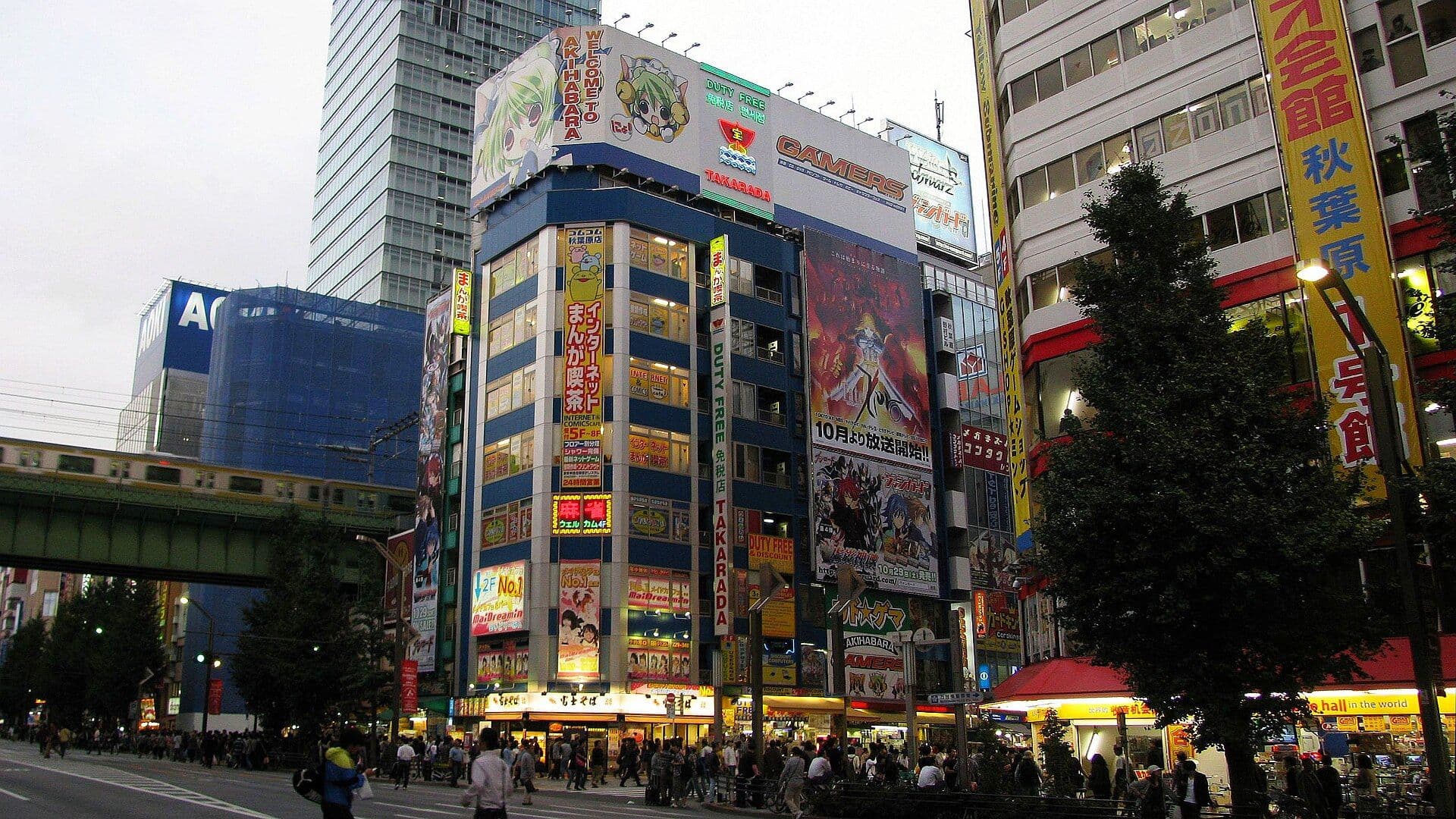
Where can you buy doujinshi today? In person at conventions like Comiket or Comitia, in specialized shops in districts such as Akihabara, or online. The platforms Pixiv, Booth and DLsite now make it possible to buy print or digital versions all year round, including from abroad.
From the firefighters' building of 1975 to the servers of Pixiv, doujinshi has proven that a culture can thrive in the margins, carried by the sheer passion of drawing for other enthusiasts. It is a reminder that, long before algorithms, Japan had already invented its own economy of sharing.
Photo credits: images in this article come from Wikimedia Commons under free licenses.
In this article
The cultural terms covered here, each with a short definition.
Comiket: The World's Largest Fanzine Fair
Comiket (コミックマーケット): 32 tables in 1975, 35,000 today. The history of Tokyo's dōjinshi fair, how it runs, its legal grey zone and its parallel economy.
Cover image: Guilhem Vellut · Guilhem Vellut, via Wikimedia Commons · CC BY 2.0