Lanzhou, biangbiang, hefen: the families of Chinese noodles
Miàn or fěn, four gestures that make four families, the pulled-noodle capital of Lanzhou, the wheat of the north and the rice of the south: how to read a Chinese noodle bowl.
La rédaction Kotoba Interactive
Studio éditorial
The cook takes a mass of dough, rolls it into a rope, pulls it apart, folds it back, twists it, slams it on the counter with a dry crack, and starts again. Eight gestures later he holds a sheaf of even strands that he drops into boiling water. The whole variety of Chinese noodles rests on that economy: one flour, water, salt, and a gesture that decides everything.
Speaking of "Chinese noodles" in the singular is a misleading shortcut. The country counts hundreds of forms, sorted by three criteria that intersect: the material (wheat, rice, starch), the shaping gesture (pulling, shaving, rolling, pressing) and the region, which decides the seasoning. This guide follows those three axes, with the characters and pinyin that let you order the right bowl.
Miàn or fěn: the first frontier#
The founding distinction is not one of shapes but of flours. refers to wheat noodles; refers to those made from rice or starch. That separation overlaps an ancient geography: wheat dominates in the north, where dry land favours it, while rice reigns in the humid south.
A dish therefore carries its DNA in its name. is a wheat noodle soup with beef; and are rice vermicelli; refers to the wide Cantonese rice ribbons; names the translucent mung bean threads that Western kitchens call glass noodles.
In Han and Wei texts, all wheat flour preparations are called , a word covering flatbreads as well as noodles. Noodle soup appears there as , "bǐng of broth". The modern word , "flour strand", is far more recent: the Chinese noodle was for a long time a flatbread that had been stretched.
Archaeology has pushed the practice far back. In 2005, in the journal Nature, the team of Lü Houyuan described an overturned bowl unearthed at the Lajia site in Qinghai, containing noodle remains roughly 4,000 years old, made not of wheat but of millet. The Chinese noodle predates the massive use of wheat.
Four gestures, four families#
The best classification of Chinese noodles is the one based on hands, because it explains texture far better than shape does.
Pulling: lā (拉)#
The dough, highly hydrated and often alkalised, is stretched and folded until it becomes strands. This is the technique of , queen of the Muslim northwest. The master can calibrate thickness on request, which gives Lanzhou a menu of widths rather than a menu of dishes.
Shaving: xiāo (削)#
The cook holds a loaf of firm dough against his shoulder and shaves flakes off it with a knife, straight into boiling water. Shanxi's is the result: thick in the middle, thin at the edges, with a very pronounced chew.
Rolling and cutting: gǎn (擀)#
The dough is rolled out into a large sheet, folded, then cut with a knife. This is the domestic noodle par excellence, the one made at home without spectacular skill.
Pressing, pinching, tearing#
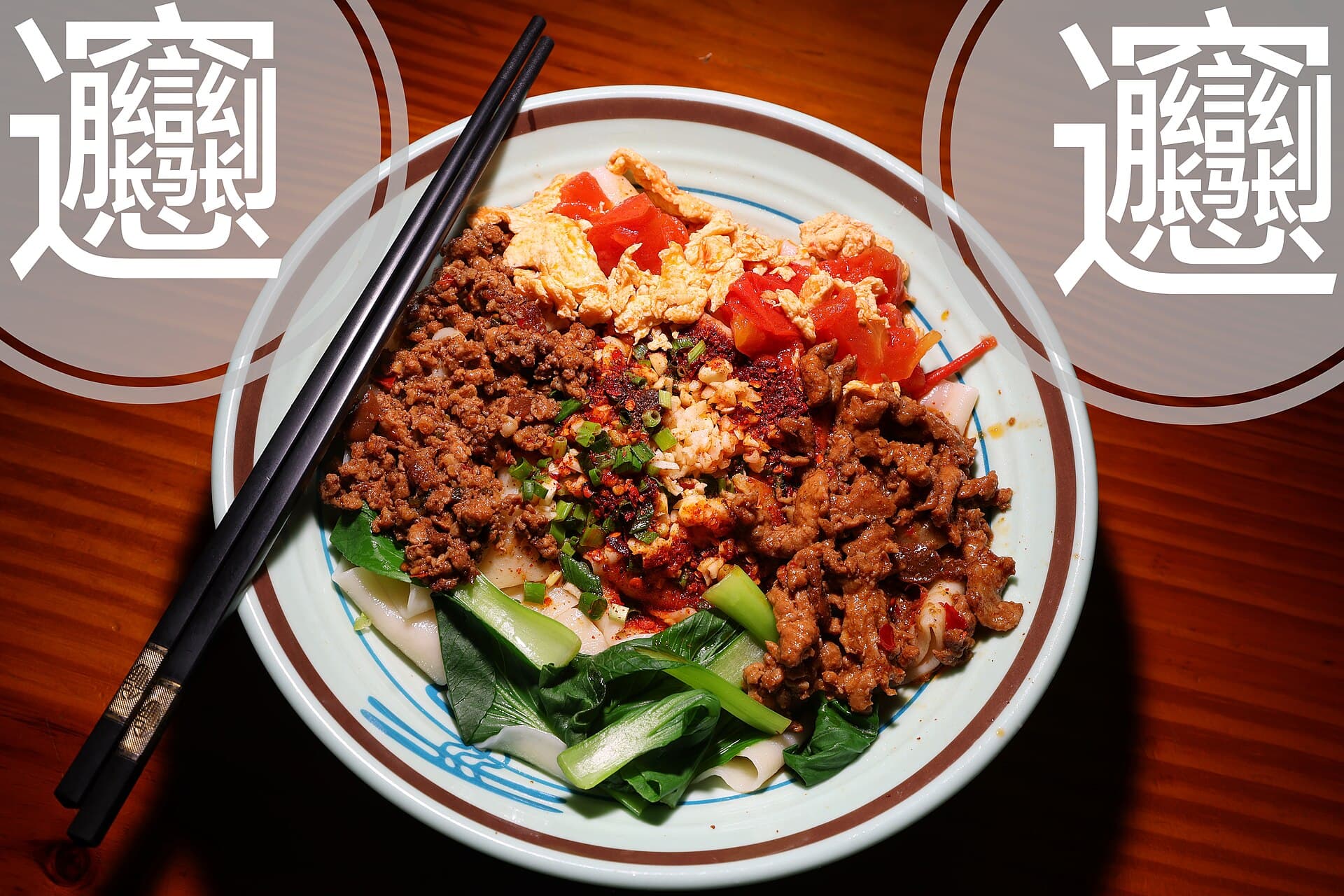
The remaining techniques play on deformation. are pieces torn by hand; , "cat's ears", are shells made by pressing a cube of dough with the thumb; are extruded through a press; Shaanxi's are wide belts, stretched then slapped on the counter, hence their onomatopoeic name.
The character for biángbiáng miàn is the most complex in everyday use: depending on the count, it stacks 56 to 58 strokes. Absent from keyboards for decades, it was only encoded in Unicode in 2020, which until then forced restaurants to write it by hand on their boards.
Lanzhou, capital of pulling#
China's most famous bowl is a beef soup from Gansu: . Tradition credits its modern form to a cook named Ma Baozi, around 1915, though the practice is older among the region's Hui communities.
Its success rests on a formula the shops still display: 一清二白三红四绿五黄 (yī qīng èr bái sān hóng sì lǜ wǔ huáng), "one clear, two white, three red, four green, five yellow". The broth must be limpid, the radish white, the chilli oil red, the coriander and garlic sprouts green, the noodles yellow thanks to the alkaline agent. That alkali was traditionally , the ash of a steppe plant, now replaced by carbonate salts.
The customer does not choose a dish but a thickness. The menu runs from , thin as a hair, to , wide as a strap, by way of , , , "chive leaf", and the triangular .
Ordering in China comes down to a few characters: 面 (miàn, wheat noodle), 粉 (fěn, rice noodle), 拉 (lā, to pull), 宽 (kuān, wide), 辣 (là, spicy). Learn them with ChineseSRS and its spaced repetition, and read a Lanzhou noodle shop menu without translation.
The noodle North: Shanxi and Shaanxi#
Two neighbouring provinces, often confused, form the historic heart of the Chinese noodle. claims hundreds of forms produced by the same cutting or pinching gestures, and eats them gladly with a local black vinegar. , around Xi'an, prefers wide noodles and blunt seasonings.
This is where the most recognisable dishes live: , wide noodles doused with smoking oil poured over ground chilli, which cooks the aromatics in the bowl; Qishan's , with pork and vinegar sauce; , wheat starch ribbons served cold, a legacy of a long-attested technique for separating starch from gluten.
The South: rice, egg and alkalinity#
The south reverses the raw material. In Guangdong, is kneaded by riding a long bamboo pole, a technique that gives the egg noodles of , wonton noodle soup, their characteristic bite. Wide rice hé fěn goes into the wok for the famous , beef with dry-fried rice noodles, a recognised test for Cantonese cooks.
Yunnan gave the world , "crossing the bridge rice noodles", served with a scalding broth sealed by a film of oil in which diners cook their own meat and vegetables. Local legend attributes the device to a wife carrying meals every day to her studying husband, on the other side of a bridge.
Guangxi supplies the most recent hit: Liuzhou's , rice vermicelli in a river snail broth, with its smell of fermented bamboo shoots. The instant version, industrialised from the 2010s, has become an export product and a symbol of the new regional cuisine in a packet.
| Dish | Characters and pinyin | Region | Distinctive feature |
|---|---|---|---|
| Lanzhou beef noodles | 兰州牛肉面 (lánzhōu niúròu miàn) | Gansu | Clear broth, width to order |
| Knife-shaved noodles | 刀削面 (dāoxiāo miàn) | Shanxi | Thick flakes, strong chew |
| Biangbiang noodles | 𰻞𰻞面 (biángbiáng miàn) | Shaanxi | Wide belts, smoking oil |
| Fried sauce noodles | 炸酱面 (zhájiàng miàn) | Beijing | Pork and fermented soybean paste |
| Hot dry noodles | 热干面 (règān miàn) | Wuhan | Sesame paste, no broth |
| Dandan noodles | 担担面 (dàndàn miàn) | Sichuan | Crisp pork, chilli and Sichuan pepper |
| Chongqing small noodles | 重庆小面 (chóngqìng xiǎomiàn) | Chongqing | Seasoning at the bottom of the bowl |
| Yangchun noodles | 阳春面 (yángchūn miàn) | Shanghai | Clear broth, lard, spring onion |
| Wonton noodles | 云吞面 (yúntūn miàn) | Guangdong | Egg dough kneaded with bamboo |
| Crossing the bridge noodles | 过桥米线 (guòqiáo mǐxiàn) | Yunnan | Broth sealed by oil |
| Snail rice noodles | 螺蛳粉 (luósī fěn) | Guangxi | Deeply fermented broth |
| Braised beef noodles | 红烧牛肉面 (hóngshāo niúròu miàn) | Taiwan | Legacy of the 1949 migrations |
What the noodle says about ritual#
The Chinese noodle carries a symbolic charge the flatbread does not: its length. , "longevity noodles", are eaten on a birthday and must never be cut, on pain of shortening the life they represent. In some families the whole strand is slurped in one go.
The food calendar follows the same logic. Noodles accompany departures, returns and births, and appear at festive meals in wheat regions, where the south serves glutinous rice. A plate of noodles in China is never neutral: it wishes something.
Read alsoMala: Sichuan pepper and chilli, how it actually worksA bowl of dandan miàn only makes sense with the pairing of chilli and Sichuan pepper: discover the mechanics of mala, that double sensation of burning and numbness.
The instant noodle followed a parallel path in Korea, to the point of becoming a national marker in its own right.
One country, endless bowls#
Remembering every Chinese noodle is impossible, and that is precisely what makes the subject interesting: each province, each city, sometimes each street defends its shape, its thickness, its seasoning. The grid itself stays simple, and is enough to find your way anywhere: ask about the material, watch the gesture, read the region.
What strikes in the end is how constant the technical repertoire has been across four millennia. From the millet bowl of Lajia to the packet of luósī fěn shipped to the other side of the world, the same idea circulates: turn a flour into a strand, and a strand into a meal.
FAQ#
What is the difference between miàn and fěn? refers to wheat noodles, dominant in northern China. refers to rice or starch noodles, dominant in the south. A dish name therefore states its raw material before any other detail.
Which Chinese noodles are the most famous? Hand-pulled Lanzhou beef noodles (兰州牛肉面) are the most widespread in China. They are followed by Shanxi knife-shaved noodles, Shaanxi biangbiang noodles, Beijing zhájiàng miàn, Wuhan règān miàn and Sichuan dàndàn miàn.
What is the oldest known noodle find? A bowl containing millet noodle remains roughly 4,000 years old, discovered at the Lajia site in Qinghai and described in the journal Nature in 2005 by the team of Lü Houyuan.
Why are some Chinese noodles yellow? Because the dough contains an alkaline agent, historically the plant ash in Lanzhou, now carbonate salts. Alkali yellows the dough, makes it elastic and gives it its characteristic aroma.
Why are birthday noodles never cut? , longevity noodles, symbolise the span of a life. Cutting them would amount to shortening it, so they are eaten whole, slurped rather than sliced.
Photo credits: the images in this article come from Wikimedia Commons and are under a free license.
Why Sichuan eats so much chilli
Chilli has only existed in China since the 16th century. How Sichuan, already famous for its taste for pungency, made it the pillar of its cuisine: migration, climate, economics.
Cover image: 田纳西的雨 · 田纳西的雨, via Wikimedia Commons · CC BY 4.0