Gwangju 1980: The Uprising That Awakened Korean Democracy
From May 18 to 27, 1980, the city of Gwangju rose against martial law. The story of the massacre, its cover-up, and its democratic legacy.
La rédaction Kotoba Interactive
Studio éditorial
On the morning of May 21, 1980, in front of the former South Jeolla provincial government headquarters, a crowd sang the Korean national anthem, arms linked, facing a row of paratroopers. Just past noon, the soldiers opened fire on the unarmed demonstrators. Within minutes, Geumnam-ro avenue was strewn with bodies, and an entire city was transformed. What had begun as a student protest against martial law had just become a popular insurrection: the first, in South Korea, to answer the army's rifles not with resignation, but with revolt.
The , also known by its date, , remains the founding event of modern South Korean democracy. For seven years, the dictatorship branded it a "communist-inspired riot"; today, its archives are inscribed in UNESCO's Memory of the World register, and every May 18 the South Korean state honors the citizens it once had killed. To understand Gwangju is to understand how a nation paid in blood for the freedom it now exercises every day.
A country without spring: from Park's assassination to Chun's coup#
The Gwangju Uprising was born out of a power vacuum. On October 26, 1979, President , a military dictator in power since his own coup in 1961, was assassinated in Seoul by his intelligence chief, , during a dinner. Eighteen years of authoritarian rule collapsed in a single evening. For millions of South Koreans, this death suddenly opened the long-forbidden prospect of a civilian democracy.
This brief hope took the name , by analogy with the Prague Spring. Students, unions, and intellectuals demanded an end to martial law, the release of political prisoners, and free elections. But one man, in the shadows, was preparing to seize that spring for himself.
General , then head of the Defense Security Command, saw his opportunity. On December 12, 1979, he orchestrated an internal coup within the army, having the chief of staff arrested on the pretext of complicity in Park's assassination. Within a few months, this officer, almost unknown to the general public, took real control of the machinery of the state. The Seoul Spring had lasted only a few weeks.
On May 17, 1980, fearing the spread of pro-democracy protests, Chun extended to the entire country. Universities were closed, political activity banned, and the press censored. The main opposition leaders were arrested overnight, including , a democratic figure from Jeolla province, an arrest that would be felt in Gwangju, the capital of that region, as a direct provocation.
reads o-il-pal: o (5), il (1), pal (8), meaning the 18th of the 5th month. In Korea, referring to a historical event by its numerical date is common, as with 3·1 (samil, the March 1, 1919 independence movement) or 4·19 (the student revolution of April 1960).
The ten days of Gwangju: from closed campus to insurgent city#
It all began on the morning of May 18, 1980, in front of Chonnam National University (전남대학교) in Gwangju. Students gathered despite the ban; they clashed with soldiers stationed at the gates of the closed campus. Driven back, they retreated toward the city center and joined Geumnam-ro avenue, the main artery of the city. What might have remained a campus scuffle would, within hours, turn into a revolt of the entire population.
The brutality of the military response was the catalyst. The regime had deployed to Gwangju: elite combat-trained troops, not crowd-control forces. Consistent testimonies, later corroborated by official investigations, describe soldiers clubbing, bayoneting, and killing protesters and bystanders alike (students, but also workers, high-schoolers, and the elderly). Far from dispersing the crowd, this indiscriminate violence raised up the entire city: by May 20, tens of thousands of residents were in the streets.
That night, one episode became legendary. A column of more than two hundred taxis and buses, headlights blazing, converged on the center, horns blaring, to support the demonstrators and carry the wounded. The taxi drivers of Gwangju, at first mere witnesses, became actors in the insurrection, a scene that Korean cinema would immortalize much later.
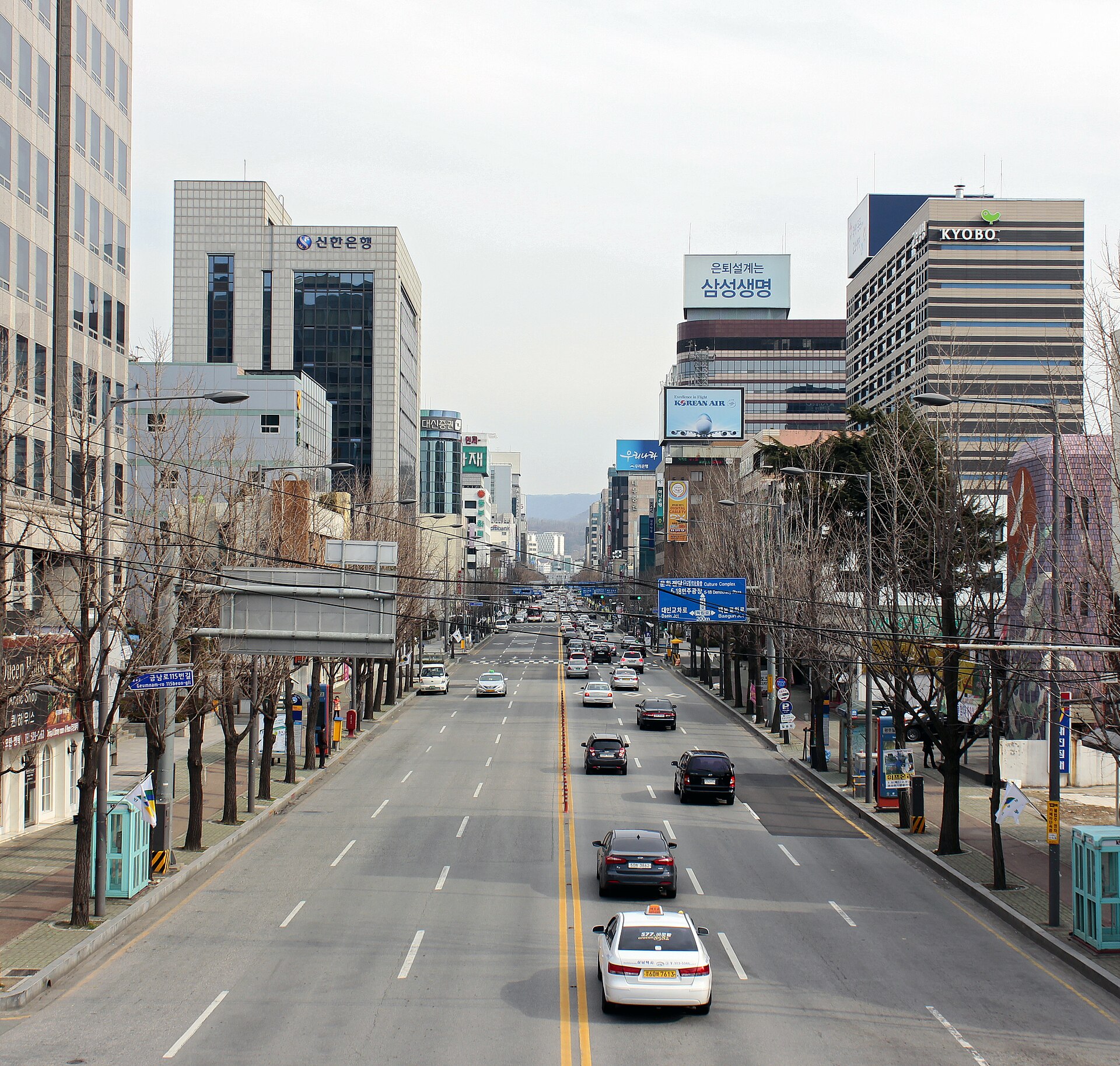
The turning point came on May 21. In front of the former provincial government headquarters, the army opened fire with live rounds on the assembled crowd. The death toll for that single day ran into the dozens. In response, the residents did what no Korean city had dared: they armed themselves. Protesters seized weapons from police stations and armories across the region, forming self-proclaimed citizen militias, the . Under this unexpected armed pressure, the army withdrew from the city by the end of the day.
For five days, a Korean city governed itself, with no police and no army. Shop windows were not looted, crime fell, and strangers shared their rice in the streets. Gwangju had just proven that an abandoned people is not a people without order.
The "Gwangju Commune"#
From May 22 to 26, Gwangju was a free city, cut off from the rest of the country. This interlude of self-governance, often nicknamed the "Gwangju Commune" (echoing the Paris Commune of 1871), fascinates historians. A "settlement committee" (수습위원회, susubwiwonhoe), bringing together citizens, clergy, and professors, tried to negotiate with the army for the release of detainees and compensation, while daily gatherings were held on the square in front of the provincial headquarters.
Contrary to the regime's propaganda, which described a city given over to chaos and looting, testimonies describe a remarkable degree of self-organization: distribution of food and blood, garbage collection, collective funeral wakes in the provincial government hall where the coffins were laid out in rows. Women cooked for the militiamen and the wounded, and teenagers handled liaison tasks. This solidarity, in a city surrounded and doomed to be crushed, is one of the most moving aspects of the episode.
But the outcome was hardly in doubt. The army, massed on the outskirts, was preparing to retake the city. At dawn on May 27, 1980, thousands of soldiers, backed by armored vehicles, entered Gwangju and stormed the provincial government headquarters, the militiamen's last stronghold. The resistance, symbolic against such disproportionate forces, was crushed within hours. The uprising was over.
The names that run through this story are written in 한글 (hangeul, the Korean alphabet): 광주 (gwangju, the martyred city), 민주주의 (minjujuui, democracy), and 자유 (jayu, freedom). With KoreanSRS, spaced repetition will help you recognize them in the newspapers, films, and streets where this history was written.
The human toll: figures still debated#
How many died in Gwangju? The question, more than forty years later, has no definitive answer, and this uncertainty is itself a direct consequence of the regime's determination to erase the traces. The military government of the time announced a derisory official toll (roughly 170 to 190 dead) while presenting the victims as "rioters."
Survivor organizations, bereaved families, and several later investigative commissions put forward far higher figures. Serious estimates generally place the number of dead between several hundred and around two thousand, including the missing whose bodies were never found. The official count acknowledged by the South Korean state after democratization records several hundred dead and missing, along with thousands wounded and thousands arrested and then tortured.
The gap between these figures stems from several factors: bodies buried in haste, sometimes in anonymous pits; falsified hospital records; families who, out of fear of reprisals, never reported their missing; and decades of concealed military archives. A truth commission, relaunched in 2019 to investigate the events anew, continued this work of establishing the facts, particularly on the question of the shootings, the sexual violence committed by soldiers, and the disappearances. Caution is therefore warranted: any precise figure presented as certain should be viewed with skepticism.
For years, the South Korean army denied firing on the crowd from helicopters. It was not until 2017 that ballistic analyses of the former provincial headquarters, riddled with impacts, provided material evidence supporting testimonies of aerial gunfire, thirty-seven years after the events.
The cover-up, then the recognition#
For the next seven years, the South Korean state imposed a false official version. Chun Doo-hwan, who became president in September 1980, portrayed Gwangju as a stirred up by North Korean agents and communist agitators. Merely commemorating the dead, speaking about them publicly, or writing about them was grounds for prosecution. Families grieved in silence, and the city of Gwangju long carried an unjustly stigmatized reputation across the rest of the country.
The true account nonetheless survived through clandestine channels: leaflets, testimonies from foreign missionaries, reports from Western journalists who managed to smuggle out footage. The German correspondent Jürgen Hinzpeter, whose filmed images were broadcast abroad, played a decisive role in ensuring the world learned what the regime was hiding. Inside the country, the name Gwangju became the watchword of a generation of students and activists: living proof that Chun's regime had been born in blood.
Recognition came with democratization. After the 1987 transition, tongues loosened. In 1988, televised parliamentary hearings began to establish the facts publicly. In 1995, a special law made it possible to prosecute those responsible. In 1996, Chun Doo-hwan and his successor were tried for the coup and the Gwangju crackdown: Chun was sentenced to death (later commuted to life imprisonment, then pardoned). The event, reclassified as a "democratization movement," entered school textbooks, and May 18 became an official national day of remembrance in 1997.
In Gwangju, the truth took seven years to rise from the ground, and twenty to obtain justice. But in the end it toppled the very men who had thought they could bury it with the bodies.
From Gwangju to June 1987: the posthumous victory#
The crushed uprising of 1980 bore fruit seven years later. Gwangju became the moral reference point and the founding cause of the South Korean democratic movement of the 1980s. Every spring, university campuses across the country commemorated 5·18, and the demand to "shed light on Gwangju" (광주의 진상규명, the bringing forth of the truth) became a unifying rallying cry of the opposition.
Gwangju belongs to a long line of Korean uprisings named after their numerical date, each figure becoming a civic symbol in its own right:
| Event | Korean name | Year | Nature |
|---|---|---|---|
| 3·1 | 삼일 (samil) | 1919 | Independence movement against Japanese colonization |
| 4·19 | 사일구 (sailgu) | 1960 | Student revolution, fall of Syngman Rhee |
| 5·18 | 오일팔 (o-il-pal) | 1980 | Gwangju Uprising against martial law |
| 6월 항쟁 | 유월 항쟁 (yuwol hangjaeng) | 1987 | June Democratic Struggle, end of military rule |
The final catalyst came in 1987. In January, a student activist, , died under police torture; in June, another student, , was fatally wounded by a tear-gas grenade during a demonstration. These two deaths, against the backdrop of Gwangju's memory, set the country ablaze. The gathered, over three weeks, millions of citizens: students, but also, for the first time on a massive scale, the urban middle classes, the famous "white collars" (넥타이 부대, nektai budae, "the necktie army").
Under this immense popular pressure, and fearing a second Gwangju on a national scale, the regime gave way. On June 29, 1987, the ruling party's candidate, Roh Tae-woo, announced a series of democratic reforms, including the direct popular election of the president. This is the birth certificate of the Sixth Republic, the democratic system under which South Korea still lives today. Without the sacrifice of Gwangju seven years earlier, this peaceful shift would have been unthinkable: the martyred city had shown both the price of resistance and the ultimate impossibility of governing a people by terror alone.
Read alsoThe Japanese Occupation of Korea (1910-1945)Before winning its democracy, Korea first had to reclaim its sovereignty: thirty-five years of Japanese colonization forged a national memory of resistance.
The memory: cemetery, archives, and cinema#
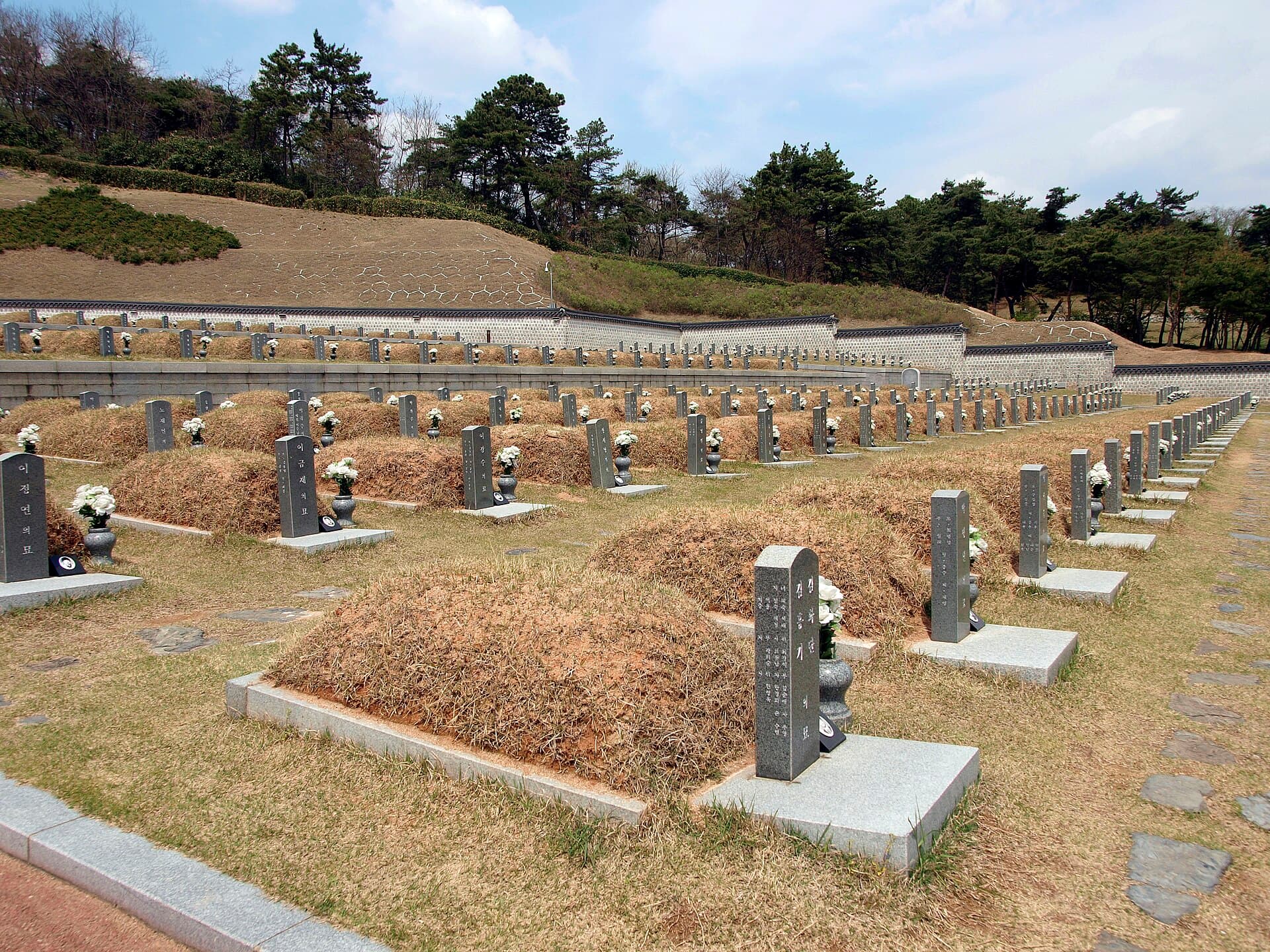
Gwangju is no longer a hidden wound but an institutionalized site of memory. The , inaugurated in its current form in 1997, brings together the graves of the recognized victims. Every May 18, a state ceremony is held there in the presence of the country's highest authorities, including presidents who come to bow before the dead that the state had once had killed. Nearby, the former South Jeolla provincial government headquarters, heart of the Commune's resistance, has been preserved as a memorial.
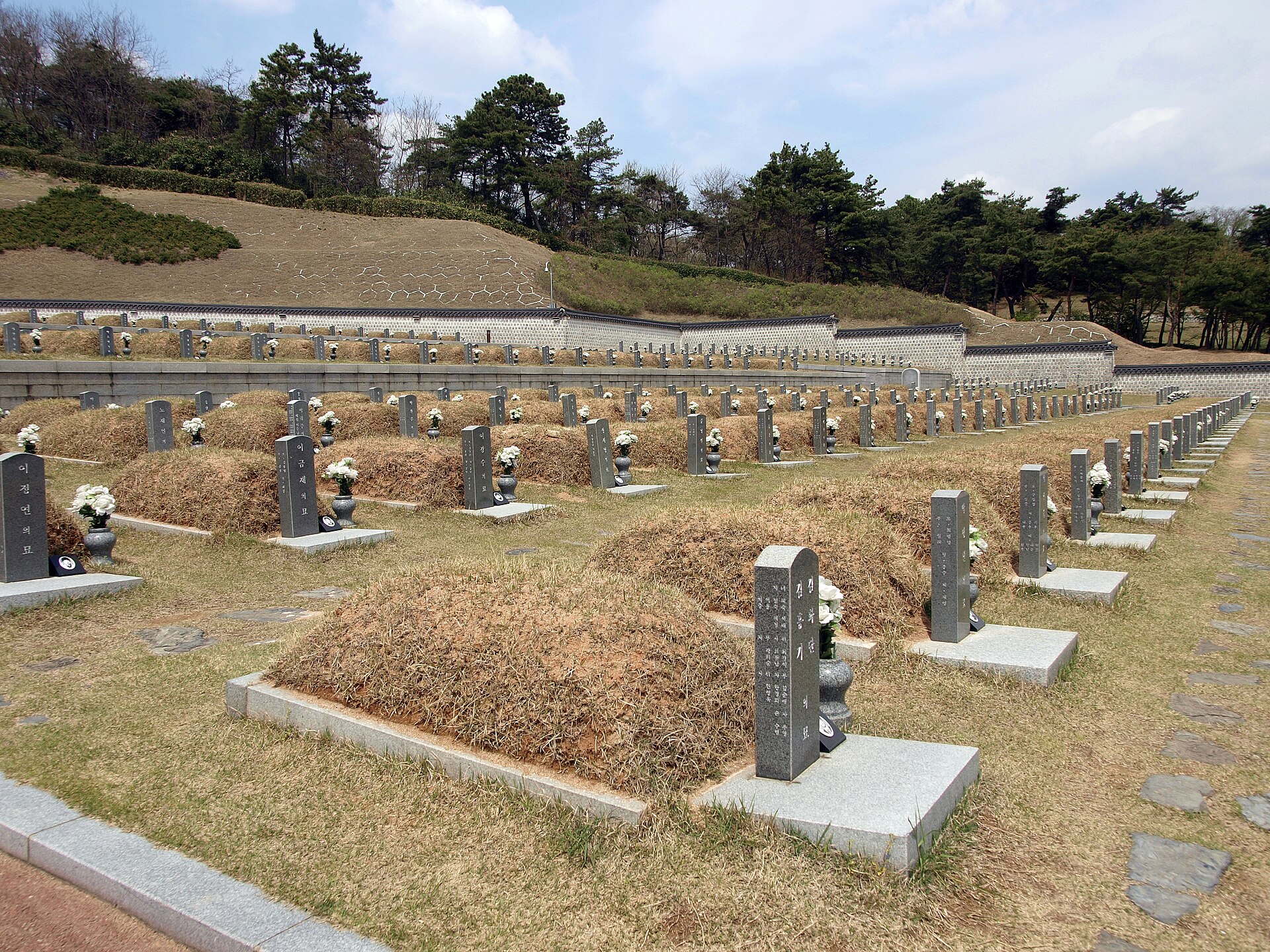
In 2011, the archives of the uprising (administrative documents, court files, journals, photographs, testimonies, filmed footage, and recordings) were inscribed in . This international recognition enshrined Gwangju no longer as a shameful national news item, but as a documentary heritage of humanity on nonviolent resistance and human rights.
Memory also traveled, and perhaps above all, through popular cinema. In 2007, the film 화려한 휴가 (Hwaryeohan hyuga, "Splendid Holiday," the ironic military code name of the crackdown operation) brought the uprising to a wide audience in theaters for the first time. Ten years later, in 2017, 택시운전사 (Taeksi unjeonsa, released as A Taxi Driver) was a huge success: the film follows a Seoul taxi driver who drives the German journalist Hinzpeter to Gwangju, and made the story known to millions of new viewers, in Korea and abroad.
Read alsoHallyu: How the Korean Wave Conquered the WorldThe success of films like A Taxi Driver illustrates the narrative power of Korean cinema, the same craft that carried the hallyu cultural wave to the four corners of the world.
Want to read these names and dates in the original text? Learn 광주 (Gwangju), 민주주의 (minjujuui, democracy), and everyday Korean vocabulary with KoreanSRS (koreansrs.com), coming soon: join the waitlist.
Gwangju's persistence in the Korean imagination is not only historical: it is civic. Each generation draws from it the reminder that South Korean democracy is nothing to be taken for granted. This was measured once again in the winter of 2024, when a brief attempt to impose martial law by those in power immediately revived, in the collective consciousness, the specter of Gwangju, and provoked a swift parliamentary and citizen resistance. The dead city of 1980 continues to watch over the living city of today.
Read alsoChaebols: History, Structure and Succession of Korea's GiantsThe democratization of 1987 accompanied another Korean transformation: the rise of the family-owned industrial giants that made the country a global economic power.
FAQ#
What does "5·18" mean? It is the date the uprising broke out, the 18th of the 5th month (May 18, 1980), read o-il-pal in Korean. In Korea, major events are often designated by their numerical date, like 3·1 (the 1919 independence movement) or 4·19 (the 1960 revolution).
How many people died in Gwangju? The toll remains debated. The military regime announced fewer than 200 dead; estimates from survivors and investigative commissions range from several hundred to around two thousand, including the missing. The concealment of archives and bodies makes any precise figure uncertain.
Who was responsible for the crackdown? General Chun Doo-hwan, the author of the December 1979 coup and the instigator of the May 1980 martial law. Tried in 1996, he was convicted for these acts, then pardoned. He never acknowledged personal responsibility before his death in 2021.
Why is Gwangju so important to Korean democracy? The uprising became the founding cause of the democratic movement. Its memory fed the June Democratic Struggle of 1987, which forced the military regime to accept free elections: the birth certificate of present-day South Korean democracy.
Which films tell the story of the Gwangju Uprising? Two major works: 화려한 휴가 (A Splendid Holiday, 2007) and, above all, 택시운전사 (A Taxi Driver, 2017), an international success recounting the role of a taxi driver and the German journalist Jürgen Hinzpeter.
Photo credits: images in this article come from Wikimedia Commons and are under free licenses.
Gojoseon, Silla, Goryeo, Joseon: Korea's dynasties made clear
Two thousand years in five names: the founding kingdom, the Three Kingdoms, unified Silla, Goryeo which gave the country its name, and Joseon which lasted five centuries.
Cover image: Ulrich Lange · Ulrich Lange, Bochum, Germany / Wikimedia Commons · CC BY-SA 3.0