Chaebols: History, Structure and Succession of Korea's Giants
The anatomy of chaebols: zaibatsu roots, circular shareholdings, low-capital family control and billion-dollar successions at Samsung, Hyundai and LG.
La rédaction Kotoba Interactive
Studio éditorial
One morning in 1961, a general has just seized power in Seoul by military coup. Among his first measures, he orders the arrest of a handful of industrialists accused of amassing illicit fortunes under the previous regime. Then, a few weeks later, he frees them, not to clear their names, but to strike a bargain with them: their wealth will be spared, provided they build the factories the country needs. From this handshake between a dictator and a group of merchants, industrial South Korea was born. The companies they run will bear a name: .
Everyone knows who they are: Samsung, Hyundai, LG, the towers of Gangnam, the intrigues of K-dramas. The question that stays unanswered is more technical and more unsettling: how they work. How does a single family control an empire worth a fifth of the national GDP while sometimes owning only a few percent of its capital? Where does this architecture come from, and why does it survive half a century of reform attempts? To understand it, you have to open the hood: the circular shareholdings, the tens-of-billions inheritances, the powerless antitrust commissions.
The word 재벌 (chaebol, revised romanization jaebeol) combines two Sino-Korean morphemes: and . It maps exactly onto the Japanese 財閥 (zaibatsu), written with the same characters, a lineage that is anything but coincidental.
At the Roots: The Zaibatsu and Park Chung-hee's Choice#
The chaebols descend directly from an imported model: the Japanese . Before 1945, the Korean peninsula was a Japanese colony, and the modern economy taking root there followed the structures of the metropole. In Japan, industry was dominated by a handful of sprawling family conglomerates (Mitsui, Mitsubishi, Sumitomo, Yasuda), organized around a family that controlled, through a cascade of shareholdings, banks, mines, shipyards and trading houses. The word chaebol is not merely the phonetic calque of zaibatsu: it is the same ideogram, the same idea, transplanted.
This kinship also explains one of history's ironies. After the defeat of 1945, the American occupation authorities dismantled the Japanese zaibatsu, judged complicit in the war machine, replacing them with looser networks, the keiretsu. Korea took the opposite path. Freed from colonial rule and then ravaged by the war of 1950-1953, it rebuilt its industry around family conglomerates, at the very moment Japan was unraveling its own.
The decisive turning point is the regime of , in power from 1961 until his assassination in 1979. A military officer trained under Japanese occupation and an admirer of the Japanese industrial model, Park made a bet: rather than scatter scarce capital across thousands of small businesses, the state would concentrate everything (subsidized credit, foreign currency, import licenses, tariff protection) on a small number of "national champions" ordered to export. This doctrine is known as developmental dirigisme. The state picked the winners; the winners obeyed.
The Korean state did not merely regulate the market: it designated the victors in advance, then financed them into dependency. The chaebol is the child of this bargain struck between an authoritarian power and a few ambitious families.
The five-year plans (starting in 1962) set production targets; companies that met them received still more credit, while those that failed were left to die. The apex of this policy was the launched in 1973: steel, chemicals, shipbuilding, electronics, automobiles. It was this plan that pushed Hyundai toward the shipyards of Ulsan and the automobile, Samsung toward semiconductors, POSCO toward steel. The founding families (the Lees of Samsung, the Chungs of Hyundai, the Koos of LG, the Cheys of SK) built in a single generation empires that, even today, bear their clan names.
| Group | Founding family | Historical sector | Founding year |
|---|---|---|---|
| Samsung (삼성, Samseong) | 이 (Lee, romanization I) | Electronics, semiconductors | 1938 |
| Hyundai (현대, Hyeondae) | 정 (Chung, romanization Jeong) | Construction, automobile, shipbuilding | 1947 |
| LG (엘지) | 구 (Koo, romanization Gu) | Chemicals, home appliances | 1947 |
| SK (에스케이) | 최 (Chey, romanization Choe) | Energy, telecoms | 1953 |
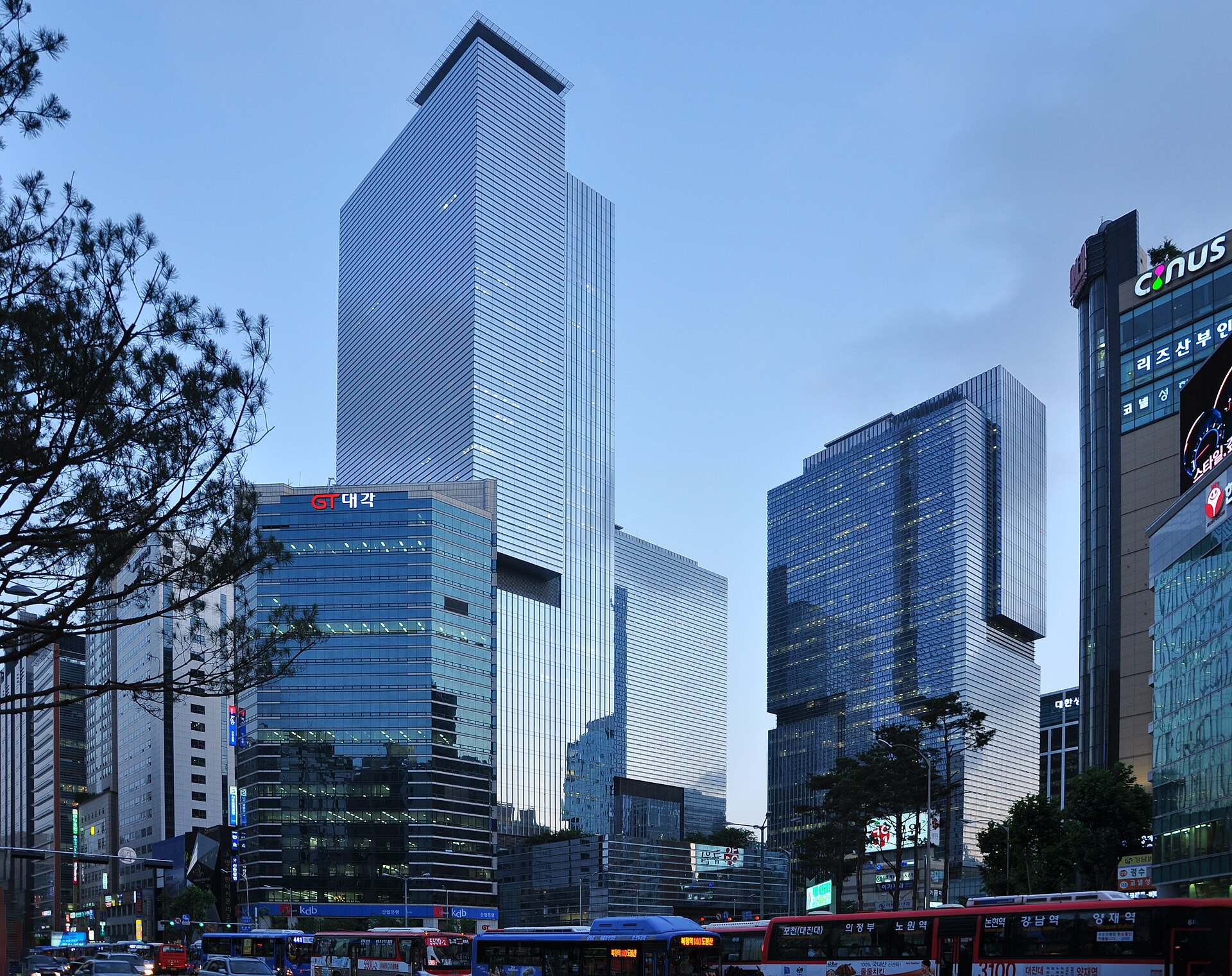
Those four families are not alone. Lotte, founded in 1948 by the Shin family, runs retail, confectionery and hotels across both Korea and Japan. Hanwha covers defence and solar, CJ Group food and cinema, with CJ ENM behind a share of K-pop and Korean film. Doosan builds heavy machinery. Together, the top four alone account for more than half of the country's exports.
That concentration has a concrete consequence in an ordinary life. A Korean can be born in a Samsung hospital, study at a university founded by a group, work for LG, live in a flat built by Hyundai, shop at Lotte and have their funeral arranged by a conglomerate subsidiary. A chaebol is not a company you come across: it is a city inside the city.
The Invisible Mechanics: Circular Shareholdings and Low-Capital Control#
The question that baffles every foreign observer is this: how can a family owning 2 or 3 percent of a group's capital retain absolute control of it? The answer lies in a single mechanism: the , or cross-shareholding. It is the secret heart of chaebol anatomy.
The principle is fearsomely elegant. Imagine three subsidiaries A, B and C. The family owns a stake in A. A owns a stake in B. B owns a stake in C. And C, closing the loop, owns a stake in A. The capital turns in a circle: each company is a shareholder of the next, and the ring closes upon itself. The family, by controlling just one low-value link, effectively holds the entire chain, because the subsidiaries' votes follow the founder's voice. Economists speak of a control leverage effect: a few percent of real capital command tens of percent of effective voting rights.
literally means "investment in circulation": sunhwan (循環, "cycle," "circulation") and chulja (出資, "capital contribution"). The related term designates simple cross-shareholding, reciprocal between two companies, banned under Korean law, which is why groups prefer the circular arrangement with three links or more.
The difference is legal: a direct cross-shareholding A↔B has been prohibited since 1987, but a ring A→B→C→A remained legal for a long time. The chaebols therefore lengthened their chains to skirt the ban.
Above these rings, some groups have adopted a holding-company structure (지주회사, jiju hoesa): a single parent company sits atop the subsidiaries, which is more legible for the markets. LG pioneered this conversion as early as 2003, and SK followed. But the holding company does not dissolve family power: on the contrary, it concentrates it in a single key company, in which the family keeps the majority. Samsung, long reluctant, relied instead on a linchpin, , and on the stakes held by Samsung Life Insurance in Samsung Electronics, to lock down the chain of control.
Here lies the structural controversy. The founder and his family collect the dividends and wield the power of an owner, while bearing only a fraction of the real financial risk, the rest being carried by minority shareholders often shortchanged in internal restructurings. Economists call this gap tunneling: value is quietly transferred from listed subsidiaries, where the public owns capital, toward the companies where the family holds the majority. Every mispriced merger, every dubious sale price between subsidiaries is an opportunity to slide wealth toward the clan.
These mechanisms read differently in their original language: 재벌 (jaebeol, chaebol, the family conglomerate), 순환출자 (sunhwan chulja, circular shareholding) and 지주회사 (jiju hoesa, holding company). With KoreanSRS, spaced repetition will fix this vocabulary of the Korean economy in your memory, hangeul included.
Succession: Passing On an Empire Without Selling It#
Passing a chaebol from one generation to the next is the most perilous problem in the entire system, and the most revealing of its flaws. South Korea applies one of the heaviest inheritance taxes in the world: up to 50 percent of an estate's value, and even 60 percent for the transfer of a large company's controlling shares, once the so-called "management" premium is applied. For a dynasty that already holds only a thin slice of capital, a tax bill of this magnitude threatens control itself: paying the tax may force a sale of shares, and thus a dilution of the family.
Samsung: The Lee Family's Inheritance and Its Record Bill#
The textbook case is the death of , chairman of Samsung and long the richest man in Korea. On his death in October 2020, his heirs, including his son , faced inheritance taxes estimated at around 12 trillion won, or more than 10 billion dollars: the largest estate bill in Korean history, and one of the heaviest ever recorded anywhere in the world. The family secured a six-year installment plan, sold stakes, took out loans pledged against its shares, and donated part of the deceased's art collection to the state to lighten the bill. Paying without losing control: that is the balancing act every chaebol succession must pull off.
It is precisely the fear of succession dilution that fueled the group's most contested maneuvers. The 2015 merger between Samsung C&T and Cheil Industries, approved at a ratio deemed unfavorable to C&T's minority shareholders, had the mechanical effect of strengthening Lee Jae-yong's position in the chain of control ahead of the succession. The scandal that followed, tangled with the political corruption affair of 2016, earned the heir a conviction and then a presidential pardon: a perfect illustration of the chaebol-state-justice triangle.
In a chaebol, inheritance tax is not an accounting constraint: it is an existential threat to the dynasty. The group's entire financial engineering converges on a single question: how to pass the baton without letting go of the reins.
Hyundai (2000), LG and GS: When the Family Splits#
Not all successions are settled by taxation: some are settled by division. In 2000, the Hyundai group was rocked by the , the open struggle among the sons of founder over his succession. The clash tore the empire apart: the group split into separate entities, including Hyundai Motor Group (which went to Chung Mong-koo), Hyundai Heavy Industries, and the original Hyundai group reduced to a shadow of itself. What had been a single conglomerate became a constellation of groups bearing the same name but rivals to one another.
Family division can also happen amicably and give birth to a new chaebol. In 2005, the LG group (founded by the Koo family) split off part of its businesses to the allied Huh family, associated with the Koos from the very beginning: thus was born GS Group (retail, energy, construction). This "separation" (계열분리, gyeyeol bulli) shows that clan logic trumps firm logic: when two lineages can no longer coexist, the empire is carved up along bloodlines, not along industrial rationale.
Reforming the Unreformable: Antitrust, Gapjil and Today's Debate#
Since the 1980s, every Korean government has promised to clean up chaebol governance, and each has run into the same wall. The main instrument is the , created in 1981 and tasked with enforcing antitrust law. It was this body that, in 1987, banned direct cross-shareholdings; it caps investments between subsidiaries, publishes each year the official list of groups placed under surveillance, and hunts down value transfers within the empires.
Its weapons remain blunt, however. The Asian financial crisis of 1997-1998 was the most brutal shock: several over-indebted chaebols collapsed, including the giant Daewoo in 1999, whose founder Kim Woo-choong fled abroad. The IMF imposed reforms: debt reduction, accounting transparency, protection of minority shareholders. But as soon as the recovery came, old habits returned: the shareholding rings reformed, lengthened to stay legal.
To the financial structure is added a cultural and social dimension, summed up in a word that has become taboo: . It denotes the abuse of power of the strong over their subordinates: the gap (갑, the strong party in a contract) crushing the eul (을, the weak party).
갑질 (gapjil) combines , which in a contract designates the dominant party (the principal) and the suffix 질 (jil), which marks reprehensible conduct (as in geojitmal-jil, "lying"). The word therefore means "to behave as a gap," to abuse a power imbalance. It took hold in public debate after several resounding scandals involving chaebol heirs.
The emblematic case is the of 2014: a vice president of Korean Air, daughter of the Hanjin group's chairman, ordered a plane to turn around on the tarmac in New York because she had been served macadamia nuts in a bag rather than on a plate. The episode, mocked worldwide, crystallized Korean anger against the arrogance of the industrial dynasties and made gapjil a political issue.
Want to decode these words, 재벌 (chaebol), 순환출자, 갑질, in the original text? KoreanSRS (koreansrs.com) opens soon: join the waitlist to learn hangeul and the vocabulary of the Korean economy.
The contemporary debate pits two visions against each other. For the chaebols' defenders, these groups remain the country's export engine: Samsung Electronics alone accounts for an outsized share of national exports and R&D, and dismantling the empires would amount to scuttling Korean competitiveness against China. For their critics, this concentration stifles start-ups, locks up social mobility and perpetuates a caste. A younger generation, the MZ세대 (millennials and Gen Z), regards these dynasties with a new distance, less enthralled by a lifetime job at Samsung than their elders were.
To understand the anatomy of a chaebol is to grasp a founding paradox: a structure designed for collective industrial performance ended up serving the perpetuation of a few families. Korea built its miracle on this ambiguity, and it still has not decided whether it wants to correct it or preserve it.
That omnipresence turned the chaebol into a fictional character in its own right. The arrogant conglomerate heir falling for a girl of modest means became a k-drama cliché, from Boys Over Flowers to The Heirs. Cinema uses it differently: Parasite, by Bong Joon-ho, Palme d'Or in 2019, sets two families against each other in a Korea where social mobility has stalled. Gapjil is not only a word from the business pages, it is a plot device.
Read alsoThe Japanese Occupation of Korea (1910-1945)The colonial DNA of the chaebols comes from there: it was under Japanese occupation that the zaibatsu model took root in the peninsula, before being reborn under the name chaebol.
Chaebol hierarchy does not stop at the office: the hoesik, that near-mandatory company dinner, extends the gap/eul relationship all the way to the glasses of soju.
FAQ#
What is the difference between a chaebol and a Japanese zaibatsu? Both words are written with the same ideograms (財閥) and designate family conglomerates. But the zaibatsu were dismantled by the American occupation after 1945, whereas Korea, on the contrary, strengthened its chaebols to rebuild its economy from the 1960s onward.
How does a family control a chaebol with little capital? Through circular shareholdings (순환출자): the subsidiaries hold stakes in one another in a loop. By controlling a single link, the family commands the entire chain of votes, wielding power far greater than its real share of the capital.
Why did the Samsung inheritance trigger a record tax bill? On the death of Lee Kun-hee in 2020, his heirs had to pay around 12 trillion won (more than 10 billion dollars) in inheritance taxes, because Korea taxes the transfer of controlling shares at up to 60 percent. They spread it over six years by selling shares and donating an art collection to the state.
What is gapjil? Gapjil (갑질) denotes the abuse of power of the strong party (gap) over the weak party (eul). Popularized by scandals such as the 2014 "nut rage" at Korean Air, it symbolizes the perceived arrogance of chaebol heirs and fuels the debate over their reform.
Can the chaebols really be reformed? The Fair Trade Commission (created in 1981) oversees shareholdings and antitrust, and the 1997 crisis imposed reforms. But the groups routinely circumvent the rules by lengthening their shareholding chains, and their economic weight makes any radical reform politically risky.
Photo credits: images in this article come from Wikimedia Commons and are under free licenses.
K-pop for export: YouTube, song camps and cultural policy
Three concrete cogs behind K-pop's export: distribution through YouTube, the song camps where foreign writers build the hits, and state support.
Cover image: Ox1997cow · Ox1997cow, via Wikimedia Commons · CC BY 3.0