Samulnori: when four drums become a storm
History and meaning of samulnori, Korean percussion: four instruments, the peasant roots of pungmul, cosmic symbolism and the move from street to stage.
La rédaction Kotoba Interactive
Studio éditorial
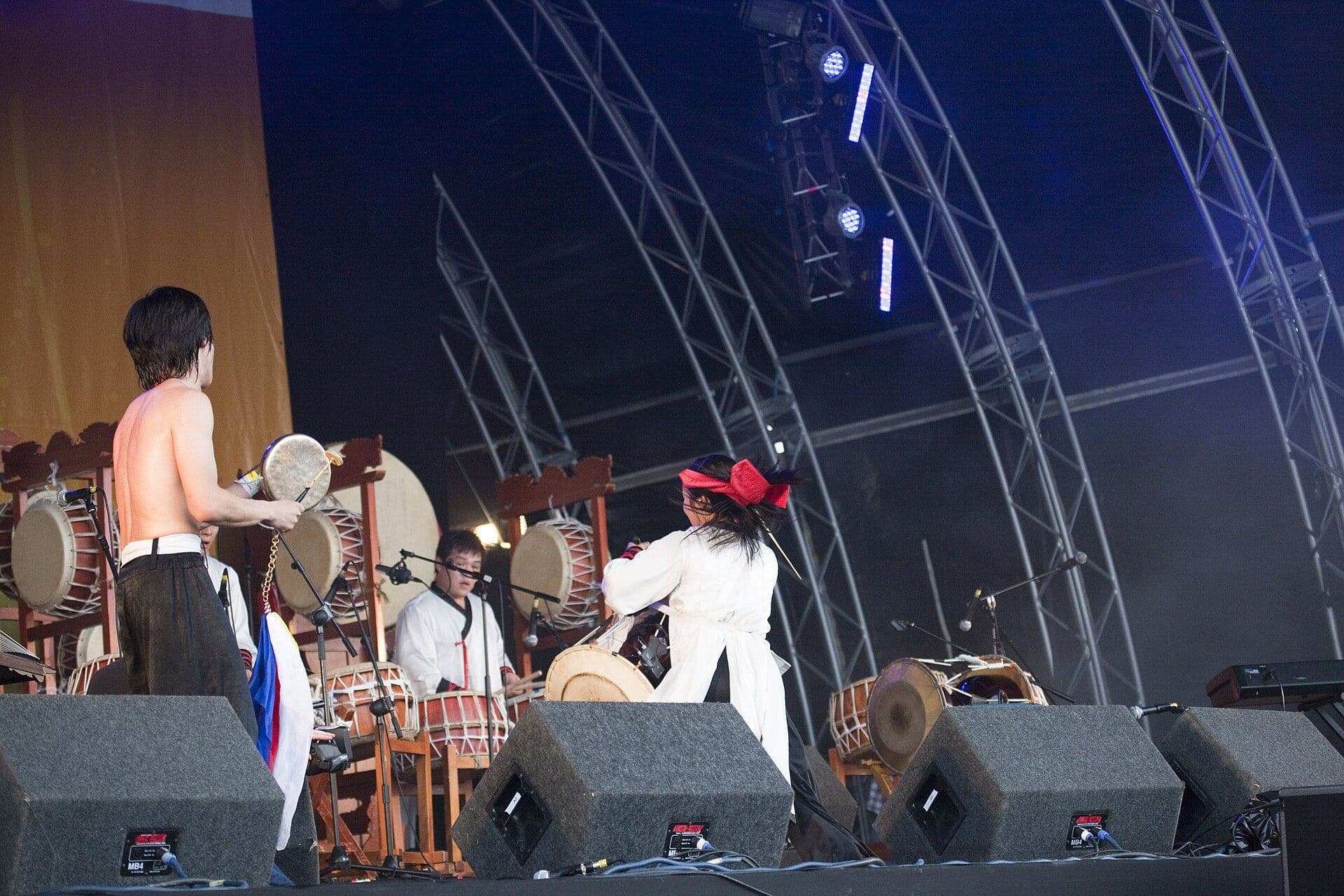
A sharp stroke of a small gong tears the silence, like a lightning bolt. At once it is answered by the rumble of a large gong, the gallop of an hourglass drum and the round beat of a barrel drum. Four musicians, seated or standing, drive the rhythm to dizziness, accelerate it, suspend it, relaunch it. In a few minutes, four percussion instruments have conjured a whole storm. This is samulnori.
is a Korean percussion ensemble that, in a few decades, has become one of the most recognisable faces of Korea's traditional music. Four instruments, four elements, pure energy: behind its stage intensity hides an art deeply rooted in Korean peasant culture and cosmology. To understand it is to hear the rhythmic heart of the peninsula beat.
Four instruments, one tempest#
The name of samulnori says its structure: four instruments, all percussion, which converse in a tight rhythmic weave. The , a small metal gong with a piercing sound, leads the dance and gives the signals. The , a large gong with a deep and long resonance, lays down the background pulse. The , an hourglass-shaped drum struck on both sides, weaves the most complex patterns. The , a barrel drum, provides the round and low beat.
| Instrument | Type | Element symbolized | Rhythmic role |
|---|---|---|---|
| 꽹과리 (kkwaenggwari) | Small metal gong | Lightning | Leads and gives the signals |
| 징 (jing) | Large gong | Wind | Lays down the background pulse |
| 장구 (janggu) | Hourglass drum | Rain | Weaves the complex patterns |
| 북 (buk) | Barrel drum | Clouds | Provides the low beat |
From this combination is born a music of striking intensity, made of accelerations, tensions and releases. Samulnori does not unfold a melody: it builds an architecture of rhythms that overlap, answer one another and culminate in finales of overflowing energy.
Samulnori does not play a melody: it plays the rhythm itself, until the four percussion instruments become one.
The elements of the sky#
The power of samulnori is not only musical: it is also symbolic. According to a traditional reading, each of the four instruments embodies a natural phenomenon. The kkwaenggwari, quick and sharp, figures the lightning; the jing, vast and sustained, evokes the wind; the janggu, sparkling and changing, represents the rain; the buk, deep and steady, suggests the clouds.
The word 사물놀이 (samulnori) is made up of samul (사물), "the four objects" or "the four things," and nori (놀이), "the game, the entertainment." Literally "the play of the four objects," the name designates both the four instruments and the playful, festive spirit that animates this music.
Thus, to play samulnori is in a way to re-enact a storm: the lightning calls the wind, the wind the rain, and all settles down beneath the clouds. This cosmic dimension links the music to the old agrarian rites, where rhythm served to call forth the good season.
Samulnori sticks first through its names: 꽹과리 (kkwaenggwari, the small leading gong), 장구 (janggu, the hourglass drum) and 놀이 (nori, play, festivity). With KoreanSRS and its spaced repetition, learn Korean to lock in this vocabulary and hear the culture behind every beat.
From the fields to the stage#
If samulnori seems ancestral, it is in reality a recent creation. It was born in 1978, when a group of musicians led by Kim Duk-soo brought to the stage, in a condensed and virtuosic form, a much older tradition: , also called , the percussion music of Korean peasants.
Pungmul, for its part, was played in the open air: in villages, at festivals and during fieldwork, troupes of musicians and dancers paraded in a circle, blending percussion, dances and acrobatics to give rhythm to collective work and drive out evil spirits. Samulnori extracted from this mobile and festive tradition its pure rhythmic core, to present it, seated, before a concert audience.
Read alsoPansori: Korea's opera of a single breathSamulnori is the art of rhythm and percussion; pansori, that of the voice and the sung narrative. To discover the other great tradition of the Korean stage, explore pansori.
A worldwide success#
In a few decades, samulnori has conquered the world. Its immediate power, its virtuosity and its universality (rhythm speaks to everyone) have made it an ambassador of Korean culture on the international stages, where it performs, is taught and inspires even musicians from other horizons. Born of a peasant tradition, it has become a recognised concert art.
From the rice paddies to the concert halls, samulnori has managed to transform the rhythm of the fields into pure stage thrill without losing any of its soul. To discover it is to feel physically the pulse of Korea, and to learn Korean is to be able to name each instrument, understand why four percussion instruments tell of a storm and grasp the spirit of "play" hidden in its name.
FAQ#
What is samulnori? Samulnori (사물놀이) is a Korean percussion ensemble made up of four instruments: the kkwaenggwari (small gong), the jing (large gong), the janggu (hourglass drum) and the buk (barrel drum). It is an intense rhythmic music, created in 1978 from peasant traditions.
What does the word samulnori mean? It is made up of samul (사물), "the four objects," and nori (놀이), "the game": literally "the play of the four objects." The name designates the four percussion instruments and the festive spirit of this music.
What is the difference between samulnori and pungmul? Pungmul (or nongak) is the traditional peasant percussion music, played in the open air with dances and parades. Samulnori, created in 1978, is a condensed stage form for four seated musicians, intended for the concert stage.
What do the four instruments symbolise? According to a traditional reading, each instrument embodies a natural phenomenon: the kkwaenggwari the lightning, the jing the wind, the janggu the rain and the buk the clouds. To play samulnori amounts to recreating a storm in music.
Photo credits: the images used in this article come from Pexels and Unsplash and are royalty-free.
K-indie: Korea's alternative scene, from Hongdae to Spotify
Crying Nut, Jang Kiha, Hyukoh, wave to earth, Parannoul: the story of Korea's independent scene, its clubs, its labels and its way out through abroad.
Cover image: William Murphy from Dublin, Ireland · William Murphy from Dublin, Ireland, via Wikimedia Commons · CC BY-SA 2.0