Naicha: how bubble tea became a generational obsession in China
From Taiwanese milk tea to the naicha phenomenon in mainland China: Heytea, Nayuki, three-hour queues and the sociology of a drink turned lifestyle.
La rédaction Kotoba
Studio éditorial
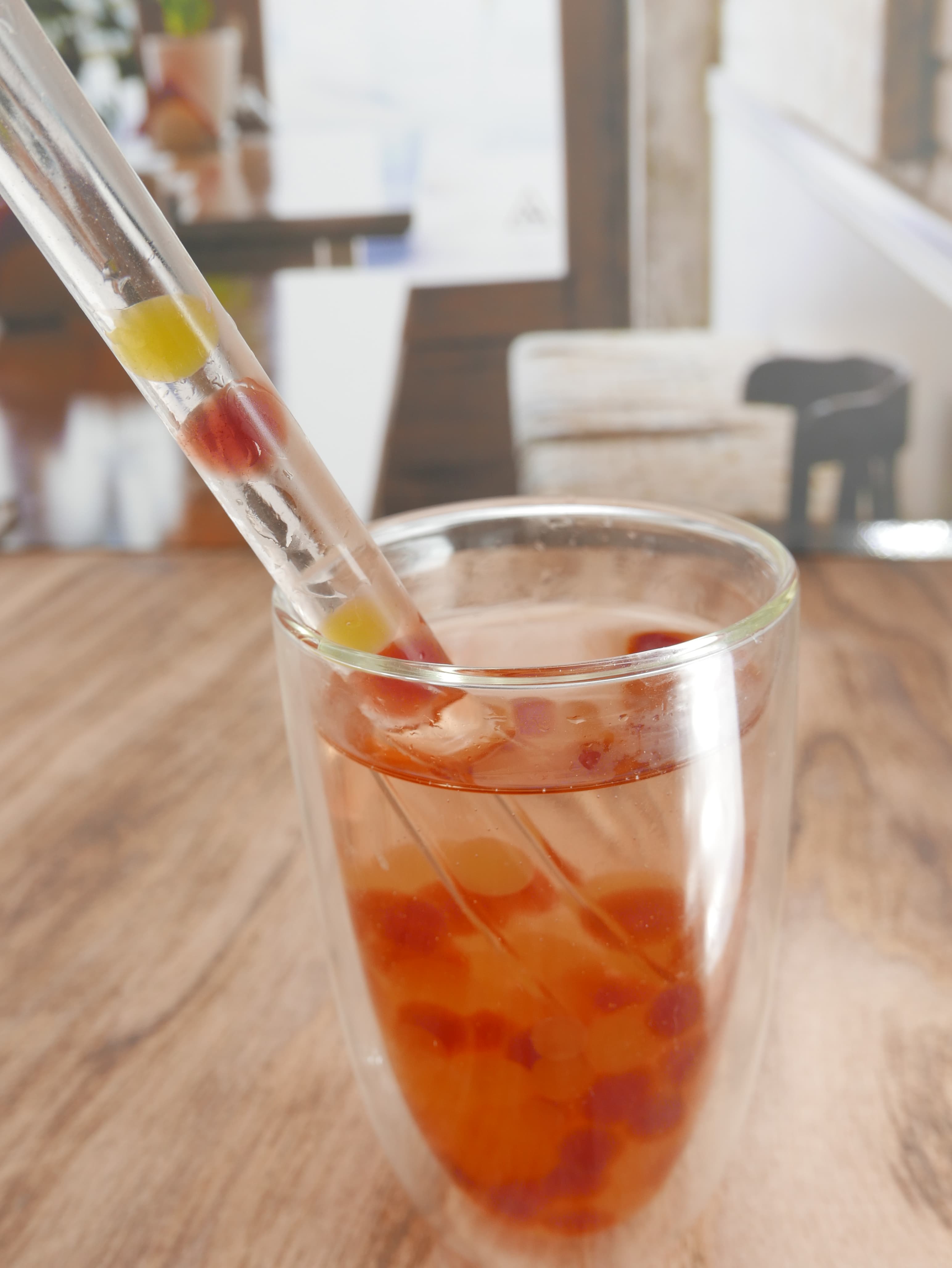
There is a scene you will see in any Chinese city, at any time of day: a queue in front of a pastel-coloured shop, young people scrolling on their phones, waiting twenty, thirty, sometimes sixty minutes for a single drink. Not a coffee. Not a juice. A — a milk tea, often topped with tapioca pearls, jelly, whipped cream or toppings whose variety sometimes defies imagination.
Bubble tea is not new. But what has been happening in China over the past ten years goes beyond a simple food trend. It is a cultural, economic and social phenomenon that has turned a Taiwanese street-stand drink into a multi-billion dollar industry — and a generational identity marker.
The origins: Taiwan, 1980s#
The history of bubble tea begins in Taiwan in the 1980s, and even there, nobody quite agrees on who invented it.
Two tea houses dispute the paternity: in Taichung, whose product director Lin Hsiu Hui (林秀慧) claims to have had the idea of pouring tapioca pearls into iced tea in 1988; and in Tainan, which claims an earlier date. The legal battle lasted years and concluded without a definitive winner.
奶茶 (nǎichá): 奶 (nǎi) means "milk"; 茶 (chá), "tea." The term is generic in mainland China and designates any drink based on tea and milk, with or without pearls. The word 珍珠奶茶 (zhēnzhū nǎichá, "pearl milk tea") is more specific and refers to classic bubble tea with tapioca balls.
What is certain is that the original recipe was simple: brewed black tea, milk (or condensed milk), sugar, and — those black, chewy balls you suck up through an oversized straw. The drink conquered Taiwan, then Southeast Asia, then the Asian neighbourhoods of major Western cities.
But the revolution was led by mainland China.
The explosion: Heytea and the birth of premium tea#
Until the early 2010s, naicha in China was mostly industrial powders mixed with hot water in plastic cups, sold for one or two yuan on street corners. No real tea. No real milk. No pretension. Just a sweet, cheap, comforting drink.
Everything changed with .
Founded in 2012 by Nie Yunchen (聂云宸), then twenty-one years old, in the small city of Jiangmen in Guangdong, Heytea made a bet that nobody found obvious: use real quality tea — oolong, pu'er, jasmine green tea — as a base, add a salty-sweet on top, and sell the whole thing at three to five times the price of street naicha.
The result was a tidal wave. Queues outside Heytea shops reached absurd lengths — three hours in Shanghai for certain store openings. Resellers bought drinks to flip them on the adjacent pavement. Chinese social media erupted: every new Heytea product became an event, every shop a photographic pilgrimage site.
, founded in 2015, followed a parallel trajectory, adding European pastries and targeting urban female customers. The company became the first premium tea chain to go public, on the Hong Kong Stock Exchange, in 2021.
The naicha economy: staggering numbers#
The ready-to-drink tea market in China now exceeds one hundred billion yuan (around thirteen billion euros). There are more than five hundred thousand naicha outlets in the country — more than all the Starbucks in the world combined.
The chains number in the dozens: Heytea, Nayuki, for the budget segment, for pure tea without excess sugar, , , . Each has its positioning, its aesthetic, its clientele.
The most spectacular phenomenon is Mixue Bingcheng, whose snowman mascot has become an internet meme. With over thirty-six thousand outlets, it is the world's largest beverage chain — ahead of Starbucks. Its secret: unbeatable prices (a naicha for four yuan, about fifty euro cents) made possible by total vertical integration, from tea cultivation to cup manufacturing.
Sociology of the cup: why naicha is more than a drink#
Naicha is not tea. Not really. It is a social object.
Ordering a naicha is first an act of personalisation. The customer chooses the type of tea, the sugar level (全糖, 七分, 五分, 三分, 无糖 — from "full sugar" to "no sugar"), the ice level, the toppings (pearls, coconut jelly, pudding, red beans, taro, cheese foam...). Each order is unique. It is a small act of sovereignty in an office-bound day.
It is then a gesture of social connection. In China, buying someone a naicha is a code: it says "I'm thinking of you" without the weight of a formal gift. Chinese offices run on group naicha orders — someone launches the order on the WeChat group, everyone sends their specifications, and the Meituan driver drops fifteen cups at the reception desk twenty minutes later. Naicha is the new water-cooler coffee, except it comes to you.
It is finally an aesthetic marker. The cups are designed to be photographed. Collaborations with fashion brands, artists and video game franchises produce limited editions whose designs are collected. Heytea x Fendi. Nayuki x teamLab. Chagee with its motifs inspired by traditional Chinese painting. The cup in hand is an accessory, on par with a bag or a pair of trainers.
Sugar, health and the debate#
The success of naicha is not without controversy. A standard naicha with full sugar and toppings can contain between four hundred and seven hundred calories and the equivalent of fifteen to twenty sugar cubes. In 2022, Shanghai's consumer association published a study that went viral on social media: some tested drinks contained more sugar than a litre of Coca-Cola.
The industry responded quickly. Chains promoted reduced-sugar options, developed ranges based on pure tea without milk or added sugar, and some — like Chagee — built their entire identity around "healthy tea." The 无糖 (wú táng, "no sugar") option has become the most common order among educated urban consumers — although "no sugar" does not always mean zero calories, since the toppings carry their own glycaemic load.
The government has also acted. Since 2024, naicha chains in several provinces are required to display the calorie count and sugar content of each drink, similar to food nutrition labels. Naicha has become, almost despite itself, the battleground of a public health debate.
Naicha goes global: worldwide conquest#
Chinese naicha chains have begun expanding abroad with an ambition reminiscent of Starbucks in the 2000s. Mixue Bingcheng has opened thousands of shops across Southeast Asia — Indonesia, Vietnam, Thailand, the Philippines. Heytea and Chagee are targeting Europe and the United States. In London, New York, Paris and Sydney, Chinese tea brands now sit alongside third-wave coffee shops and artisan bakeries.
The challenge is cultural as much as logistical. Western palates are different: taro, red bean and cheese foam bewilder the uninitiated. The chains adapt their menus, add familiar flavours (mango, strawberry, matcha), but keep the signature toppings — tapioca pearls, above all, have become universal.
What perhaps exports best is the ritual: the idea that a drink can be personalised endlessly, that it can be beautiful before it is consumed, that it can be shared as a gesture of care. Naicha, in that sense, is not a product: it is a way of living.
FAQ#
What is the difference between bubble tea and naicha? Bubble tea (珍珠奶茶) specifically refers to milk tea with tapioca pearls, a Taiwanese invention from the 1980s. Naicha (奶茶) is a broader term encompassing any tea-and-milk drink, with or without pearls, with or without toppings. In mainland China, people more commonly say naicha.
Why are the queues so long? Several reasons: drinks are made to order with fresh ingredients, the customisation options slow down the production chain, and scarcity effects (limited editions, new openings) create surges in demand. It is also a social phenomenon: the queue is part of the experience.
Is naicha really tea? Premium chains (Heytea, Chagee, Nayuki) use real brewed tea — oolong, pu'er, jasmine green tea. Budget chains sometimes use powders or extracts. Asking about the tea base is a good quality indicator.
Can you order a naicha without sugar? Yes, and it is increasingly common. Most chains offer five sugar levels. Be aware, though, that toppings (pearls, pudding, jelly) contain sugar themselves. For a truly light naicha, choose "no sugar" and "no toppings" — or go for a pure tea at Chagee.
Xiaolongbao: the soup dumplings that conquered the world from Shanghai
The complete history of xiaolongbao (小笼包): origins in Nanxiang, the gelatin technique, the ritual 18 pleats, Din Tai Fung and the global rise of Shanghai's most iconic dumpling.
Cover image: Coldsea.eu · Wikimedia Commons · CC BY-SA 4.0