Hanfu: the spectacular return of traditional Chinese clothing
The hanfu movement in China: how millions of young Chinese have revived Han traditional dress, between cultural pride, social media and the fashion industry.
La rédaction Kotoba
Studio éditorial
An ordinary Sunday in the Beigongmen area of Beijing, near the Summer Palace. A young woman crosses the Seventeen-Arch Bridge in a wide-sleeved robe, silk sash tied high under the chest, pleated skirt brushing the ground. She is not a film extra. She is not a cosplayer. She is a computer science student who has chosen to spend her Sunday in — the traditional clothing of the Han ethnic group.
She is not alone. Around her, ten, twenty, fifty people wear similar outfits: cross-collared robes, straight-collar tunics, elaborate hairstyles adorned with fabric flowers and golden pins. They photograph each other, adjust a fold, laugh, exchange tips about fabric suppliers on Taobao. The scene repeats every weekend in the parks, temples and historic districts of every major Chinese city.
The hanfu movement is one of the most remarkable cultural phenomena in contemporary China. In twenty years, it has gone from the pet project of a few online enthusiasts to a multi-billion yuan market, supported by the state, celebrated on social media and carried by a generation that refuses to choose between modernity and tradition.
What is hanfu?#
The term literally means "clothing of the Han" — the majority ethnic group in China, representing approximately ninety-two per cent of the population. It designates the traditional garments worn by the Han from the Shang dynasty (around 1600 BCE) to the end of the Ming dynasty (1644).
汉服 (hànfú): 汉 (hàn), the Han people, China's majority ethnicity; 服 (fú), "clothing, garment." Hanfu is not a single costume but a family of garments that evolved over three millennia, with distinct forms for each dynasty.
The basic structure is remarkably constant despite the centuries: a garment with a , fastened right over left (右衽, yòurèn), with wide sleeves and a or marking the waist. The principle is one of draping rather than tailored fit: the fabric wraps the body without constraining it, creating a fluid, ample silhouette.
Forms vary considerably across dynasties:
-
The of the Han and Tang dynasties: a short tunic worn with a high-waisted skirt, sometimes tied under the chest. This is the most popular form in the current movement, especially the Tang version with its vivid colours and floral patterns.
-
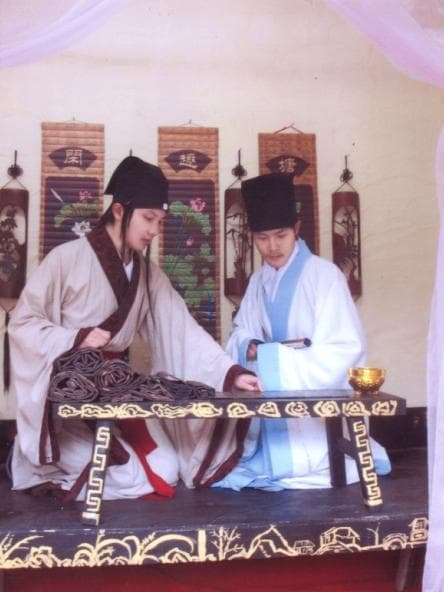
The : a single-piece garment wrapping the entire body, worn by scholars and officials since the Zhou dynasty. Sober, elegant, considered the archetype of formal hanfu.
-
The of the Song dynasty: an open-fronted jacket worn over a tunic, with a restrained elegance reflecting Song aesthetics — what art historians consider the pinnacle of Chinese refinement.
-
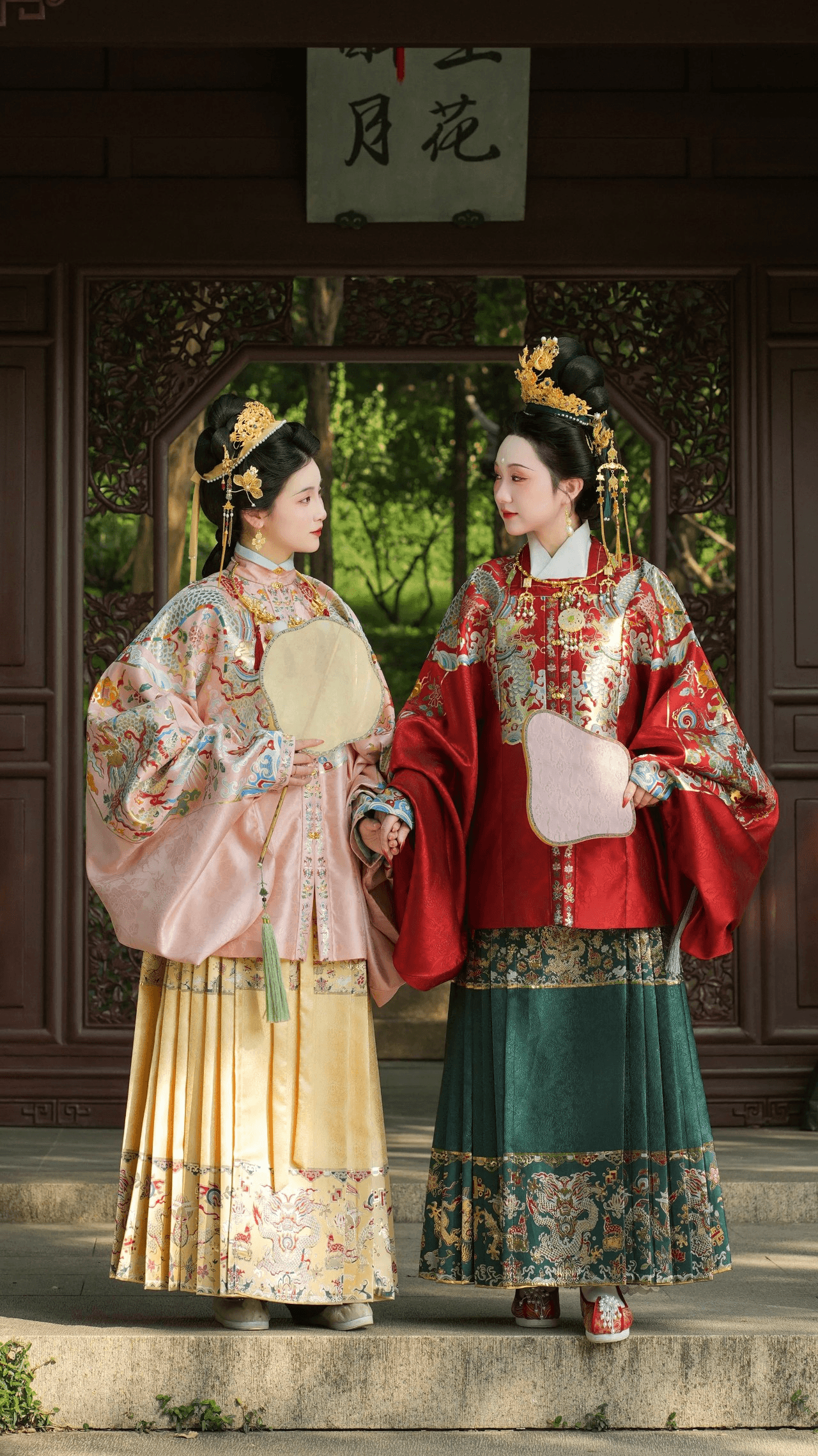
The of the Ming dynasty: a straight-collar jacket with a pleated skirt, more structured and colourful than its predecessors. Often embroidered with auspicious motifs — cranes, peonies, clouds.
The 1644 rupture: why hanfu disappeared#
To understand the current movement, you need to understand why hanfu disappeared in the first place.
In 1644, the Manchus — a people from northeastern China — overthrew the Ming dynasty and founded the . One of their first acts was the Tifayifu decree (剃发易服): "Shave the hair, change the clothes." Han men had to adopt the Manchu hairstyle — the front of the head shaved with a queue at the back — and abandon hanfu in favour of Manchu garments: the and the .
Resistance was brutal, and repression even more so. The slogan of the era captures the terror: 留头不留发,留发不留头 (liú tóu bù liú fà, liú fà bù liú tóu) — "Keep the head, not the hair; keep the hair, not the head." Massacres followed in cities that refused the edict. Within a few decades, hanfu vanished from daily life. The , the garment that would become emblematic of the "Chinese dress" in Western eyes, is an evolution of the Manchu costume, not hanfu.
For three and a half centuries, hanfu existed only in ancient paintings, traditional operas and the fragmentary memory of classical texts.
The renaissance: from an internet forum to a mass movement#
On 22 November 2003, a man named walked through the streets of Zhengzhou, in Henan province, wearing a hanfu he had made himself. Photos were taken and posted online. Reactions were mixed: curiosity, mockery, a few impassioned comments about Han cultural pride.
This moment is generally considered the starting point of the modern hanfu movement. In the years that followed, communities formed on Chinese forums — , then — around historical research, textile reconstruction and daily hanfu-wearing. The first enthusiasts were amateur scholars, often students of history or sinology, who dug through ancient sources to recover patterns, dyeing techniques and wearing conventions.
The movement remained marginal for a decade. Wearing hanfu on the street in 2008 meant exposing yourself to puzzled stares, questions ("Is that a kimono?", "Are you in a film?") and sometimes hostility from passers-by who saw it as a rejection of modernity.
The tipping point came between 2017 and 2019, driven by three converging forces:
Visual social media. The rise of and gave hanfu the perfect medium: short videos showing the garment in motion, filmed in natural or historical settings, set to remixed traditional music. Creators like and Huo Wanqing amassed millions of followers by posting "hanfu transformation" videos — the switch from modern clothes to a full traditional ensemble, hairstyle included, in a few seconds of editing.
The guochao movement. is a broader cultural trend that valorises Chinese products, aesthetics and references. Li-Ning, the sportswear brand, led the way by integrating traditional embroidery motifs into its trainers. Hanfu fits into this wave: wearing ancient clothing is a way to assert cultural identity in a globalised world.
Institutional support. The Chinese government, which promotes "cultural confidence" (文化自信, wénhuà zìxìn), sees hanfu as a vehicle for soft power and national cohesion. Official events incorporate hanfu parades. The , set on the third day of the third lunar month, is celebrated in hundreds of cities with gatherings, competitions and markets.
The industry: from craft to mass market#
The hanfu market in China is estimated at over fifteen billion yuan (around two billion euros). More than five million people regularly buy hanfu pieces, with the figure growing by twenty to thirty per cent annually.
The supply covers every segment. At the entry level, complete sets are available on Taobao and Pinduoduo from fifty yuan (six euros) — pieces in printed polyester, mass-produced in Zhejiang workshops. Mid-range brands like , a movement pioneer, or offer pieces in real silk with gold-thread embroidery, between five hundred and three thousand yuan.
At the top end, hanfu haute couture ateliers create bespoke pieces that can exceed fifty thousand yuan. These ceremonial robes, often commissioned for weddings or photoshoots, use traditional textile techniques: Suzhou su embroidery (苏绣), indigo dyeing, Nanjing yunjin weaving (云锦, "cloud brocade"), classified as UNESCO Intangible Cultural Heritage.
Wearing hanfu: between reconstruction and freedom#
The hanfu movement is shaped by a debate that has structured it since its origins: should hanfu be worn in a historically exact manner, or can it be freely reinterpreted?
The purists (considered the first wave of the movement) insist on the accuracy of cuts, colours and accessories. A Tang ruqun must have the proportions documented in the Dunhuang frescoes. Colours must correspond to pigments available at the time. Hair must be styled according to patterns attested by funerary figurines (俑, yǒng).
The modernists believe hanfu is a living garment, not a museum piece. They mix dynasties, combine hanfu with contemporary elements (trainers, handbags, sunglasses), create hybrid forms that never existed historically but are wearable in everyday life. — pieces that preserve the spirit of hanfu (cross collar, wide sleeves, sash) but with simplified cuts and modern fastenings — now accounts for the majority of sales.
Between the two, a consensus is emerging: the beauty of hanfu lies in its principles (the draping, the fluidity, the relationship with the body) rather than in reproducing a fixed model. Hanfu is not a period costume: it is a sartorial vocabulary that everyone can conjugate in their own way.
What hanfu says about contemporary China#
The hanfu movement is not just about fashion. It crystallises deep questions about Chinese identity in the twenty-first century.
It is first a response to cultural globalisation. Faced with the dominance of Western fashion — jeans, T-shirts, suits and ties — hanfu proposes an aesthetic alternative rooted in China's own history. It is not a rejection of the West: many hanfu wearers listen to hip-hop, watch American series and work at international companies. It is the assertion that one can be modern and Chinese, connected to the world and rooted in a millennia-old tradition.
It is then an act of historical reclamation. The fact that hanfu was banned by imperial decree — rather than naturally abandoned — gives the movement an emotional dimension that other clothing revivals lack. For some, wearing hanfu is about repairing a historical rupture, reconnecting a thread cut four centuries ago.
It is finally a space for creativity. Young Chinese who wear hanfu do not want to live in the past. They want a future where Chinese aesthetics have their place — in fashion, in design, in cinema, in everyday life. Hanfu is the testing ground for that ambition.
FAQ#
Are hanfu and qipao the same thing? No. The qipao (旗袍) derives from the Manchu garment adopted under the Qing dynasty, then modernised in 1920s-1930s Shanghai. Hanfu is the clothing of the Han ethnicity, predating it by several millennia. Both are traditional Chinese garments, but they belong to distinct traditions.
Can you wear hanfu if you are not Chinese? The vast majority of the hanfu community welcomes non-Chinese who take an interest in the garment, provided the approach is respectful and informed. Wearing hanfu to appreciate Chinese culture is generally viewed positively.
Where can you buy hanfu? Taobao is the main platform, with hundreds of specialised shops. For buyers outside China, sites like AliExpress, Newhanfu.com or specialised Etsy shops offer international shipping. Prices range from a few dozen euros for entry level to several thousand for embroidered silk.
Is hanfu comfortable to wear daily? Improved hanfu (改良汉服) is designed for everyday wear: simplified cuts, practical fastenings, machine-washable fabrics. Full traditional forms, with their trailing sleeves and multiple layers, are better suited for special occasions and photoshoots.
Hanfu: The History and Revival of Chinese Traditional Dress
The history of hanfu, the traditional dress of the Han: its forms, its symbolism, its disappearance under the Qing and its spectacular revival among Chinese youth.
Cover image: 六百万堂 · Wikimedia Commons · CC BY-SA 4.0