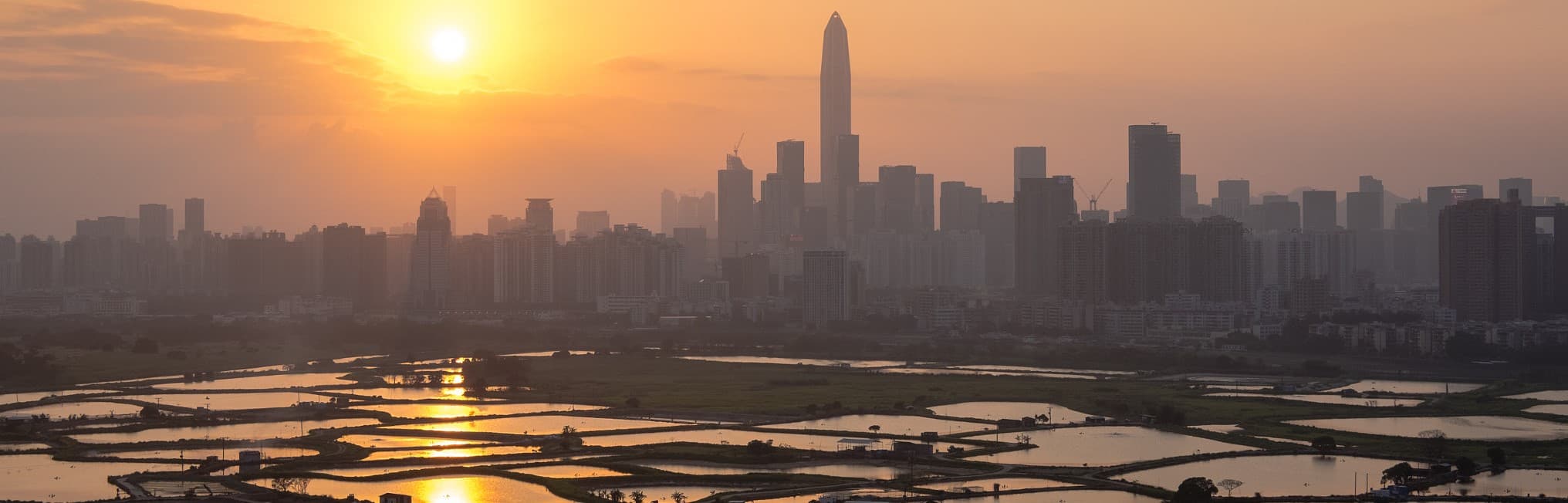
Shenzhen: how a fishing village became the tech capital of the world
From special economic zone to innovation megacity: Shenzhen embodies China's tech revolution. Huaqiangbei, maker culture, startups and futuristic urbanism.
La rédaction Kotoba
Studio éditorial
In 1979, Shenzhen had thirty thousand inhabitants. It was a small town of fishermen and rice farmers in Guangdong, separated from Hong Kong by a river and a world. Today the city exceeds eighteen million residents, its GDP rivals Portugal's, and the density of patents filed per square kilometre is the highest on the planet.
This is not a smooth success story. It is the story of an urban laboratory where China tested, broke, rebuilt and reinvented its relationship with technology, speed and capitalism — in forty-five years.
The Special Economic Zone: Deng Xiaoping's gamble#
Everything begins on 26 August 1980. Deng Xiaoping (邓小平) designates Shenzhen as one of China's first four . The concept is simple and radical: create enclaves where market rules apply in a country still officially communist. Foreign investment allowed. Reduced taxation. Streamlined bureaucracy.
The slogan that captures Shenzhen's spirit at the time: 时间就是金钱,效率就是生命 (shíjiān jiùshì jīnqián, xiàolǜ jiùshì shēngmìng) — "Time is money; efficiency is life." It was posted at the entrance to the Shekou industrial zone, and it has never been taken down.
特区 (tèqū): literally "special zone." 特 (tè) means "special, extraordinary"; 区 (qū), "zone, district." The term has taken on historical significance in China: it designates the territories where the country learned capitalism, one neighbourhood at a time.
The first factories were assembly workshops for foreign brands — toys, textiles, low-end electronics. The labour force came from interior provinces: millions of migrant workers (农民工, nóngmíngōng) flowed toward the Pearl River Delta, drawn by wages that, however modest, exceeded what farming could offer. Shenzhen was growing at ten per cent per year. Not its GDP: its population.
Huaqiangbei: the market that taught the world to tinker#
No place on Earth resembles . This neighbourhood of a few streets, wedged into the Futian district, holds the world's largest electronics market. Not a shop: an ecosystem. Dozens of shopping centres stacked over multiple floors, each specialised — passive components on the third floor, LCD screens on the fifth, motherboards on the seventh.
You can find everything there. An infrared sensor for a drone? Third aisle, stand 47. A batch of a thousand gold-plated USB-C connectors? Negotiable on site, deliverable tomorrow. A complete phone prototype, from PCB to casing, assembled in seventy-two hours? That is the house speciality.
Huaqiangbei long had the reputation of a counterfeiter's den — and it was not entirely false. The , those copies of branded products sold at a fraction of the price, thrived there in the 2000s. But reducing Huaqiangbei to piracy means missing the point. What the neighbourhood actually created was an open supply chain: anyone with an idea and a minimum of technical knowledge could get a working prototype manufactured there in a few days, for a few hundred dollars.
This accessibility attracted a generation of makers from around the world. Engineers from Silicon Valley, European designers, African tinkerers — all came to Huaqiangbei to turn an idea into a physical object at a speed that Cupertino or Düsseldorf cannot match. The documentary Shenzhen: The Silicon Valley of Hardware (2016) popularised this reality for Western audiences, but regulars had known for years: if you want to build something, Shenzhen is the most efficient place in the world to do it.
The giants born in Shenzhen#
The city did not just assemble other people's products. It spawned its own empires.
, founded in 1987 by Ren Zhengfei, a former army engineer, started by reselling telephone equipment imported from Hong Kong. Forty years later, it is the world's leading manufacturer of telecommunications equipment and one of the largest smartphone makers, despite American sanctions that cut off access to the most advanced chips.
, founded in 1998, launched QQ and then WeChat (微信, Wēixìn), the app that redefined what a phone can do. Messaging, payment, government services, food delivery, doctor appointments, tax filing — WeChat is the digital Swiss army knife of a billion Chinese. Tencent's headquarters, twin towers linked by a sky bridge in the Nanshan district, has become one of the city's architectural symbols.
, founded in 1995 as a rechargeable battery manufacturer, has become the world's leading electric vehicle maker. Its headquarters and factories are in Shenzhen. By 2025, the city became the first megacity in the world to have a fleet of fully electric buses and taxis — sixteen thousand buses, twenty-two thousand taxis, zero emissions.
, founded in 2006 by a student at the Hong Kong University of Science and Technology, dominates the global civilian drone market with over seventy per cent market share. Its headquarters, Sky City, is a spectacular brutalist structure in the Nanshan district.
The culture of speed: Shenzhen Speed#
The Chinese have a term for Shenzhen's pace: 深圳速度 (Shēnzhèn sùdù), "Shenzhen Speed." The expression was born in the 1980s, when the International Trade Center was built at a rate of one floor every three days — a record at the time. It has since become a cultural concept.
In Shenzhen, a prototype that takes six months in Silicon Valley gets done in six weeks. A thirty-storey building rises from the ground in as many days. A startup can go from idea to commercial product in a few months, because every link in the chain — components, assembly, testing, logistics — is a taxi ride away.
This speed has a cost. Working hours are among the most intense in China. The — working from nine in the morning to nine at night, six days a week — was an implicit norm in the tech sector for years, before the government began to restrict it. Chinese youth responded with cultural movements like , a form of passive resistance to the culture of overproductivity.
Urbanism of the future, now#
Shenzhen does not look like other Chinese megacities. Beijing is imperial, Shanghai is cosmopolitan, Chengdu is laid-back. Shenzhen is new. Everything has been built in the last forty years. The result: the city is a playground for contemporary architecture.
The , a financial free-trade zone, lines up towers designed by international firms. The Shenzhen Bay Super Headquarters, currently under development, aims to create a fully connected Central Business District with aerial walkways between towers and terraced parks. The Shenzhen Opera House, designed by Jean Nouvel, and the Science and Technology Museum, by Zaha Hadid Architects, rival the architectural icons of Dubai or Singapore.
But perhaps the most striking thing happens at street level. Shenzhen is one of the greenest cities in China. Forty per cent of its area is covered by green spaces. The Shenzhen Bay Park, a thirteen-kilometre coastal promenade facing Hong Kong, has become a daily gathering place: joggers at dawn, families on weekends, impromptu concerts in the evening.
Shenzhen's youth: neither quite Chinese, nor from elsewhere#
Shenzhen is a city of internal migrants. Almost no one is "from" Shenzhen — the city did not exist two generations ago. Residents come from Hunan, Sichuan, Henan, Dongbei, from every province. The result: no dominant local dialect, no "Shenzhen cuisine," no ancestral traditions. Standard Mandarin is the lingua franca, and culture is built in real time.
This absence of roots has created a paradoxical identity. Shenzhen residents are often described as more open, more pragmatic and less bound by convention than inhabitants of the old capitals. The city attracts those who want to build something — a company, a career, a different life — without the weight of family or social expectations that bear down in more traditional cities.
It is also a young city: the average age is around thirty-two, one of the lowest of any major Chinese city. Specialty coffee shops, coworking spaces, climbing gyms and electronic music festivals flourish with an energy reminiscent of Berlin in the 2000s — plus tropical heat.
What Shenzhen says about the rest of the world#
Shenzhen disturbs as much as it fascinates. For optimists, it is proof that a city can reinvent itself in a generation, that innovation is not a Western monopoly, that the Global South can lead the technology race. For sceptics, it is a model built on intensive labour, digital surveillance and state capitalism that plays by its own rules.
Both are right, and that is what makes Shenzhen so hard to classify. The city that invented QR code payment is also the one that perfected large-scale facial recognition. The Huaqiangbei market that democratises access to electronics is also the one that made it possible to manufacture low-cost surveillance devices.
What is certain is that Shenzhen waits for no one. It builds, tests, fails, starts again — at Shenzhen Speed.
FAQ#
Is Shenzhen dangerous for tourists? No. Shenzhen is one of the safest major cities in China, with a very low crime rate. The city is well organised, the metro is modern and extensive, and digital payments work everywhere.
Do you need to speak Chinese to visit Huaqiangbei? It is a considerable advantage, but many vendors speak functional English, especially those who deal with foreign buyers. Real-time translation apps are also widely used on site.
Can you visit the Huawei, Tencent or DJI headquarters? Huawei has a visitor campus in Dongguan (the "Ox Horn Campus"), but visits are by invitation. Tencent and DJI do not offer regular public tours, but their buildings are visible from outside and worth a visit for the architecture alone.
Shenzhen or Hong Kong: which one to visit? Both, ideally. They are separated by a border and thirty minutes by train. Hong Kong offers colonial heritage, Cantonese street food and Victoria Peak. Shenzhen offers tech, contemporary architecture and a radically different energy.
996: the work system that is burning out China
Investigation into China's 996 system, where tech employees work from 9 AM to 9 PM, 6 days a week. Origins, backlash, the tang ping movement, and reforms.
Cover image: Benhui31 · Wikimedia Commons · CC BY-SA 4.0