Anisong: When Anime Music Conquered the World
From Astro Boy theme songs to Animelo Summer Live concerts, the story of anisong, Japanese anime music turned global industry and a musical genre in its own right.
La rédaction Kotoba Interactive
Studio éditorial
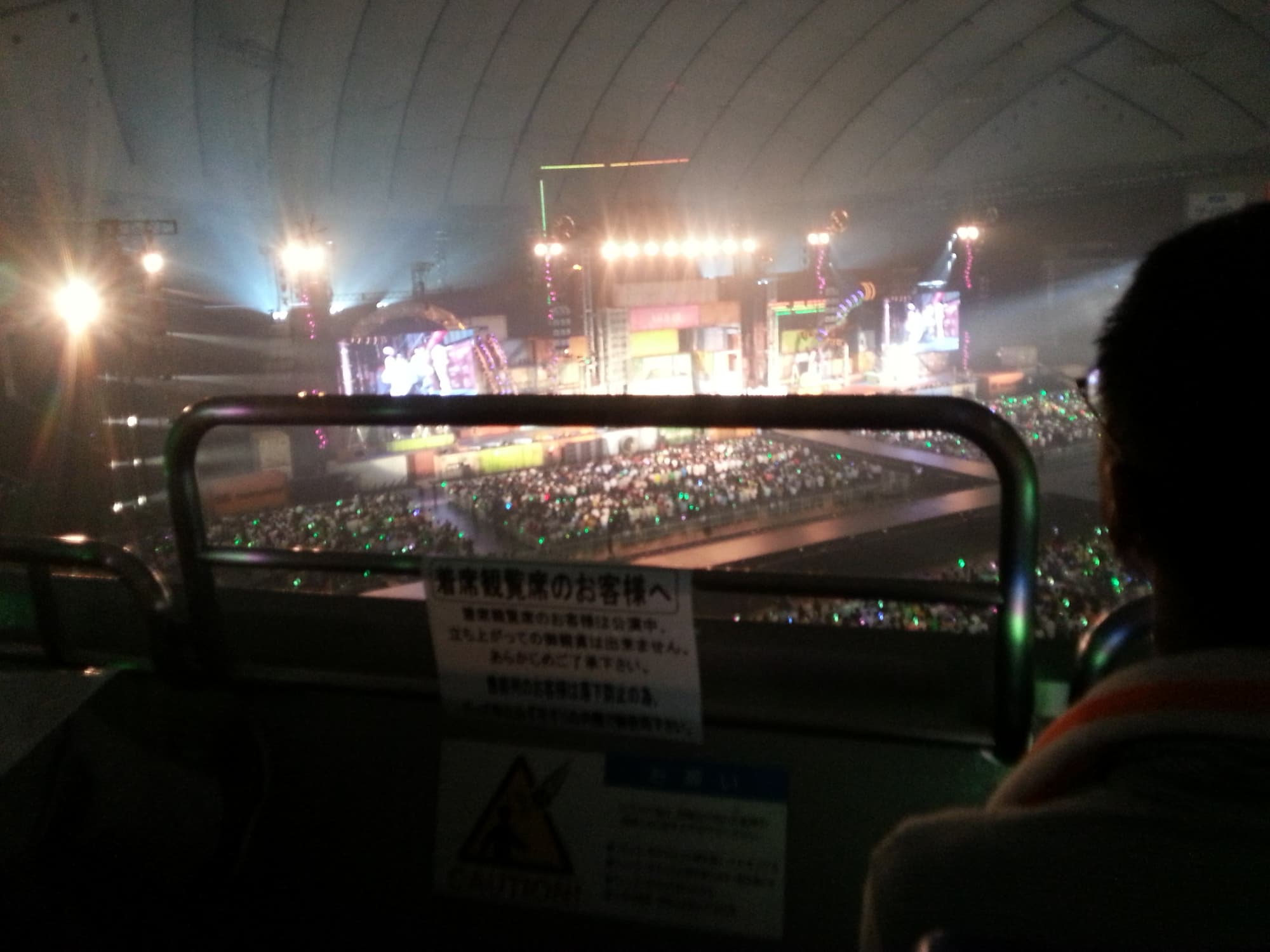
The opening chord rings out. Thirty thousand people raise their lightsticks. On stage, a band strikes the first notes of a song the crowd knows by heart, because they have heard it hundreds of times while watching their favorite anime. This is Animelo Summer Live, the biggest anime music festival in the world, and for two days the Saitama Super Arena vibrates to the rhythm of a genre the rest of the music industry long ignored: anisong.
The term refers to any song created for an anime: opening themes (OP), ending themes (ED), insert songs, and original soundtracks. What was once a spin-off product has become a musical genre in its own right, with its stars, its labels, its festivals, and a growing global influence.
| Type | Japanese term | Placement | Role |
|---|---|---|---|
| Opening theme | オープニング (ōpuningu, OP) | Start of the episode | Sets the energy and identity of the series |
| Ending theme | エンディング (endingu, ED) | End of the episode | Cools the emotion down, often more intimate |
| Insert song | 挿入歌 (sōnyūka) | At the heart of a key scene | Amplifies a specific dramatic moment |
| Original soundtrack | 劇伴 (gekiban) | Under the dialogue | Supports the mood without lyrics |
| Character song | キャラソン (kyarason) | Outside the episodes (albums) | Lets a character sing "in role" |
アニソン (anison) combines アニメ (anime) and ソング (songu, from the English song). The term appeared in the 1990s to distinguish anime music from mainstream J-pop. Today the boundary is fading: major artists compose for anime, and anisong singers fill stadiums.
From Modest Origins to the Global Charts#
The Pioneer Era (1960-1970)#
The first true anisong is generally considered to be the theme song of in 1963. Composed by Tatsuo Takai and sung by a children's choir, it set the template: a catchy melody, lyrics that capture the spirit of the work, and a 90-second length perfectly calibrated for the TV format.
In the 1970s, the giant robot anime (Mazinger Z, Getter Robo) established an epic style, with brass, powerful choirs, and heroic male voices. Isao Sasaki, Ichiro Mizuki, and Mitsuko Horie became the first anisong stars: specialized singers whose entire careers were built around this repertoire.
The Golden Age (1980-1990)#
The 1980s saw anisong grow in sophistication. City Hunter, Touch, Cat's Eye: theme songs became full-fledged J-pop hits, performed by mainstream artists such as TM Network and Anri. The line between anime music and popular music began to blur.
The turning point: the theme song of Dragon Ball Z, "Cha-La Head-Cha-La" (1989), sung by Hironobu Kageyama. The track sold more than 1.5 million copies, propelling anisong into a new commercial dimension.
Hironobu Kageyama, nicknamed "the prince of anisong," has sung the theme songs of more than 100 anime. He is also a member of the supergroup JAM Project, formed in 2000, which brings together the greatest anisong voices for epic performances.
The Contemporary Explosion (2000-Present)#
The 2000s marked the rise of anisong as an industry. Several factors converged:
The anime-to-single boom: Studios commission songs from established artists, knowing that the theme song of a popular anime guarantees massive sales. Asian Kung-Fu Generation (Naruto), L'Arc-en-Ciel (Fullmetal Alchemist), Yoko Kanno (Cowboy Bebop, Ghost in the Shell: Stand Alone Complex): the cream of J-rock and J-pop composes for animation.
The seiyuu singers: Anime voice actresses (seiyuu) launch parallel music careers. They often sing "in character," performing songs attributed to their roles. The phenomenon exploded with idol anime such as Love Live! and The Idolmaster, where music sits at the heart of the work.
Streaming platforms: Spotify, Apple Music, and anime streaming platforms (Crunchyroll, Funimation) expose anisong to a global audience. LiSA's "Gurenge" (Demon Slayer) reached a billion streams. "Shinzou wo Sasageyo!" (Attack on Titan) became a worldwide meme.
The Artists Who Define the Genre#
LiSA#
Born Risa Oribe, LiSA became the undisputed queen of anisong in the 2020s. Her track "Gurenge," the theme song of Demon Slayer: Kimetsu no Yaiba, broke records: the first anisong to exceed 400 million streams on Spotify, the first to reach a billion on YouTube.
Her style blends energetic rock with raw emotion. She has also sung for Sword Art Online, My Hero Academia, and Fate/Zero, building a repertoire that spans generations of otaku.
Kenshi Yonezu#
A former Vocaloid composer under the name Hachi, Kenshi Yonezu has become one of Japan's most streamed artists. His track "Lemon" (2018) set records, but it was "KICK BACK" (theme song of Chainsaw Man, 2022) that demonstrated his mastery of anisong: a song that captures the manga's unhinged spirit while remaining endlessly replayable.
Aimer#
With a deep, atmospheric voice, Aimer (pronounced "eh-meh") has specialized in anisong charged with heavy emotion. Her tracks for Fate/stay night and Demon Slayer (the Entertainment District arc) reach peaks of lyricism. She often sings at night, she says, to capture that particular atmosphere.
YOASOBI#
The duo YOASOBI (Ayase on composition, ikura on vocals) represents the new generation. Their songs are based on short stories, a narrative approach that resonates with the storytelling of anime. "Idol" (theme song of Oshi no Ko, 2023) became the first Japanese-language song to reach number one on the Billboard Global Excl. U.S. chart (peaking at number seven on the Global 200).
Read alsoVocaloid and Hatsune Miku: Japan's Synthetic Pop RevolutionSeveral anisong composers come from the Vocaloid scene. Kenshi Yonezu (formerly Hachi), Ayase (YOASOBI), DECO*27: this generation learned composition by releasing songs with Hatsune Miku before moving on to the human voice.
The Concerts: From the Budokan to Crunchyroll Expo#
Anisong has its temples. The Nippon Budokan, Tokyo's legendary hall, regularly hosts concerts. But the true event is Animelo Summer Live, an annual two-day festival at the Saitama Super Arena, with 30,000 spectators per day and around a hundred artists.
Internationally, anime conventions now include concerts. Anime Expo (Los Angeles), Japan Expo (Paris), Crunchyroll Expo: anisong artists tour abroad, carried by a community of fans who know the lyrics by heart, in Japanese.
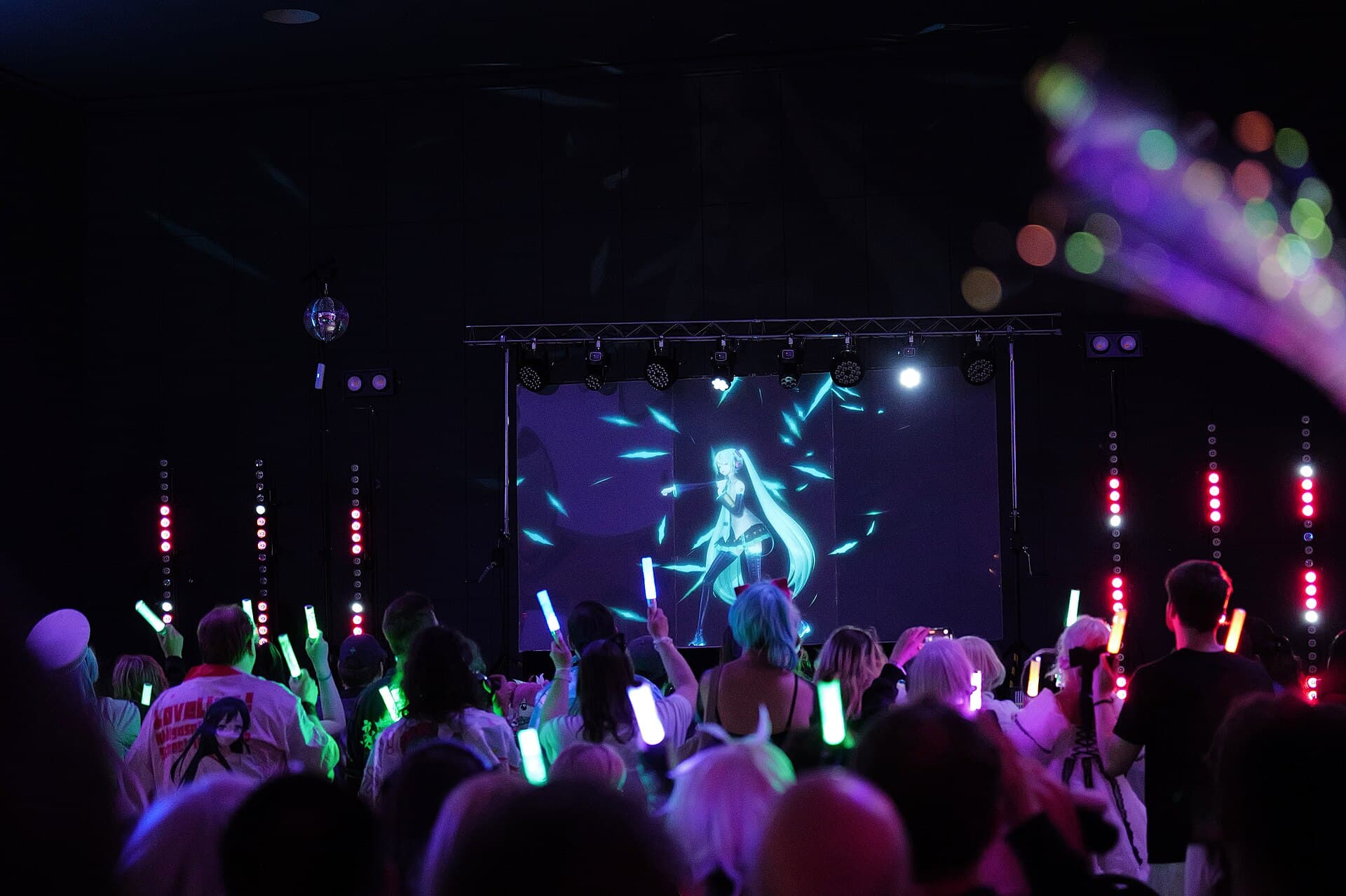
The phenomenon of lightsticks and wotagei (synchronized fan choreographies) has traveled with the music. In an anisong concert hall, the audience is not passive: they sing, shout, and wave lights according to precise codes inherited from idol culture.
Singing "Gurenge" by heart is one thing; understanding every 歌詞 (kashi, lyrics) is another adventure. With JapaneseSRS and its spaced repetition, learn to read the theme songs you love, from 紅蓮 (guren, the crimson lotus) to the 心臓 (shinzō, heart) offered up in "Sasageyo!".
Anisong as a Gateway#
For millions of non-Japanese people, anisong is the first contact with the Japanese language. Theme songs, replayed dozens of times, settle into memory. Whole phrases are memorized before anyone even studies the language.
This phenomenon has been documented by researchers: repeated exposure to Japanese music through anime creates a phonetic familiarity that eases later learning. Anisong, without meaning to, has become a global teaching tool.
The expression , taken from the theme song of Attack on Titan, has become an internet meme instantly recognizable to an entire generation, far beyond Japan.
The Industry Behind the Music#
Anisong is an economy of its own. Labels such as Lantis, Flying Dog (formerly Victor Entertainment), Sacra Music (Sony), and Pony Canyon specialize in production and distribution. Contracts are often tied to anime projects: an artist signs on for the theme song of a specific series.
Revenue comes from CD sales (still significant in Japan), streaming, concerts, and merchandise. A hit anisong single can generate tens of millions of yen, justifying studios' investment in top-tier composers.
Synchronization with the anime's imagery is crucial. Producers work in close coordination with animation studios so that the theme song reflects the atmosphere of the work. A mismatch between the music and the anime is immediately noticed by fans.
FAQ#
What is the difference between anisong and J-pop? Anisong is a subgenre of J-pop, composed specifically for anime. The boundary is porous: mainstream J-pop artists compose anisong, and anisong singers reach the pop charts.
What is the most popular anisong of all time? In terms of streams, LiSA's "Gurenge" (Demon Slayer) dominates. In terms of cultural impact, "Cha-La Head-Cha-La" (Dragon Ball Z) and "A Cruel Angel's Thesis" (Evangelion) are often cited.
Can you legally listen to anisong outside Japan? Yes, most anisong is available on Spotify, Apple Music, and YouTube Music. Some older tracks may be geo-restricted.
Are all seiyuu singers? No, but many voice actresses develop a parallel music career. Some seiyuu agencies (such as Horiagency or I'm Enterprise) manage both activities.
Photo credits: images in this article come from Wikimedia Commons under free licenses.
In this article
The cultural terms covered here, each with a short definition.
Vocaloid and Hatsune Miku: Japan's Synthetic Pop Revolution
The history of Vocaloid software, Hatsune Miku's rise as a virtual pop star, the creative community behind the phenomenon, and the cultural revolution of Japanese synthetic music.
Cover image: Douglas Paul Perkins · Douglas Paul Perkins, via Wikimedia Commons · CC BY 3.0