The 36 Stratagems: the handbook of Chinese cunning
The 36 Chinese stratagems (三十六计), their origins, their six categories and their famous chengyu. Military ruses turned into an art of negotiation.
La rédaction Kotoba Interactive
Studio éditorial
A slim booklet with no named author, found at a bookseller's in Shaanxi in 1941: that is all history has to attest the existence of the Thirty-Six Stratagems as we know them today. Yet the text distils two thousand years of Chinese war ruses, each one summed up in four characters that snap shut like proverbs. The most famous of them all advises, without the slightest hedging, to take flight.
This collection (三十六计, Sānshíliù jì) holds a place apart in Chinese strategic thought. Where Sun Zi's Art of War lays out principles, the Thirty-Six Stratagems deliver a catalogue of practical moves, mnemonics for deceiving, dividing and turning a situation around. Long passed on by word of mouth, today quoted in boardrooms as readily as on the diplomatic stage, they fascinate because they codify a mastery of manoeuvre that refuses the head-on clash.
A late text, a thousand-year tradition#
The reference edition appeared in 1941, printed by a local publisher in Shaanxi province from an anonymous and undated manuscript. The booklet slipped into semi-obscurity until an article in the daily Guangming Ribao (光明日报), on 16 September 1961, brought it back into public view in China. Its finished form probably dates to the late Ming (1368-1644) or early Qing (1644-1912), a period when it circulated quietly among military scholars and, according to several historians, within anti-Manchu secret societies.
The phrase itself is far older. It appears in the Nan Qi shu (南齐书), the official history of the Southern Qi dynasty compiled in the sixth century: the biography of general Wang Jingze (王敬则) mentions "Lord Tan's thirty-six stratagems", an allusion to general Tan Daoji (檀道济), who died in 436 and was famed for his skilful retreats. The formula meant, in essence, that flight was sometimes the best of all options. The number thirty-six is no literal tally: in the numerology of the Yi Jing (易经), six multiplied by six stands for multiplicity, a totality of possibilities rather than a closed list.
三十六计 (Sānshíliù jì) literally means "the thirty-six calculations" or "stratagems". The character 计 (jì) covers calculation, plan and ruse all at once: Chinese strategy conceives of war as an operation of the mind before it is a matter of weapons.
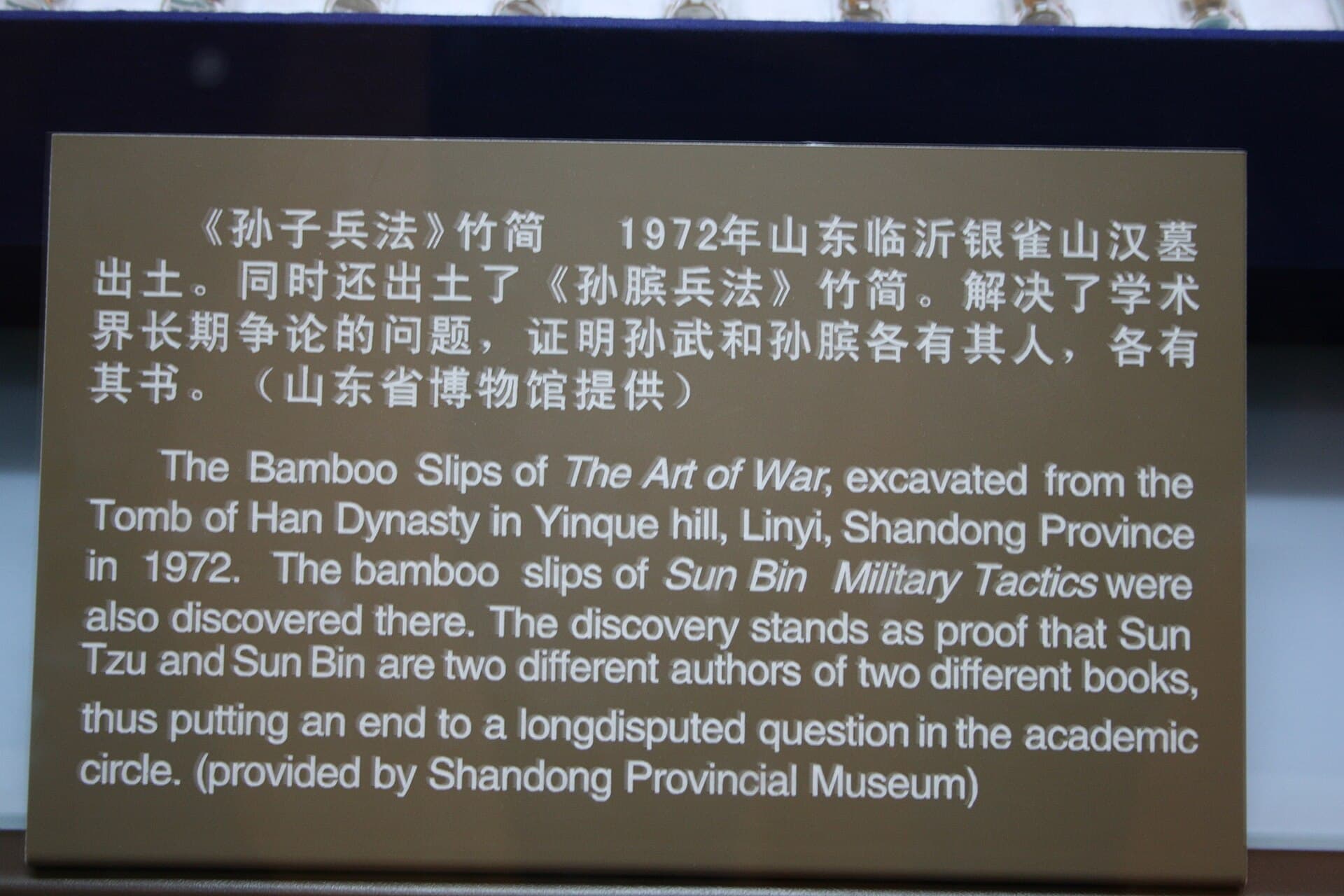
Tying the collection to Sun Zi is therefore a matter of intellectual lineage rather than authorship. The Art of War (孙子兵法, Sūnzǐ bīngfǎ), written around the fifth century BCE and recovered on bamboo slips in the Han tombs of Yinque Shan in 1972, sets out the founding principle: "all warfare is based on deception" (兵者,诡道也). The Thirty-Six Stratagems are its manifold application, the rendering into memorable formulas of a philosophy of deceit.
Six families for thirty-six ruses#
The collection is arranged in six chapters of six stratagems each, classified by the balance of power. This structure, laid out in the modern editions established from the 1941 booklet, runs from the most comfortable position to the most desperate.
The six categories read like a ladder of controlled defeat:
- : when you dominate, you deceive without risk.
- : with forces evenly matched, you must create the advantage.
- : go on the offensive with discernment.
- : exploit the general disorder.
- : manoeuvre between partners and rivals.
- : when all is lost, save what can be saved.
Each stratagem fits into a chengyu (成语), those fixed four-character expressions that compress an image, a historical precedent, a lesson. The brevity is deliberate: it etches the ruse into memory and lets you summon it in a single word, in the heat of the action, without reciting any theory.
In the Chinese spirit of strategy, the shortest formula is the one that lands most precisely: four characters are sometimes worth a treatise.
Every ruse fits into four characters: 三十六计 (sānshíliù jì, the thirty-six stratagems), 成语 (chéngyǔ, fixed expression) or 兵法 (bīngfǎ, the art of war). Learn to read these hanzi and anchor them for good with ChineseSRS, the spaced-repetition method dedicated to Mandarin.
Four emblematic stratagems#
The first stratagem in the collection, "cross the sea by deceiving the sky" (瞒天过海, mán tiān guò hǎi), teaches you to mask your true intentions behind the routine of everyday life. Tradition illustrates it with a ruse attributed to general Xue Rengui under the Tang: to get Emperor Taizong aboard ship, frightened as he was by the sea crossing towards Korea, his officers are said to have lodged him in a lavish banquet tent set up aboard a vessel disguised as a house. When the emperor drew back the hangings, the fleet was already sailing on the open sea. What is too familiar ceases to arouse suspicion.
"Make a noise in the east and attack in the west" (声东击西, shēng dōng jī xī), the sixth stratagem, formalises the feint: you fix the enemy's attention on one point in order to strike elsewhere. The Chinese military annals abound with it, from the Warring States period to the campaigns of the twentieth century. The principle runs through field tactics as much as modern communication, where you saturate one channel with information to draw the gaze away from another.
"Kill with a borrowed knife" (借刀杀人, jiè dāo shā rén), the third stratagem, consists in letting a third party strike the blow in your place. You set two rivals against each other, you use an ally's hand to remove a nuisance, you preserve your own forces while others wear themselves out. The Romance of the Three Kingdoms (三国演义, Sānguó yǎnyì), compiled by Luo Guanzhong in the fourteenth century, offers repeated variations on it, so thoroughly does the intrigue of those decades of civil war (2nd-3rd century) revolve around such crossed manipulations.
The strategist Zhuge Liang (诸葛亮), a hero of the Romance of the Three Kingdoms, is said to have once ordered a hundred thousand arrows to be gathered from the enemy by sending out boats bristling with straw bundles under cover of night and fog: the opposing archers riddled them with shafts, which he then had only to harvest. The scene captures the spirit of the collection long before it was ever put down on paper.
走为上: flight is the best stratagem#
The thirty-sixth and final stratagem, "flight is the best of stratagems" (走为上, zǒu wéi shàng), is also the most cited and the most misunderstood. It does not praise cowardice but the refusal of a battle lost in advance. Facing a superior enemy, withdrawing preserves the army, the time and the future: a defeat avoided is already half a victory. It is the direct echo of the formula attributed to Tan Daoji in the fifth century, carried down to us across fifteen centuries of military wisdom.
That closing position is no accident. To end a manual of offensive ruses with a tribute to retreat is to remind us that the best manoeuvre is sometimes not to give battle at all, a principle Sun Zi had already summed up by asserting that the height of the art lies in winning without fighting.
The four ruses detailed here give the measure of the collection:
| No. | Chengyu | Pinyin | Lesson |
|---|---|---|---|
| 1 | 瞒天过海 | mán tiān guò hǎi | Mask your intentions behind the routine of everyday life |
| 3 | 借刀杀人 | jiè dāo shā rén | Let a third party strike the blow in your place |
| 6 | 声东击西 | shēng dōng jī xī | Feint at one point in order to strike elsewhere |
| 36 | 走为上 | zǒu wéi shàng | Refuse a battle lost in advance and withdraw |
From battlefields to meeting rooms#
Since the 1980s, the Thirty-Six Stratagems have enjoyed a second life beyond the military sphere. Translated into dozens of languages, they have become a classic of Asian management literature, reissued as handbooks of negotiation, marketing and diplomacy. The German sinologist Harro von Senger, whose book Stratagems was translated into French as early as the 1990s, did much to spread them in the West by showing how these formulas still shape the Chinese way of thinking about the balance of power.
In commercial negotiation, "make a noise in the east" becomes the art of the false concession; "kill with a borrowed knife" reads as the use of an intermediary or a regulator to weaken a competitor. Business schools, in China and elsewhere, draw on this vocabulary to describe logics of influence that game theory formalises by other means. The appeal lies in the concision: where a Western model deploys equations, the chengyu offers an immediate image.
A stratagem is neither good nor bad in itself: everything depends on the hand that wields it and the moment it chooses.
One should, however, be wary of seeing in it a secret code that explains contemporary Chinese strategy on its own, a seductive but reductive reading that several sinologists have criticised. The Thirty-Six Stratagems are a shared cultural heritage, a reservoir of images and precedents, much as Aesop's fables or Machiavelli's maxims are in the West. Their strength lies less in dictating conduct than in providing a common grammar for naming the ruse.
Read alsoChengyu: Four-Character Idioms That Tell the Story of ChinaEach stratagem boils down to a chengyu: discover how these four-character expressions compress a whole story.
Go (weiqi) applies on a board the very same intelligence of encirclement and calculated sacrifice as the Thirty-Six Stratagems.
Strategic cunning is in dialogue in China with Confucian ethics: two visions of power that have answered each other since antiquity.
FAQ#
Who wrote the 36 stratagems? The author is unknown. The compiled text as we know it is anonymous and undated; it is thought to have taken its final form in the late Ming or early Qing. The reference edition comes from a manuscript found in Shaanxi and printed in 1941. The phrase itself goes back to the sixth century in the Nan Qi shu.
What is the link between the 36 stratagems and Sun Zi? The lineage is intellectual, not direct. Sun Zi's Art of War (fifth century BCE) sets out the principle that "all warfare is based on deception". The Thirty-Six Stratagems are its practical application, each ruse fitting into a four-character chengyu. Sun Zi did not write this collection, which came almost two thousand years later.
What does the 36th stratagem, "flight is best", mean? 走为上 (zǒu wéi shàng) teaches that, faced with a superior enemy, retreat is the best option: it preserves your forces for a future confrontation. It is not praise of cowardice but of refusing a battle lost in advance, in the spirit of Sun Zi, for whom winning without fighting is the height of the art.
How are the 36 stratagems organised? Into six categories of six stratagems each, classified by the balance of power: winning battles, confrontation, attack, chaos, alliances and desperate situations. Each ruse is summed up by a four-character expression (chengyu) that makes it easy to memorise and to summon in the heat of the action.
Are the 36 stratagems still used today? Yes, far beyond the military sphere. Since the 1980s they have been reissued as handbooks of negotiation, management and diplomacy, and spread in the West notably by the sinologist Harro von Senger. They provide a vivid vocabulary for describing logics of influence, without constituting a secret code of Chinese strategy.
Thirty-six formulas, two thousand years of wars and a final lesson that advises you to leave: the collection teaches above all that mastery of manoeuvre is worth more than brute force, and that knowing when to give up is sometimes the highest ruse of all.
Photo credits: images in this article come from Wikimedia Commons under free licenses.
Acupuncture: principles, history and the state of the evidence
Meridians, points, moxibustion: where Chinese acupuncture comes from, what its founding texts say and what clinical trials have established since.
Cover image: Gary Todd · Gary Todd, via Wikimedia Commons · CC0